The Douglas C-54 Skymaster Vanishing (1950)
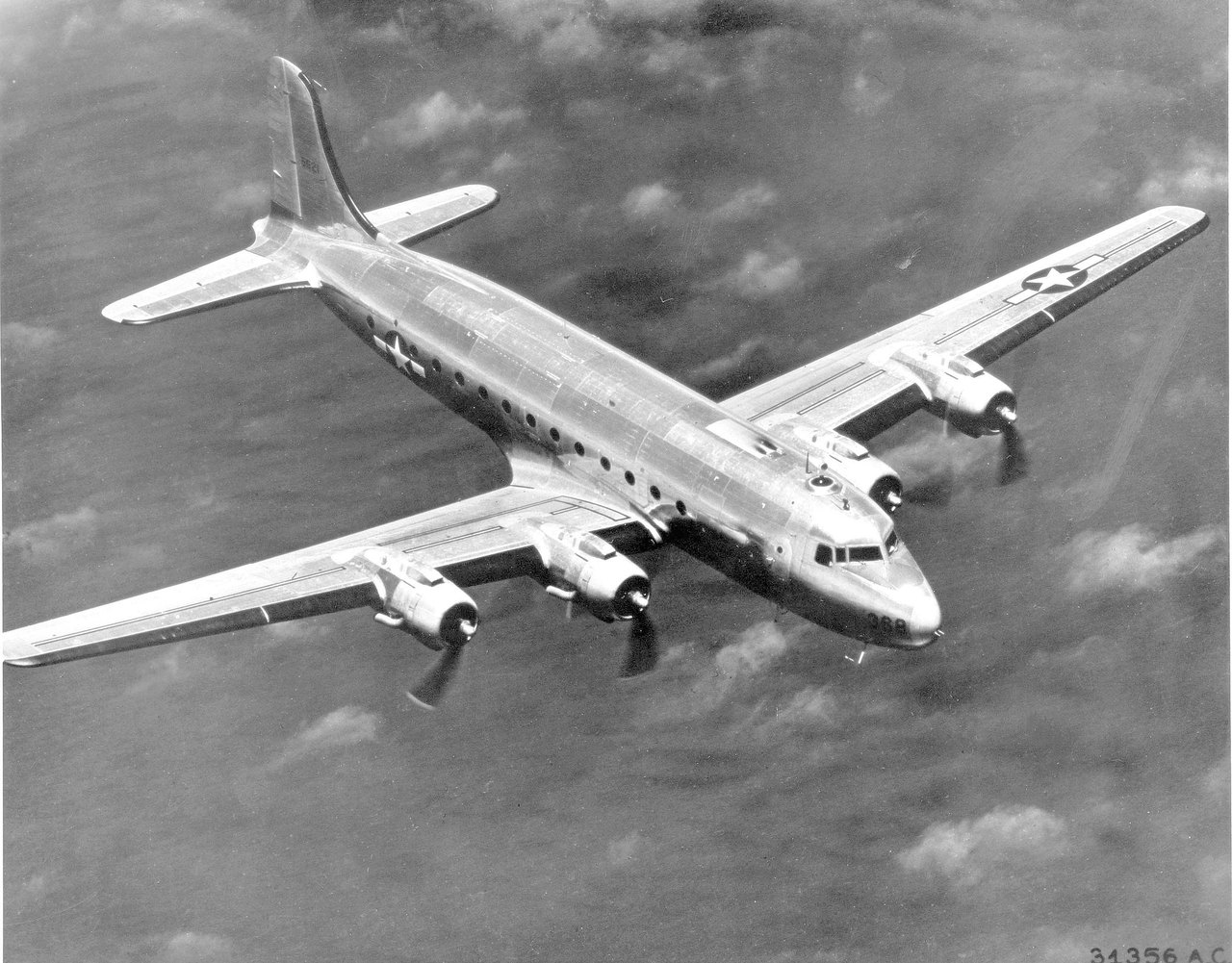
On the evening of 26 January 1950 a United States Air Force Douglas C-54D Skymaster, serial number 42-72469, assigned to the 2nd Strategic Support Squadron of Strategic Air Command, lifted off from Elmendorf Air Force Base at Anchorage, Alaska, bound for Great Falls Air Force Base in Montana. This case file covers what witnesses reported, the official narrative, and a two-pass assessment with its evidence tier.
What did witnesses see at Between Snag and Aishihik?
On the evening of 26 January 1950 a United States Air Force Douglas C-54D Skymaster, serial number 42-72469, assigned to the 2nd Strategic Support Squadron of Strategic Air Command, lifted off from Elmendorf Air Force Base at Anchorage, Alaska, bound for Great Falls Air Force Base in Montana. The flight is remembered as Flight 2469. Aboard were 44 people: an eight-man crew and 36 passengers, including 33 military personnel and three civilians, among them a woman and an infant. The crew was commanded by First Lieutenant Kyle E. McMichael as instructor pilot and mission commander, with First Lieutenant Mike Tisik as pilot, Major Gerald F. Brittain, navigator First Lieutenant Joseph W. Metzler, radio operator Staff Sergeant Clarence A. Gibson, and flight engineers Master Sergeant Clyde A. Streitman, Technical Sergeant Harry W. McConegley, and Staff Sergeant Raymond H. Snow. The departure had been delayed by engine trouble.
The planned route followed the wartime Green Eight and Amber Two airways down the Alaska Highway corridor, a roughly eight-hour trip with the crew expected to check in by radio along the way. About two hours in, near 11:09 pm, the Skymaster called the tiny radio outpost at Snag in the southwest Yukon. It reported flying at around 10,000 feet, with ice forming on the wings, low visibility, some turbulence, and a strong tailwind, but said that otherwise all was well. The aircraft was due to report next over the radio range at Aishihik about thirty minutes later. That call never came. Nothing more was ever heard from Flight 2469, and no wreckage, no debris, and no remains of the 44 people aboard have ever been found in the decades since. It stands as one of the largest groups of American military personnel ever to vanish at once.
What is the official explanation?
The United States Air Force treated the loss as a missing-aircraft emergency and launched an enormous joint search with Canada, codenamed Operation Mike after the lost pilot, Lieutenant McMichael. An emergency control center was set up at Whitehorse. Within about twenty hours roughly 25 aircraft were committed, and the effort drew on the 20,000 troops who had been gathered nearby for the Operation Sweetbriar cold-weather exercise. At its peak the search fielded as many as 85 American and Canadian aircraft and around 7,000 personnel on the ground, flying grid patterns along the presumed track between Snag and Whitehorse. Smithsonian Magazine records that searchers covered more than 165,000 square miles, or roughly 354,000 square miles counting overlapping passes. The operation was itself hazardous: several search planes crashed during the hunt.
The official record points squarely at natural causes in punishing terrain and weather. The crew's own last words documented icing on the wings, and the Yukon below was a maze of gullies and peaks, many of them higher than the aircraft's safe cruising altitude, where snow could bury a downed plane within hours. Investigators considered that the Skymaster may have struck high ground, or attempted a forced landing on a frozen lake and gone through the ice to sink out of sight in the spring thaw, or drifted off course south over the Gulf of Alaska and ditched in the sea. The search was wound down for a stark reason that had nothing to do with the missing transport: on 13 February 1950 a Convair B-36 bomber carrying a Mark IV nuclear weapon suffered multiple engine fires off the Alaska coast in the first publicly known American "Broken Arrow," and Air Force resources were diverted to that crisis. Operation Mike was suspended on 14 February and officially cancelled on 20 February 1950, with all 44 declared presumed dead and next of kin notified. No accident board ever produced a finding on what actually happened, because there was no wreckage to examine. The non-profit Project Recover, with principal investigators Jim Thoreson and Michael Luers, has since announced a modern remote-sensing search, the Yukon 2469 mission, and a local Skymaster 2469 CAN/AM Society continues annual surveys.
What did the witnesses think it was?
The people closest to Flight 2469 never accepted that the answer was simply gone forever, and several spent their lives looking. The most documented is Master Sergeant Robert Espe, whose pregnant wife Joyce and 23-month-old son Victor were among the passengers. Smithsonian Magazine reports his last instruction to Joyce before the flight: "If you have to jump, give the baby to Sergeant Roy Jones." After the loss Espe devoted himself to the search, dedicating a room of his home to his lost family, fitting it with a ham radio and lining the walls with maps. The grief of dozens of families turned the case into a decades-long open wound rather than a closed file, which is part of why local and veteran groups keep returning to it.
Contemporary witnesses on the ground gave the search its only fragments of a lead. Smithsonian records that an Indigenous trapper near Aishihik reported hearing a sound like thunder around the time the aircraft would have passed, consistent with a possible snowslide, and noted carrion birds gathering, yet searchers who followed up found nothing. The Royal Canadian Air Force was openly pessimistic from the start, with one assessment that the "feelings of the RCAF is that results of this radio search will be nil." None of the people involved at the time, crew, families, searchers, RCAF, or USAF, attributed the loss to anything but weather, ice, terrain, or mechanical failure. The notion of an "alien beam" pulling the plane from the sky does not come from any witness or any 1950 record. It appears only in later popular UFO retellings, and even the UFO Casebook entry that circulates the story concedes "the alien beam is only a theory, there is no definitive answer to the disappearance."
The dispute
The dispute here is not a counter-explanation that threatens a real UFO case; it is the reverse. The conventional account, advanced by the United States Air Force and Royal Canadian Air Force in 1950 and reinforced by every serious modern treatment, holds that a heavily iced, engine-troubled C-54D went down in the Yukon mountains or onto lake ice in extreme winter conditions and was simply never found. That account is backed by the crew's own final transmission reporting ice on the wings, by documented icing, turbulence, a powerful tailwind, terrain higher than the aircraft's safe altitude, and by an exhaustive 85-aircraft, 7,000-person search that found nothing because the terrain swallows wreckage. Smithsonian Magazine, the CBC, Explorersweb, War History Online and the aviation-history record all converge on weather, ice and geography, with theories ranging from a mountain impact to a lake-ice break-through to a ditching in the Gulf of Alaska.
The paranormal claim, by contrast, is thin and traceable to popular media rather than to any record. It surfaces in UFO Casebook's retelling and similar cable-documentary framing, which graft on a story of unexplained radar "interference" and an "alien beam" said to have taken the plane. No primary 1950 source, no search log, no named witness, and no accident document mentions a beam, a craft, anomalous radar returns, or any aerial intruder. UFO Casebook's own entry undercuts the claim, conceding that "the alien beam is only a theory, there is no definitive answer to the disappearance." Because the exotic explanation rests on an unsourced caption and the mundane one rests on documented icing and terrain, this is a barely disputed case in which the dispute is really the UFO angle being weak. It stops short of being fully settled only because, with no wreckage ever recovered and no accident board finding, the exact mechanical or geographic cause has never been positively confirmed by physical evidence.
Is the Douglas C-54 Skymaster Vanishing (1950) real? The two-pass assessment
Pass one, the ordinary explanation. This is, on the documented evidence, a conventional and tragically well understood kind of disaster. A 1945-built four-engine transport with 4,387 hours on it, delayed by engine trouble before departure, flew at night into the subarctic Yukon in late January and reported ice building on its wings over Snag. Severe airframe icing, mountainous terrain rising above the plane's safe altitude, a 60 to 80 mph tailwind that could push a navigating crew off their expected position, and ground temperatures around minus 25 Fahrenheit are individually capable of bringing down an aircraft and collectively a near-textbook recipe for one. A crash into a remote drainage that snow buried within hours, a forced landing onto lake ice that gave way in the thaw, or a drift south to a ditching in the Gulf of Alaska all fit the silence and the absence of wreckage. The official apparatus, the USAF and RCAF, never invoked anything stranger than weather and geography, and the only reason the search ended was the entirely separate B-36 nuclear-weapon emergency. The lack of a body or a debris field is not evidence of the exotic; it is exactly what the Yukon does to small metal objects.
Pass two, if it were genuinely anomalous. The reason this case appears in UFO literature at all is a single thread: a popular retelling, propagated by UFO Casebook and at least one cable documentary, that pairs the vanishing with an unexplained "interference" on a radar screen and an "alien beam," sometimes adding that the radio operator saw odd returns that came and went two hours apart. No 1950 document, no search record, no crew transcript, and no named witness supports a beam, a craft, or any aerial intruder, and the UFO sources themselves flag the idea as speculation with no definitive answer. There is real, durable mystery here, 44 people who left a clear position report and then erased themselves from a continent, but the mystery is the location of the wreck, not the agency that caused the loss.
The honest tier is Barely Disputed. The "dispute" runs in the unusual direction for this archive: the official and natural explanation is the strong, well-sourced position, and it is the paranormal overlay that is weak, late, and unsupported. The case earns a place because it is a famous unexplained disappearance that UFO lore has adopted, but nothing about the primary record pushes it toward a genuine UAP event, and the absence of recovered wreckage means the conventional explanation, while overwhelmingly likely, has never been formally proven by an accident board. It stays barely disputed rather than strongly, because no specific cause has ever been positively confirmed by physical evidence.
Sources
- www.smithsonianmag.com/history/the-enduring-mystery-of-a-plane-that-vanished-in-the-icy-canadian-wilderness-with-44-people-on-board-180985878/
- www.projectrecover.org/project-recover-and-its-partners-announce-new-mission-locate-us-air-force-c-54-skymaster-and-aircrew-gone-missing-in-yukon-canada-in-1950/
- honoredbound.org/douglas-c-54-skymaster-missing-january-26-1950/
- explorersweb.com/the-mystery-of-skymaster-flight-2469-lost-somewhere-in-the-yukon-in-1950/
- afterburner.com.pl/26-january-1950-c-54d-skymaster-disappearance/
- www.warhistoryonline.com/cold-war/disappearance-of-a-usaf-c-54.html
- web.archive.org/web/20250802051539/http://www.ufocasebook.com/2024/douglas-disappearance.html
More cases from this region: UFO sightings in Canada