A UFO with Occupants over Pittsburg, Kansas (1952)
At about half past five on the morning of 25 August 1952, William Squyres, a musician and staff entertainer at radio station KOAM in Pittsburg, Kansas, was driving from his home near Frontenac to the station for an early broadcast. This case file covers what witnesses reported, the official narrative, and a two-pass assessment with its evidence tier.
What did witnesses see at Yale Road near Frontenac?
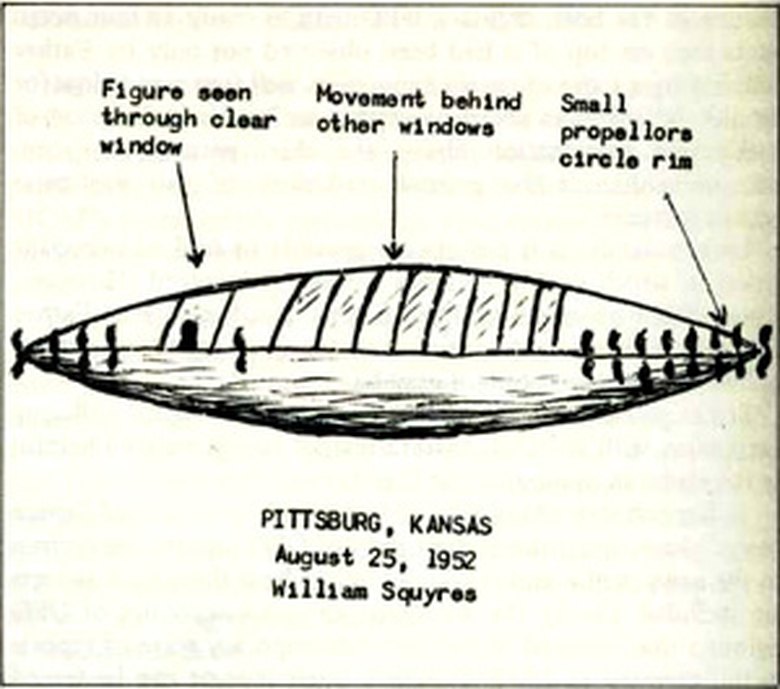
At about half past five on the morning of 25 August 1952, William Squyres, a musician and staff entertainer at radio station KOAM in Pittsburg, Kansas, was driving from his home near Frontenac to the station for an early broadcast. He was on the Yale Road, a rough gravel route about a quarter of a mile off US Highway 160 and roughly seven miles northeast of Pittsburg, when he saw a large object hovering low over a field on the right side of the road. By his account the thing was sitting about ten feet above a two-acre patch of grass, perhaps a hundred yards off the road, rocking gently back and forth.
Squyres described it in terms that found their way verbatim into the official file: "One dull aluminum object, shaped like two meat platters, face to face, estimated at 75' long, 45' wide, and 15' thick." Other accounts he gave put the depth at the midsection nearer twenty-five feet. Along the rim where the two halves met he counted a series of small propellers, six to twelve inches in diameter, spaced closely together all the way around the outer edge, mounted so they turned in a horizontal plane and spinning at high speed.
The detail that lifted this out of the ordinary saucer report was what he said he saw inside. The official record states it plainly: "Through a window in the front section shone a blue light, the head and shoulders of a man could be seen. The mid section had numerous windows through which could be seen some kind of regular movement." Squyres said the figure in the forward window was a single man, sitting motionless and facing the front edge of the craft. He was firm that this was no abstract glow or shadow. By his telling he had genuinely watched a seated human-looking pilot through clear glass.
He stopped his vehicle and watched. After a short time the object lifted straight up. The record notes the departure exactly: "It then ascended vertically with a sound like a large covey of quail starting to fly at the same time." As it left, the grass and brush directly beneath it showed signs of having been pressed and stirred, the disturbance Squyres likened to the backwash of something taking off. He drove on to the station, shaken, and reported what he had seen to the police, which is how the account reached the Air Force.
What is the official explanation?
The sighting entered the official record through Project Blue Book, the United States Air Force's standing UFO study, which had been running under that name since early 1952 out of the Air Technical Intelligence Center at Wright-Patterson Air Force Base. The Squyres report was logged as Blue Book case 1972, and the verbatim summary preserved in the project files reads in full: "One dull aluminum object, shaped like two meat platters, face to face, estimated at 75' long, 45' wide, and 15' thick. Through a window in the front section shone a blue light, the head and shoulders of a man could be seen. The mid section had numerous windows through which could be seen some kind of regular movement. A series of small propellers were spaced close together along the outer edge of the object, revolving at high speed. The object was hovering about 10' above the ground, 100 yards off the road, with a slight rocking motion. It then ascended vertically with a sound like a large covey of quail starting to fly at the same time. Vegetation showed signs of having been disturbed under the object."
The Air Force did not write this off. The case was carried as an "Unknown," the project's term for sightings that survived investigation without being matched to any conventional aircraft, balloon, astronomical body, or known phenomenon. Squyres himself was assessed and given a witness reliability rating of "good." The case became one of the standing examples of an unsolved report and was folded into Project Blue Book Special Report No. 14, the large statistical study issued on 5 May 1955. That report classed roughly 434 of the 2,199 object sightings it analysed, about 19.7 percent, as Unknown, and it set a deliberately high bar for that label: identifications were "entrusted only to selected, specially qualified scientists and engineers," and a final reading required "a conference of four qualified persons, two from ATIC and two from the panel of consultants." A report only stayed Unknown after that gauntlet failed to explain it.
The investigation did include a look at the ground. Soil and grass samples from the field were reportedly forwarded to the Technical Analysis Division at Wright-Patterson for examination, and the file notes the disturbed vegetation under the hover point. Here the official picture splits. The Air Force record kept the disturbed-ground observation, but a local police check of the site is reported to have found no clearly beaten-down area of grass, with any absence of trace put down to rain that had fallen that morning. So the physical-trace leg of the case was real enough to be collected and shipped for analysis, yet thin enough that the on-the-ground confirmation was contested almost immediately.
What did the witnesses think it was?
William Squyres was not a fringe figure or a thrill-seeker. He was a working radio entertainer and musician at KOAM, a man with a public job and a name in the community, and that is part of why his report carried weight. He never softened or recanted the account in the years that followed. What he was most emphatic about was the occupant. He insisted he had clearly seen the head and shoulders of a seated man through the forward window, and the reading he took from it was strikingly down to earth. As later researchers recorded, Squyres came away convinced the craft was "piloted by humans, and not some men from Mars." He was not reaching for visitors from space. He thought he had watched a person flying a machine he could not identify.
The corroboration in this case is physical and documentary rather than a second pair of eyes on the object itself. Squyres was alone on the road when he saw it, which the file acknowledges as a single-witness sighting. But the case did not rest only on his word. He reported it the same morning, the local press carried it that same day under his name and the basic facts, and officials and radio-station people went out to the field and looked at the ground where he said the thing had hovered. Those who examined the spot reported the vegetation in the area was disturbed, pressed and swirled as though by a downdraft, which is the kind of mundane, checkable detail a fabricator does not usually invite, since it can be inspected and contradicted.
Serious investigators have continued to treat Squyres as a credible witness rather than dismiss him. Kevin Randle, who has spent decades sifting Blue Book material, singles this case out as one of only a small handful of Project Blue Book occupant reports that the Air Force investigators did not brush aside as psychological, noting that the file took the description more or less at face value. The picture that survives is of a sober, named, locally known man who saw something at close range, reported it at once, accepted that it was probably built and flown by people, and stuck to that story.
The dispute
The dispute rests on two strands, neither of which amounts to a confession or a positive identification of the object. The first and strongest is J. Allen Hynek's physics objection. Hynek, the astronomer who consulted for Project Blue Book, focused on the ring of small propellers Squyres described and pointed out that propellers only six to twelve inches in diameter could not possibly lift a craft seventy-five feet long. As a piece of engineering common sense this is sound, and it means the object cannot literally be the propeller-driven flying machine Squyres seemed to picture. The catch is that the same objection equally rules out any ordinary aircraft, since no conventional plane or helicopter matches the platters-edge-to-edge shape with a fringe of tiny rotors either. Hynek's point wounds the literal interpretation without supplying a mundane replacement for what was seen.
The second strand is the contested ground trace. The Air Force file recorded that vegetation under the hover point showed signs of disturbance, and soil and grass samples were reportedly sent to the Technical Analysis Division at Wright-Patterson. But a local police check of the field is reported to have found no clearly beaten-down circle of grass, with any absence of marks attributed to rain that had fallen that morning. The one piece of physical evidence in the case is therefore read two ways by two sets of investigators, which weakens but does not erase it.
What the dispute does not contain is decisive. There is no confession from Squyres and no recantation; he held to the account, including the seated occupant, for the rest of his life. No specific real-world object, aircraft, balloon, or launch has ever been identified as the stimulus. No hoax props were recovered and no method of fabrication was ever demonstrated. The structural identification offered by skeptics is a plausibility argument about propeller physics plus a disagreement over a trace, advanced after the fact, not a shown explanation of this particular event. Against that sits a same-day newspaper report, a named and locally known witness rated "good," and an official Air Force "Unknown" classification that survived the demanding Special Report No. 14 review and was never overturned. That balance keeps the case in the Barely Disputed tier rather than anything stronger.
Is the A UFO with Occupants over Pittsburg, Kansas (1952) real? The two-pass assessment
Pass one, the ordinary readings. The most economical explanation is a misperceived conventional object seen in poor dawn light by a single witness who was driving and then stopped. The case has the classic vulnerabilities of a lone sighting at distance: no photograph, no film, no second independent observer on the object, and a hundred-yard separation that makes size and detail estimates unreliable. J. Allen Hynek, the Air Force's own astronomical consultant, fastened on the physics and made the sharpest skeptical point available, that propellers six to twelve inches across could not conceivably lift a craft seventy-five feet long, so the described object as described cannot be a real flying machine of the kind Squyres pictured. The ground trace, the one piece of hard evidence, is genuinely disputed: a local police check is reported to have found no beaten-down grass, with the absence attributed to morning rain, which undercuts the physical corroboration. A hoax is conceivable for a radio entertainer who knew how to tell a story, and simple misidentification of an unusual aircraft, a low balloon catching dawn colour, or even a vivid hypnagogic moment at the wheel cannot be formally ruled out. None of these, though, has ever been demonstrated for this specific event. No one has produced the real object, named the aircraft, recovered a prop, or shown Squyres fabricating anything.
Pass two, if the report is essentially accurate. Then a working, named, sober witness watched a large structured craft hover at low altitude in daylight, observed regular internal movement and a seated occupant through windows, heard a distinctive departure, and saw the vegetation stirred where it had been. The Air Force collected ground samples, rated the man "good," ran the report through its high-bar Special Report No. 14 process requiring a four-person conference to clear a case, failed to explain it, and left it formally Unidentified as case 1972. That official "Unknown" is not a mark against the case under our rules; it is the investigating apparatus conceding it could not close the file. Hynek's propeller objection, importantly, cuts both ways. It defeats the conventional-aircraft reading just as surely as it strains the literal one, because no ordinary plane or helicopter looks like two meat platters fringed with six-inch propellers either.
Weighing the two passes: there is a real and serious counter-argument here, principally Hynek's physics objection and the contested ground trace, and it is honest to flag the case as disputed. But the dispute is partial and unresolved. There is no confession, no recantation, no recovered prop, and no positive identification of a specific real-world object, balloon, or aircraft. What exists is one strong skeptical argument about plausibility and one piece of physical evidence that two investigations read differently, set against a same-day report, a named credible witness, and an official Unidentified rating the Air Force never withdrew. That profile is the textbook definition of the Barely Disputed tier: a counter-explanation exists but is partial and contested, and the case largely stands.
Sources
- ufologie.patrickgross.org/htm/bluebooku52.htm
- ufologie.patrickgross.org/bb/1972.htm
- www.nicap.org/1952ad.htm
- archive.org/details/ProjectBlueBookSpecialReport14
- archive.org/details/hynekuforeport00alle
- www.saturdaynightuforia.com/html/articles/articlehtml/itn52part33.html
- iccra.org/bystate/Kansas/ICCRA%20-%20KS%20-%20Pittsburg,%20Crawford%20County%20(August%2025,%201952).htm
- kevinrandle.blogspot.com/2020/12/coast-to-coast-occupant-reports.html
- uapdiscovery.discourse.group/t/august-25-1952-pittsburg-ks-the-radio-man-on-the-highway/306
More cases from this region: UFO sightings in United States