The Brecon Beacons Multi-Lighted UFO
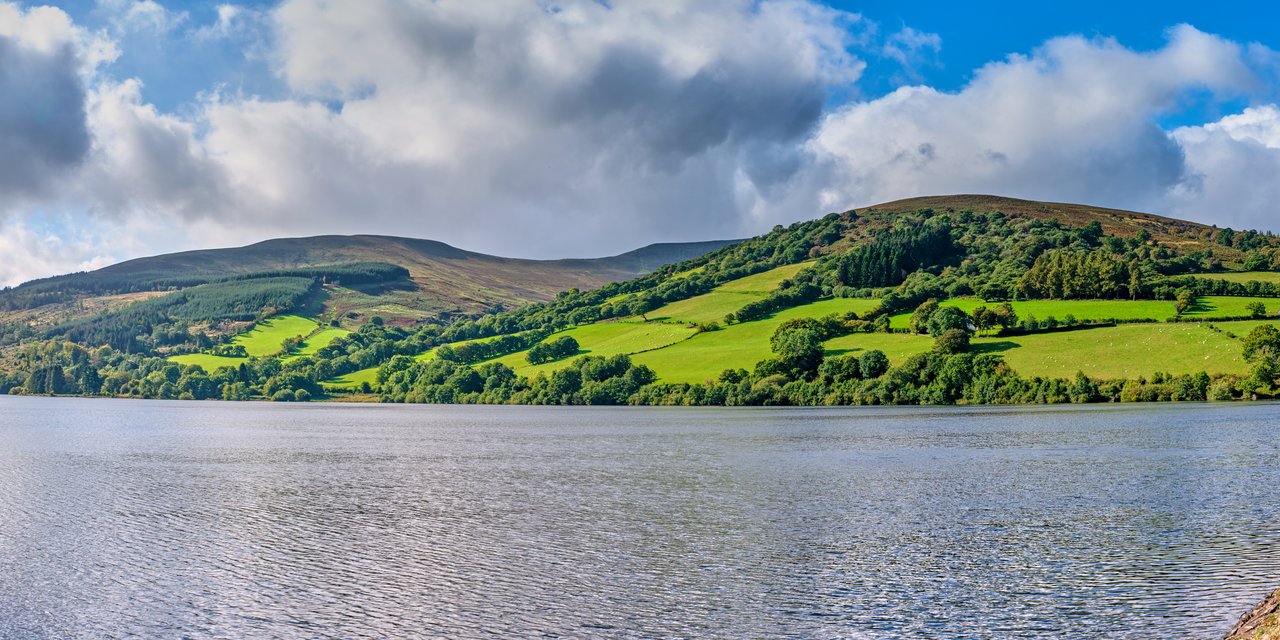
On an early evening in November 1989 a great-aunt named Janice was driving her two great-nieces and nephew home from a holiday visit, heading from Leamington Spa in the English Midlands across to Neath in south-west Wales. This case file covers what witnesses reported, the official narrative, and a two-pass assessment with its evidence tier.
What did witnesses see at Brecon Beacons moorland?
On an early evening in November 1989 a great-aunt named Janice was driving her two great-nieces and nephew home from a holiday visit, heading from Leamington Spa in the English Midlands across to Neath in south-west Wales. The route took them over the open moorland of the Brecon Beacons. In the car were Janice at the wheel, eleven-year-old Katie in the back, and Katie's five-year-old brother Tim. The sky was already dark but the moor was still faintly visible, the weather was clear with very little cloud, and the road was deserted with no other traffic on it.
Katie was the first to notice it. High in the sky and some distance off she saw an object carrying a row of many coloured lights that were flashing and changing colour, mostly white and red but with other colours mixed in too. There were far too many lights along it to be a normal aircraft. It moved slowly and oddly, seeming to change position, disappearing and then reappearing somewhere else in the sky. She pointed it out and Janice pulled the car over so they could watch.
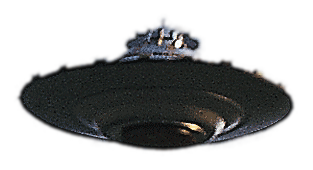
Then the object closed the distance. It came much nearer and much lower, by Katie's estimate under 100 feet up, sitting behind and to the right of the car. From this range the witnesses could see the coloured lights were arranged in a curved line, as though strung along the edge of a large disc-shaped craft, though the main body of the object itself stayed dark and invisible against the night. Katie judged it to be enormous, at least twice the size of a house. It made no sound at all, not even a hum, and it simply hovered there. As they sat watching, it gave the unnerving impression of holding station with the car rather than drifting on its own.
Janice, more fascinated than frightened, stopped the car fully, got out and opened the boot to fetch her camera. She could not work out how to set the night-exposure setting in the dark and fumbled with it. By now Katie was terrified and began screaming at her great-aunt to get back in the car, so Janice abandoned the photograph and climbed back in. They drove on. Shortly after they set off again, the hills directly in front of the car suddenly lit up with a huge glow of bluish-white light that flooded the landscape for up to ten seconds before fading away. Janice was convinced the glow was connected to the object but kept the thought to herself because Katie was already so scared. They saw nothing more for the rest of the journey.
What is the official explanation?
There is no official narrative for this event, and that absence is itself the central fact about it. Nobody in the car reported the encounter to the police, the RAF, or the Ministry of Defence at the time, so no incident number, no air-defence radar trace, no MoD UFO desk file, and no contemporary press report was ever generated. The case exists only because, nearly two decades later, the account was given to a civilian investigator and written up.
That investigator was Dave Hodrien, chairman of BUFOG, the Birmingham UFO Group. His report is the primary document for the case and is unusually candid about his relationship to the witnesses. It opens, "Back in November 1989 my ex-wife Katie Hodrien, and her great aunt Janice, had a stunning close encounter with a UFO while crossing the Brecon Beacons." The witness publicly named in some recycled versions as "Katie Francis" is the same person Hodrien identifies in the original report as Katie Hodrien. He interviewed both Katie and Janice and reconstructed the sequence above from their testimony. The report was first published on 29 December 2008 and later revised on 26 June 2019.
Hodrien's own assessment in that report is restrained. He notes the only conventional candidate worth raising, writing that "the area of the Brecon Beacons is used for military training and often jets are flown over it," but he sets that against the object's behaviour, its silence, its size and its apparent interest in the car, and concludes it does not fit an aircraft or helicopter. His closing line records the witnesses' position rather than a verdict of his own: "To this day, both witnesses are convinced that the object they saw was definitely not a conventional aircraft or helicopter of any kind." No government body, then or since, has examined, confirmed, or contradicted any of this. The Brecon Beacons sit within and beside military low-flying and training areas, and the RAF has long flown fast jets across the region, but no service record has ever been tied to this specific night.
What did the witnesses think it was?
Both witnesses came away certain that what they had seen was a structured craft and not any ordinary aircraft. Katie, who was eleven at the time and recounted the event again as an adult, held to the core details consistently: a single large object, a curved arc of multicoloured flashing lights, complete silence, a hover at very low altitude, and the sense that it was pacing the car. Her fear in the moment was real enough that she screamed for her great-aunt to abandon the photograph and get back in the vehicle, and that emotional memory anchors her account. Janice, the adult driver, was the calmer of the two and the more curious. She was confident enough in what she was seeing to stop the car, get out, and try to photograph it, and she was the one who linked the later bluish-white glow over the hills to the object, a connection she deliberately kept from the frightened child beside her.
There is no independent witness to the 1989 encounter itself beyond the three people in the car, and Tim was only five. But Hodrien's report sets the sighting alongside a later, separately documented Brecon Beacons case that strengthens the local pattern. In June 2008, Dr Simon Griffey, an educational psychologist from Cardiff, and his adult son Jack were driving near Llangynidr Mountain when they watched a formation of seven silent lights hanging over Talybont-on-Usk. Jack filmed them on his mobile phone, yet when they checked the footage only three of the seven lights had registered, and Griffey told the press that a police helicopter crew who also saw the lights failed to record them on their own equipment, his point being that a purely natural phenomenon should have photographed cleanly. That account was reported in The Sun on 27 June 2008. The Griffey sighting does not corroborate the 1989 event directly, the two are nineteen years apart, but it is an independent, named, same-region report of silent multi-light objects over the very same stretch of Welsh upland, and it is why the 1989 witnesses' insistence that they were not looking at ordinary aircraft cannot simply be waved away as a one-off misperception.
Is the Brecon Beacons Multi-Lighted UFO real? The two-pass assessment
Pass one, the entirely ordinary readings. The Brecon Beacons lie in and around military low-flying country, and the RAF routinely runs fast jets and exercises across the region, so a night-flying aircraft or a formation showing navigation and anti-collision lights is the first candidate, exactly the possibility the investigator himself flagged. A line of coloured flashing lights, seen at night by an excited eleven-year-old from a moving car, can be a single aircraft whose strobes and nav lights read as a "curved row," with the dark unlit airframe behind them invisible against the sky and the apparent "pacing" produced by the car's own motion against a distant light source. The later bluish-white glow that lit the hills for up to ten seconds has a mundane shelf of explanations too: a bright meteor or bolide, distant lightning, a flare dropped on a training range, or aircraft landing lights sweeping the moor. The size estimate, twice the size of a house, is the least reliable element of all, because the human eye cannot judge the distance or scale of an unlit object against a black sky, so the figure tells us how big it felt, not how big it was. And the load-bearing weakness of the whole case is documentary: nothing was reported in 1989, nothing was photographed because Janice could not work the camera, and the account was only written down nineteen years later by an investigator who is the lead witness's ex-husband, which is a real route for memory to harden and drift over two decades.
Pass two, if the testimony is taken at face value. Then a very large, silent, structured object descended to under 100 feet beside a car on an open moor, held a low hover, carried a curved arc of colour-changing lights along what looked like the rim of a disc, appeared to match the car's movement, and was followed minutes later by a powerful bluish-white illumination of the surrounding hills. Total silence at that proximity is the detail that resists the aircraft and helicopter readings, because anything large enough and low enough to loom "twice the size of a house" at 100 feet would normally be deafening. The behaviour described, a slow approach, a hover, an interest in the witnesses, is the classic close-encounter pattern rather than the steady transit of an aircraft on a heading. The later Griffey report of seven silent lights over the same uplands, filmed but only partly captured, with a police helicopter unable to record them, adds an independent strand to the local picture even though it is a distinct event.
Weighing the two: this case rests entirely on the consistent testimony of two witnesses, with no physical trace, no image, no radar, and no official file on either side of the ledger. Crucially, there is no method-shown debunk either. Nobody has identified a specific aircraft, training sortie, meteor, or balloon for that night, demonstrated a hoax, or recovered any contradicting evidence, so the mundane readings above remain plausible reconstructions rather than proven causes. With no official narrative to dispute and no positive identification of an ordinary cause, the case neither qualifies as verified nor as disputed in the method-shown sense. It stands on its witnesses and nothing else. That places it in the Unknown tier.
Sources
More cases from this region: UFO sightings in United Kingdom