The Carbondale UFO Crash
On the evening of Saturday 9 November 1974, three teenage boys were near a coal-silt pond behind Russell Park in Carbondale, Pennsylvania, a former anthracite town in Lackawanna County. This case file covers what witnesses reported, the official narrative, and a two-pass assessment with its evidence tier.
What did witnesses see at Russell Park silt pond?
On the evening of Saturday 9 November 1974, three teenage boys were near a coal-silt pond behind Russell Park in Carbondale, Pennsylvania, a former anthracite town in Lackawanna County. By the account they gave to WVIA reporters at the scene, the boys were Robert Gillette Jr, Bill Lloyd and John Lloyd. Public-media reporting by WVIA gives their ages that night as 15, 15 and 13; the Associated Press wire and later retrospectives put Gillette at 14 and Bill Lloyd at 16, so the exact ages vary by a year across sources, but the three names are consistent everywhere.
The boys said they were smoking cigarettes by the wastewater pond when they saw a bright object cross the sky. "Well we seen a big bright light," Gillette told WVIA on tape at the scene. "It looked like a star, that's what we thought it was at first, a fallen star. We seen it coming down at an arch." They described a red, whirring or sparking ball that came over Salem Mountain at low altitude, appeared to stop briefly, then dropped toward the pond. They said the object hissed when it hit the water, "like putting a cigarette out in liquid." When they ran roughly 200 yards to the bank they saw ripples and a light under the surface that seemed to move.
The boys called the Carbondale Police. By their own telling the first officers did not believe them: "They didn't come up, they thought we were on dope or something, they didn't believe us," Gillette said. But officers who went to the bank reported a steady glow coming from beneath the water, and it did not go away. The boys later said on tape that police fired at the light in the pond, claiming the officers shot at it five times.
Over the next two days the pond produced a green-tinged glow that observers timed at roughly eight to nine hours through the first night. Word spread, regional and national media arrived, and thousands of spectators converged on the silt pond. Police, firefighters and Civil Defense worked the site; the department reportedly contacted NORAD and NASA. The cost to the small city ran to nearly 1,000 dollars at the time. Crews tried to reach the light with a boat and a net and watched the glow appear to shift position, which only deepened the sense that something was down there under its own power.
What is the official explanation?
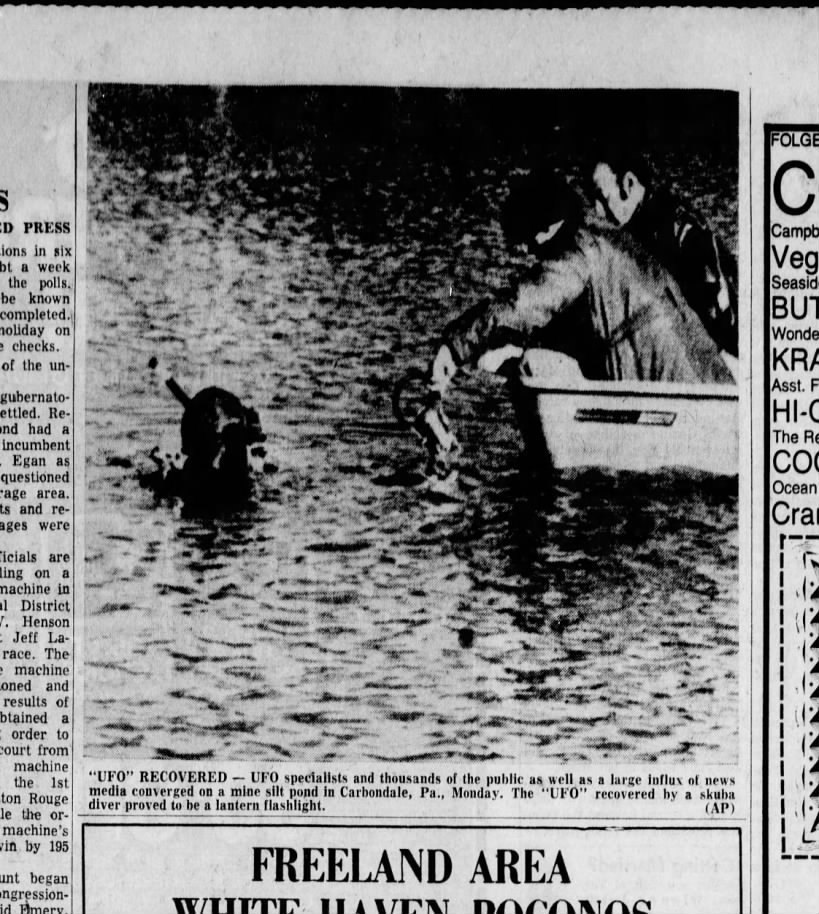
The official posture moved from open investigation to a flat hoax ruling within about forty-eight hours. On Monday 11 November 1974 a scuba diver, Mark Stamey, was finally allowed into the murky pond. Working in roughly three feet of visibility and tethered near a police boat, he felt a metal handle sticking out of the silt. He brought up an electric railroad lantern, its bulb still lit by a six-volt battery. An Associated Press wire photograph of that moment, the diver in a rowboat at the silt pond, was carried nationally; its caption read in part, "'UFO' RECOVERED. UFO specialists and thousands of the public as well as a large influx of news media converged on a mine silt pond in Carbondale, Pa., Monday. The 'UFO' recovered by a skuba diver proved to be a lantern flashlight."
Carbondale officials closed the case as a prank. Acting police chief Francis Dottle announced to the crowd that "Those of you who are at the scene have gathered by now that we found nothing to substantiate the alleged UFO sighting is anything other than what appears to be a hoax. The flashlight was found by scuba divers and we have every reason to believe this was the object which caused the concern." Mayor A. J. Kaufman told a press conference, "I've gathered by now that we found nothing to substantiate the alleged UFO sighting is anything other than what appears to be a hoax," while conceding the city had treated it seriously: "We recognized in the beginning that it could have been a hoax, but it was our responsibility to take into consideration other responses, other possibilities." A persistent local rumor that a military-style flatbed truck quietly hauled a tarp-covered object out of town was addressed by officer Dominick Andidora, a young patrolman in 1974, who said the flatbed carried broken machinery from a coal breaker being removed early that Sunday.
The most thorough on-scene civilian investigation was run by Matthew J. Graeber, executive director of the Philadelphia-based UFO Report and Information Center (UFORIC), who heard the bulletin on WCAU radio around 2 a.m. and was in Carbondale by about 6 a.m. Graeber, one of three UFO field investigators physically present during the event, concluded in his published reports and his later "Carbondale Chronicles" that the boys' sky sighting was a bolide, a large bright meteor that broke up over Salem Mountain, and that the pond glow was a hoax, "probably perpetrated by three teenage boys," using a battery-powered railroad lantern thrown into the man-made pond around 7:30 p.m. He stressed this was "an empirical observation of well-documented fact and evidence discovered in the pond, NOT an expression of my belief and bias." Graeber also pushed back on the cover-up embellishments, stating there were "no vehicles with floodlights or cranes at the scene during the entire 44 hour fiasco."
What did the witnesses think it was?
The three boys never accepted that a small lantern was what they had chased. After the lantern came up they are heard on the WVIA tape insisting it could not have been the object, and they maintained that the thing they saw streaked in from the sky, hissed into the water and moved. Robert Gillette spent decades giving a moving target of a story. On the 25th anniversary in 1999, at age 39, he told the Scranton Times-Tribune that he had thrown a battery-powered, sealed-beam lantern into the water to scare his sister Maria and her friends, adding, "I made the story up, and they bought it." Then in 2016, hanging around the anniversary celebration at age 56, he flatly recanted that confession: "My girlfriend broke up with me, so I was in a bad mood. I just told them what they wanted to hear, that it was a lantern. It wasn't a lantern. Something was pulled out of the pond." Gillette did not claim aliens; he leaned toward a Soviet satellite. "I don't think it was aliens. Some people do. I never called it a UFO. The official people did."
The diver himself, Mark Stamey, became an unlikely doubter. Speaking from Key Largo, Florida, at age 77, he recalled that the instant he saw the lit lantern in the silt his thought was, "This is a decoy." He remembered the teenager he knew as Bobby Gillette telling him he felt he was being framed: Stamey said the boy claimed police "were trying to make him say he threw the lantern in the pond, or he'd be sent to juvenile hall." Maria Gillette, the sister Robert supposedly meant to frighten, said on a local 2019 podcast that she did not believe her brother threw any lantern, that she saw a "huge, round glow" covering half the pond before police arrived, and that an officer warned the family to stay quiet.
Years later Dr. S. Robert Powell of the Carbondale Historical Society received an anonymous message from a man identifying himself as a police officer that night. Powell quoted it: "Robert, I was there. I handed this lantern. The police chief handed me this lantern, and I threw it into the pond." Local skeptics of the official story add a physical objection: people who say they handled or saw the recovered lantern note it was largely plastic and ask how it could have survived submerged and glowing for eight or nine hours. The corroborating circle is wide. Thousands of townspeople saw the glow, multiple fire and police personnel worked the pond, and contemporaneous press and an AP photographer documented the recovery in real time.
The dispute
The dispute is whether the recovered electric railroad lantern actually explains the Carbondale event, or whether it was a prop that closed an embarrassing UFO scare. The official explanation, advanced by Carbondale police and Mayor A. J. Kaufman within forty-eight hours, is that the whole thing was a teenage hoax: a lantern in the pond made the glow, and the boys exaggerated a meteor into a crash. Importantly, that reading did not rest on the police alone. UFORIC investigator Matthew Graeber, on the scene by about 6 a.m. and one of three UFO field investigators physically present, examined the pond and the lantern and concluded the boys saw a bolide over Salem Mountain while a battery-powered railroad lantern thrown into the water produced the light. He called this an empirical finding from the evidence, not a bias, and he also debunked the cover-up trimmings, stating there were no cranes or floodlit vehicles at the scene during the entire event. The strongest single piece for the mundane reading is a confession: on the 25th anniversary in 1999, witness Robert Gillette told the Scranton Times-Tribune he threw the lantern to scare his sister Maria and her friends, "I made the story up, and they bought it." Paired with the on-camera recovery of the lantern by diver Mark Stamey and the Associated Press photo captioning the object a "lantern flashlight," that is a specific real object plus a participant admission, which is why this case was over-tiered toward a clean close.
Where the counter-explanation falls short is that it never closes the core anomaly and its own two pillars are contested by the people who handled the evidence. The central claim was never just a light in the sky; it was a green-tinged underwater glow that ran roughly eight to nine hours, drew thousands, and appeared to move beneath the surface as crews worked it with a boat and a net. No one ever demonstrated that a battery lantern produces that specific sustained, mobile glow, and local witnesses who saw the recovered lantern say it was largely plastic and question how it could glow underwater for eight or nine hours at all, so the official answer is an assertion of cause without a shown method. The confession that anchored the close was retracted by the same witness in 2016, Gillette reversing to "it wasn't a lantern, something was pulled out of the pond," which turns the admission into contested testimony with one man on both sides. The lantern is real, but whether it was the original cause or a decoy is exactly what is disputed by the people nearest to it: Stamey, the diver who pulled it up, said his immediate thought was "this is a decoy" and that police pressured Gillette to take the blame or be sent to juvenile hall, and an anonymous man who said he was an officer that night told Carbondale Historical Society figure Dr. S. Robert Powell, "the police chief handed me this lantern, and I threw it into the pond." So the dispute is not whether a lantern was recovered, it plainly was, but whether that lantern caused the multi-hour moving glow or was a staged solution dropped in to end the spectacle. A recovered object plus a recanted confession closes the easy prank reading, but it does not close the central light, so the case is genuinely disputed rather than settled.
Is the Carbondale UFO Crash real? The two-pass assessment
Pass one is the ordinary reading, and it is unusually well supported here because a specific physical object was recovered on camera. An electric railroad lantern, still lit by a six-volt battery, was lifted from the silt by diver Mark Stamey on Monday 11 November 1974, photographed by the Scranton Times and carried on the Associated Press wire as the recovered "UFO," the caption calling it a "lantern flashlight." A railroad signal lantern glowing under a few feet of coal-laden, sulfurous water is a clean fit for a steady, eerily colored light that appears to drift as a net or current nudges it. The lead on-scene civilian investigator, Matthew Graeber of UFORIC, reached the hoax conclusion independently of the police, splitting the event into two ordinary parts: a bright meteor or bolide over Salem Mountain that the boys saw in the sky, and a lantern dropped into the pond that produced the underwater light. Graeber stressed this was "an empirical observation of well-documented fact and evidence discovered in the pond," not bias, and he knocked down the cover-up trimmings too, stating there were "no vehicles with floodlights or cranes at the scene during the entire 44 hour fiasco." On top of all that, one of the three named witnesses, Robert Gillette, confessed in 1999 that he threw the lantern to scare his sister Maria, saying "I made the story up, and they bought it." An identified real-world object, an independent civilian reconstruction, and a participant admission is exactly the kind of stack that pushes a case hard toward the mundane.
Pass two is what survives that, and a real anomaly does survive. The first thing the debunk never actually does is show its own mechanism. No one ever demonstrated that a small battery lantern produces the specific light that officers and a large crowd reported: a green-tinged glow timed at roughly eight to nine hours through the first night, bright enough to draw thousands, that crews watched appear to shift position as they worked it with a boat and a net. Acting chief Francis Dottle said the department had "every reason to believe this was the object which caused the concern," but reason-to-believe is an assertion, not a shown method, and local doubters who handled the recovered lantern note it was largely plastic and ask how it could survive submerged and glowing for eight or nine hours. The two pillars of the official close are also contested by the very people closest to the evidence. Gillette retracted his confession in 2016, reversing to "I just told them what they wanted to hear, that it was a lantern. It wasn't a lantern. Something was pulled out of the pond," so the confession is now the same witness on both sides rather than a settled admission. Mark Stamey, the diver who actually brought the lantern up, said his first thought on seeing it lit in the silt was "this is a decoy," and recalled Gillette telling him police pressured the boy to claim he threw it or face juvenile hall. An anonymous man told Carbondale Historical Society figure Dr. S. Robert Powell that "the police chief handed me this lantern, and I threw it into the pond," which, if true, makes the lantern a planted prop introduced to end the spectacle, not the original source of the glow.
The verdict is Barely Disputed. The case does not reach Strongly Disputed because nothing here positively closes the core anomaly, the sustained, mobile underwater light running through the entire police response. A Strongly Disputed close would need a confession that stands, a prop demonstrably tied to producing this light, or a positive identification of the cause with the method shown. Instead the confession was walked back by the same man who gave it, the recovered lantern is genuinely real but is disputed as a possible decoy by the diver who pulled it and by an alleged insider who says it was handed to him to throw, and no one ever showed that a lantern made an eight or nine hour moving glow. What the debunk does close is the easy peripheral reading, a kid's prank with a meteor mistaken for a crash, and that reading is well evidenced, which is why the case is disputed at all. But a recovered object plus a recanted teen confession leaves the central light unexplained, so the case substantially still stands, and it sits in Barely Disputed rather than settled.
Sources
- www.wvia.org/news/local/2024-11-02/celebrating-close-encounters-of-the-carbondale-kind
- www.yahoo.com/news/articles/diving-ufos-scuba-diver-found-010800661.html
- www.washingtontimes.com/news/2016/nov/13/carbondale-ufo-tale-rises-again/
- ufologie.patrickgross.org/htm/carbond74.htm
- carbondalien.com/?s=thelegend
- www.hmdb.org/m.asp?m=135019
- anomalien.com/the-carbondale-ufo-crash-the-pond-that-glowed-for-hours/
More cases from this region: UFO sightings in United States