The Edwin Fuhr Encounter
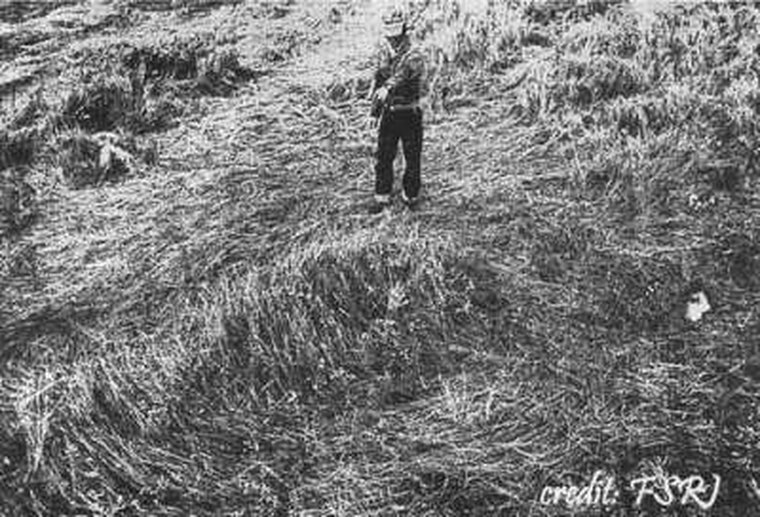
On the morning of 1 September 1974, Edwin Fuhr, a 36-year-old farmer working land about six miles north of Langenburg in eastern Saskatchewan, was out swathing a rapeseed (canola) crop near the edge of a slough. This case file covers what witnesses reported, the official narrative, and a two-pass assessment with its evidence tier.
What did witnesses see at Near Langenburg?
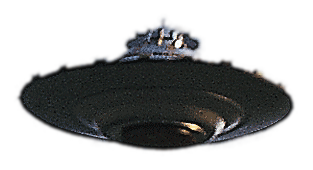
On the morning of 1 September 1974, Edwin Fuhr, a 36-year-old farmer working land about six miles north of Langenburg in eastern Saskatchewan, was out swathing a rapeseed (canola) crop near the edge of a slough. By his account it was around mid-morning, roughly 10:30, and he had stopped the swather when he noticed what he first took to be a metal grain bin sitting in the grass about fifty feet ahead of him at the slough's edge. He climbed down and walked toward it to see what it was. Closing to within about fifteen feet, he saw it was not a bin. It was a dome-shaped, saucer-like object roughly the colour and finish of brushed stainless steel, and it was hovering perhaps a foot above the ground and spinning. The grass directly beneath it was being whipped around by the rotation.
Frightened, Fuhr backed away, and as he did he realised there was not one object but five, arranged in a rough semicircle near the slough. The objects were close together, some of them only a short distance apart. Each was hovering just off the ground and rotating in place. Fuhr described them as metallic, dome-topped, and silent. He did not hear engine noise. He retreated to his swather and sat on it, by his telling too scared to move, and watched the formation for several minutes, an interval usually given as somewhere between roughly fifteen minutes and half an hour.
The departure is the most consistent part of his account across the early sources. The five objects rose more or less in unison to a height Fuhr estimated at a couple of hundred feet. As they lifted, a grey vapour or exhaust was emitted from the underside of the craft, and a downward gust pressed the grass and standing crop around the site. The objects then moved off and vanished into low cloud, again without any loud sound. When Fuhr went to look at the ground where they had hovered, he found five rings of flattened grass. In each ring the grass had been swirled down in a clockwise direction while the grass at the very centre of the ring was left standing upright, and there were no scorch marks or burning. The rings were close together, matching where he had seen the five objects sitting. A further detail reported in the days after: additional flattened circles, commonly described as a sixth ring, were found in the same hay flat a few days later, said by the family to have appeared overnight.
What is the official explanation?
Fuhr's neighbour and family persuaded him to call the police, and the Langenburg detachment of the Royal Canadian Mounted Police sent Constable Ron Morier, then 27, to the farm. Morier inspected the five rings, took measurements, and looked for any sign that the marks had been faked. He found none. By the RCMP figures later cited from the incident report, the flattened band of each ring was about 18 inches wide, two of the circles measured about 12 feet in total diameter and the other three about 10.5 feet. The report's own summary characterised the marks as "five different distinct circles, caused by something exerting what had to be heavy air or exhaust pressure over the highgrass." That exact phrase is the one the Royal Canadian Mint quoted from the RCMP report in 2024 when it issued an official commemorative coin for the event.
Morier went on the record in 1974 and stuck to the same position for the rest of his life. His contemporary statement was that "something was there and I doubt it was a hoax. There's no indication anything had been wheeled in or out and Mr. Fuhr seemed genuinely scared." In later interviews he was blunter still, telling investigators "there is no way that this is a hoax. Whatever was in there, it came out of the air and departed the same way, as far as I could tell," and vouching for the witness in personal terms: "he's the last guy in the world that would. I mean he was a teetotaller. He's a churchgoer, a very quiet, shy man." Crucially, the police investigation reached no identification of any aircraft, vehicle, or device, and found no tracks leading into or out of the rings.
Beyond the local police, the case entered the formal Canadian and American UFO record. Soil and grass were looked at, and the matter drew the attention of the National Research Council of Canada, which in this era was the body that collected Canadian UFO reports. The case was logged by American physical-trace specialist Ted Phillips, who was working under J. Allen Hynek's Center for UFO Studies, and it appears in Phillips' 1975 CUFOS catalogue "Physical Traces Associated with UFO Sightings, A Preliminary Catalog" as a Canadian ring case dated 1 September 1974, summarised as five dome-shaped objects hovering low over a field followed by five circular rings of flattened, bent-but-unburned vegetation, with the RCMP unable to find evidence of a hoax. The one contemporary counter-explanation to surface in the official and press record was the suggestion that the marks were a "fairy ring," a fungal growth pattern in the turf, a line carried in a Saskatoon Star-Phoenix headline of 27 September 1974, "UFO May Be 'Fairy Ring'."
What did the witnesses think it was?
Edwin Fuhr never claimed to know what the five objects were. He did not say they were alien craft, and across decades of retelling he avoided embroidering the core of what he had seen: five spinning, metallic, dome-shaped objects hovering a foot off the ground by his slough, a grey vapour on departure, and five swirled rings left in the grass. People who knew him and the officer who investigated him described a reluctant witness rather than an eager one. He found the flood of attention distressing rather than gratifying. By his own later account the farm was overrun in the weeks that followed, with cars lined up along the road, sightseers walking into the standing crop during harvest, and visitors arriving from as far away as the United States, Australia, Japan and China, along with interest from Canadian and American air force personnel. Fuhr said he gave a very large number of interviews and came to regret ever reporting it.
The strongest corroboration is not a second eyewitness to the objects in flight but the independent physical and testimonial record. Constable Morier saw and measured the same five rings, with their distinctive flattened-clockwise bands and standing centres, and judged on the spot that nothing had been wheeled or walked in. That is a trained, initially sceptical investigator confirming the trace evidence and the witness's demeanour within a day of the event. A further reported corroboration is that livestock on a neighbouring farm became agitated around the time of the encounter, bellowing and breaking through a fence, and that farm dogs were uneasy at the site, though these animal-reaction details are softer than the ring measurements and rest mainly on family testimony.
Canadian researcher Chris Rutkowski, who has documented this case in his books on Canadian UFO reports, has treated the original five rings and the RCMP no-hoax finding as the firm core of the case while flagging that some later additions are weaker. In particular, two dramatic claims that circulate widely, that the landing site became "extremely radioactive" and that astronaut Neil Armstrong personally telephoned Fuhr to discuss the objects, do not appear in the 1974 RCMP report, the September 1974 newspaper coverage, or Phillips' 1975 catalogue. They surface only in much later popular retellings and carry no primary documentation, so they should be read as folklore that grew on top of the case rather than as part of what was actually recorded in 1974.
The dispute
The only counter-explanation on the contemporary record is that the five rings were a "fairy ring," meaning a circular fungal growth in the grass rather than a landing trace. This was raised in the immediate aftermath and reached print in a Saskatoon Star-Phoenix headline dated 27 September 1974, "UFO May Be 'Fairy Ring'." It is the natural-cause hypothesis most often repeated since. The trouble is that it was floated as a suggestion, not established by any analyst who showed their work. No mycologist or soil scientist of record demonstrated that a fungus produced these specific marks at this specific site, and the morphology argues against it: fairy rings are slow, living features, whereas these rings were found the same morning the objects were reported and presented a tight band of grass swirled flat in a clockwise direction with the grass at the centre left standing, which is not how a fungal ring of dead or stimulated turf normally looks.
The investigating RCMP officer, Constable Ron Morier, measured the rings the day after the event and looked specifically for fakery. He found no tracks leading in or out and nothing to indicate anything had been wheeled or carried to the spot, and he stated plainly that he did not think it was a hoax and that the witness was genuinely frightened. That is an initially sceptical investigator examining the physical evidence at first hand and rejecting the mundane explanations, which is the opposite weight to an unsupported press suggestion. Skeptical commentators in later years have added two arguments: that there is an inconsistency between Fuhr describing the objects spinning counterclockwise and the grass being pressed clockwise, and that low effort could in principle stamp circles into grass. Neither is backed by a confession, recovered props, or a demonstration carried out on this field, so both remain conjecture.
What pushes this case into the disputed column at all is therefore an official-adjacent assertion without a shown method, contested at the time and since, not a positive identification of a real-world cause. There is no named drone, balloon, aircraft, or proven fabrication of these marks. Under that weight the dispute is real but weak and partial, and the case largely stands, which is why it is tiered Barely Disputed rather than Strongly Disputed.
Is the Edwin Fuhr Encounter real? The two-pass assessment
Pass one, the ordinary explanations. The earliest counter-claim, raised in the press within weeks, was that the marks were a "fairy ring," a circular fungal growth in the turf. Fairy rings are real and common in prairie grassland, so the idea is not absurd on its face. But it does not fit the specific evidence. A fungal ring is a slow biological feature, not a thing that appears overnight matching five hovering objects a frightened farmer reported the same morning, and it does not produce a sharp band of grass swirled flat in a clockwise direction with the central grass left standing. No named scientist published a worked demonstration that fungus, dew, frost or animal activity created these particular patterns at this site. A deliberate hoax is the other ordinary route, and here the investigation cuts against it: Constable Morier, who measured the rings the next day, found no tracks in or out and no sign anything had been wheeled to the spot, and he repeatedly stated he did not believe the quiet, teetotal, churchgoing Fuhr had faked it. Skeptics on later forums have noted a logical wrinkle, that Fuhr described the objects spinning counterclockwise while the grass was pressed clockwise, and have floated ideas like wind-flapped structures or someone simply tramping circles, but these are armchair suggestions with no recovered props, no confession, and no demonstration tied to this field.
Pass two, if the trace and testimony are taken at face value. What is documented is five low-hovering, rotating, metallic-looking domed objects, silent, leaving a downward exhaust pressure that pressed five rings into standing grass before lifting away into cloud. There is no conventional aircraft, helicopter, balloon or vehicle on the 1974 record that the RCMP or the National Research Council matched to it, and the physical trace was real enough to be measured by police and catalogued by Ted Phillips at CUFOS as a classic ring case. The honest verdict is that the object itself remains unidentified.
The dispute that exists is a contemporary official-adjacent assertion, the "fairy ring" fungus suggestion, advanced in the press without a shown method and contradicted by the swirled-flat, standing-centre pattern and the RCMP's no-hoax measurements. That is a weak, partial counter-explanation rather than a positive identification of a specific real-world cause, and the case very largely stands on the trace evidence and a credible investigating officer. By the project's rules an official or press assertion without a demonstrated method keeps a case in the Barely Disputed tier, not Strongly Disputed, because there is no confession, no recovered hoax props, and no positive identification of the actual object. Tier: Barely Disputed.
Sources
- www.mint.ca/en-us/shopping/archives/2024/1-oz-pure-silver-glow-in-the-dark-coin-canada-s-unexplained-phenomena-the-langenburg-sighting-
- www.cjwwradio.com/2024/09/15/langenburg-ufo-sighting-memorialized-on-new-coin-released-by-the-mint/
- langenburg.ca/p/ufo-sightings
- ufologie.patrickgross.org/htm/ufocrop.htm
- www.metabunk.org/threads/langenburg-ufo-1974.13193/
- oldcropcircles.weebly.com/north-america-1974-langenburg.html
More cases from this region: UFO sightings in Canada