The Carteret, New Jersey Lights
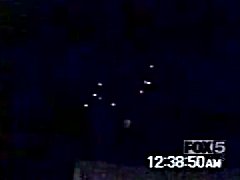
In the first minutes after midnight on 15 July 2001, drivers on the New Jersey Turnpike and residents of Carteret looked up and saw a tight group of golden-orange lights hanging over the Arthur Kill, the tidal strait that separates Carteret from Staten Island. This case file covers what witnesses reported, the official narrative, and a two-pass assessment with its evidence tier.
What did witnesses see at Carteret?
In the first minutes after midnight on 15 July 2001, drivers on the New Jersey Turnpike and residents of Carteret looked up and saw a tight group of golden-orange lights hanging over the Arthur Kill, the tidal strait that separates Carteret from Staten Island. Witnesses counted roughly thirteen to sixteen lights. Several were arranged in a clear V, others scattered loosely around it. The lights hung nearly motionless for ten to fifteen minutes, drifted slowly, then faded out one by one until the sky was empty.
Carteret police took the calls themselves and then saw it from their patrol. Lt. Daniel Tarrant of the Carteret Police Department told reporters, "I saw 16 golden-orange colored lights, several in a V-type formation. Others were scattered around the V." In a separate account he described "a string of bright yellow lights that flashed in a V-formation for about 10 minutes, then faded one-by-one into darkness." Police dispatchers logged at least fifteen calls inside an hour reporting orange lights over the water.
The Turnpike itself came to a near halt. Roughly seventy-five cars pulled onto the shoulder so people could get out and stare. Witness Steven Vannoy, watching from the Turnpike, was adamant the lights were not ordinary: "It wasn't fireworks, and it couldn't have been a hot-air balloon, not at night near the airfield." He added, "What we saw last night qualifies as a UFO. It was an unidentifiable flying object." Another witness, David Stich, said, "I never in my life saw anything like it," comparing the individual lights to volleyballs that dwarfed the surrounding stars. A witness named Pam Russell described a diamond-shaped pattern with smaller lights leading the formation and bringing up the rear.
The mood among the witnesses was calm rather than frightened. Joe Malvasio described the ending plainly: "They were just hovering, and then they just disappeared. One at a time, each one started to fade until they were gone." Other residents quoted in the coverage were almost reverent. Veronica Bagley called it "really amazing." Paulette Holmes said, "I wasn't alarmed because it was peaceful." Patty Ercolino went furthest: "Very peaceful, very serene, very beautiful. I think we witnessed some type of miracle." The original Star-Ledger account opens with a drowsy Carteret mother who saw flickering golden lights through her window and ran for her camera.
What is the official explanation?
There was no formal federal investigation. Carteret police did the legwork of an official inquiry on the night, calling the agencies that should have known if something was in the sky. They came up empty. Newark International Airport reported no unusual flight patterns and no pilots calling in strange lights. The National Weather Service found nothing in the atmospheric conditions to explain it. McGuire Air Force Base reported no military aircraft aloft in that window. Tarrant and his officers were left without an explanation of their own.
The Federal Aviation Administration's public position was thin. An FAA spokesman, quoted by ABC News on 19 July 2001, said there were no planned military operations he was aware of, that air traffic was light, and that no pilots had reported anything unusual. Because nothing showed on the primary radar picture the FAA chose to characterize, the agency effectively treated it as a weather phenomenon and declined to investigate further.
The first counter-explanation came not from a government body but from a privately funded research outfit. Colm Kelleher of the National Institute for Discovery Science (NIDS), the Las Vegas group bankrolled by Robert Bigelow, gave ABC News a preliminary assessment that the lights were most likely "military flares." This is the seed of the flare theory that has trailed the case ever since, but it was a preliminary guess from a private body, not a finding tied to a documented flare drop, and McGuire AFB had already said it had nothing flying.
A civilian group, the New York Strange Phenomena Investigators (NY-SPI), pushed in the opposite direction. NY-SPI said it obtained an FAA radar report from Newark for that night and that the report "indicates an enormous number of airborne objects, without transponders, beginning at 10:31 PM and ending at 12:51 AM EST." That window brackets the sighting. One witness was reported to have used an infrared rangefinder and put the objects at under 2,000 feet. The radar claim and the rangefinder reading point in opposite evidential directions, one toward many real low-transponder-less targets aloft, the other toward something close and low to the ground, which is exactly the altitude band where a prank balloon would sit. NY-SPI's own investigation page has since gone dark, its domain now resolving to an unrelated casino site, so the radar printout itself can no longer be read at source and survives only through secondhand quotation.
What did the witnesses think it was?
The witnesses, including the two police officers, were uniform on the core facts: a fixed count of golden-orange lights, a V or diamond core, silent, a slow drift, and a sequential one-by-one fade rather than a sudden vanish. None of them reported sound, none reported a solid structure, and several specifically rejected the obvious mundane candidates. Vannoy ruled out fireworks and night balloons on the spot. Stich and others stressed the size and brightness against the stars. The consistency of the count and the formation across independent strangers on the Turnpike and residents in their yards is the case's spine, and the presence of trained police observers who called the airport and the air base is what kept it from being dismissed as a single excited report.
What the witnesses believed varied. The Turnpike crowd leaned toward the genuinely anomalous, with Vannoy flatly calling it a UFO. The Carteret residents quoted by ABC leaned toward the wondrous and the peaceful, with Ercolino reaching for the word miracle. Nobody in the contemporary record claimed to see a craft, occupants, or beams. They saw lights that behaved oddly and faded.
There is one witness account that cuts against the anomalous reading and it deserves equal weight. J.C. Guskind, a B&L Towing driver and volunteer firefighter, reported seeing strange lights floating up from the back yard of a home opposite the Rising Star Diner on Roosevelt Avenue, a spot northwest of where the westernmost Turnpike witnesses were standing and upwind of the whole formation. That is the signature of a ground launch, and it is the single most important piece of testimony in the file because it places an origin point on the ground rather than in the deep sky.
The case picked up a famous and frequently misattributed cousin. In January and February 2009, red lights appeared over Morris County, New Jersey, and two self-described skeptics, Joe Rudy and Chris Russo, confessed in the eSkeptic newsletter on 1 April 2009 that they had tied road flares to helium balloons and launched them to fool the media and UFO investigators. They were charged as disorderly persons, fined 250 dollars each, and given fifty hours of community service. That 2009 Morristown hoax is a completely separate event from the 2001 Carteret sighting. Rudy and Russo never claimed Carteret, the Carteret prankster, if there was one, was never caught, and their confession describes a different county eight years later. The two are constantly merged in casual retellings, and that merger is itself a fact this archive has to flag rather than repeat.
The dispute
The leading counter-explanation, advanced by independent skeptic Tim Printy, is that the Carteret lights were home-launched prank balloons carrying flares or small lights. This is not an official ruling but a civilian analysis, and it comes with a shown method rather than a bare assertion. Printy assembled four converging lines of evidence: wind data from Sandy Hook and Bergen Point showing a 300 to 325 degree drift that matches the observed slow movement of the formation; the testimony of witness J.C. Guskind, who reported lights "floating up from the back yard" upwind of the formation, pointing to a ground launch; witness descriptions of "sparks" and of lights "fading out one by one," which fit tethered flares burning out individually rather than a single solid craft; and an infrared rangefinder reading placing the lights under 2,000 feet, consistent with balloon altitude. Together these account for the formation's drift, behavior, fade pattern, and apparent height, and Printy concluded the prank balloons were "the most likely cause."
The official apparatus, by the archive's standard, did not produce a method, only assertions. The FAA reported no planned military operations, light traffic, no pilot reports, and nothing on radar, then "characterized" the event as potentially weather-related and declined to investigate. McGuire Air Force Base and Newark Airport simply reported nothing unusual on their end. NIDS investigator Colm Kelleher offered an unofficial guess that the lights were "most likely military flares," but the page notes this was speculation unsupported by any documented flare drop or agency confirmation. Per this archive's method, that institutional non-finding is a claim, not a verdict, because no civilian-checkable technique sits behind it.
What keeps the case from being fully closed is that Printy's own analysis "stops short of proof": no flare drop was ever documented and the Carteret launcher was never found. The mundane reconstruction is consistent and well-supported but rests on inference rather than a recovered device or a confession. The page is also explicit that the 2009 Morristown flare-balloon hoax by Joe Rudy and Chris Russo is a completely separate event eight years later in a different county, so it cannot be cited as a confession for Carteret. The dispute therefore is a strong, evidence-backed prank-balloon hypothesis that lacks only the physical proof to finish the job.
Is the Carteret, New Jersey Lights real? The two-pass assessment
Pass one, the ordinary reading. The strongest mundane candidate is prank flares or pyrotechnic charges suspended under helium balloons, drifting on the wind and burning out in sequence. This is not a hand-wave. The independent skeptic Tim Printy worked the Carteret case in detail (his analysis was posted and updated by October 2008, before the 2009 Morristown stunt, so it cannot be hindsight from that hoax) and concluded, "The most likely cause for the Carteret lights, based on previous case histories and the reports by a majority of the witnesses, were these prank balloons." His method is shown, not asserted. He notes the recorded winds at Sandy Hook and Bergen Point that night blew from roughly 300 to 325 degrees, northwest to southeast, the same direction the formation was seen to drift. He leans on Guskind's account of lights rising from a back yard upwind of the crowd. He points to the witnesses' own descriptions of sparks and of lights breaking into pieces and fading one at a time, which is how a tethered flare dies, not how a structured craft departs. The infrared rangefinder reading of under 2,000 feet fits a balloon far better than a high craft, and the agencies all confirming nothing was flying fits a thing that needs no flight plan because someone let it go from a yard. The flare-balloon explanation accounts for the V (a cluster of separately buoyant flares spreads into a rough chevron as it rises and the wind shears it), the silence, the hover, the drift, and above all the sequential burnout.
Pass two, if it is not that. If the prank-balloon reading is wrong, then a dozen-plus stable, silent, brightly lit objects held a formation over a major airport approach and a federal highway for ten to fifteen minutes and then extinguished in order, while the FAA's own radar (per NY-SPI's quotation of it) allegedly carried numerous transponder-less returns across the same window. That would be a genuinely unexplained structured aerial display over restricted-adjacent airspace, observed by police and a crowd, with no aircraft, no weather, and no military activity to hang it on. The case has been repeatedly listed among the more credible modern multi-witness events for exactly that reason.
The verdict is Disputed. The official apparatus left it formally unexplained, and under this archive's rules that official non-explanation is not a strike against the case. But there is independent, civilian, method-shown analysis (Printy's wind data, the upwind backyard-launch witness, the spark and sequential-fade descriptions) that builds a coherent ordinary explanation without invoking any authority's say-so. That analysis is strong, yet it stops short of proof: no flare drop was ever documented, the Carteret launcher was never found or confessed, the much-cited flare confession belongs to a different county in 2009, and the NIDS flare guess was preliminary and contradicted by McGuire reporting nothing aloft. A counter-explanation exists and is serious, but it does not close the case. That is the definition of contested, so the tier is Disputed rather than Verified Unexplained, and it is not advanced as a proposed discredit because the discrediting method, while shown in principle, was never demonstrated against this specific event.
Sources
- abcnews.com/US/story?id=92865
- abcnews.com/US/story?id=92798&page=1
- nuforc.org/sighting/?id=18439
- astronomyufo.com/UFO/balloon.htm
- www.grunge.com/234728/the-unexplained-2001-ufo-sighting-over-the-new-jersey-turnpike/
- web.archive.org/web/20240420073406/https://www.ufocasebook.com/2008c/cateretnj2001.html
More cases from this region: UFO sightings in United States