The Claremont, New Hampshire Dome Object
In the early hours of 30 July 1968, two unconnected sets of witnesses in Claremont, New Hampshire reported a low, luminous object within about two miles and roughly an hour of each other. This case file covers what witnesses reported, the official narrative, and a two-pass assessment with its evidence tier.
What did witnesses see at Claremont?
In the early hours of 30 July 1968, two unconnected sets of witnesses in Claremont, New Hampshire reported a low, luminous object within about two miles and roughly an hour of each other. At about 1:12 a.m. a worker from a local manufacturing plant, carrying two buckets of water out toward his garden, saw what NICAP recorded as "a bright round object float in a gentle arc low in the sky to the northeast." He described it as looking like a full moon but sitting at an extremely low altitude, an arcing path low over the horizon rather than anything high in the sky.
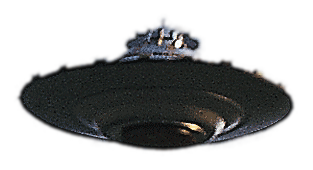
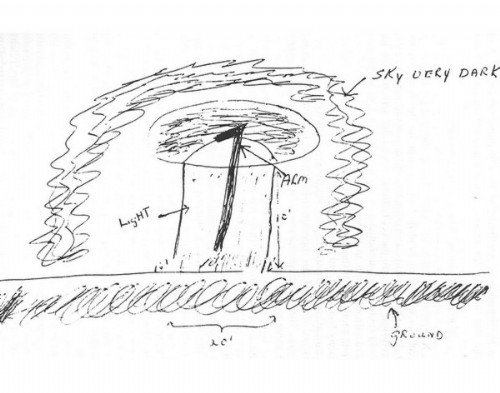
The main account came from a land surveyor and his wife. At about 2 a.m. they watched a dome-shaped object hovering close to the ground in a field near their home. The surveyor, used to judging distance for a living, put the thing at roughly 230 feet away, about 20 feet wide, and hovering only about 10 feet above the ground. Its underside threw a grayish beam of light down onto the field, casting a lit circle about 20 feet across on the ground. The witnesses said the object was moving slowly and that this caused shadows to shift across some freshly cut hay below it, a detail that only makes sense if a real light source was casting real shadows on the field.
The object gave off a steady high-pitched humming sound that the witnesses compared to the noise of a utility-pole transformer. While they watched, a projection, which the surveyor drew and labeled an "arm," descended from the object toward the ground. At one point the object shifted about 25 feet to the east and then held position. It stayed in the field until about 4:30 a.m., when the humming grew very loud, the light intensified, and the object rose at a low angle and moved away to the west, clearing the trees and vanishing.
Inside the house the animals and children reacted through the whole episode. The family German shepherd was whimpering and whining "as if something was hurting her," and at the departure she whined loudly. A poodle pawed at the side of the bed and was, in the witnesses' words, "actually shaking," only settling once the object left. The couple's children were restless and moaning in their sleep, described as crying out as if something was hurting them, then quieting after the object was gone.
What is the official explanation?
There is no government file on this case. Project Blue Book, the Air Force's UFO program, was still running in 1968, but Claremont does not appear among the Blue Book record cards as an investigated incident, and no Air Force, FBI, or other federal inquiry into the sighting is on record. The only investigation was civilian.
The investigating body was NICAP, the National Investigations Committee on Aerial Phenomena, then the most prominent civilian UFO organization in the United States. The case was worked by John Meloney of NICAP's New Hampshire Subcommittee and written up in NICAP's 1969 special report "Strange Effects from UFOs," authored by NICAP director Donald E. Keyhoe and assistant director Gordon I. R. Lore, where the Claremont account runs across pages 38 to 40. It was later carried in NICAP's own 1968 chronology, which summarizes it as a "dome-shaped object hovered low over ground, grayish light beam cast sharp shadows; humming sound, dogs reacted strongly," and cross-references it to "The UFO Evidence." NICAP filed the witnesses' names internally but did not publish them, a routine NICAP practice for cooperative private witnesses.
The closest thing to an official touchpoint is local law enforcement. The surveyor reported the encounter to the Claremont Police Department, and Police Captain Ernest M. Fausse spoke with NICAP's Meloney about it. Fausse did not witness the object himself, but he confirmed to Meloney that the witness "appeared nervous and apprehensive" when he came in to report it, an independent read on the man's state from someone whose job is judging whether a person is telling the truth. That is the full extent of officialdom here: a civilian investigative report and a police captain's character note, with no military or federal explanation ever offered.
What did the witnesses think it was?
The surveyor and his wife believed they had watched a real, structured craft sitting in their field for over two hours, close enough to estimate its size and low enough to light the hay underneath it. The surveyor's profession matters to how the case was weighed: estimating distances, heights, and ground dimensions is exactly what a land surveyor is trained to do, and his figures, about 230 feet out, roughly 10 feet off the ground, around 20 feet wide with a 20-foot circle of light on the ground, are the careful numbers of someone used to measuring. He took the trouble to draw the object afterward, marking the dark sky, the downward light, the ground line, the 20-foot light circle, and the descending "arm," which is the sketch NICAP reproduced.
The corroboration is the strongest part of the case. The manufacturing-plant worker about two miles away saw a low, bright, arcing object at around 1:12 a.m. without any apparent connection to the surveyor's family, an independent report of an anomalous low light in the same town in the same window of the same night. Inside the house there were further witnesses to the effects if not the object: the wife, the children moaning in their sleep, and two dogs in obvious distress, a German shepherd whining as if in pain and a poodle shaking and pawing the bed. Animal distress that tracks the presence and departure of the object, alongside the children's restlessness, is the kind of involuntary, multi-party reaction that is hard to stage and that the witnesses clearly found frightening.
Captain Fausse's note that the surveyor was nervous and apprehensive when he reported it fits people who believe they have just seen something genuinely unexplained rather than people inventing a story for attention. The family did not seek publicity, the names were kept private, and the report reads as a frightened household describing a long, close, physical encounter they could not explain.
Is the Claremont, New Hampshire Dome Object real? The two-pass assessment
Pass one, the ordinary explanations. Because the object hung only about 10 feet off the ground for over two hours and threw a beam that lit a measured circle on the field, most distant-light explanations fail on their face. A star, planet, or the Moon does not sit 10 feet above your hay for two and a half hours, move 25 feet sideways, cast moving ground shadows, hum like a transformer, and then climb away to the west. An aircraft or helicopter would not hover silently low over a field all night, and the witnesses reported a steady transformer-like hum, not engine or rotor noise. The transformer comparison naturally raises whether the witnesses confused a nearby electrical installation, a substation or pole transformer, with a hovering craft, but a fixed transformer does not move 25 feet, change height, project a descending arm, or fly off over the treeline, so it cannot account for the reported motion and departure. A hoax is always possible with a private, name-withheld family, but the case carries an independent second witness two miles away, involuntary animal and child distress, a police captain's note that the man was visibly shaken, and a contemporaneous NICAP field investigation, none of which a household gains anything from by faking, given that they avoided publicity entirely. Nobody has ever produced a prop, a confession, a recantation, or a specific identified object.
Pass two, if it was real. Taken at face value this is a classic late-1960s close-approach or near-landing: a domed, roughly 20-foot object hovering at treetop-to-rooftop height, emitting a directed beam and a transformer-like hum, with physiological-style effects on animals and sleeping children and a moving "arm" or projection extending toward the ground. It belongs to the same family of low, humming, dome-shaped objects NICAP was collecting in that era, which is exactly why Keyhoe and Lore filed it under physical and physiological effects in "Strange Effects from UFOs."
On the evidence the case is genuinely unresolved. There is no official narrative to dispute, no Blue Book file, no government explanation, and no civilian method-shown debunk identifying a specific star, aircraft, balloon, or installation as the cause. What survives is multi-witness testimony, a trained observer's measured estimates, an independent second sighting, corroborating animal and child reactions, a police character note, and the witness's own sketch, all documented by NICAP within months of the event. That puts the case in the Unknown tier: it stands on its witnesses and the surviving 1969 NICAP report, with no counter-explanation strong enough to move it and no authentication strong enough to call it Verified Unexplained.
Sources
- www.nicap.org/chronos/1968fullrep.htm
- www.nicap.org/ar-680730dir.htm
- www.thinkaboutitdocs.com/1968-witnesses-observe-near-landing-of-ufo/
- web.archive.org/web/20250130090418/https://www.ufocasebook.com/claremontnewhampshire1968.html
- www.scribd.com/document/482269089/Strange-Effects-from-UFOs-A-NICAP-Special-Report-1969
More cases from this region: UFO sightings in United States