The Copenhagen Airport Drone Incursions (September 2025)
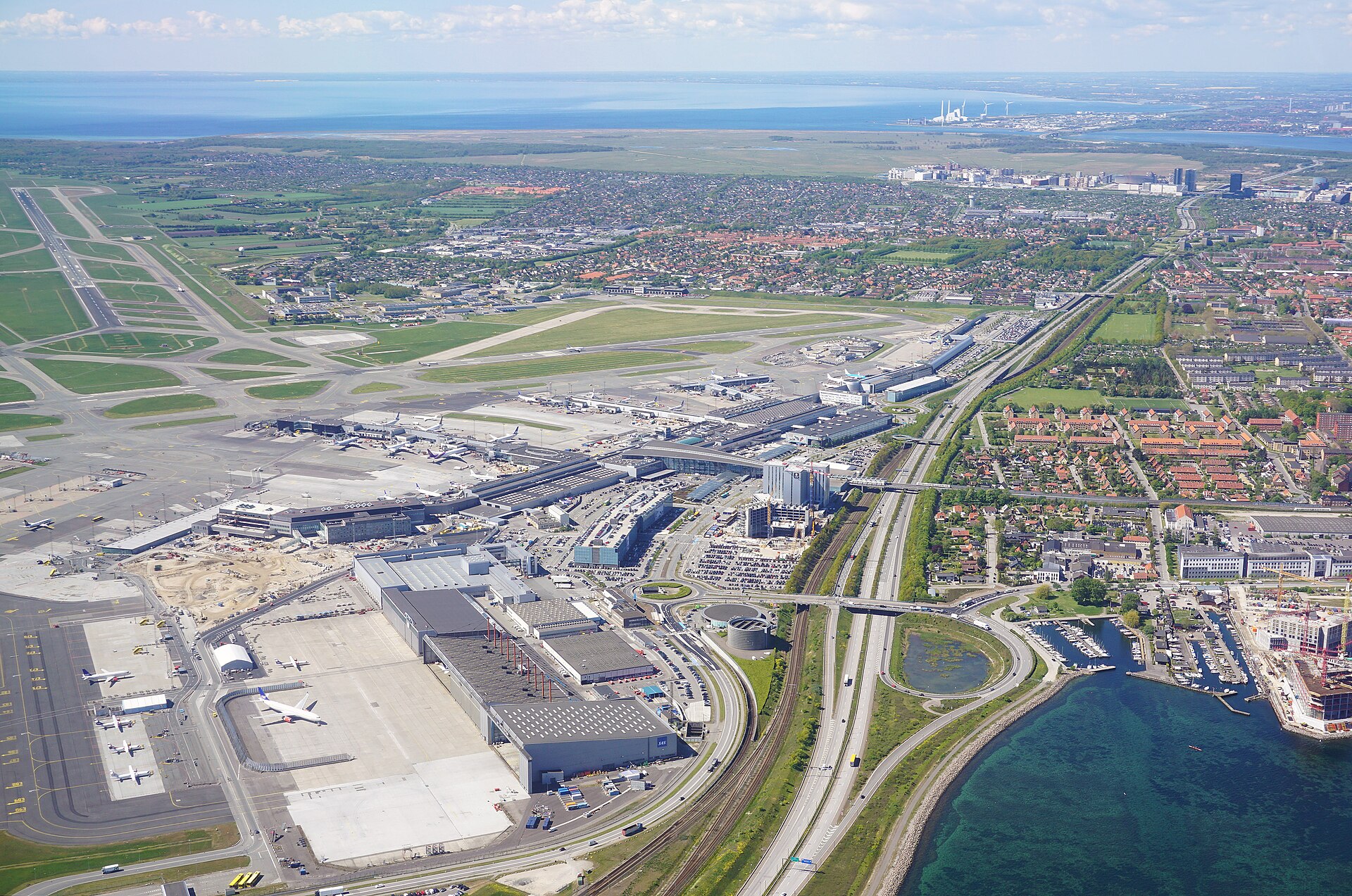
On the night of 22 September 2025, two to three large drones were reported over Copenhagen Airport and all flights were halted for about four hours. Over the following days more objects appeared over a second airport and over Denmark’s biggest military base. Nine months later two government investigations finished, and they did not agree: the armed forces concluded the drones were real and unexplained, while the police concluded they could not even prove a drone had been there.
What did witnesses see at Copenhagen Airport (Kastrup) and Danish military sites?
At about 20:26 on 22 September 2025, Copenhagen Airport suspended all departures and arrivals after air traffic staff and police reported two to three large drones inside the controlled airspace. The airfield stayed closed for nearly four hours and reopened around 00:20 on 23 September. The shutdown forced at least 109 cancellations and 51 redirections, with roughly 15 flights diverted to other airports. Police stressed at the time that these were not small hobby machines but large drones flown, in their words, by a capable operator.
The same night, Oslo’s main airport at Gardermoen was also disrupted by drone reports. Over the following days the sightings spread across Denmark. A second airport closed, and on 27 September police reported one to two drones near and over Karup, the country’s largest military base, which houses the armed forces’ helicopters, its airspace surveillance, and its flight school. On 28 September Denmark banned all civilian drone flights nationwide, with the country holding the rotating presidency of the Council of the European Union and an informal European Council summit about to convene in Copenhagen.
What the record does not contain is a clear picture of the objects. No sharp photograph or video of the drones over the airport has emerged. The one clip that travelled widely as proof was later assessed as most likely showing a training aircraft rather than a drone.
What is the official explanation?
The Danish government treated the wave as deliberate. Prime Minister Mette Frederiksen called it the most serious attack on Danish critical infrastructure to date and said the country had been the victim of hybrid attacks. Officials described a likely hybrid operation by a professional actor, said the drones appeared to have been launched locally, and stated explicitly that they did not believe the activity came from Russia. No operator was ever identified and no craft was recovered.
Two official investigations reported their findings in June 2026, and they reached opposite conclusions. The Danish Armed Forces, with access to military sensors, concluded that the incursions were real: drones were identified in several instances over military sites during the late September wave. Defence Minister Jeppe Bruus said the military’s ability to detect and respond to the drones had not been sufficient. The investigation confirmed the incursions happened but could not say who was behind them.
The police investigation, led for the Copenhagen airport incident by Chief Superintendent Soren Thomassen, landed in a very different place. After analysing witness statements, photographs, videos, CCTV, radar data, and air and maritime traffic records, Thomassen said on 25 June 2026: "Overall, our conclusion today is that we cannot demonstrate that there was drone activity in and around the airport." He added that police could not rule out that drones had been present, and acknowledged unexplained activity in the airspace that evening. Across the Danish police districts, many of the autumn reports were resolved as ordinary aircraft, helicopters, satellites, stars, or birds. The single radar trace, an object travelling around 100 kilometres an hour over the Oresund strait, came from a bird radar whose own manufacturer, Robin Radar, noted it was not designed to detect drones. Air traffic controllers said they saw no drones at the time. Thomassen conceded that police had not sufficiently communicated the uncertainties early on, when security concerns around the EU summit shaped their initial confidence.
What did the witnesses think it was?
The witnesses here were not hobbyists with a phone but airport operations staff, police, and military personnel, and the objects were credible enough to close a major international airport and to put the country’s biggest air base on alert. That is the weight on one side of the case.
The weight on the other side is the thinness of the hard evidence. There is no clean image of the objects, the only radar hit came from a sensor not built to catch drones, and the controllers on duty reported seeing nothing. The two state investigations, working the same autumn from different vantage points, could not even agree on whether craft were present. The military says yes, in several instances, over military sites. The police say they cannot prove it at the airport. Both agree on the one fact that keeps the case open: nobody knows who, or what, was responsible.
Is the Copenhagen Airport Drone Incursions (September 2025) real? The two-pass assessment
Pass one, the ordinary reading. A real possibility is that the airport closures were a cascade of misidentification under primed conditions. Europe was already on edge after Russian drones crossed into Poland and Romania weeks earlier, and once one airport shut every light in the sky became a drone. The police review resolved a large share of the autumn reports as aircraft, satellites, stars, and birds; the viral video was likely a training plane; and the lone radar return came from a bird radar its maker says cannot reliably detect drones. On this reading the four hour shutdown was a precautionary response to ambiguous reports rather than proof that craft were there.
Pass two, if the objects were real. The Danish military, with classified sensors and no incentive to inflate a foreign threat against its own readiness record, separately concluded that drones were present in several instances over military sites, and the government treated the wave as a deliberate hybrid operation by a capable, locally launched actor. Large coordinated drones over a capital airport and the nation’s main air base, timed to Denmark’s EU presidency, is a serious provocation, not a flock of birds. And the objects remain officially unattributed: no operator named, no wreckage, two government bodies reaching opposite verdicts on whether anything flew.
This is filed as Unknown, and it earns the label honestly. The likeliest non mundane explanation is a hostile state drone operation rather than anything exotic, and most of the airport reports may yet prove to be misidentified aircraft. But strip the case to what the state itself will stand behind and you are left with an unresolved core: objects that halted critical infrastructure and a NATO air base, one official body calling them real and unexplained, another unable to prove they existed at all, and no one able to say who sent them.
Sources
- www.bloomberg.com/news/articles/2026-06-19/denmark-probe-confirms-drone-incursions-leaves-culprits-unknown
- www.usnews.com/news/world/articles/2026-06-25/danish-police-find-no-proof-drones-caused-copenhagen-airport-shutdown
- www.dronewatch.eu/after-months-of-investigation-no-evidence-of-drones-over-copenhagen-airport/
- cphpost.dk/2026-06-26/news/round-up/planes-and-stars-mistaken-for-drones/
- www.aljazeera.com/news/2025/9/22/copenhagen-airport-shut-after-sighting-of-unidentified-drones
- www.france24.com/en/europe/20250927-new-drones-sighted-over-denmark-s-largest-military-base
- www.pbs.org/newshour/world/denmark-reports-new-drone-sightings-at-military-facilities-amid-security-concerns
More cases from this region: UFO sightings in Denmark