The Lago de Cote Disc: Costa Rica's Government Mapping Plane Photograph (1971)
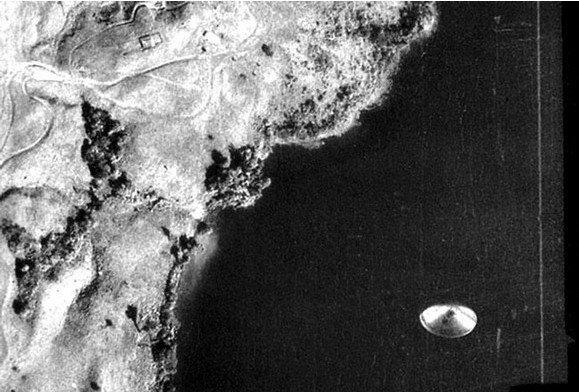
On the morning of 4 September 1971, a four-man crew from the Instituto Geografico Nacional of Costa Rica was flying an aerial survey of the Arenal region, photographing the terrain to make maps ahead of the hydroelectric project that would later flood the valley to create Lake Arenal. This case file covers what witnesses reported, the official narrative, and a two-pass assessment with its evidence tier.
What did witnesses see at Lago de Cote?
On the morning of 4 September 1971, a four-man crew from the Instituto Geografico Nacional of Costa Rica was flying an aerial survey of the Arenal region, photographing the terrain to make maps ahead of the hydroelectric project that would later flood the valley to create Lake Arenal. The aircraft was at 10,000 feet. The downward-pointing survey camera fired automatically every 20 seconds, and nobody aboard was looking out a window for anomalies. According to the data block printed along the edge of the film, frame 300 was exposed at 08:25 am local time over a small body of water called Lago de Cote, with the altimeter reading 10,000 feet and the notation "ARENAL 10,000 feet 4-9-71."
None of the four crew, named in the Haines and Vallee analysis as Sergio L. V. (the aerial photography specialist), Omar A. (pilot), Juan B. C. (geographer) and Francisco R. R. (topographer), saw anything unusual during the flight. The disc was discovered only later, when the developed negatives were examined back on the ground. On frame 300, sitting clearly against the uniformly dark water in the lower half of the lake, was a sharply defined ellipsoidal object that looked like a classic metallic disc seen at an angle. The two adjacent frames, number 299 taken 20 seconds earlier and number 301 taken 20 seconds later, both cover the same ground and show no disc at all. Whatever it was, it was present for one exposure only.
In the enlargements, the object shows light and dark shading consistent with a three-dimensional body lit by the sun, a generally triangular dark region on the right side, an extremely sharp and dense northern (top) edge, and a noticeably diffuse, almost transparent left edge that runs north to south rather than along the object's own long axis. There are no visible means of lift or propulsion, no lines or attachments to the disc, and no blur on the leading or trailing edges. Measured on the negative, the oval image is 4.2 mm long. If the object sat at the surface of the lake, 10,000 feet from the camera, that scales to a maximum dimension of about 210 meters, roughly 683 feet across. That is a hard upper bound set by the geometry, because a downward-looking camera cannot place the object any farther away than the ground it photographed.
The same lake produced a second, independent encounter fifteen years later. On 25 October 1986 at about 9:00 am, in clear weather, two men, farm manager Joaquin U. A. (40) and farmer Ronald-Alberto L. A. (23), watched a row of three or four dark, post-like cylinders rise about three feet above the mirror-flat surface of Lago de Cote, spaced about three feet apart and apparently attached to a single structure that stayed submerged. After five to ten minutes the cylinders tilted together and the whole object sank back into the lake with significant turmoil and waves. Their sketch was reproduced as Figure 11 in the 1989 paper.
What is the official explanation?
There is no military UFO file on this event because it is a Costa Rican civil cartographic photograph, not an intercept. The official footprint is the photograph's provenance with the Instituto Geografico Nacional and the film's own printed metadata (frame counter 909, altimeter 10,000 feet, C = 152.44, plate 21186, clock 08:25, frame note 300 L-11 M-13), together with the peer-reviewed analysis by Richard F. Haines and Jacques F. Vallee in the Journal of Scientific Exploration, Vol. 3, No. 2, pp. 113-131, 1989, and their follow-up "New Evidence" in Vol. 4, No. 1, pp. 71-74, 1990. The camera was an R-M-K 15/23 Zeiss survey instrument, fixed-focus 6-inch (152.44 mm) lens, 1/500 second at f/5.6, 20-second intervallometer, ASA 80 black-and-white emulsion on Kodak Safety aerial film type 3665, 23 by 23 cm frames covering about 11.5 km of ground per side. Haines and Vallee measured the sun at azimuth 85.4 and altitude 16.7 degrees (matching cloud shadows but not the dark regions on the disc), found no ground shadow, found no grain distortion indicating a double exposure, and concluded: an unidentified, opaque, aerial object was captured on film at a maximum distance of 10,000 feet, with no visible means of lift or propulsion, the case to remain open. The journal printed a dissenting referee review by Lockheed scientist Marilyn E. Bruner (pressure-mark artifact hypothesis) and the authors' detailed rebuttal in the same issue. After the Instituto Geografico Nacional released the original negative, Haines reported the emulsion was smooth, undercutting the pressure-mark idea.
What did the witnesses think it was?
The witnesses to the photograph itself are unusual in that there are none in the normal sense. The four-man flight crew, Sergio L. V., Omar A., Juan B. C. and Francisco R. R., saw nothing during the flight and only learned of the object when the film came back. This is exactly why the photograph carries weight with researchers: there was no observer with an agenda at the moment of capture, no story being built around a sighting, just an automatic survey camera that happened to record something on one frame of a 20-second sequence. The specialist Sergio L. V. (identified in popular accounts as Sergio Loaiza) later met the Costa Rican investigator Ricardo Vilchez in 1980 and discussed the flight, but neither man could say what the object was.
Ricardo Vilchez, who with his brother ran a civilian research group in San Jose, is the chain-of-custody figure. He obtained the photograph years after the flight, provided a second-generation negative to Haines and Vallee for analysis in 1985, and later helped secure the original negative from the Geographic Institute. Vallee has been blunt about why that mattered, saying in interviews that he obtained the negative from the government of Costa Rica and that without the negative, analysis is a waste of time.
The corroborating human witnesses are the two men at the lake in 1986, Joaquin U. A. and Ronald-Alberto L. A., interviewed at the site two weeks after their sighting by Ricardo and Carlos Vilchez. They were not connected to the 1971 flight and had no stake in the photograph; their account of dark cylinders rising from and sinking back into the same small lake is what links the photographic event to a pattern of activity at that specific location rather than a one-off film anomaly. Neither the crew nor the lake witnesses ever claimed the object was extraterrestrial. The people closest to the evidence consistently held the careful position that the object was unidentified, not that it was proven to be a craft.
The dispute
The dispute is whether frame 300 records a physical object at all or a defect in the film or camera. It was advanced first, and most credibly, by Marilyn E. Bruner, a senior staff scientist at Lockheed Palo Alto Research Laboratory, in a referee review printed alongside the 1989 paper. Bruner argued the oval is "more likely to be an artifact such as a pressure mark than a photographic image of a physical object," caused by a foreign particle trapped between layers of film on the supply spool. Her central technical point was that the northern edge of the image appears sharper than the lens should be able to resolve and shows none of the diffusion or halation that a genuine bright source produces, while the density gradients she read as a particle's varying thickness rather than as scene illumination. She proposed a concrete test: examine the original negative under strong glancing illumination to look for emulsion marks or base deformation.
A second, later version of the dispute came from the Rocky Mountain Paranormal Research Society in 2013, which proposed the disc was produced by reflections of ambient light inside the camera optics, a combination of the camera type, the aircraft's angle to the light, the sun's position and light off the water. This is attractive because it would also explain the missing shadow, since an internal optical reflection casts none. Independently, Mick West demonstrated that the popular high-resolution "4K" version of the image is an AI upscale of a roughly 1000-pixel source, which invalidates any modern analysis that leans on detail visible only in that enlarged copy.
These challenges are real and were made by qualified people, which is why the case is disputed rather than verified. But none has been shown by method. The Rocky Mountain Paranormal explanation is offered as a hypothesis, with no recreation that reproduces the image and no indication the group examined the original negative. The pressure-mark hypothesis was, by contrast, tested against the physical film: after the Instituto Geografico Nacional released the original first-generation negative, Haines reported the emulsion was smooth, which is inconsistent with a trapped particle. Haines and Vallee had already answered Bruner in print, noting that house roofs elsewhere in the same frame are sharper than the disc (so the lens resolution was not exceeded), that no grain deformation surrounds the image, and that a spooled particle should have left a matching secondary impression on frame 299 or 301, which a careful search did not find.
So the dispute weakens but does not close the case. To reach the strongly disputed tier, someone would need to identify the specific cause, reproduce this exact frame through a demonstrated optical artifact, or locate a fabrication, and that has not happened. What exists is a serious unproven counter-explanation against an unrefuted technical rebuttal grounded in the original negative. The case largely stands, which places it in the barely disputed tier.
Is the Lago de Cote Disc: Costa Rica's Government Mapping Plane Photograph (1971) real? The two-pass assessment
Pass one, the ordinary explanations. The strongest mundane candidate is a film or camera artifact, and it was raised by a qualified analyst at the time. Marilyn Bruner of Lockheed argued in the journal itself that the disc was probably a pressure mark from a foreign particle trapped against the film, pointing to the abnormally sharp, near-saturated northern edge and the absence of the flaring a real bright source would produce. A trapped particle, or a chip or reflection inside the optics, would also neatly explain the missing shadow, because an artifact on the film casts no shadow on the ground. In 2013 the Rocky Mountain Paranormal Research Society advanced a related idea, that the image came from reflections of ambient light inside the camera optics produced by a specific combination of camera type, aircraft angle, sun position and light off the water. Other commentators on Metabunk floated an emulsion bubble, a development mark, or a punctured frame. Separately, Mick West showed that the widely shared high-resolution 4K version of the image is an AI upscale of a roughly 1000-pixel original, so any analysis based on the sharp detail in that enlarged version is analyzing invented pixels, not the negative.
Two things keep these explanations in the realm of plausible-but-unproven rather than demonstrated. First, none of them was ever shown by recreation. The Rocky Mountain Paranormal optics hypothesis is presented as a hypothesis; their own page describes no experiment that reproduced the image, and there is no evidence they examined the original negative. The pressure-mark idea was specifically tested against the physical film and, per Haines, the original emulsion was smooth, which is the opposite of what a trapped particle should leave. Second, Haines and Vallee pre-empted the artifact case with checks an artifact should fail: a particle on continuously spooled film should leave a matching secondary dimple at a predictable distance on frame 299 or 301, and a careful search of both adjacent frames found nothing. The convergent shadow geometry and the three-dimensional shading also fit a lit object better than a flat blemish, though none of this is conclusive on a second-generation negative.
Pass two, if it is a real recorded object. Then a downward survey camera at 10,000 feet froze, in 1/500 of a second, a sharply focused opaque disc up to about 210 meters across, present for exactly one 20-second interval and gone before and after, sitting over a lake that produced a second independent submerged-object sighting in 1986. There is no propulsion, no exhaust, no tether, no motion blur, and no shadow, the last consistent with the object resting at or just above the water surface. The case has the rare virtue of an automatic, no-witness capture by a government instrument on calibrated mapping film, which removes most of the usual hoax and misperception vectors at the moment of exposure.
Where this lands: the photograph is authentic and officially sourced, the object is genuinely unidentified, and the only counter-explanations on the table are an artifact hypothesis that was argued but not demonstrated and, on the evidence of the original negative, appears to have been weakened rather than confirmed. That is a real, named, qualified dispute, so the case is not Verified Unexplained. But because no analyst has reproduced the image, identified a specific particle, ship, balloon or optical defect, or shown a method that produces this exact frame, the dispute does not close the case. It sits as Barely Disputed: a strong, primary-sourced photograph with a serious but unproven mundane challenge and an unrefuted technical rebuttal from the original investigators.
Sources
- www.nicap.org/articles/710904_JSE_03_2_haines.pdf
- www.scribd.com/document/34892561/Photo-Analysis-of-an-Aerial-Disc-Over-Costa-Rica-New-Evidence
- ufologie.patrickgross.org/htm/decote.htm
- www.metabunk.org/threads/1971-lake-cote-lago-de-cote-ufo-aerial-photo.11729/
- www.rockymountainparanormal.com/1971costaricaufo/index.html
- openminds.tv/costa-rica-ufo-dossier-pt-1/
More cases from this region: UFO sightings in Costa Rica