The Delphos, Kansas Glowing Ring
At about 7:00 in the evening on 2 November 1971, sixteen year old Ronald Johnson was penning sheep on his family's farm near Delphos, in Ottawa County, Kansas, when he saw a mushroom shaped object hovering in a grove of trees roughly 75 feet from where he stood. This case file covers what witnesses reported, the official narrative, and a two-pass assessment with its evidence tier.
What did witnesses see at Johnson family farm near Delphos?
At about 7:00 in the evening on 2 November 1971, sixteen year old Ronald Johnson was penning sheep on his family's farm near Delphos, in Ottawa County, Kansas, when he saw a mushroom shaped object hovering in a grove of trees roughly 75 feet from where he stood. He estimated it at about nine feet in diameter and about ten feet tall, sitting around two feet above the ground. Its entire surface was illuminated, glowing with what he described as a mix of blue, red and orange light, and there was a bright glow projected down between the object and the soil. The thing made a sound he likened to "an old washing machine which vibrates," and as it began to move off it passed over a nearby shed, emitted a jet like noise, and grew so bright that Ronald lost his vision for a short time.
When his sight returned Ronald ran to the farmhouse and told his parents, Durel and Erma Johnson. They did not believe him at first and he became agitated, then all three went outside and watched the object receding into the southern sky as a bright luminous body, which they compared to "the color of an arc-welder" and judged to be at least half the size of the full moon, which was visible in the south-east at the same moment. About ten miles south at Minneapolis, Kansas, a reserve police officer named Lester Ernsbarger independently reported by radio to his base that he had seen a bright light in the sky at around 7:30 pm, providing separate corroboration that an illuminated object was over the area.
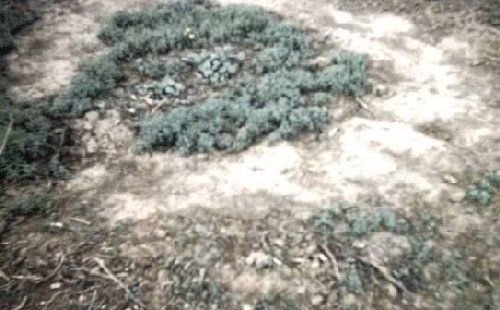
The family then walked to the grove where the object had hovered and found a glowing ring of soil on the ground, with portions of the nearby trees also glowing. Erma Johnson was so struck by it that she ran back to the house for a Polaroid 104 camera and photographed the ring, in the dark and with no flash, because the ring itself was bright enough, she said, to read a newspaper by. She had a single exposure left and could see the glowing ring through the viewfinder well enough to frame it. The witnesses touched the ring and described it as cool, slick, and crust like, "as if the soil was crystallized," pitted with tiny craters or "blisters" like hail damage, and slightly moist. On touching it both adults felt an immediate numbing of their fingertips, like a local anaesthetic, and Erma wiped her hand on her leg, which then went numb there too. Her finger numbness reportedly persisted for around two weeks and, by one later account, never fully left.
The animals reacted strongly. The family dog tried frantically to get into the house at nightfall for about two weeks afterward, nearly destroying the screen door until it was replaced with a metal one, and every evening at sunset the sheep would jump from the pen and run wildly. Ronald's eyes were red and watered the next day, and for about a week he woke screaming from nightmares.
What is the official explanation?
There was no Air Force investigation of Delphos. Project Blue Book had been formally terminated on 17 December 1969, almost two years before the event, so the United States government produced no official file. The investigation that exists is civilian and law-enforcement.
The Ottawa County Sheriff's Office responded the day after the sighting. Reporter Thaddia Smith of the Delphos Republican drove out to the farm on 3 November, then telephoned the local weather bureau, the sheriff's office and radio station KSAL. Sheriff Ralph Enlow, with his undersheriff and another officer, reached the Johnson farm at about 2:00 pm on 3 November. Enlow's noted comments from that visit read: "We observed a ring shaped somewhat like a doughnut with a hole in the middle. The ring was completely dry with the hole in the middle and outside of the ring mud. We were given a picture taken the previous evening by Mrs. Johnson which showed that the ring glowed in the dark. The soil sample taken was almost white in color and very dry, the soil was not radioactive." Kansas State Highway Patrol and the undersheriff also filed statements, and the undersheriff's statement references the Ernsbarger sighting.
The serious technical work was carried out by Ted Phillips, the physical-trace specialist who investigated for the J. Allen Hynek Center for UFO Studies. Phillips arrived on 4 December 1971, about a month after the event, and found the ring still outlined by un-melted snow. He photographed it, interviewed the witnesses, and took surface and sub-surface samples of the dry ring soil from beneath the snow along with control material from outside the ring. Phillips documented that the ring soil was still dry to a depth of at least twelve inches even though it had been rained and snowed on, while soil immediately outside the ring was wet and black. His findings were published as "Landing Report from Delphos" in Flying Saucer Review Case Histories No. 9 in 1972, and again in his monograph "Delphos, a Close Encounter of the Second Kind" issued by the UFO Research Coalition in 2002.
The soil then passed through a long chain of laboratory analyses, compiled by Dr. Michael Swords in the Journal of UFO Studies (New Series, Volume 3, 1991, pages 115 to 133). Early laboratory work at institutions including Oak Ridge National Laboratory and the Agri-Science Laboratory established that the ring soil carried sharply higher levels of several metals than control soil, by atomic absorption: iron rose from about 6.8 to 28 parts per million, manganese from 5.2 to 56, zinc from 0.18 to 20, copper from 1.0 to 2.48, and calcium roughly tripled, the Agri-Science figures giving about 2,400 ppm in the ring against 912 ppm in control and Oak Ridge's SEM X-ray work averaging 2.44 percent calcium in the ring versus 0.95 percent in control. The soil showed no sign of heating and was not radioactive.
In 1999 the analytical chemist Phyllis A. Budinger of Frontier Analysis re-examined ring and control samples that had been preserved in John Timmerman's attic after the CUFOS Chicago office closed, located again on Thanksgiving Day 1998 and received for analysis on 7 December. Her report, Technical Service Response UT001 dated 9 August 1999 and requested by Ted Phillips of the Center for Physical Trace Research, ran a full instrumental battery (EDX, XPS, XRD, FT-IR, SEM/EDX, GC/MS, NMR, ion chromatography) and concluded there had been "a definite release of material," most probably deposited as an aqueous solution, amounting to about 2 to 3 weight percent of the ring soil and composed of roughly 85 percent humic substance (a low molecular weight fulvic acid), about 5 percent calcium oxalate, and about 1 percent calcium carbonate. She confirmed the soil had not been heated, noted that "calcium oxalate and oxalic acid are known skin and eye irritants" that "could account for the physical effects suffered by the witnesses," and proposed that humic substances in the presence of oxalate derivatives and a catalyst such as hydrogen peroxide "may possibly cause the chemiluminescence (glowing) effect." Her stated bottom line was that "the analysis neither proves nor rules out a UFO source of the release."
What did the witnesses think it was?
Ronald Johnson (16, primary witness), with parents Durel Johnson and Erma Johnson; corroborating witness Lester Ernsbarger of Minneapolis, Kansas; reporter Thaddia Smith and Sheriff Ralph Enlow at the site next day
Is the Delphos, Kansas Glowing Ring real? The two-pass assessment
Pass one, the ordinary explanations. Three have been put forward and each has been tested against the actual soil. A hoax is the first. The chemist Erol Faruk, who performed the deepest organic analysis, argued a hoax is almost impossible to construct: the defining anomaly is an extreme, glass-like water repellency that runs fourteen inches deep through a ring of soil, and no ordinary household or farm chemical reproduces that. He specifically dismissed the idea that the glow could have come from commercial Cyalume light sticks, since those use toughened plastic to prevent spillage, rely on a different two-component peroxide chemistry, and thousands would have been needed to impregnate a ring of that size and depth. A second candidate is a natural fungal "fairy ring." Faruk rejected it on grounds drawn from the material itself: the ring never grew outward over time as fairy rings do, and although tiny amounts of fungal matter were present, Ted Phillips established that ring samples taken the day after the event showed no fungal growth at all, while only the month-old samples did, meaning the fungus appeared after the fact rather than causing the ring. A third candidate is mundane "well-seasoned barnyard soil." Budinger's 1999 analysis ruled this out directly: barnyard contamination would leave high nitrogen, phosphorus and potassium plus urea, uric acid and ammonium decomposition products, and "these are not detected. Only the fulvic acid predominates." It is worth noting that Budinger's own preferred label, fulvic acid, leans toward a natural-product reading, and that is the strongest counter-current in the file; but she still attributed the deposition to the object, and Faruk disputes the identification on chemical grounds, pointing out that a fulvic acid would not precipitate with silver nitrate the way the ring compound did, because it is itself an acid rather than a metal salt of one.
Pass two, if the trace is real and the witnesses are describing what they saw. Here the physical evidence is unusually strong and has been authenticated repeatedly. The soil is real, preserved, chain-of-custody intact in sealed film canisters, and re-analysed across decades by independent laboratories: Oak Ridge, Agri-Science, the Battelle Memorial Institute (which Phillips described as "the finest soil laboratory in the U.S."), Faruk at Nottingham University, and Budinger at Frontier Analysis. They agree on the core facts. There was a genuine deposition of material, most likely laid down as an aqueous solution, producing a ring soil that is sharply elevated in calcium, iron, manganese, zinc and copper, that was never heated or irradiated, and that repels water to a depth of fourteen inches. Faruk's 1977 work isolated from the ring soil a water-soluble, soap-like compound, an alkali-metal salt of a carboxylic acid, which he characterized via its silver salt and methyl ester and assigned the rough empirical formula C14H14N2O12 around a calcium center. Critically, the isolated active component fluoresced bright bluish-white under ultraviolet light and behaved as an oxidative chemiluminescent substance, which would directly explain a ring that glowed in the dark, the witnesses' "fluorescent" description, and even the object's own glow if it carried such a solution. Faruk noted the elevated copper and manganese in the ring are exactly the kind of metal ions known to amplify chemiluminescent reactions by orders of magnitude. The numbing the family felt fits too, since the compound's dual water-loving and water-hating structure mirrors how topical anaesthetics work, and Budinger separately flagged calcium oxalate and oxalic acid as known skin irritants.
The single most decisive piece of pass-two evidence is recent and on camera. In 2020 a Kansas State University team, guided by the now adult Ronald Johnson, excavated material he had decades earlier buried to protect it, and reproduced the ring soil's extreme hydrophobicity on video, confirming that the anomaly is real, physical, and persistent nearly half a century after the event, not an artifact of memory or a trick of one old sample. No official body ever issued a debunk of Delphos, and the civilian counter-explanations on offer each fail against the chemistry of the actual soil.
This is a multiple-witness close encounter backed by an authenticated, preserved, independently re-analysed physical trace whose defining anomaly has been reproduced on camera in 2020, and which no natural or hoax explanation has been able to account for. The competing natural readings exist but are weak and have been answered point by point by the analysts who held the material. The object itself remains unidentified. Tier: Verified Unexplained.
Sources
- documents.theblackvault.com/budinger/UT001.pdf
- drive.google.com/file/d/1B7PNmNITmERJn7pbMfjkAcutW_8yPwxz/view
- www.explorescu.org/post/a-new-appraisal-of-the-data-of-the-delphos-ce2-1971-case
- www.theblackvault.com/casefiles/analysis-soil-samples-related-delphos-kansas-november-2-1971/
- www.liberationtimes.com/home/the-uap-cold-case-that-could-yield-new-physical-insights-into-the-biological-effects-and-nature-of-the-phenomena
- www.ufoevidence.org/cases/case192.htm
- www.thinkaboutitdocs.com/1971-delphos-kansas-landing-ring/
More cases from this region: UFO sightings in United States