The Amarante Case: A Lone Biologist's Ovoid in a Laxou Garden
On the late morning of Thursday 21 October 1982, a 30 year old biology researcher, anonymised by GEPAN as Monsieur Henri, was cleaning ornamental garden bowls in the small front garden of his house on Rue Noel Bernard in Laxou, a town on the western edge of the Nancy conurbation in Meurthe-et-Moselle. This case file covers what witnesses reported, the official narrative, and a two-pass assessment with its evidence tier.
What did witnesses see at Laxou?
On the late morning of Thursday 21 October 1982, a 30 year old biology researcher, anonymised by GEPAN as Monsieur Henri, was cleaning ornamental garden bowls in the small front garden of his house on Rue Noel Bernard in Laxou, a town on the western edge of the Nancy conurbation in Meurthe-et-Moselle. In his own words recorded in the gendarmerie deposition and reproduced verbatim in GEPAN Note Technique No. 17, he looked up to a clear sky with the sun behind him and saw a bright point he first took for an aircraft. As it inflected its path toward his house it grew rapidly. He stepped back three or four metres and saw "la forme ovale de l'engin".
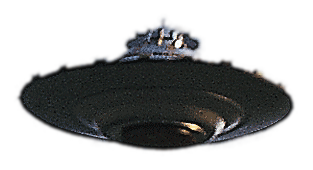
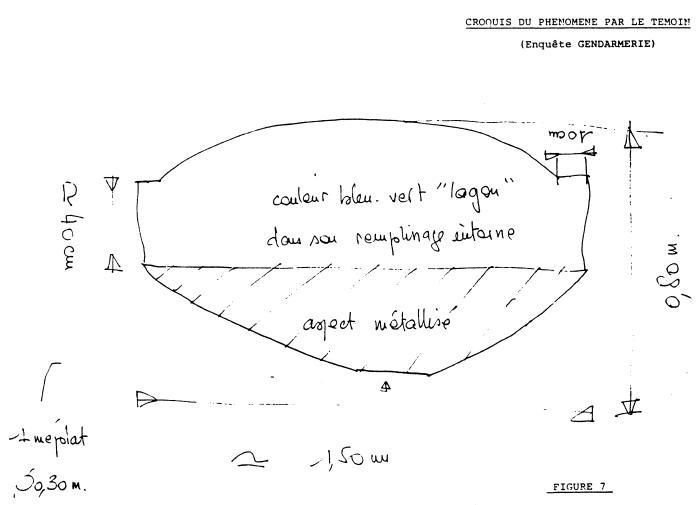
The object came to rest in mid air, motionless, about one metre above the lawn, and stayed there, by his insistent account, for exactly twenty minutes. He had looked at his watch. He described it precisely: ovoid, roughly 1.5 metres in diameter and 0.80 metres thick, the lower half with a metallic look he compared to "beryllium poli", the upper half a translucent "bleu-vert lagon" filling that he called the coque, the shell. It made no sound and gave off no heat, cold, radiation, magnetism or electromagnetism that he could detect. He approached from 1.5 metres down to about 50 centimetres and examined it from several angles. By his account he even said hello in several languages to the shell, which seemed to subjugate him, and got no answer.
During the twenty minutes he went up to the first floor of his house, fetched his loaded camera and came back down. The object had not moved. He tried to fire the shutter but the camera jammed, a fault he said it had shown before, so no photograph exists. At the end the object rose vertically and vanished into the sky at an enormous speed, "comme sous l'effet d'une forte aspiration", as if sharply sucked upward. As it left, he saw the tufts of grass directly beneath it stand bolt upright and then drop back to normal. No mark was left on the ground, the grass was neither scorched nor crushed. He was alone in the garden, saw no neighbour, and noted his house sits below road level so the object could not have been seen from the street while it sat in the garden. Returning later he found a row of amaranth flowers along the garden edge withered, which he linked to what he had seen.
What is the official explanation?
The case is one of the most documented in the French official archive because GEPAN, the UFO study unit then attached to the national space agency CNES, conducted a full field investigation and published it as Note Technique No. 17, signed in Toulouse on 21 March 1983 and titled "L'Amarante" after the plant affected. The chain of custody is recorded in the note itself. The gendarmerie of the local brigade took Monsieur Henri's deposition at 18h on 21 October 1982 after he and his wife reported the morning's events. A telex went out on 22 October 1982. GEPAN was informed on 23 October, decided to intervene on 27 October, and its team travelled from Toulouse, reaching the gendarmerie on the morning of 29 October to take statements, plans and photographs.
The physical evidence centred on a bed of red amaranth, Amaranthus, "queues de renard", running less than a metre from where the object hovered. The closest plants, about 20 centimetres away, showed drying of stems and leaves, with water content measured at 40 percent against 80 percent in control flowers further off, and a colour shift from bright red to dull brown. The gendarmes took a first sample series, then a second on 27 October that was studied in several laboratories. GEPAN's biochemical chapter was candid about its own limits. The note states that cold storage at plus 4 degrees followed by freezing at minus 30 was insufficient to halt enzymatic activity, that the witness had dug up plants soon after, and that "aucune conclusion n'a pu etre tiree de ces analyses". The note found three times more amino acids in control flowers than in withered ones and a slightly higher hydroxyproline level, which it read as "probablement une reponse a un stress d'origine parasitaire ou consecutif a une blessure ou a un exces d'engrais", in other words an ordinary plant stress. Crucially the note recorded that the meteorological station nearby reported the previous night, 20 October, a temperature below zero with light mist, so GEPAN itself suggested that frost on the frost sensitive amaranth could explain the desiccation.
On the grass standing upright, GEPAN consulted Monsieur Chauzy of the Laboratoire de Physique de l'Atmosphere at the Universite Paul Sabatier. His report, quoted in the note, said the effect resembled grass tufts under an intense vertical electric field through corona discharge, and estimated a minimum field of 30 kV per metre for 15 centimetre grass. But he immediately flagged the contradiction: the witness had stood within 50 centimetres of the object without feeling anything, where the field would have exceeded 60 kV per metre, a level that would have been strongly felt and dangerous. GEPAN's own conclusion was careful. It noted the observation conditions, as reported, would have been excellent, in daylight, close up, from several angles, so any honest misperception would have to be "enorme, fondamentale, absolue". The discourse analysis revealed nothing pathological, so "aucun indice raisonnable ne permet de rejeter le temoignage", yet the note stressed that the single witness made any inter testimony coherence check impossible. GEPAN explicitly declined to tie it to its other trace cases such as Trans-en-Provence. The case was filed in the agency's top strangeness class, PAN D, unexplained.
What did the witnesses think it was?
Monsieur Henri believed without hesitation that he had watched a structured craft of unknown origin hover in his garden. His credibility weighed heavily on the investigators. His profession as a biological researcher, his composure and his insistence on precision impressed GEPAN, and years later the agency's own Jean-Jacques Velasco, interviewed by Robert Roussel in August 1987, called him "certainement le meilleur observateur que j'ai jamais rencontre", the best observer he had ever met. Velasco went on, in his 1993 book co-written with journalist Jean-Claude Bourret and in television appearances, to cite the Amarante alongside Trans-en-Provence as evidence that these phenomena interact with their environment and probably involve intense electromagnetic, perhaps microwave, fields.
The corroboration problem is the heart of the case. There was only one observer of the object itself. The witness's wife did not see the craft, she received his account around 17h and went with him to the gendarmerie an hour later. No neighbour reported anything, even though the object was bright enough to catch his eye in the middle of the day over a town inside a conurbation of several hundred thousand people. No public appeal for witnesses was ever issued, and skeptics later noted GEPAN never canvassed the immediate neighbourhood. The only material corroboration is the row of dried amaranth, which both the gendarmes and GEPAN photographed and sampled, and the camera that jammed at the decisive moment, leaving the strongest claim in modern French ufology resting on one man's testimony and one bed of wilted flowers.
The dispute
The dispute is a named, published, method shown natural explanation that the case is a runaway metallised mylar balloon misperceived as a craft. It was advanced principally by French skeptic Eric Maillot, with David Rossoni and Eric Deguillaume, in the 2007 book "Les OVNI du CNES: 30 ans d'etudes officielles 1977-2007" and in the Observatoire Zetetique chapter "L'Amarante (1982)". Working from the GEPAN file and previously unpublished investigation audio, Maillot proposes a biface mylar balloon roughly 0.91 metres across that broke loose from a local celebration and settled onto the curved stems of the tall garden flowers reaching about 1.7 metres, the roses tremieres and the amaranth bed. On this reading the lens shaped balloon gives the ovoid outline and the apparent floating, while the reflective film accounts for both the polished metallic lower face the witness likened to beryllium and the blue green "lagon" sheen above, since these are ordinary mylar colours rather than exotic materials. A shift in the light wind explains the sudden vertical departure.
The reconstruction also neutralises the physical traces. GEPAN's own Note Technique No. 17 records that the meteorological station logged a sub zero temperature with light mist on the night of 20 October, the day before, so the drying of the cold sensitive amaranth can be attributed to frost rather than to any object, and the note states plainly that the compromised plant samples allowed no conclusion to be drawn. The grass that stood upright was modelled by the agency's own consultant, Monsieur Chauzy of the Laboratoire de Physique de l'Atmosphere, as a corona effect needing at least 30 kV per metre, but Chauzy himself noted that such a field would have exceeded 60 kV per metre at the witness's 50 centimetre approach and would have been strongly felt, which it was not, undercutting the electromagnetic interpretation. On the perceptual side the skeptics highlight the start time logged inconsistently as 12h35 and 12h33, the technically wrong use of "beryllium" for a light metal, the lack of any eyesight or neurological check on a lone witness, and the close resemblance of the translucent shell to the egg in the 1979 film Alien as cultural priming, and they raise a complex visual illusion or migraine aura, which typically lasts about twenty minutes, as an alternative to a real object.
Why it does not fully close the case. Maillot recovered no balloon, obtained no confession and won no concession from the witness, who never retracted, and GEPAN, now GEIPAN, has never reclassified the file from its top strangeness category PAN D, unexplained. The balloon and illusion model is a reconstruction built on a hypothetical, unrecovered object and an unprovable perceptual episode, and Maillot himself presents it as explanatory plausibility rather than demonstrated fact, writing that a mundane favourable environment plus one missing datum is enough to manufacture a false great mystery that endures. It is the strongest natural account available and it explains the shape, the colours, the silence and the frost damaged amaranth, which is why the case is Barely Disputed, but because it stops short of recovered props, a confession or a witness concession it does not settle the matter, and the case is not proposed for discredit.
Is the Amarante Case: A Lone Biologist's Ovoid in a Laxou Garden real? The two-pass assessment
Pass one, the entirely ordinary reading. This is a single witness daytime case with no photograph, no second observer and ambiguous physical traces, which is exactly the profile that invites a mundane explanation. The most developed natural account comes from French skeptic Eric Maillot, working from the case file and previously unpublished GEPAN audio, and published in the 2007 book "Les OVNI du CNES" by David Rossoni, Eric Maillot and Eric Deguillaume and in the Observatoire Zetetique chapter on the case. Maillot proposes a runaway festive metallised mylar balloon, about 0.91 metres across and biface, that had drifted loose and settled onto the curved 1.7 metre stems of the tall garden flowers, the roses tremieres and the amaranth. A lens shaped mylar balloon caught at that height accounts for the ovoid outline, the silent stillness, the polished metallic lower face and the blue green "lagon" sheen of the upper face, all standard mylar colours, and a gentle wind shift explains the abrupt vertical departure. On the plants, GEPAN's own note already offered the frost of the sub zero night of 20 October as a cause for the desiccation of the cold sensitive amaranth, independent of any object, and the laboratory work was too compromised by poor sample preservation to show anything exotic. On the man, the skeptical authors point to the contradictions a true sighting should not contain, the start time logged as both 12h35 and 12h33 with an end at 12h56, the misuse of "beryllium" for a metal that is in fact very light, and the absence of any check on his eyesight or on a transient perceptual episode such as a complex migraine aura, which characteristically lasts around twenty minutes. They note the scene's eerie resemblance to the translucent egg in the 1979 film Alien as a source of cultural priming. The jammed camera, the single witness and the dug up plants conveniently removed the three pieces of evidence that could have settled it.
Pass two, if it is real. If Monsieur Henri described what was actually in his garden, then a 1.5 metre metallic ovoid hung motionless one metre above his lawn for twenty minutes in full daylight, let him approach to arm's length, emitted nothing he could sense, then shot vertically out of sight, and left a frost like desiccation pattern and an electrostatic grass effect that GEPAN's own atmospheric physicist could only model with a field intense enough to have harmed the witness who felt nothing. That is not a balloon's behaviour, and GEPAN, after a rigorous investigation by a state aerospace unit, classified it PAN D, genuinely unexplained, and never reclassified it.
Verdict. The official apparatus studied this case hard and left it open, which under our rules is evidence it was real enough to need closing, not a mark against it. But the civilian counter case here is unusually specific and method shown. Maillot is a named independent analyst who reconstructed the environment, the balloon dimensions, the plant anchoring, the frost timeline and a plausible perceptual mechanism from the primary file. He did not recover a balloon, produce a confession or win a concession from the witness, and he frames his own work as explanatory plausibility rather than proof, so the case is not closed and is not discredit grade. Yet the mylar balloon and illusion reconstruction comes close to settling a no photograph, single witness event whose own physical traces GEPAN could not pin to the object. That places the Amarante in Barely Disputed: a detailed, named, method shown ordinary explanation stands against an official unexplained file, without fully extinguishing it.
Sources
- www.cnes-geipan.fr/sites/default/files/note_tech_17.pdf
- cufos.org/PDFs/pdfs/gepan.pdf
- rr0.org/science/crypto/ufo/enquete/dossier/Amarantes/
- www.zetetique.fr/wp-content/uploads/2019/03/OvniDuCnes_chapitre15.pdf
- www.academia.edu/40492558/The_PAN_D_of_October_21_1982_called_L_amarante_a_great_illusion_
- www.fichier-pdf.fr/2018/11/13/amarante-ovni-bilan-final-2108/
- www.guichetdusavoir.org/question/voir/131982
More cases from this region: UFO sightings in France