The Cullen Abduction
Tim Cullen was a cement contractor living in Yuma, a small farming town on the high plains of eastern Colorado. This case file covers what witnesses reported, the official narrative, and a two-pass assessment with its evidence tier.
What did witnesses see at Yuma?
Tim Cullen was a cement contractor living in Yuma, a small farming town on the high plains of eastern Colorado. By his own account the strange part of his life began not with a light in the sky but with a dream. On the night of 2 April 1978 he dreamed in vivid detail of a terrible car wreck on a lonely stretch of highway. One week later, on 9 April 1978, he was driving on Highway 34 with his friend Ken Ruberg when he recognized the exact spot from the dream. "I thought about stopping and going back to town, but didn't," he later said. Seconds afterward he lost control, the vehicle rolled five times, and Cullen broke his neck on the first roll. Ruberg, who was uninjured, pulled him from the ditch and flagged down help. Cullen survived but needed surgery on his neck.
The central event came weeks later. On the night of 30 May 1978, after 11 PM, Cullen and his wife Janet, a registered nurse who was then five months pregnant, were driving home on Highway 59 near the Vernon Road junction after returning from Denver. There they saw a large, silent craft. Cullen described it in plain measuring-tape terms: "about a hundred foot long and twenty foot wide, and about ten foot high." It carried "two diffused lights that shone at the back of the craft, one a light yellow, and the other red," and he stressed that "it didn't make any noise." He watched it cross to the west, pass under the power and telephone lines, and hover over a pasture. After a short look he told Janet they "might as well go on to town." Neither of them registered any dramatic missing time that night, only an odd, hard-to-place unease that Cullen put down to nerves.
He says the same place produced a second encounter in 1980, when a craft hovered there showing two diffused yellow lights, one of them blinking. Then in 1994, about forty miles south of Yuma, Cullen, Janet and their three daughters watched a smaller object carrying a strobe light hover off the road for several minutes before it shot away to the north. The 1994 sighting matters because it brought multiple family members in as witnesses to at least one event, rather than leaving the whole story resting on the two adults from 1978.
What is the official explanation?
There is no government file on the Cullen case. Project Blue Book had closed in 1969, nine years before the sighting, so there was no Air Force investigation, no Condon-style review, and no official narrative of any kind. What stands in for an "official" record here is medical and the work of a private investigator, which is exactly why the case is unusual.
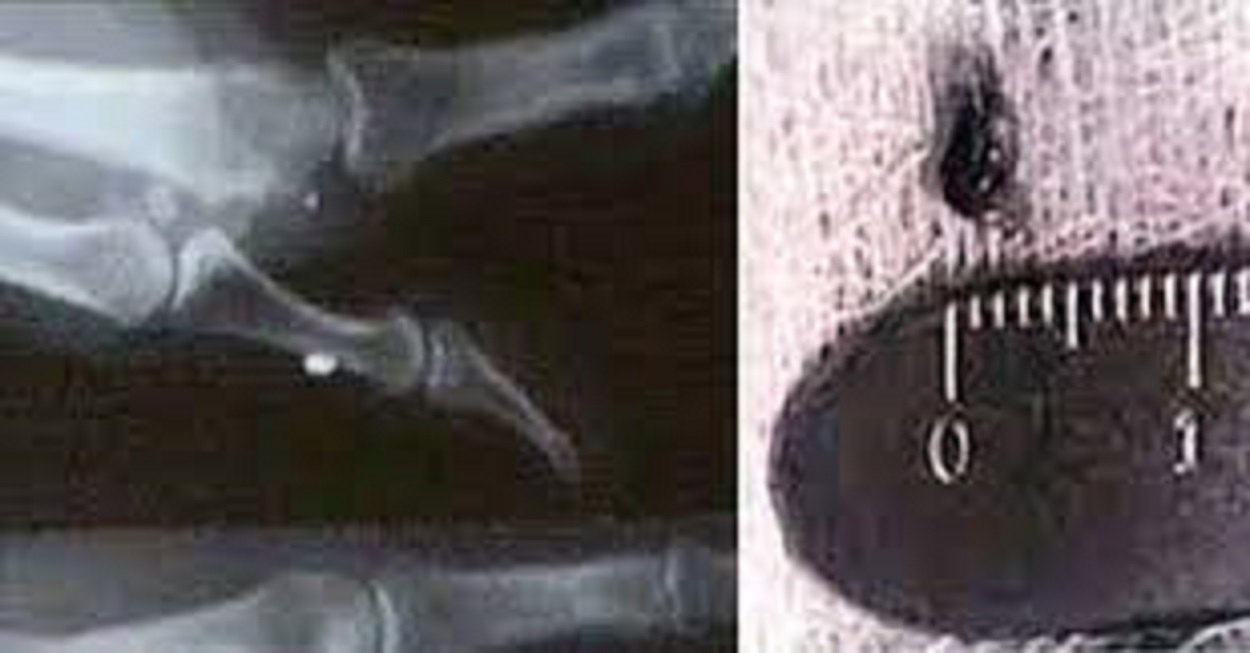
The physical thread opened in 1998. While working, Cullen smashed his thumb with a hammer and went to the Yuma Clinic, where Dr. Mark Hubner X-rayed the hand. The film showed a small dense foreign object lodged in the soft tissue, a bright triangular shape sitting above the bones of the wrist and hand. Cullen connected it to 1978 and started contacting UFO researchers. He reached Dr. Roger K. Leir, a California podiatric surgeon who by then was well known in UFO circles for surgically removing objects he called alien implants and writing them up in his book The Aliens and the Scalpel.
On 5 February 2000, in Thousand Oaks, California, a surgical team led by Leir and with Dr. John D. Matrisciano performing the procedure removed the object from Cullen's left forearm. The Learning Channel videotaped the surgery. The object was small, roughly 7 millimeters by 4 millimeters, shaped like a melon seed, wrapped in what Leir described as a reddish-brown membrane, with several fine receptor-like fibers running from one end into the surrounding tissue and a darker metallic core inside. Leir reported that when a magnet was brought to within half an inch, the object "literally leapt to the magnet." This was logged as the ninth implant removal in Leir's series, which is why Don Robertson's contemporaneous report carried the title "The 9th Alleged ET Implant Removal," dated 26 February 2000. Robertson's account is explicit that at the time of writing the removed object had not yet been sent anywhere for analysis: "An appropriate laboratory is being sought, as are funds for performing various tests." The strongest claims about exotic composition came later and were Leir's own interpretation of testing he commissioned, never a peer-reviewed finding from an independent body.
What did the witnesses think it was?
Tim Cullen never hid. He attached his real name, phone number and email to the story, spoke about it to his Catholic congregation and to his wife Janet's Presbyterian church, and appeared on Art Bell's Dreamland program alongside Leir and the program's host that season, the author Whitley Strieber. His stated reason was not money or fame. "I'm coming forward because someone has to put a face to the alien stories," he said, and "the truth needs to come out." He framed the membrane around the implant as something that might even have a medical upside, a coating the body did not reject, which he thought could matter for human implant medicine someday. He believed the 1978 wreck, the dream that preceded it, the silent craft and the object in his arm were all parts of one experience involving non-human visitors, and that his own memory of the abduction itself had been blocked.
The corroboration is uneven but real. Janet Cullen, a trained nurse, was beside him for the 30 May 1978 sighting and is the second adult witness to the craft. Ken Ruberg was the passenger and second witness for the 9 April 1978 accident, though that was a crash, not a sighting. The 1994 event added the three daughters as witnesses to lights in the sky. On the medical side, Dr. Mark Hubner is an independent local physician with no UFO stake who simply read an X-ray and found a foreign body, and the object's existence is not in question. It was filmed coming out of Cullen's arm. Leir's team, Whitley Strieber and the wider implant-research community treated Cullen as a credible, consistent witness who told the same story for years and welcomed scrutiny rather than dodging it.
The dispute
The dispute is not about whether Tim Cullen had an object in his arm. He did, and it was X-rayed by an independent physician and filmed during removal. The dispute is about what the object was and what it proves. The skeptical case, advanced most clearly by investigator Joe Nickell in his 1998 Skeptical Inquirer column "Alien Implants: The New Hard Evidence" and by Brian Dunning on Skeptoid, is that the alleged implants in Dr. Roger Leir's series, Cullen's included, are ordinary embedded foreign bodies. Nickell argued that such objects are mundane materials like slivers of glass, jagged metal and carbon fiber, that they cluster in hands, feet and shins because those are the body parts most likely to pick up debris from falls and minor trauma, and that the surrounding "membrane" is nothing more exotic than a foreign body granuloma, the fibrous scar tissue the body forms around any embedded fragment. Cullen's history fits this neatly: he was a cement contractor and he survived a violent five-roll car wreck in 1978, both excellent ways to drive a small fragment into a wrist.
Dunning pressed the physical specifics. He noted that across Leir's cases the dramatic-sounding properties did not hold up. The magnetic readings cited for these objects were a tiny fraction of the normal variation in Earth's own magnetic field, and the claim that the object "leapt to a magnet" rested on verbal reports rather than recorded measurement. On composition, he pointed out that a famous Leir specimen analyzed by Raman spectroscopy resolved to silica glass and human tissue, and that another reduced to common nickel-iron, and that proving extraterrestrial origin requires isotopic analysis, not the elemental-ratio comparisons Leir leaned on.
The decisive point for tiering is what the laboratories actually said versus what Leir said they said. No independent, peer-reviewed body ever confirmed an extraterrestrial origin for the Cullen object or any other in the series. Don Robertson's own February 2000 report states that at the time of removal the object had not yet been sent anywhere for testing. The later "anomalous isotope" and "extraterrestrial" language was Leir's interpretation of analyses he commissioned, and outside specialists who reviewed his broader work, including a UCLA meteorite expert quoted in VICE's reporting, concluded only that more testing was needed. Critics also flagged that Leir and his associate Derrel Sims were reluctant to hand specimens to independent forensic labs, which kept the strongest claims from ever being checked by neutral parties.
This is why the case is Barely Disputed rather than Strongly Disputed. The skeptical explanation is coherent and probably correct, but it is a general reconstruction of how such objects usually arise, not a demonstrated identification of the specific Cullen fragment as a known piece of debris from a known incident. There is no confession, no recovered hoax prop, and no positive match. An unproven mundane account on one side and an unproven exotic account on the other leave a real witness and a real object still partly unexplained, so the case stands, weakened but not closed.
Is the Cullen Abduction real? The two-pass assessment
Pass one, the entirely ordinary reading. A foreign object in the wrist of a working tradesman is not strange on its own. Cement and construction work, plus a violent five-roll car wreck in 1978 in which Cullen broke his neck, are exactly the kind of events that drive small slivers of metal or glass into the hands and arms, where they sit unnoticed for years. The body walls such fragments off in fibrous scar tissue, a routine process called a foreign body granuloma, which produces precisely the "membrane" Leir described. The skeptic Brian Dunning, on Skeptoid, laid out the medical reasoning and noted that Leir's objects across the series turned out to be mundane materials, with one famous specimen analyzed by Raman spectroscopy resolving to silica glass and human tissue, and another being commonplace nickel-iron. Dunning also deflated the magnet drama: the magnetic readings reported for these objects were a tiny fraction of the normal variation in Earth's own field, and the "leaps to a magnet" claim rested on verbal reports rather than measured data. Joe Nickell, in his 1998 Skeptical Inquirer column "Alien Implants: The New Hard Evidence," had already argued that alleged implants are ordinary embedded debris, and that they cluster in hands, feet and shins precisely because those are the body parts that pick up fragments from falls and barefoot steps. On the sky side, two diffused lights on a large silent shape low over a dark Colorado pasture at night, watched briefly from a moving car, is a description thin enough to fit aircraft, distant ground lights, or a misjudged ordinary object. The premonitory dream a week before a real crash is the sort of coincidence memory reshapes after the fact, especially after a head and neck trauma.
Pass two, if real. If the experience is what Cullen believed, then the 1978 craft was a structured, controlled, noiseless object that dropped below local power lines and hovered, and the object later cut from his arm was a deliberately placed device with a non-rejecting biological coating and a metallic core. That would make the X-ray and the filmed surgery rare physical evidence in an abduction case, the thing most such cases never have.
The case sits between those two readings, and the honest verdict turns on what the physical object actually is. Here the record is decisive in one narrow way and open in another. It is decisive that no independent, peer-reviewed laboratory ever confirmed an extraterrestrial origin for any Leir implant, including Cullen's. When VICE's Daniel Oberhaus reported on the broader Leir work, even the outside specialists who looked, including a UCLA meteorite expert, concluded only that more testing was needed, not that anything alien had been shown. The "extraterrestrial" framing was Leir's interpretation of tests he himself arranged. But it is also true that there is no confession, no recovered hoax prop, and no positive identification of the Cullen object as a specific known fragment from a specific known event. The skeptical reconstruction is strong and plausible, yet it remains a reconstruction rather than a proven match for this object. A real man really did have a real object in his arm, two adults reported a real craft, and the exotic claims on one side and the foreign-body claims on the other both outrun what was actually demonstrated. That combination, a credible witness and a genuine physical object set against a powerful but unproven mundane explanation and an equally unproven exotic one, is the textbook shape of a case that is disputed but still standing. Tier: Barely Disputed.
Sources
- www.lightnet.co.uk/the-9th-alleged-et-implant-removal-by-dr-roger-leir-team/
- skeptoid.com/episodes/519
- www.vice.com/en/article/roger-leir-alien-implant-ufo-abduction/
- skepticalinquirer.org/1998/09/alien-implants-the-new-hard-evidence/
- www.thinkaboutitdocs.com/cullen-abduction/
- www.ufoinsight.com/aliens/abductions/the-tim-cullen-alien-abduction-case
- believingthebizarre.com/alien-abduction-of-tim-cullen/
More cases from this region: UFO sightings in United States