The Fostoria Train Encounter
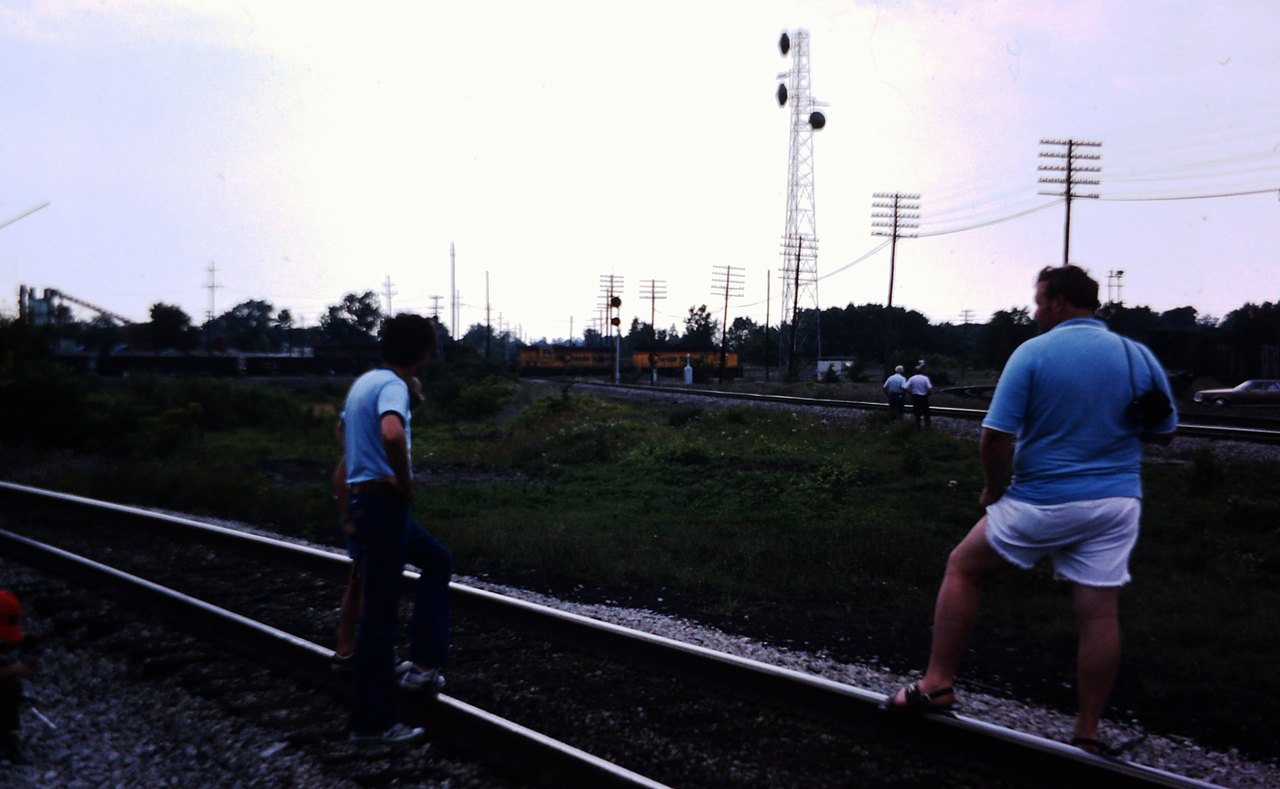
At roughly 3:20 in the morning on a night in late October 1977, a Chesapeake and Ohio (C&O) freight crew was working the spur that served the Fostoria Distribution Company warehouse, a private track running parallel to U.S. Route 23 a few miles outside Fostoria, Ohio. This case file covers what witnesses reported, the official narrative, and a two-pass assessment with its evidence tier.
What did witnesses see at Fostoria?
At roughly 3:20 in the morning on a night in late October 1977, a Chesapeake and Ohio (C&O) freight crew was working the spur that served the Fostoria Distribution Company warehouse, a private track running parallel to U.S. Route 23 a few miles outside Fostoria, Ohio. The engineer, identified in the report only by the pseudonym "Howard J. Albert," was sitting in the cab of a General Motors locomotive at the head of a string of empty boxcars, waiting while the train was spotted into the warehouse. Looking off to the west he first saw what he took to be a shooting star. Then the light curved down out of the northwest and kept coming, which a meteor does not do.
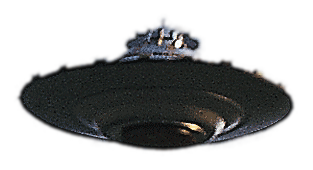
The object dropped toward the field beside the tracks and then crossed it slowly, at about the speed of a walking man. It came to a stop on the far side of the rails, roughly sixteen feet off the ground, between four and five boxcar lengths away, which Howard estimated at 180 to 270 feet. At that range he had a long, steady look. He described a disk or "birthday cake" shape, something like ninety feet across and forty-five feet high. The underside looked like ceramic, and he reached for a very specific comparison: it was "the color of a common kind of knife sharpening stone, gray with a trace of lavender." The body carried banks of nine bright vertical "tubes" separated by dark void spaces that reflected no light at all, with short horizontal tubes running across the top and bottom of those voids. The whole thing glowed yellow.
The disk was slightly tilted and rotating counter-clockwise. Around the rim, blue electric-like energy arcs ran in the opposite direction, clockwise. There was no sound. No windows, no ladders, no antennas, no markings of any kind. Howard and his conductor were railroad men used to timing things precisely, so they did the obvious thing: they pulled out their railroad stopwatches and clocked the rotation twice. Both times it came out to nine revolutions per minute.
Then Howard tested it. He flicked the locomotive's main headlight on for a two count and shut it off. The object responded, lighting up very bright for about the same length of time and then dimming back down. He repeated the signal and got the same answer again. As a control of sorts he increased the engine's electrical output to 1500 amps to see whether the locomotive itself was provoking a reaction. The object did not respond to that at all, only to the headlight. The encounter lasted about twenty-two minutes. At the end the disk began to spin faster and faster, then rose and accelerated up and away to the northwest until it shrank to a point that looked like a yellow star and was gone.
What is the official explanation?
There is no official government investigation of this case, and that absence is itself a documented fact rather than an oversight to hold against the witnesses. The United States Air Force closed Project Blue Book, its public UFO investigation program, in December 1969, eight years before this encounter. By late 1977 there was no federal office tasked with taking such a report, no Blue Book card to file, and no military intelligence channel that a civilian rail crew was expected to use. The crew also worked for a private railroad on a private spur in the middle of the night, with nothing to gain and a paycheck to protect, which is the ordinary reason working people in safety-sensitive jobs stayed quiet about sightings in that era.
The only investigative apparatus that ever touched this case is civilian. The account exists because Francis L. Ridge (1942 to 2026), a veteran investigator who served as Indiana State Director for MUFON and ran a NICAP investigation team in Indiana from the 1960s, collected it and archived it on the National Investigations Committee on Aerial Phenomena (NICAP) website. Ridge was the architect of the modern NICAP archive, which he launched online on 15 December 1997 and built into one of the largest organized chronologies of UFO reports anywhere, including all of the Project Blue Book "unknowns" from 1947 to 1969 and hundreds of pilot and radar cases. His report on the Fostoria encounter carries a submission timestamp of 29 July 2007 and preserves the witness names as pseudonyms ("Howard J. Albert," conductor "Donald," tower operator "Merv"), which is consistent with the engineer agreeing to share the story only on condition that he not be publicly identified.
What that means in plain terms is that the "official record" here is a single carefully archived civilian report and nothing else. There is no contemporaneous newspaper item from 1977, no police blotter entry, no FAA radar trace, and no military file, because the event was never reported when it happened. The case surfaced roughly thirty years after the fact when the engineer finally told it. So the documentary spine is thin by design: it rests on the testimony itself and on the credibility of the man who recorded it, not on any agency finding. No official body has ever endorsed the account, and none has ever debunked it, because none ever examined it.
What did the witnesses think it was?
The witnesses were a working freight crew, not enthusiasts looking for a UFO. Howard, the engineer, was the primary observer and had the clearest and longest look from the cab. His conductor, "Donald," was seven or eight car lengths down the track when it began; Howard called him forward on the radio, and Donald came up to the engine and watched alongside him. The two of them together timed the rotation with their stopwatches and agreed on nine revolutions per minute, which is the detail that most marks this as the report of railroaders rather than dreamers: faced with a hovering disk, their instinct was to measure it. A brakeman was working the warehouse end of the train, and a tower operator named "Merv" back in Fostoria followed the whole thing over the railroad's radio system. Merv's voice cutting in over the radio, "Hey, Howard, you got a UFO out there?", places at least four C&O employees inside the event, two as direct visual witnesses at close range and two more tracking it live on the company channel.
What the men believed comes through in how they behaved. They were close enough and curious enough that approaching the object was an option, and they chose not to. By their own account they felt the thing was not hostile, that there was even something almost friendly in the way it answered the headlight, yet they also felt strongly that they should keep their distance and not push it. Howard's headlight experiment shows a witness actively probing what he was looking at rather than fleeing or freezing. He treated the encounter as a real, present, responsive object and tried to communicate with it, got an answer twice, and noted carefully that running the engine up to 1500 amps drew no reaction at all. That selectivity, a response to light but not to electrical load, is the kind of specific, slightly inconvenient detail that witnesses inventing a story rarely bother to include.
The most telling thing about the witnesses is the thirty-year silence. Howard did not call a newspaper, did not contact a UFO group, and did not try to profit from the story. He sat on it for roughly three decades, which is the opposite of the behavior expected from a hoaxer and entirely consistent with a railroad professional who did not want to be the man who saw a flying saucer on the night shift. When he finally did talk, it was to a serious civilian archivist who kept his name out of it. The crew believed they had seen a real, structured, intelligently controlled craft at close range, and the way they conducted themselves during and after the event lines up with that belief rather than cutting against it.
Is the Fostoria Train Encounter real? The two-pass assessment
Pass one, the ordinary explanations. A light first taken for a shooting star is worth taking seriously, and a fireball or re-entering debris can genuinely look like a star that "curves." But a meteor or re-entry lasts seconds, never stops, never hovers sixteen feet off a field, and never holds station beside a train for twenty-two minutes, so the duration alone rules out anything ballistic. Aircraft and helicopters are the next candidates, and a low, slow-moving light at 3:20 AM deserves that scrutiny; yet the crew reported no engine noise and no rotor sound at a couple hundred feet, a steady disk that rotated at a measured nine rpm rather than a fuselage with running lights, and a vertical climb-and-vanish departure that no fixed-wing aircraft performs. A balloon drifts with the wind and cannot move "against a walking man" across a field and then accelerate away to the northwest. The blue arcing around the rim invites a plasma or electrical reading, and a railyard is full of high-voltage hardware, but the men explicitly tested that by running the locomotive to 1500 amps and got no reaction, which works against a stray electrical artifact tied to the train. That leaves hoax. The honest weakness of this case is that it is single-sourced testimony with pseudonymous witnesses, no photograph, no sketch, no physical trace, and a thirty-year gap before it was told, so a fabrication cannot be formally excluded. Nothing in the record, however, demonstrates one: no confession, no recovered props, no method shown, no contradiction surfaced, and the teller stayed anonymous and uncompensated.
Pass two, if it is real. Then what the Fostoria crew described is a structured, sound-suppressed, intelligently controlled craft that descended under power, held a deliberate close-range station, rotated at a constant and measurable rate, displayed an electrical-discharge effect around its rim, and engaged in a simple two-way light exchange before departing with an acceleration profile no conventional aircraft of 1977 could match. The selective response, answering a headlight twice but ignoring a large change in the locomotive's electrical draw, reads as discrimination between an intentional signal and ambient noise, which is exactly the kind of detail that pushes a sighting from "strange light" toward "apparent intelligence." Two professional observers measuring it with stopwatches gives the report an unusual internal discipline.
On the tier, this case has no official narrative for or against it, and it has never been investigated by any agency or subjected to a method-shown civilian debunk. There is no confession, no recovered prop, and no positive identification of a real-world object, so it does not belong in either disputed tier. It also is not authenticated by physical evidence, radar, or imagery, so it is not "Verified Unexplained." It stands exactly on its witnesses and a single carefully archived account, which is the definition of "Unknown." Tier: Unknown.
Sources
- www.nicap.org/reports/771021fostoria_reports.htm
- nicap.org/bios/detailed/Ridge_F_detailed%20_bio.htm
- www.ufoinsight.com/ufos/close-encounters/fostoria-incident
- www.thinkaboutitdocs.com/1977-fostoria-ohio-late-october-close-encounter-with-a-train/
More cases from this region: UFO sightings in United States