The Ellsworth AFB "Site L-9" Document (1977)
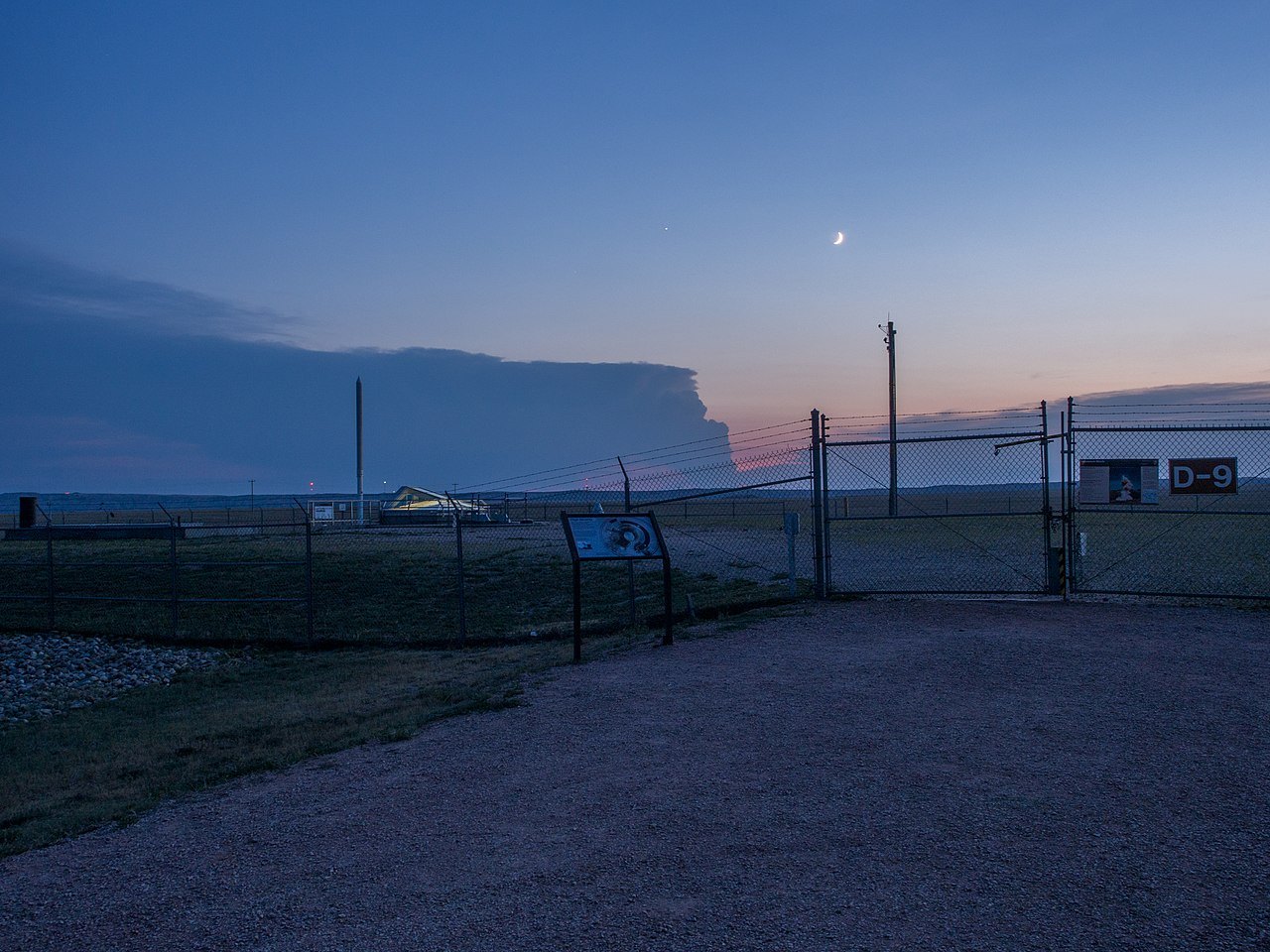
There were no witnesses to an actual event. This case file covers what witnesses reported, the official narrative, and a two-pass assessment with its evidence tier.
What did witnesses see at Site L-9 Minuteman missile field?
There were no witnesses to an actual event. What exists is a two-page typed document, presented as a United States Air Force Office of Special Investigations incident report, that narrates a close encounter at a Minuteman missile launch facility designated Site L-9, located in the missile field roughly seven miles southwest of Nisland, South Dakota, under the control of Ellsworth Air Force Base. The lead UFO archive that carried it spelled the base "Alsworth," a misspelling of Ellsworth, which is how the case acquired that alternate name.
The document reads as a security log. At 2059 hours on 16 November 1977, an airman named Phillips at Lt A Lims Security Control telephoned Wing Security Control to report an Outer Zone alarm activation at L-9. A Security Alert Team of two airmen, A1C Jenkins and A1C Raeke, was dispatched. At 2132 hours, on arrival, the document says they saw a bright light shining vertically upward from behind the fence line. Raeke went to investigate and reportedly encountered an individual in a glowing green metallic uniform wearing a helmet with a visor. The figure allegedly aimed an object that emitted a bright flash of light, which struck and disintegrated Raeke's M16 rifle and caused second and third degree burns to his hands.
The narrative continues that Jenkins, who had stayed with the vehicle, then saw two of these green-uniformed figures. He fired two rounds at them with his M16. The figures, according to the document, entered a saucer shaped object described as approximately twenty feet in diameter and twenty feet thick, emitting a glowing greenish light. The craft climbed vertically and disappeared to the east. At 2147 hours the situation was escalated to COVERED WAGON status, a real Strategic Air Command term for a major security incident, under a Facility Security Officer given as Capt Stokes, Larry D. A backup Security Force arrived at 2230 hours, and a Site Survey Team at 0120 hours reportedly logged radiation readings of 1.7 to 2.9 roentgens. The document closes by claiming nuclear components were found missing from a warhead, that Raeke was hospitalized for radiation burns, and that his rifle could not be located. A wing commander named Col Speaker is listed in the chain. Every dramatic detail in the case comes from this single sheet of paper and nowhere else.
What is the official explanation?
There is no genuine official narrative because there was no genuine incident to investigate. The document presents itself as the official record, but the United States Air Force has no matching report, and the named base, Ellsworth, has no record of an event of this kind at its missile sites in November 1977. The provenance trail is itself part of the story. The version that spread most widely was credited to a Mr Warren York, who supplied it to a group calling itself Vangard Sciences, with the claim that it had been obtained through the Freedom of Information Act. That FOIA claim has never been substantiated with a release stamp, a request number, or a responding agency, which is the first thing a real FOIA document carries.
The decisive official-adjacent finding came from inside the UFO research community rather than from the government. Bob Pratt, a former National Enquirer investigative reporter who edited the MUFON UFO Journal, investigated the case and published his findings in the January 1984 MUFON UFO Journal under the title The Truth About the Ellsworth Case, concluding it was a hoax. His exposure has been cited and summarized by Jerome Clark in The UFO Encyclopedia and reproduced in researcher dossiers. The substance of the technical critique was laid out by named analysts. Tom Deuley, a former atomic weapons specialist and communications officer, concluded the message was fabricated because the personnel listed were not actually at the base, because the ranks, names and people were, in his words, messed up, and because the calm tone was wrong for a report describing missing nuclear warhead components. He said it read like a news report, not a nuclear incident report, and noted that Strategic Air Command officials treated it as a joke.
Brad Sparks identified concrete technical impossibilities. He pointed out that the precise radiation figures given, 1.7 to 2.9 roentgens, would not register the way the document describes on the actual survey meters used, and that a real reading would be specified as a rate, rads or roentgens per hour, not as a bare total dose. The document also carries glaring internal errors that no Air Force typist would produce in a classified missile-security report: the word Missile is written throughout with the letter i missing, the word Strategic appears as both Stratagic and Stratigic, and Launch is rendered as Lanch. These are the fingerprints of someone imitating military paperwork from the outside. Taken together, the people who actually examined the paper, Pratt, Deuley and Sparks, treated it as a fabrication, and the genuine official apparatus simply has nothing on file because nothing happened.
What did the witnesses think it was?
Because there was no real event, the relevant question is who created and believed the document, not who saw a craft. The names on the page, Phillips, Lims, Jenkins, Raeke, Stokes and Speaker, function as characters in a fabricated narrative rather than as locatable witnesses who later told their stories. Investigators who checked could not place the key airmen at the base, which is part of why the report collapsed. No airman ever came forward to say he had been burned by a green-suited figure, lost his rifle to a disintegration beam, or watched beings board a saucer at a Minuteman silo. For a claimed nuclear-security incident with hospitalizations and missing warhead components, that silence is total and damning.
The believers and promoters are the traceable human element. The document was pushed into circulation through Warren York and Vangard Sciences with the FOIA cover story, and from there it traveled the late 1970s and early 1980s researcher network. The most consequential thread runs to Richard C. Doty, a special agent with the Air Force Office of Special Investigations who has publicly described being tasked with hoaxing documents and feeding false information to UFO researchers, most infamously in the campaign that targeted Albuquerque businessman Paul Bennewitz near Kirtland Air Force Base. Doty was stationed at Ellsworth in the relevant period. According to physicist and researcher Bruce Maccabee, Bill Moore acknowledged that Doty confessed to forging the document describing the Ellsworth events. Brad Sparks likewise recorded that the report was strongly suspected to be a Doty fabrication.
What the original promoters believed is harder to pin down than what the forger intended. Some who passed the paper along clearly took it as a genuine leaked report and argued the green-uniformed figures and the disintegrated rifle were evidence of a hostile non-human intrusion at a nuclear site. Others, once Pratt and the technical analysts had spoken, accepted that they had been handed a manufactured story. A separate strand of belief, voiced by a former Strategic Air Command intelligence officer, holds that the 1977 tale was deliberately built on top of a real but mundane missile-site mishap in the early 1970s to muddy the waters. That theory is itself unverified and only underscores the point: the human testimony attached to this case is testimony about a piece of paper, not about a craft.
The dispute
The dispute is not a competing interpretation of an event; it is a demonstration that the event itself was invented. The counter-explanation is that the Ellsworth Site L-9 incident is a hoax document with no underlying occurrence, and it was advanced by people who examined the actual paper. Bob Pratt, a professional investigative reporter and editor of the MUFON UFO Journal, investigated the case and published The Truth About the Ellsworth Case in the January 1984 MUFON UFO Journal, concluding it was a fabrication. His finding is recorded and summarized by Jerome Clark in The UFO Encyclopedia and reproduced in NICAP's case file, which is explicitly titled as a hoax.
The method behind the verdict is specific and technical, not a hand-wave. Tom Deuley, a former atomic weapons specialist and communications officer, found that the personnel named in the report were not actually stationed at the base, that the ranks and names were jumbled, and that the calm, news-report tone was inconsistent with a genuine report of missing nuclear warhead components; he noted Strategic Air Command officials treated the document as a joke. Brad Sparks identified that the radiation readings of 1.7 to 2.9 roentgens were stated in a way that would not register on the actual meters and should have been given as a dose rate rather than a total. The document itself carries telltale errors: Missile is consistently written without the letter i, Strategic appears as Stratagic and Stratigic, and Launch appears as Lanch, errors that an Air Force unit would not commit in a classified missile-security report.
The identification of the fabricator is what pushes this case past the usual official-assertion threshold and into the strongly disputed tier. According to physicist Bruce Maccabee, Bill Moore acknowledged that Richard Doty confessed to forging the document. Doty was an Air Force Office of Special Investigations special agent who has separately and publicly admitted to being tasked with creating hoaxed documents and feeding disinformation to UFO researchers, most notoriously in the Paul Bennewitz affair. Brad Sparks independently recorded that the report was strongly suspected to be a Doty fabrication, and Doty was stationed at Ellsworth in the relevant window. This is a named forger, a confession relayed through a named intermediary, internal document errors, and converging technical analysis from multiple independent researchers.
The case does not fully close only in the narrow sense that Doty's confession reaches the public through Moore and Maccabee rather than as a signed first-person statement, and because a minority view holds that a real but ordinary missile mishap was later dressed up as this story. Neither caveat rescues the document. No independent witness, instrument record, medical file, or authentic FOIA release has ever surfaced to support a real L-9 encounter, while the affirmative evidence of fabrication is concrete and shown. On the weight of that shown method, the case is treated as Strongly Disputed and proposed for discredit review.
Is the Ellsworth AFB "Site L-9" Document (1977) real? The two-pass assessment
Pass one, the entirely ordinary reading. This is the strongest available explanation, and it is not merely plausible, it is documented. The Ellsworth Site L-9 case is a hoax built around a typed document, not a sighting. There is no photograph of a craft, no recovered rifle, no hospital record, no FOIA stamp, no airman, and no Air Force file. The story exists only on two pages whose own text betrays it: Missile spelled without its i, Strategic written as both Stratagic and Stratigic, Launch written as Lanch. A real classified missile-security report does not misspell missile and launch. Named investigators showed the method. Bob Pratt published a full debunking in the January 1984 MUFON UFO Journal. Tom Deuley, an atomic weapons specialist, found the listed personnel were not at the base and the tone was wrong for a nuclear incident. Brad Sparks showed the radiation figures were physically wrong for the instruments and should have been stated as a rate. Most decisively, Bruce Maccabee reported that Bill Moore acknowledged Richard Doty, an Air Force Office of Special Investigations agent who has admitted to a career of hoaxing UFO documents, confessed to forging this one. That is a named forger, a confession relayed by a named intermediary, a positive identification of the fabrication mechanism, and independent technical analysis, all converging.
Pass two, the if-real reading, kept separate. If one set the debunking aside and took the document at face value, the claim would be extraordinary: armed non-human entities in glowing green metallic suits breaching a United States nuclear missile facility, disintegrating an M16 with a directed-energy weapon, irradiating an airman, and removing warhead components before departing in a twenty-foot saucer. There is a real and serious history of UFO activity reported over Strategic Air Command nuclear sites in this era, which is why a forger chose this setting and used genuine vocabulary like COVERED WAGON to lend the fake authority. But authenticity of the backdrop does not transfer to the document. No corroboration of the L-9 event has ever surfaced from any independent witness, instrument log, medical record, or official channel in nearly five decades.
This case is the rare one where the discrediting evidence is method-shown rather than asserted. It is not a contested psychological argument or an unproven natural-explanation reconstruction; it is a fabricated artifact with internal errors, an identified probable forger with a confession history, and named analysts who demonstrated the fraud. For that reason it sits at Strongly Disputed and is flagged for discredit review. The genuine 1953 Ellsworth radar-visual case investigated by Edward Ruppelt is a completely separate and credible event and must not be confused with this 1977 paper.
Sources
- nicap.org/h771116.htm
- www.thinkaboutitdocs.com/1977-ufo-incident-at-usaf-missile-base/
- www.classicalmidi.co.uk/ufo/ufo6.htm
- www.ufohastings.com/articles/the-mj-12-affair-facts-questions-comments
- worldwideufoandreports.blogspot.com/2014/09/ellsworth-air-force-base-sd-ufo.html
More cases from this region: UFO sightings in United States