The Fort Dix-McGuire Alien Encounter
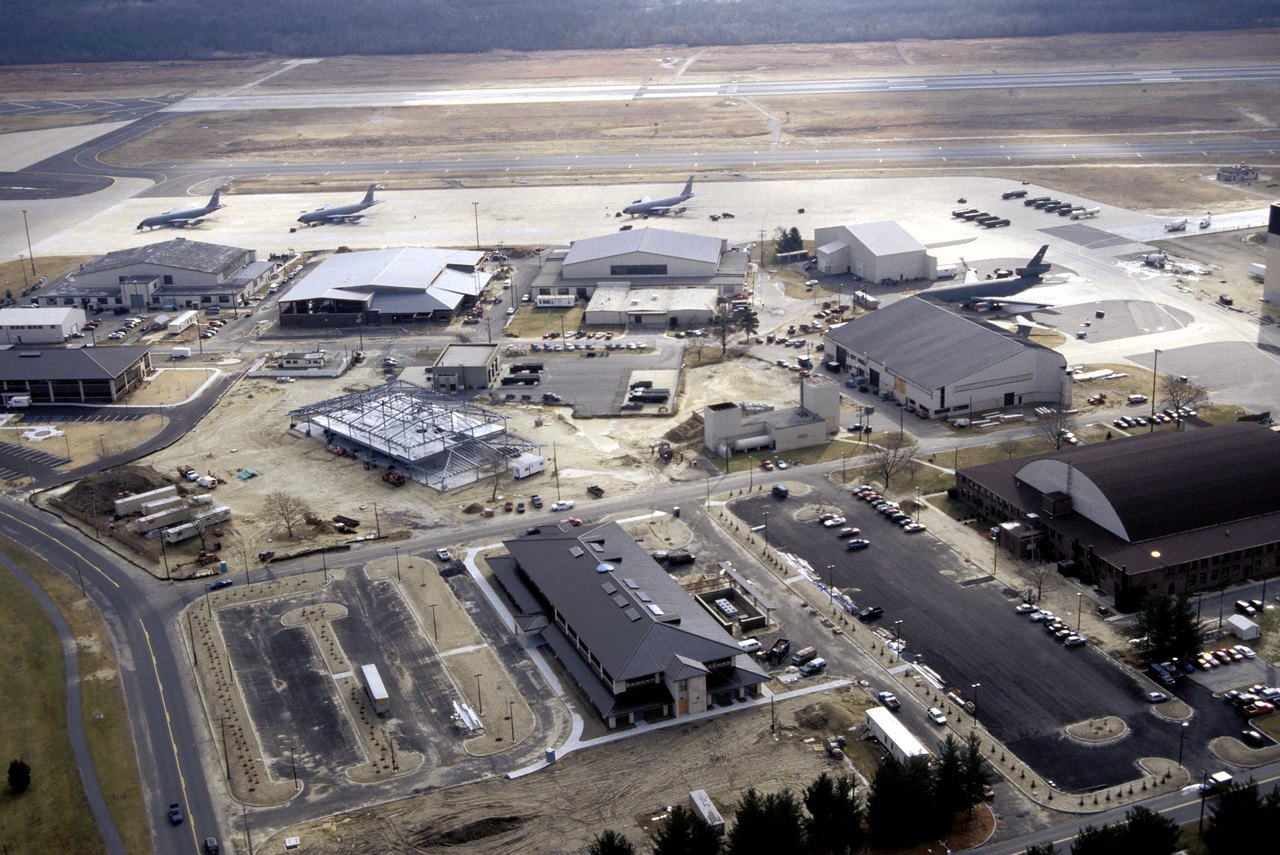
In the pre-dawn hours of 18 January 1978, somewhere between roughly 3 a.m. and 5 a.m., a string of low UFO sightings was reported over the adjoining military reservations of Fort Dix (Army) and McGuire Air Force Base (Air Force) in Burlington County, New Jersey. This case file covers what witnesses reported, the official narrative, and a two-pass assessment with its evidence tier.
What did witnesses see at Fort Dix and McGuire Air Force Base?
In the pre-dawn hours of 18 January 1978, somewhere between roughly 3 a.m. and 5 a.m., a string of low UFO sightings was reported over the adjoining military reservations of Fort Dix (Army) and McGuire Air Force Base (Air Force) in Burlington County, New Jersey. The core of the account comes from an Air Force security policeman who corresponded with crash-retrieval researcher Leonard H. Stringfield under the protective pseudonym "Jeffrey Morse." In his first letter, posted via an APO San Francisco address (he was by then stationed overseas), Morse wrote that he was a young security policeman with the 438th security apparatus at McGuire when the call came in about activity over Fort Dix next door.
By Morse's telling, a Fort Dix military policeman was pursuing a low, hovering object when a small entity appeared in front of his patrol vehicle. The MP panicked and, in Morse's words, fired "five rounds from his .45 cal. into the thing, and one round into the object above." The wounded creature fled, cleared the high perimeter fence between the two bases, ran out onto a disused runway at McGuire and collapsed dead. Morse said he and a fellow patrolman were among those who reached the body. He described it from a distance of roughly forty to seventy feet, lit by truck headlights, as about four feet tall, "grayish, brown, fat head, long arms, and slender body," hairless and unclothed, the skin looking "wet, shiny, and snake-like." A strong stench of ammonia hung in the cold air around the corpse.
Morse and his partner did what security police do at a scene: they roped it off. Then, he said, the situation was taken out of their hands. Armed men in unmarked fatigues and blue berets, faces he did not recognize, moved in and sealed the area. He watched them spray something over the body, place it in a wooden crate, spray it again and load it into a larger silver metal container. According to Morse, the object that had been hovering "fled straight up and joined with eleven others high in the sky." Around 7 a.m. a C-141 transport aircraft, he was told, flew the container out to Wright-Patterson Air Force Base in Ohio, the same base long rumored in UFO lore to warehouse recovered material. Morse said that two days later he was himself summoned, interrogated by men who warned him to stay quiet, and not long after was reassigned overseas.
What is the official explanation?
There is no acknowledging official record of a dead non-human being shot at Fort Dix, and the institutions involved have denied it flatly. When researchers pressed for documentation, an Air Force Freedom of Information Act manager replied in a letter dated 1 February 1985 that no records matching the incident details could be located for release, and the Fort Dix administrative office, on the same date, stated it had "no record of such an incident." Decades later, in the 2010s, McGuire's civilian base historian told reporters the event was "complete fiction," that the Air Force could not locate any "Jeff Morse," and that the leaked incident report contained inaccuracies in the base chain of command and even in the ZIP code.
The single most important official-looking artifact in the case is the document Morse mailed to Stringfield by certified post on 23 December 1983: a xeroxed military Incident/Complaint Report, DD Form 1569. As described in Stringfield's MUFON Symposium writeup, the form was logged by a desk sergeant, signed off by a first lieutenant, and routed up to Colonel Landon at McGuire, to a brigadier general at 21st Air Force headquarters, and to the Air Force Office of Special Investigations. Item 11 of the form was checked "Unfounded," which Morse explained reflected only the limited information his squadron was permitted; Item 13 referred the case to "Other agency" with the chilling notation that "one body of unknown origin" had been "released to other authorities." Morse blacked out the real names and social security numbers of the personnel before sending it.
It is precisely the document, not the testimony, that gives skeptics their strongest official-side handle, and that ambiguity cuts both ways. A genuine 1978 DD 1569 logging a body of unknown origin and an AFOSI referral would be extraordinary corroboration. A doctored or mistaken form, with a wrong ZIP or a garbled chain of command, would suggest fabrication. The Air Force has only ever asserted the latter. It never published a side-by-side forensic teardown of the form, never produced the authentic 1978 paperwork it says should exist, and never explained the runway activity that multiple base personnel, by several accounts, privately acknowledged. Two other McGuire servicemen reportedly confirmed to investigators that "something strange had gone on" that night while insisting they had not been involved. NICAP, the National Investigations Committee on Aerial Phenomena, looked at Morse and judged him a credible witness.
What did the witnesses think it was?
Morse stood by his account for years and at real personal cost. The investigation that grew up around him was led by two of the most careful figures in the field. Leonard H. Stringfield, the crash-retrieval specialist, opened the file when Morse's first letter reached him on 16 September 1980, and it ran on through dozens of letters and calls, mail that mysteriously failed to arrive, threats Morse said he received, and an interrogation he claimed recurred as late as February 1983. Stringfield brought in Richard "Dick" Hall, a NICAP stalwart with a reputation for sobriety. Hall met Morse face to face at a Washington, D.C. shopping mall on 13 January 1985 and wrote that he found him "well-groomed, friendly, relaxed, calm, articulate," with no obvious psychological tells, speaking confidently and without contradiction, showing a "healthy disdain for authorities" but no obsession with his own story. Hall confirmed in the 1979 Air Force Register that several of the named Wright-Patterson officers genuinely existed, though he could not extract assignment records that would prove they were where and when Morse said.
Morse offered tests of his own good faith. Shown fifteen names of prominent UFO researchers, he recognized none of them, which argued against the theory that he was a planted disinformation agent. Shown a photograph of Dr. J. Allen Hynek, after a silent bearded civilian had figured in his interrogation, Morse declined to make the easy identification: "Some similarities, but my man was about 50 and his beard was flat, not a goatee. Don't think it was Hynek." He reported government cars parked outside his home, a black-suited visitor on 31 December 1984 who offered help in exchange for denying the incident, and a Justice Department attorney's remark that his "acquaintance with Mr. Stringfield didn't help" his job prospects.
The most striking corroboration came decades later from a man who used his real name and rank. Major George A. Filer III, an Air Force intelligence officer at McGuire in 1978 whose duties included briefing the commanding general, went public and later published his account in the 2015 book "Strange Craft: The True Story of an Air Force Intelligence Officer's Life with UFOs," written with investigative reporter John Guerra. Filer said that the morning after, a sergeant told him plainly, "An alien was shot and is dead on the runway," and clarified the being was "from outer space," not a human deserter. Filer said the base security police "went out there and found him at the end of the runway dead," that a C-141 came in from Wright-Patterson and carried the body away, and that after he reported it up to General Sadler he was told to stand down and never briefed it again. He has said he would testify before Congress about what he learned firsthand.
The dispute
The dispute is whether the entire incident is a fabrication built on one unverifiable narrator. The central weakness, stated plainly by investigator Kevin Randle, is that "Jeffrey Morse" is a pseudonym, so his credentials, service record and even his presence at McGuire on 18 January 1978 cannot be independently confirmed, and the people who supposedly witnessed the actual shooting, the Fort Dix military policeman and a New Jersey state trooper, were never named or interviewed in over forty years. The New Jersey State Police would not cooperate. Jerome Clark's UFO Encyclopedia concluded that, absent substantiating evidence, the case is most safely read as an elaborate fabrication.
The most rigorous independent skeptical work was done by a researcher posting as NorCal Dave on the Metabunk forum, who compared Morse's original 1980 letter to Stringfield against the later versions published by Richard Hall and Stringfield. He documented the story growing more elaborate and more mythic with each retelling, the recovery unit shifting from a clear "AF OSI" in the first account to unrecognizable unmarked "blue beret" forces in later ones. He pressed the internal logic too: an unmarked, classified recovery team appearing within twenty to thirty minutes for an event no one could have anticipated, yet allowing rank-and-file security police and a state trooper to reach the body first, and no plausible route by which the Wright-Patterson transport detail would have leaked to multiple witnesses. One participant proposed an entirely earthly stand-in, an intruder in a thick padded anti-razor-wire suit climbing the perimeter fence, who at distance and in darkness could read as a lumpy four-foot figure. Skeptics add that there was no documented UFO flap over central New Jersey that January to corroborate the wider sighting wave.
Why it does not close the case. The skeptical case is strong on doubt but thin on proof. No analyst has shown the method by which the DD Form 1569 was forged: nobody has placed it against an authentic 1978 McGuire incident log and demonstrated fabrication, and nobody has positively identified the specific real-world object, intruder, animal or aircraft that the body "actually" was. The narrative-drift argument indicts the retellings, not a confession, and Morse never recanted. The official rebuttal, that the event is "complete fiction" with "inaccuracies" in the chain of command and ZIP code, is an assertion that the Air Force never backed with a published side-by-side analysis, and it sits awkwardly beside the on-the-record corroboration of Major George Filer III, a named intelligence officer who places a dead non-human on the same runway and a Wright-Patterson C-141 carrying it away. A contested credibility argument and an unproven mundane reconstruction keep this in the barely-disputed band rather than pushing it toward discredited.
Is the Fort Dix-McGuire Alien Encounter real? The two-pass assessment
Pass one, the ordinary readings. The whole edifice rests on a single anonymous narrator. Investigator Kevin Randle, no debunker, states the obvious limitation: a witness identified only by a pseudonym cannot be vetted, and the actual shooting was witnessed by a Fort Dix MP and a New Jersey state trooper who, across more than forty years, were never named, located or interviewed. The New Jersey State Police declined to cooperate. On Metabunk, the skeptic posting as NorCal Dave did the most disciplined work, laying Morse's original 1980 letter beside Hall's and Stringfield's later retellings and showing the story drifting and gaining mythic detail with each version, the recovery force morphing from "AF OSI" into vague unrecognizable "blue beret" troops. NorCal Dave also pressed a logical strain: an unmarked classified recovery team somehow arriving within twenty to thirty minutes for an event nobody could have known about in advance, yet letting ordinary security police and a state trooper near the body first. A commenter floated a wholly mundane stand-in, a fence-climbing intruder in a bulky padded suit looking "Michelin man" lumpy at distance and in the dark. Skeptics also note the absence of any documented January 1978 UFO flap over central New Jersey to set the scene. Jerome Clark's UFO Encyclopedia, weighing it all, concluded that with no substantiating evidence it was safest to treat the case as an elaborate fabrication.
Pass two, if real, what is it. Then this is a humanoid casualty and a same-night body recovery, the very scenario Stringfield spent a career documenting, and the DD Form 1569 with its "one body of unknown origin" and AFOSI referral is the single most concrete piece of paper any of his cases ever produced. The corroboration of Major George Filer III matters here precisely because he is not anonymous: a named intelligence officer, on the base, who says a sergeant told him an alien lay dead on the runway and that a Wright-Patterson C-141 carried it off. Other McGuire personnel privately conceded "something strange" happened. The harassment Morse described, the surveillance, the career obstruction, fits the pattern of a real classified event being papered over rather than a lone fantasist being ignored.
The weighing. Crucially, the dispute is genuine but unfinished. No analyst has produced method-shown proof of forgery: nobody has matched the 1569 against an authentic 1978 McGuire log and demonstrated it was faked, nobody has identified the specific intruder, drone, drill or animal that "really" lay on the runway, and the official position is assertion ("complete fiction," "inaccuracies") without a published forensic method. The narrative-drift critique is real but it is a critique of retelling, not a confession or a recovered hoax prop, and the strongest hostile read, that it is all one man's invention, has to explain away a credentialed second witness who used his own name. That keeps this short of strongly disputed. It is a contested case that still stands on a single primary witness, a credentialed corroborator and a disputed document, against official denial and well-aimed but unproven skepticism. Tier: Barely Disputed.
Sources
- www.nicap.org/reports/fortdixSYM.htm
- kevinrandle.blogspot.com/2020/12/jeffrey-morse-len-stringfield-richard.html
- archive.org/details/stringfield-ufo-crash-retrievals-status-report-ii-1-fsr-82-v-28-n-2
- www.metabunk.org/threads/alien-shot-dead-in-1978-at-fort-dix-mcguire-afb.12116/
- nationalufocenter.com/2013/09/alien-being-shot-dead-by-mps-january-18-1978-ft-dix-mcguire/
- brobible.com/culture/article/retired-major-alien-killed-mcguire-air-force-base/
- weirdnj.com/stories/unexplained-phenomena/the-mcguire-air-force-base-alien-encounter-1978/
More cases from this region: UFO sightings in United States