The Daytona Beach Police FLIR Footage
On 1 March 1991 a helicopter crew from the Volusia County Sheriff's Office, working the airspace near Daytona Beach, Florida, recorded roughly 33 seconds of an object on a forward-looking infrared (FLIR) camera. This case file covers what witnesses reported, the official narrative, and a two-pass assessment with its evidence tier.
What did witnesses see at Near Daytona Beach?
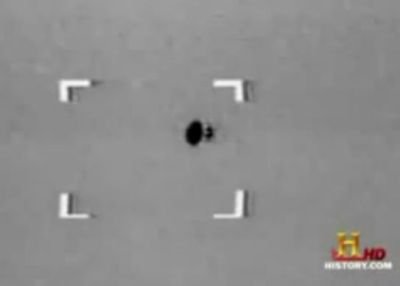
On 1 March 1991 a helicopter crew from the Volusia County Sheriff's Office, working the airspace near Daytona Beach, Florida, recorded roughly 33 seconds of an object on a forward-looking infrared (FLIR) camera. The two men named in connection with the tape are Mark Patterson, who handled the sensor, and Jim DelaRosa. The defining detail of the report is that the object was not visible to the naked eye. The crew did not set out to film it. The FLIR was looking out ahead of the aircraft and picked up a heat source the men could not see when they looked through the canopy.
On the thermal image the object reads as a barbell or dumbbell: two distinct bright (hot) lobes joined by a darker, cooler central band. In the language used during the later on-camera review, "it possibly has two different heat sources," with "a white band" in the middle indicating "a colder area," so either two separate hot bodies bridged by something cold, or "one heat source with some cold insulator" between two ends. Part of the object appears to rotate. The crew read this as a craft with a spinning section.
Patterson radioed local air traffic control during or just after the event and was told nothing unusual was showing on radar at that time. That combination, a clear thermal target on the FLIR, no corresponding radar return, and nothing the crew could see with their own eyes, is what made the men treat the footage as anomalous rather than as routine traffic. Both crew members came away believing the object may have been pacing or tracking their helicopter rather than simply drifting through the frame. The footage is short and the object never resolves into wings, a tail, a fuselage, or any other feature that would mark it as a known aircraft type. It stays a two-lobed glowing form for the length of the clip.
What is the official explanation?
There is no government UFO file on this event. No Project Blue Book entry exists, because Blue Book closed in 1969, more than two decades before the footage was shot. There is no published FAA or sheriff's-office investigative report in circulation, and the radar check amounts to a single verbal "nothing unusual" relayed to the crew at the time. In that sense the case has no official narrative in the way that a Blue Book case or a Navy-released video does.
What stands in place of an official inquiry is a televised civilian investigation. The footage entered public view through the History Channel series "UFO Hunters," in the first-season episode "Cops vs. UFOs," which aired on 5 March 2008. The on-air team that handled it was the publisher and lead investigator Bill Birnes, the field researcher Pat Uskert, and the show's technical analyst Ted Acworth, an engineer trained at the Massachusetts Institute of Technology who had worked on NASA space-telescope optical calibration and was himself a private pilot. The team visited Patterson and DelaRosa separately, reviewed the tape, and brought in an outside specialist to read the thermal data.
That specialist was Dr. Bruce Maccabee, a US Navy optical physicist. Maccabee spent about thirty-six years at the Naval Ordnance Laboratory and its successor the Naval Surface Warfare Center, Dahlgren Division, working on optical data processing and on laser and sensor systems for ballistic missile defense, and he served for decades as the Maryland state director of the Mutual UFO Network. On camera he examined the heat signature and the apparent rotation and delivered the line the episode hangs on: "All I can say is it's not a helicopter." His reasoning was instrument-based. In his account a helicopter viewed in infrared shows a concentrated hot spot at the engine and turbine, with the rotor head reading hot and the blades producing a flashing or strobing pattern as they sweep. He argued the recorded object did not present that signature, and that the way one section appeared to rotate did not match a rotor disc. The program's framing, echoed in the contemporaneous write-up of the segment, is that the experts who looked at the tape "ruled out the possibility that the object was a helicopter, or other conventional aircraft." That is the closest thing this case has to an authoritative finding, and it came not from a government body but from a single credentialed analyst on a cable documentary.
What did the witnesses think it was?
Patterson and DelaRosa are the only direct witnesses, and what is notable about their testimony is how restrained it is. They do not claim to have seen a structured craft. Patterson's own filmed statement is careful: "In my opinion, it was not a helicopter. I couldn't identify what it was." DelaRosa is described as certain the object was not a helicopter while equally clear that nothing on the tape identifies it as any known aircraft. Neither man asserts an extraterrestrial origin. Their position is the narrow, defensible one, that they recorded a heat source they could not see and could not name, that radar showed nothing, and that the object seemed to hold station relative to their aircraft.
The corroboration in this case is thin by design, because the whole point of the report is that the object was invisible to the eye. There were no ground witnesses describing a craft, no second aircraft, no photographs in visible light. The supporting weight comes instead from the instrument and from the people vouching for it: two law-enforcement crew members trained to operate the FLIR, the absence of a matching radar track, and, layered on top years later, the on-air endorsement of an optical physicist who concluded it was not a helicopter. The program also leaned on the credibility of the witnesses as "society's most credible witnesses," police officers operating professional equipment, which is precisely the framing a skeptic would push back on.
The dispute
The dispute is whether the barbell-shaped thermal target the Daytona Beach police helicopter crew recorded on FLIR was a real unidentified heat source or simply a distant, ordinary helicopter rendered into false structure by the imager itself. The prosaic counter-explanation, raised on the record during the History Channel UFO Hunters (2008) investigation, holds that a far-off helicopter viewed through a FLIR running with excessive gain produces blooming artifacts that can split a single source into the two bright lobes joined by a cooler band that the crew saw. A supporting skeptical point is that thermal optics do not work like a tape measure: an object staying apparently in focus at extreme range is a property of the lens, not proof of a solid craft, and the object's absence from radar is consistent with a small or distant helicopter that simply did not paint a return.
The weakness is that no one named advanced this explanation as a finding and no one ever demonstrated it. The page documents the prosaic fit being floated by an unnamed specialist inside the UFO Hunters investigation who "could not rule it in with certainty but flagged it as the prosaic fit," and by generic "skeptical reviewers," but it identifies no individual, no replication of the blooming effect, and no measurement tying the image to a specific aircraft. By this archive's method that is a claim, not a verdict: a real counter-explanation exists and was raised on the record, but nobody has demonstrated it.
Cutting the other way, the most qualified person to read the image rejected the prosaic reading. Dr. Bruce Maccabee, a Navy optical physicist, examined the thermal data and rejected the helicopter hypothesis on infrared-signature grounds, noting the absence of the hot rotor head and flashing blades a helicopter would show, and concluded only "All I can say is it's not a helicopter." The two FLIR-watching crewmen, operator Mark Patterson and Jim DelaRosa, independently said it was not a helicopter and could not identify it, while claiming no extraterrestrial origin. There is no government file, no FAA or sheriff's report, and no conclusive official ruling either way.
The dispute therefore does not close the case. The ordinary explanation is plausible and was articulated, but it rests on an undemonstrated artifact argument that the best-qualified analyst examined and rejected, leaving the page's own assessment well short of a method-shown discredit. The case stands as genuinely contested rather than resolved.
Is the Daytona Beach Police FLIR Footage real? The two-pass assessment
Pass one, the entirely ordinary reading. A FLIR is a heat camera, and its automatic gain and level control will stretch contrast around the hottest thing in the scene, which can turn a small, distant, defocused hot source into a bloomed, two-lobed blob that looks structured when it is not. The most economical candidate is another aircraft, most likely a helicopter, seen at a distance and slightly out of focus, with the camera's gain pushed high. That single suggestion, that the object was probably a helicopter with the gain set too high, was actually voiced inside the investigation, by a specialist who could not rule it in with certainty but flagged it as the prosaic fit. Skeptical reviewers add a sharper point about the "it was always in focus, even at ten to fifteen miles" claim used to argue the object was real: thermal optics do not work like a tape measure, and an object staying "in focus" at extreme range is a property of the lens, not proof of a solid craft, so a far-off heat source, even something as mundane as a fire or a barbecue on the horizon, can read as a crisp anomaly. The lack of a radar return is consistent with this too, because a small, low, or distant target is exactly what a radar set is liable to miss while a sensitive infrared camera still catches the heat. None of this is method-shown to closure. No analyst has taken a known helicopter, set a FLIR to high gain at the right range, and reproduced this specific barbell with its rotating section. The ordinary explanation is plausible and unrebutted, but it is asserted, not demonstrated.
Pass two, if the recording shows what the crew believed, then it is a heat-emitting object with two thermal lobes and an apparently rotating section, holding position near a police helicopter, invisible to the eye and absent from radar. The strongest card for that reading is Bruce Maccabee, an instrument-credentialed optical physicist who looked at the actual thermal data and said it did not match a helicopter's infrared signature, no hot rotor head, no flashing blades, and a rotation that did not behave like a rotor disc. His verdict is not a government cover-story and does not count against the case; it is independent civilian analysis pointing toward "unknown."
The two passes do not resolve. A credentialed analyst on one side says it is not a helicopter; a competing voice, including inside the very program that investigated it, says a distant helicopter with mis-set gain is the likely answer, and skeptics show the focus-at-distance argument rests on a misunderstanding of thermal optics. A real counter-explanation exists and was raised on the record, but nobody has demonstrated it, and the most qualified person to read the image rejected it. That is the definition of a contested case rather than a closed one, and it is well short of method-shown discredit. Tier: Disputed.
Sources
- www.youtube.com/watch?v=9H9GShmlGko
- www.imdb.com/title/tt1192544/
- www.imdb.com/title/tt1176951/episodes/
- thetvdb.com/series/ufo-hunters/allseasons/official
- www.legacy.com/obituaries/name/bruce-maccabee-obituary?pid=206941092
- forteanwinds.com/2026/05/11/the-profile-near-missing/
- web.archive.org/web/20251118221328/https://artaic.com/news_stories/extra-entrepreneurial-activity-ted-acworth/
- www.extraordinarybeliefs.com/news-3/ufos-flir-analysis
More cases from this region: UFO sightings in United States