The F-86 Triangle Over Albany, Georgia (1953)
On the evening of 28 January 1953 an unnamed United States Air Force pilot was flying an F-86 Sabre on a "round-robin" navigation flight from Moody Air Force Base to Lawson AFB to Robins AFB and back to Moody, all inside Georgia. This case file covers what witnesses reported, the official narrative, and a two-pass assessment with its evidence tier.
What did witnesses see at Near Albany?
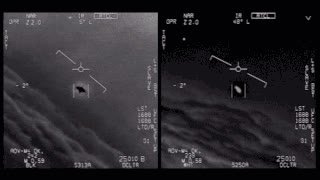
On the evening of 28 January 1953 an unnamed United States Air Force pilot was flying an F-86 Sabre on a "round-robin" navigation flight from Moody Air Force Base to Lawson AFB to Robins AFB and back to Moody, all inside Georgia. Edward Ruppelt, then head of Project Blue Book, took the case directly and recorded the pilot's own account. At exactly nine thirty-five in the evening the pilot was at 6,000 feet, heading toward Lawson on the first leg of the flight. He had just looked down and seen the lights of Albany, Georgia, then looked back up and noticed "this bright white light at 'ten o'clock high.'" It was unusually bright, which is why it stood out among the stars.
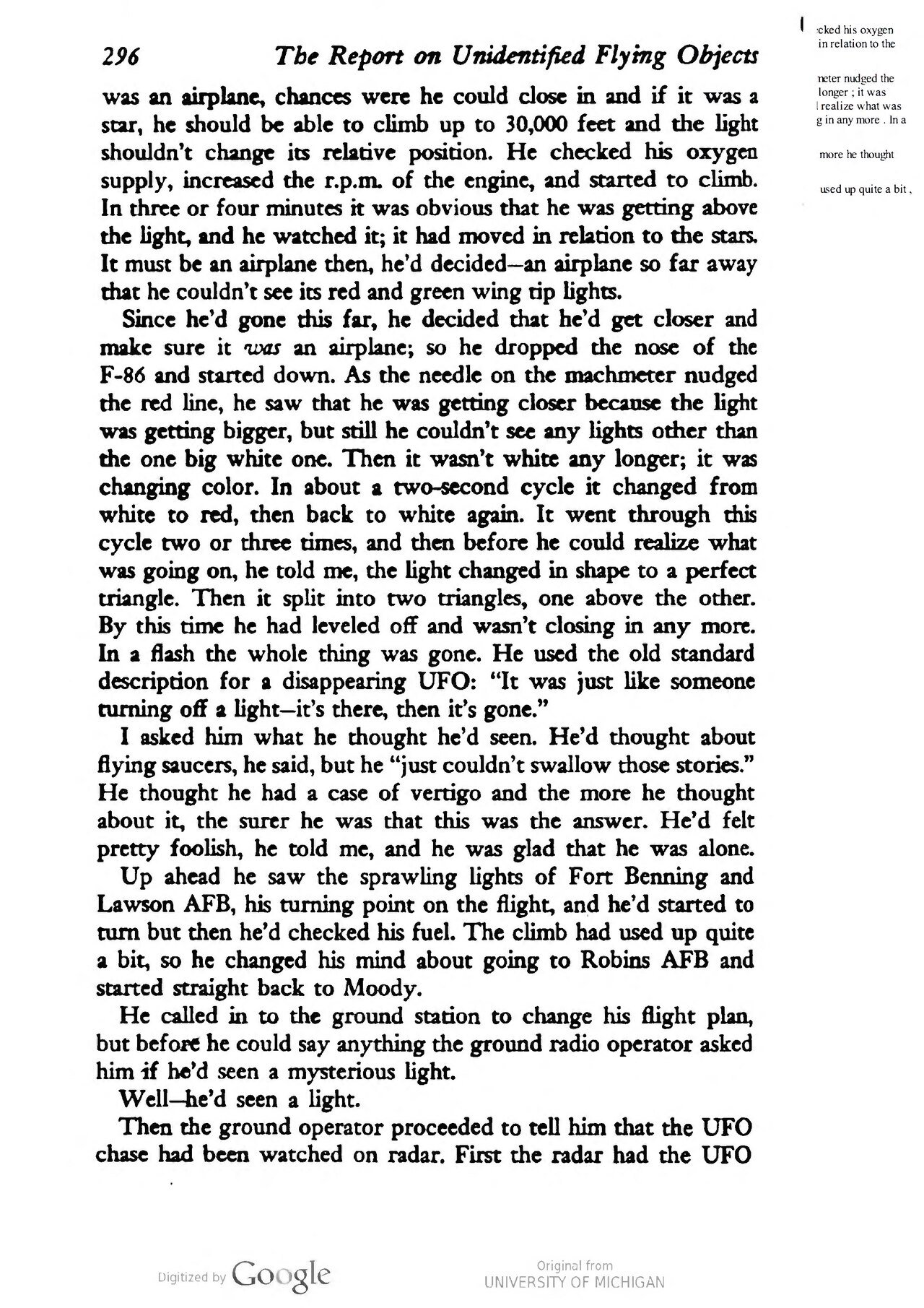
He flew on for a few minutes watching it as he passed over Albany and decided it had to be a very bright star or another airplane, except that it did not look right. In Ruppelt's words, "It had too much of a definitely circular shape." Since it was a nice night to fly and he needed the flying time anyway, he decided to close on it. He dropped the nose of the F-86 and started down, and as the needle on the machmeter nudged the red line he could see the light getting bigger, meaning he was gaining on it, yet he could still see nothing but the one big white light, no wingtip lights, no fuselage, no exhaust.
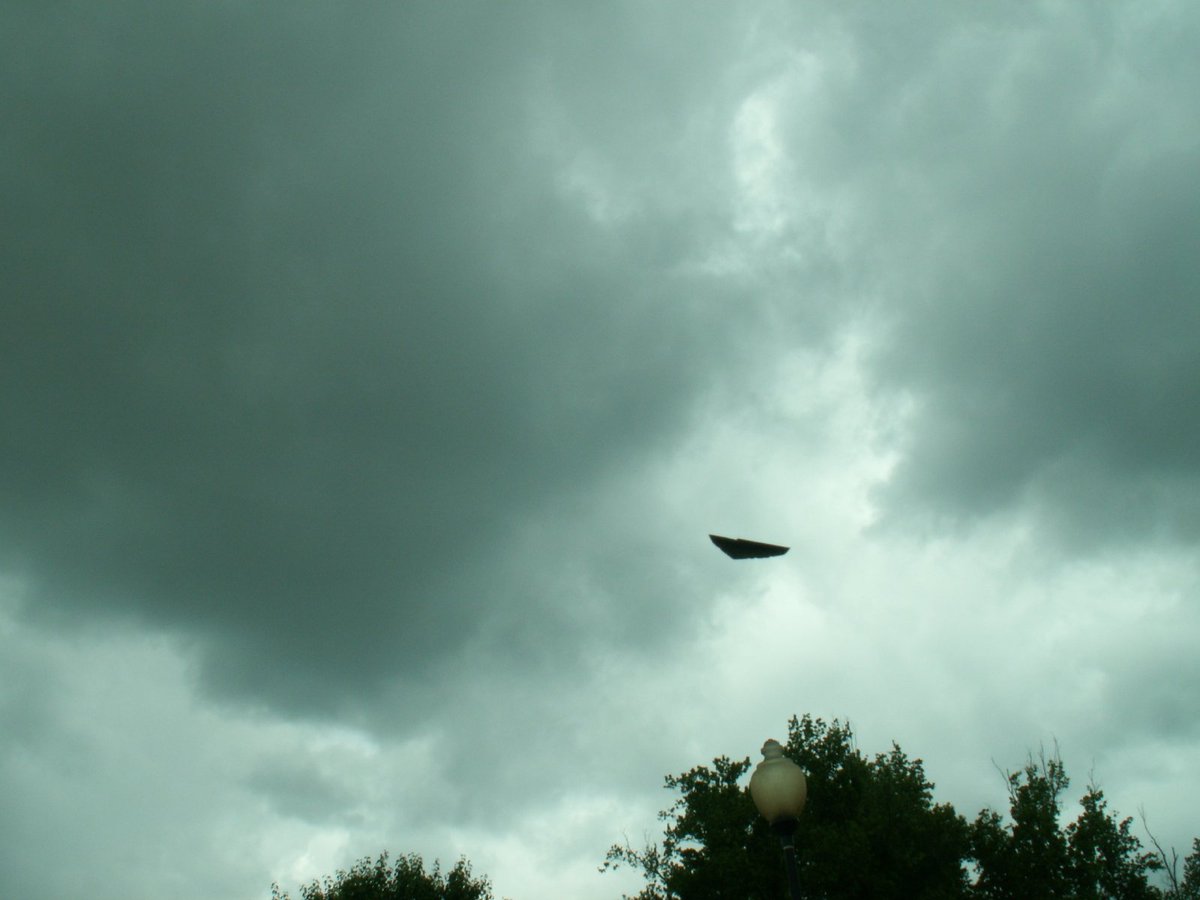
Then the object began to behave in a way no star or conventional aircraft could. "In about a two-second cycle it changed from white to red, then back to white again," and it ran through that color cycle two or three times. After that the appearance shifted entirely. As Ruppelt sets it down from the pilot's report, "the light changed in shape to a perfect triangle. Then it split into two triangles, one above the other." A moment later it was simply gone. The pilot described the ending precisely: "It was just like someone turning off a light, it's there, then it's gone."
Up ahead the pilot saw the sprawling lights of Fort Benning and Lawson AFB, his turning point, and he started to turn, but the climb and chase had burned a lot of fuel, so he changed his mind about continuing on to Robins and headed straight back to Moody. When he called the ground station to amend his flight plan, before he could even speak the ground radio operator asked whether he had seen a mysterious light. He had. The operator then told him the whole chase had been watched on radar from the ground, which is the detail that turns this from one man's nighttime impression into a correlated radar-visual event.
What is the official explanation?
The case entered the official system at the highest priority. Ruppelt records that the report came in to Wright-Patterson "sent 'Operational Immediate,' so it had priority handling; I was reading it by 12:30 A.M." The teletype gave the pilot's name and said he could be reached at Moody AFB, and Ruppelt, the serving chief of Project Blue Book, handled it personally. That alone places the event squarely inside the Air Force's own investigative apparatus rather than in folklore.
The decisive official element is the ground radar. According to the account the radar operators had the unknown on their scope first, "and it was a UFO because it was traveling much too slowly to be an airplane." They then watched the F-86 enter the picture: "the radar operators saw the F-86 approach, climb, and make a shallow dive toward the UFO. At first the F-86 had closed in on the UFO, but then the UFO had speeded up just enough to maintain a comfortable lead. This went on for two or three minutes; then it had moved off the scope at a terrific speed." The radar site tried to call the pilot directly during the chase but could not raise him, so the warning had to be relayed through the tower. This is an independent ground instrument tracking the same object the pilot was chasing, including the object's tactic of holding a lead and then accelerating away off the scope.
Ruppelt's own bottom line on the case is blunt and is the closest thing to a formal disposition in the record: "Rack up two more points for the UFO, another unknown and another confirmed believer." In other words Blue Book carried it as an unidentified, not as a solved or explained report, and the pilot who started the night a skeptic ended it convinced. The timing is significant for the official story. This sighting fell within days of the Robertson Panel, the CIA-convened scientific panel that met in Washington in mid-January 1953 and recommended that the Air Force work to strip UFO reports of their "aura of mystery" and debunk them through a public education campaign. Ruppelt notes in the same chapter that within two or three weeks of the panel's meeting he was told Blue Book would follow the panel's recommendations and reorganize. This case is therefore one of the last good radar-visual unknowns logged by the original, comparatively open Blue Book before the post-Robertson clampdown took hold.
What did the witnesses think it was?
The principal witness was the F-86 pilot himself, a serving Air Force officer whose name was in the original "Operational Immediate" message but which Ruppelt withheld in print, as he did with most of his pilot witnesses. What makes his testimony strong is that he was a hostile witness to begin with. By his own statement to Ruppelt he had "thought about flying saucers" but "just couldn't swallow those stories." When the object vanished he reached for the most ordinary explanation a fighter pilot has, vertigo, a spatial-disorientation illusion that night flyers are trained to distrust. The more he thought about it on the way back, the surer he became that vertigo was the answer and that he had simply fooled himself.
That self-debunking is exactly what the ground call demolished. The witness only abandoned the vertigo explanation because, before he could even mention the light, the ground radio operator told him the chase had been tracked on radar from the ground. Vertigo is a private illusion inside one pilot's inner ear and cannot paint a target on a separate radar scope miles away, cannot make that target hold a lead ahead of an accelerating jet, and cannot make it leave the scope at terrific speed. The corroborating witnesses are therefore the ground radar operators and the ground radio operator, all of them seeing or relaying the same event from a completely independent vantage point and a completely independent sensor. Ruppelt's phrase "another confirmed believer" refers to the pilot, who walked back his own skeptical explanation once he learned his sighting had a radar shadow he could not have invented.
Is the F-86 Triangle Over Albany, Georgia (1953) real? The two-pass assessment
Pass one, the ordinary readings. A bright point of light first taken for a star, seen at night from a fast jet, is fertile ground for misperception. The pilot's own first instinct, vertigo and autokinesis (a stationary light appearing to move and shift when the eye has no fixed reference), is a real and common night-flying illusion and explains part of the report cleanly. The two-second white-to-red color cycling is consistent with atmospheric scintillation of a bright star or planet low in the sky, and a star is a fixed object the pilot can never actually catch, which loosely matches a target that always keeps its distance. The triangle-into-two-triangles transformation could be an optical artifact, a defocused or doubled image, internal reflection in the canopy, or astigmatic streaking of a bright source. The trouble is that none of these visual explanations touch the ground radar. A star does not appear on a radar scope, does not register as a slow-moving target, does not get chased, and does not accelerate off the scope. To save the ordinary reading you have to argue that the radar was tracking something entirely unrelated, an aircraft, a weather echo, anomalous propagation, that just happened to coincide in direction and timing with the pilot's star illusion, and that the ground operators happened to watch a real F-86 close on that unrelated blip. That is a stack of coincidences, and it is not what the operators reported, because they reported the unknown was "traveling much too slowly to be an airplane," which rules out the obvious mundane radar return of another jet. No hoax mechanism is even available here, there is no photograph to fake, the witnesses are an on-duty Air Force pilot and ground radar crew, and the report came up the chain as a priority military message, not a public tip.
Pass two, if the visual and the radar are the same object, what is it. Then this is a genuine radar-visual unknown, an object holding station ahead of an accelerating F-86, changing color and apparent shape, and then either accelerating away or going dark instantly. That is precisely the class of case the original Blue Book could not close and logged as unidentified, and Ruppelt logged this one as exactly that.
The reason this lands as Verified Unexplained rather than disputed is that the documentation is authentic and primary, and the only counter-explanation on offer, vertigo, was raised and then withdrawn by the witness himself once the independent radar track surfaced. There is no confession, no recovered prop, no identified aircraft or balloon or rocket, and no method-shown civilian reconstruction that closes the case. The official apparatus did not solve it either, it carried it as an unknown on the eve of the Robertson Panel debunking program. What survives is an officially documented, radar-correlated, multi-witness sighting of an object that remains unidentified, which is the definition of this tier.
Sources
- web.archive.org/web/20260714125341/https://www.gutenberg.org/ebooks/17346
- en.wikisource.org/wiki/The_Report_on_Unidentified_Flying_Objects/Chapter_17
- en.wikisource.org/wiki/Page:Ruppelt_-_The_Report_on_Unidentified_Flying_Objects.djvu/303
- en.wikisource.org/wiki/Page:Ruppelt_-_The_Report_on_Unidentified_Flying_Objects.djvu/302
- en.wikisource.org/wiki/Page:Ruppelt_-_The_Report_on_Unidentified_Flying_Objects.djvu/301
- www.nicap.org/rufo/rufo-17.htm
More cases from this region: UFO sightings in United States