The West Pittsburg "Eastbay" Landing
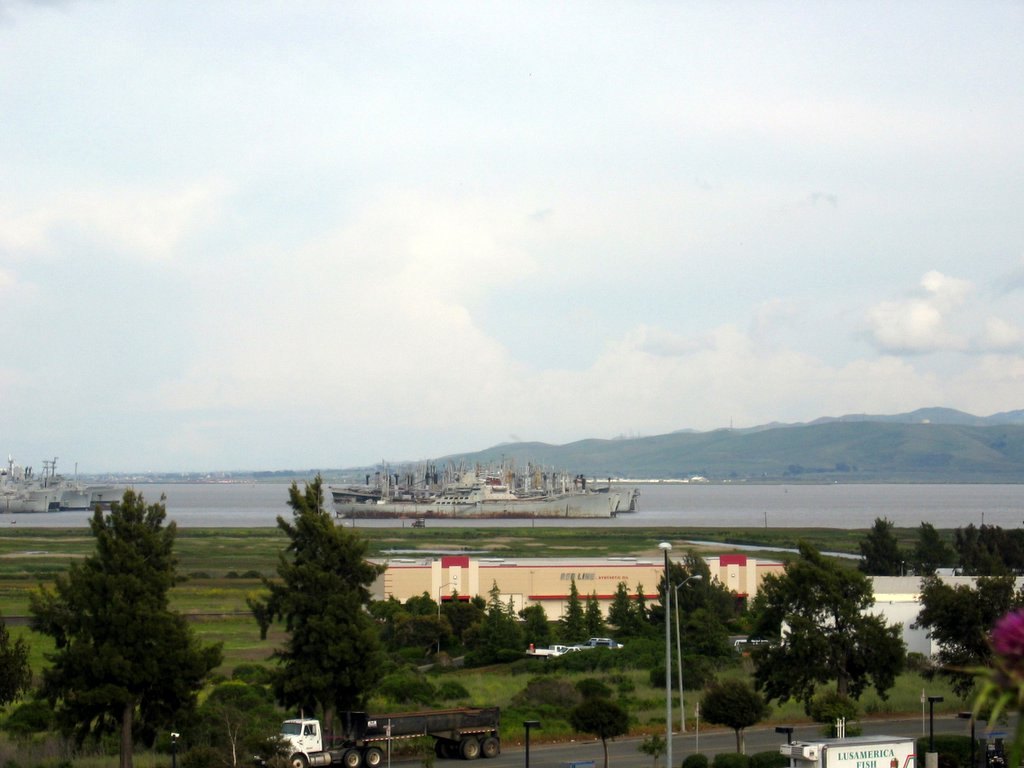
On the night of Friday 20 May 1977, around 11 p.m., three 14-year-old boys were out in a dark, open field in West Pittsburg, an unincorporated community in Contra Costa County on the south shore of Suisun Bay (the place was renamed Bay Point in 1993). This case file covers what witnesses reported, the official narrative, and a two-pass assessment with its evidence tier.
What did witnesses see at West Pittsburg (now Bay Point)?
On the night of Friday 20 May 1977, around 11 p.m., three 14-year-old boys were out in a dark, open field in West Pittsburg, an unincorporated community in Contra Costa County on the south shore of Suisun Bay (the place was renamed Bay Point in 1993). The three were Lennie Young, who lived at 10 Roberts Street in West Pittsburg; George Ferrera, the son of Muriel Wilder of Pacheco; and Patrick Morrison, of 90 Bay View Avenue in West Pittsburg. The field sat between the Santa Fe Railroad tracks and the Suisun Bay marsh, away from houses, with the only nearby light coming from a distant liquor store.
According to the account they gave separately to a sheriff's deputy and to investigators, and as reported by Fred Garretson in the Oakland Tribune, the boys first noticed a group of bright red lights low over the marsh with a single blue light "flitting like a firefly" among them. The red lights held a fixed distance from one another, which made the boys think they were all attached to one large structure. There was a row of square lights along the side that looked like windows, one of them larger than the rest, and the lights were blinking on and off. The boys described the thing as "round, but flat," and at one point Patrick Morrison reached for the comparison of "a flying building." It then moved with sudden, impossible speed, covering what the boys estimated at three miles or more in about five seconds, before coming back and descending toward the field roughly 50 to 150 feet from where they stood.
After the object came down, three figures appeared and began moving toward the boys across the dark ground. The descriptions the three gave were close to one another and unsettling. Lennie Young said, "They were like smoke. They were black. They had no faces." He put their height at about 5 feet 6 inches to 6 feet and was emphatic on one point: "I know what people look like walking in the dark. They were not people." Patrick Morrison said the figures "looked weird, walking slow," as if they "were wearing long skirts over their heads," and that they "walked as if they were linked together." George Ferrera described "gray objects, with a kind of human shape, but no eyes," and said "they walked like robots." All three agreed the figures moved with a stiff, mechanical gait and seemed wrapped in or trailing something like smoke or vapor. The boys ran, badly frightened, and made it to Patrick Morrison's house, where the adults could see the state they were in.
What is the official explanation?
There was no military or federal investigation of this case. By 1977 the United States Air Force had been out of the public UFO business for eight years, since the closure of Project Blue Book in December 1969, so the "official" handling here is split between the county sheriff's office and the civilian research groups that took the report seriously.
On the law-enforcement side, Patrick Morrison's mother phoned the Contra Costa County Sheriff's office that night. Deputy Sheriff Douglas Pendleton interviewed the three boys, and what he found is part of why the case stuck. The deputy reported that the boys were genuinely and deeply frightened, one of them described as shaking badly, and that he could find no sign they had been drinking or using drugs. The boys themselves volunteered to take lie detector tests to prove they were telling the truth. Interviewers, including the deputy, noted that all three told the same detailed story when questioned separately, which is harder to fake under pressure than a single shared narrative.
The serious civilian work came from the Center for UFO Studies (CUFOS), the group founded by Dr. J. Allen Hynek, the astronomer who had been the Air Force's own scientific consultant on Blue Book and who coined the "close encounter" classification. CUFOS rated the West Pittsburg report as one of only three credible humanoid (close encounter of the third kind) cases in the country that year. The hands-on field investigation was carried out by Richard Haines, a research psychologist with a NASA background who studied perception and pilot eyewitness reliability and who worked UFO cases as a serious sideline. Haines interviewed each boy and was struck by the consistency and depth of detail in their separate accounts, telling the Tribune in effect that the stories had a level of internal detail that did not look manufactured. But Haines also did the unglamorous part: he went to the landing site about a month after the event and found nothing. No scorched or flattened grass, no holes or impressions, no detectable magnetic anomaly in the soil, nothing physical to anchor the report. Weighing the strong testimony against the total absence of trace evidence and any corroborating witness, Haines concluded that the evidence as it then stood did not warrant further investigation.
A second researcher, Dr. James A. Harder, a professor of hydraulic engineering at the University of California, Berkeley who served as director of research for the Aerial Phenomena Research Organization (APRO) and was one of the era's main practitioners of hypnotic regression on UFO witnesses, also looked at the case. Harder attempted to use hypnosis to probe one boy's memory of the night, in case there was buried or missing-time detail, but reported that the boy was not a good hypnotic subject and the session produced nothing useful. Allan Hendry, the editor of CUFOS's International UFO Reporter and author of a rigorous field-investigation manual, summed it up bluntly: "This is a 50-50 case if there ever was one." Hendry did the cross-checking a debunker would do and reported the result honestly: he contacted the control tower supervisors on duty that night at Oakland, San Francisco International, and Travis Air Force Base, and none of them had any record of UFO reports from pilots or anything anomalous on radar.
What did the witnesses think it was?
The three boys never wavered from the core of their account, and their belief was simple and consistent: that they had watched a structured, lighted craft land in the field and that three figures which were not human beings had come out of the dark toward them. What gives the testimony its weight is less any single dramatic claim than the way the three independent versions lined up. Lennie Young's insistence that "I know what people look like walking in the dark, they were not people" is the statement investigators kept coming back to, because it is the assertion of a local kid who knew that field and was not reaching for a flying-saucer explanation, he was telling adults that whatever walked toward him did not move like a person. Patrick Morrison's "linked together" detail and George Ferrera's "walked like robots" are different words for the same strange, jointed, mechanical motion, arrived at separately.
The corroboration in this case is human rather than physical. There is no second set of unconnected witnesses who saw the craft from across town, and that absence is exactly what Richard Haines and Allan Hendry flagged as the case's weakness. What corroborated the boys instead were the trained adults who interviewed them. Deputy Douglas Pendleton, a sheriff's officer with no stake in UFOs, came away convinced the fear was real and that the boys were not drunk, high, or putting on an act, and the boys' own offer to submit to polygraph testing pointed the same way. Haines, a psychologist whose professional specialty was literally the reliability of eyewitness perception, judged the depth of detail to be more than three teenagers were likely to have invented and kept straight under separate questioning, even as he refused to call the case proven. It is worth being clear that no witness ever recanted, no adult who handled the boys ever accused them of lying, and no hoax method was ever demonstrated. The doubt in this case has always been about what is missing (traces, radar, a second viewpoint), not about anyone catching the witnesses out.
The dispute
The dispute here is mild and was raised by the case's own sympathetic investigators rather than by any hostile debunker, which is part of why it does not sink the report. The core of it is the complete absence of corroboration beyond the three boys. Richard Haines, the NASA research psychologist who interviewed the witnesses and was impressed by them, visited the alleged landing site roughly a month after the event and found no physical trace whatsoever, no scorched or matted grass, no ground impressions, no measurable magnetic anomaly, and on that basis concluded that the evidence as it stood did not warrant further investigation. That is the strongest single point against the case, and it comes from a friendly expert, not an enemy.
The second prong is Allan Hendry's independent cross-checking. Hendry, editor of the International UFO Reporter and a famously hard-nosed field investigator, contacted the control tower supervisors on duty that night at Oakland, San Francisco International, and Travis Air Force Base and found no pilot reports and nothing anomalous on radar, and he characterized the whole thing as "a 50-50 case if there ever was one." A craft that maneuvered and landed as described, near major airfields and a military base, arguably should have left some instrumental footprint, and it did not. Set against that, the skeptical reading is the ordinary one for a dark field at night: misperception of distant lights, a shared narrative built up between three frightened friends, and faceless "robot" figures conjured by the visual system at the edge of darkness.
What keeps this in the Barely Disputed tier rather than anything stronger is that the doubt never hardened into a demonstrated explanation. No witness recanted, no hoax props were ever found, and nobody identified a specific aircraft, balloon, rocket, or other real stimulus and showed that it produced this report. James Harder's attempt to use hypnosis to recover more detail simply failed because the boy was a poor hypnotic subject, which neither helps nor hurts the claim. The counter-case is essentially "we cannot find anything to confirm it," which is a real and fair criticism but is not the same as a confession, a recovered prop, or a positively identified mundane cause. Under the archive's standard that an official or expert assertion without a shown method, or a plausible-but-unproven natural reconstruction, is only a weak dispute, this case stands, barely.
Is the West Pittsburg "Eastbay" Landing real? The two-pass assessment
Pass one, the ordinary readings. A nighttime field, three 14-year-olds, near-total darkness, and a single distant light source is a setting that breeds misperception, and the skeptical case writes itself in outline. The lighted "craft" with a row of window-like squares and a darting blue light could in principle have begun as a mundane stimulus, distant aircraft on approach to one of several Bay Area fields, lights on the water or across the marsh, or a low, slow aircraft whose motion the boys badly misjudged in the dark. The three "robot" figures, gray and faceless and trailing smoke, are consistent with shapes seen at the edge of vision in poor light, where the brain supplies form and motion that are not really there, and three excited boys can amplify one another into a shared narrative very fast. The total lack of physical evidence supports an ordinary reading: Richard Haines went back a month later and found no burned grass, no impressions, no magnetic change, and Allan Hendry confirmed that no control tower at Oakland, San Francisco, or Travis Air Force Base logged anything on radar or from pilots that night. A pure hoax is also on the table in principle, three friends agreeing on a story. The important point is that nobody ever showed any of this happened. No props were found, no confession was given, no specific aircraft, balloon, or other stimulus was ever identified, and the misperception scenario, while plausible, was never reconstructed and demonstrated. It remains an argument, not a proof.
Pass two, if the encounter happened as described. Then West Pittsburg is a textbook close encounter of the third kind: a structured object with apparent windows that maneuvered at speeds no conventional 1977 aircraft could match over that short hop, that landed, and that disgorged three entities of roughly human size but inhuman motion and featureless faces. The robot-like, "linked," vapor-wrapped figures resemble the occupant descriptions in a thin but real strand of other 1970s humanoid reports, and the case earned its standing not from imagery, of which there is none, but from the quality of the witnesses and the rigor of the people who checked them. That CUFOS counted it among only three credible humanoid cases nationwide that year, that a NASA perception psychologist and an APRO research director both put real time into it, and that a sheriff's deputy independently vouched for the boys' terror, all push it above the noise floor of ordinary teenage UFO yarns.
Weighing the two passes: the case has unusually strong testimonial credibility and unusually weak physical and instrumental support, and the formal counter-explanation never rose above an honest "50-50" verdict from the case's own investigators. Haines declined to pursue it further, but declining to investigate is not the same as debunking, and Hendry's null result on radar and towers is consistent with both a real low-altitude object and with no object at all. There is no confession, no recovered prop, and no identified real-world stimulus that closes the case. By the archive's rules, an honest official-and-civilian doubt that leaves the report standing but unconfirmed is Barely Disputed, and that is the tier: a high-credibility witness case with no trace evidence, contested at the level of "we cannot corroborate it," not at the level of "we caught how it was faked."
Sources
- web.archive.org/web/20231129024202/https://www.ufocasebook.com/2011/eastbaylanding1977.html
- www.thinkaboutitdocs.com/1977-3-boys-frightened-by-a-creatures-from-landed-ufo/
- www.ufoinsight.com/ufos/close-encounters/contra-costa-county-ufo
More cases from this region: UFO sightings in United States