The El Paso and Fort Hancock Counter-Drone Laser Closures, 10 to 27 February 2026
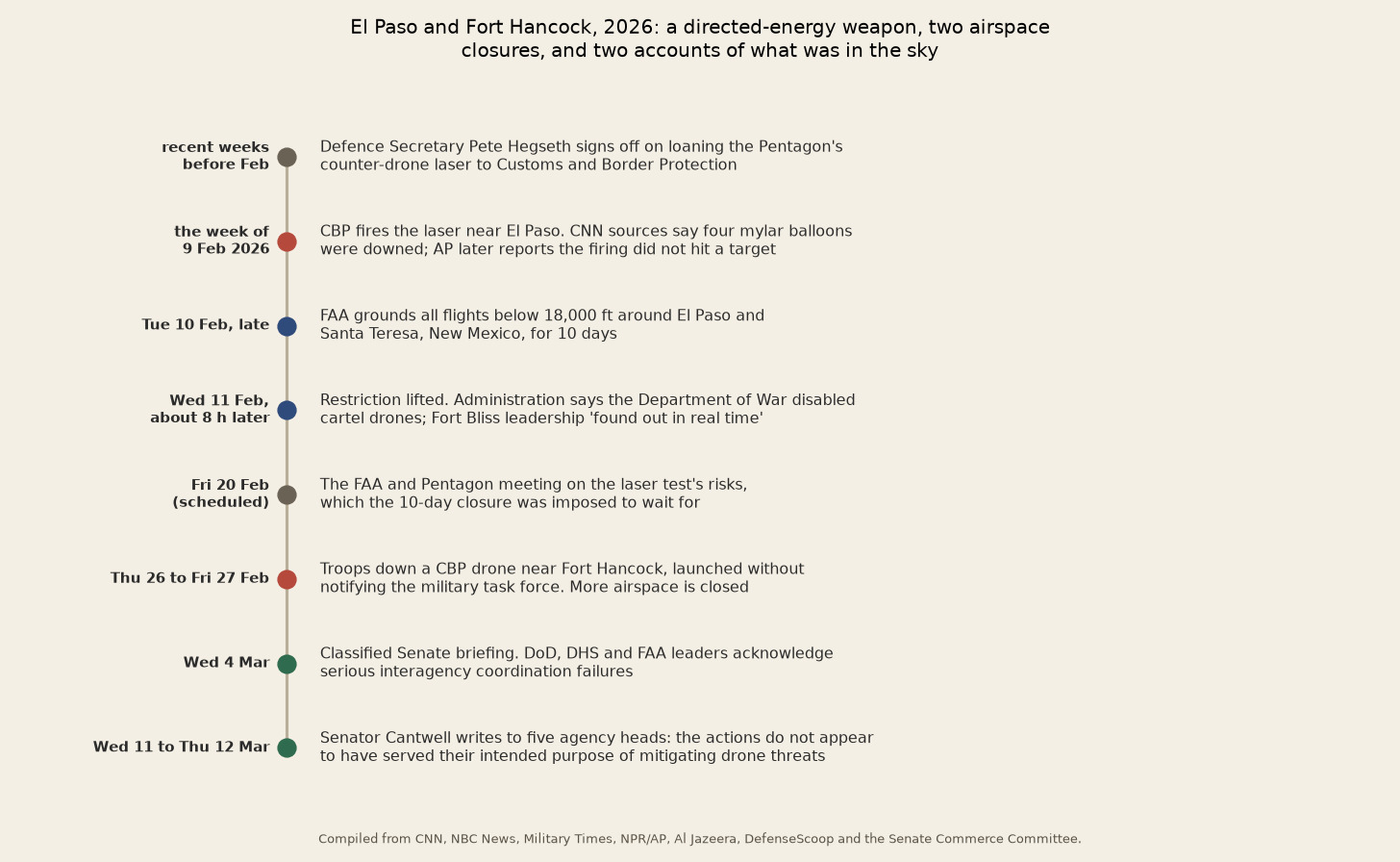
The government said it had disabled cartel drones. Multiple independently sourced accounts say the weapon was fired at four mylar balloons, and a later account says it hit nothing at all.
What did witnesses see at El Paso and Fort Hancock?
On the night of Tuesday 10 February 2026 the Federal Aviation Administration closed the airspace over El Paso, Texas. By several accounts it was the first sudden closure of American airspace for security reasons since the attacks of September 2001, and what the objects in question actually were is still contested.
The closure was wider than the city name suggests. The Senate Commerce Committee records it as a shutdown of the airspace around El Paso and around Santa Teresa, New Mexico, just over the state line.
The restriction was abrupt and total. The FAA grounded all flights below 18,000 feet within ten miles of El Paso International Airport for ten days, including commercial, cargo and general aviation, and even the helicopters used for medical transport. The airport handles roughly 100 flights a day and nearly 3.5 million passengers passed through it in the first eleven months of 2025. The FAA classified the area as National Defense Airspace and warned that pilots who violated it could be intercepted, detained and questioned. Roughly eight hours later, on the Wednesday morning, the restriction was lifted.
What the archive is interested in is the object question, because this is a case in which unidentified things in the sky were declared hostile and engaged with a directed-energy weapon, and the published accounts of what they were do not agree.
The administration said the objects were Mexican cartel drones. An administration official told Military Times that the Department of War took action to disable the drones, and Transportation Secretary Sean Duffy wrote on X that the Department of Defense acted swiftly to address a cartel drone incursion, that the threat had been neutralised and that there was no danger to commercial travel.
The reporting says something different. CNN was told by a source that the laser was used to shoot down four mylar balloons that week, and that this contributed to the FAA decision. NBC News reported, on four people familiar with the matter, that Customs and Border Protection officials used a military-provided anti-drone laser to shoot down objects that were later identified as party balloons, and did so without coordinating with the FAA. CNN added the detail that CBP, not the military, was physically operating the device, that Defense personnel were present, and that Defence Secretary Pete Hegseth had signed off on loaning the technology to CBP in recent weeks.
Then a third account appeared. When a second laser event occurred later in the month, the Associated Press reported that the earlier firing near Fort Bliss did not hit a target at all. That is not a small discrepancy, and it is not resolved. One set of accounts has a weapon destroying four balloons, another has it hitting nothing, and the government has the same weapon neutralising a cartel threat.
What is the official explanation?
There are two official postures here and they do not sit comfortably together.
The first is the threat account. The administration attributed the closure to cartel drone activity, the Department of War was described as having acted to disable the drones, and the Transportation Secretary publicly credited a swift response to an incursion. The Pentagon continued to refer reporters to that statement even as other explanations circulated.
The second is the coordination account, and it comes from inside the system. CNN reported that FAA and Pentagon officials had been scheduled to meet on 20 February to review the potential impacts of a test of the laser system, a technology the Pentagon had been testing in more remote parts of the country, but that the Defense Department sought to use it sooner around El Paso. On that account the FAA imposed the restriction precisely to force the coordination to happen first. The detail that makes this account hard to dismiss is arithmetical: the ten-day restriction would have expired on 21 February, which is one day after the meeting it was waiting for.
The closure also surprised the people it should not have surprised. CNN reported that the FAA acted without telling the White House first. Military Times reported that leadership at Fort Bliss, less than ten miles from the commercial airport, was left in the dark about the shutdown of the airspace around its own base and was not told when the restrictions were lifted, with one defence official saying leadership found out in real time. Representative Veronica Escobar, who represents El Paso, called the move unprecedented.
Senator Ted Cruz, chair of the Senate Committee on Commerce, Science and Transportation, requested a classified briefing, saying that at that point the details of what exactly occurred over El Paso were unclear. FAA Administrator Bryan Bedford was on Capitol Hill that evening and declined to answer reporters’ questions about the closure.
The second event produced a joint statement from the Pentagon, the FAA and CBP saying the military had used a counter-unmanned aircraft system to mitigate a seemingly threatening unmanned aerial system operating within military airspace, that it took place far from populated areas with no commercial aircraft nearby, and that the agencies would work on increased cooperation and communication to prevent such incidents in future.
The congressional record that followed is the most useful source on this case, because it is where federal officials stopped briefing anonymously and put things in writing.
On 4 March 2026 officials from the Department of Defense, the Department of Homeland Security and the FAA gave a classified briefing to senior senators. According to the Senate Commerce Committee, those leaders acknowledged serious interagency coordination failures. Senator Ted Cruz told reporters afterwards that there were real challenges in operationalising counter-drone technology and that all the senators in the briefing urged the Department of War, CBP and the FAA to significantly improve their coordination. He put the underlying tension plainly: everyone wants hostile drones incapacitated, but not in a way that threatens civilian aircraft, and it ought to be possible to do both. Coordination, he said, fell far below what should have happened.
On 11 March Senator Maria Cantwell, ranking member of the Commerce Committee, wrote to Defence Secretary Pete Hegseth, Attorney General Pam Bondi, Transportation Secretary Sean Duffy, Homeland Security Secretary Kristi Noem and FAA Administrator Bryan Bedford. Her letter, released the following day, contains the single most important official statement on the object question. She wrote that federal officials had deployed a novel counter-drone high-energy laser near the Texas-Mexico border on multiple occasions and that it does not appear these actions served their intended purpose of mitigating specific drone threats, and that the incidents instead highlighted serious process failures exposing the flying public to unacceptable safety risks. The committee release also records a fact the news coverage had not established: the El Paso incident was the first known domestic use of a counter-drone laser system conducted outside of a controlled environment.
The same release resolves the second event. CBP, it states, did not notify the military about its own drone operations in the Department of Defense’s vicinity, which led to the military downing a CBP drone. DefenseScoop reported the same thing and located it near Fort Hancock, a small Texas town southeast of El Paso, adding that the Pentagon’s counter-drone organisation is Joint Interagency Task Force 401.
What happened next is on the record and it belongs on this page, because it shows the February engagements were the leading edge of a programme rather than an isolated improvisation. Joint Interagency Task Force 401, the Pentagon counter-drone organisation named above, went on to partner with the Federal Aviation Administration for a live fire high energy laser safety assessment at White Sands Missile Range in New Mexico. The Department of War's own account of that work, published on 5 October 2026, states that "the FAA determined that the system posed minimal risk to the National Airspace System and established a framework for continued coordination."
The sequence is worth stating plainly. A counter-drone laser was fired in open American airspace near El Paso in February, by the committee's own account the first known domestic use outside a controlled environment, and the formal airspace safety assessment for that class of weapon followed afterwards rather than preceded it.
The same release announces the next phase. Directed by the Fiscal Year 2026 National Defense Authorization Act, JIATF-401 selected four directed energy systems for a counter-drone pilot programme across the homeland: the AeroVironment Palletized High-Energy Laser, the Epirus Leonidas High-Powered Microwave, the Kord Firefly High-Energy Laser, and the Boeing Compact Laser Weapon. U.S. Army Brig. Gen. Matt Ross, the task force director, is quoted saying that "high-energy lasers and high-powered microwave systems are tools that can be effectively used in a layered drone defense" and that "there is no silver bullet, or one size fits all solution to countering the threat of drones." The Department added that it would hold a further directed energy shoot-off at Dugway Proving Ground in December to assess additional systems.
What did the witnesses think it was?
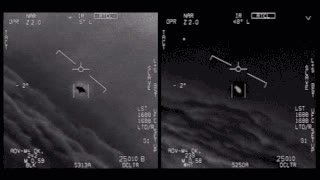
This case has no civilian witnesses in the ordinary sense, and that absence is itself worth stating. Nobody filmed the engagement, no imagery of the objects has been released by any agency, and the public has never been shown what was fired at. Everything known about the objects comes from officials describing them afterwards, either on the record or as sources.
The nearest thing to testimony comes from legislators reacting to being informed. After the second event, Representative Rick Larsen and two other senior Democrats on the House Transportation and Infrastructure and Homeland Security committees said in a joint statement that they were stunned when they were officially notified. "Our heads are exploding over the news," they said, criticising the administration for sidestepping a bipartisan bill intended to train drone operators and improve communication between the Pentagon, the FAA and the Department of Homeland Security, and adding that the result was what they called incompetence.
The second event is the stranger of the two on its own facts. By the account given to Congress, the United States military used a laser to shoot down a drone belonging to United States Customs and Border Protection. The reporting states plainly that it is not clear why the laser was deployed. That closure was smaller and commercial flights were not affected.
The legislators’ later account is firmer than their first reaction. After the March briefing Cantwell framed the federal interagency coordination process for counter-drone activities as clearly broken, and tied the problem to authorities Congress had just granted in the 2026 National Defense Authorization Act, asking who should hold authority to use high-energy laser technology at all. She also pointed forward rather than back, noting the 2026 FIFA World Cup, including six matches in Seattle that June and July, and the 2028 Los Angeles Olympics, and arguing that every agency with counter-drone responsibilities needed to be ready to act without jeopardising aviation safety.
Is the El Paso and Fort Hancock Counter-Drone Laser Closures, 10 to 27 February 2026 real? The two-pass assessment
Pass one, how could this be mundane. Almost entirely, and that is the finding rather than a deflation of it.
Nothing in this case requires an exotic object. The most consistent reading across the reporting is a bureaucratic one: a directed-energy counter-drone weapon, developed by the Department of Defense and loaned to Customs and Border Protection with the Defence Secretary’s approval, was used near a major civilian airport before the coordination meeting that was supposed to assess the risk to civil aviation. The FAA, lacking any other lever, shut the airspace until that meeting could occur. The objects engaged were, on two independent sets of sources, mylar or party balloons.
That is also why the case belongs in this archive. Strip away the vocabulary and it is a textbook misidentification event: unidentified objects in the sky were assessed as a hostile threat by the national security apparatus, engaged with a weapon, and then reportedly turned out to be balloons. The archive holds a long line of cases in which an unremarkable object was taken for something alarming. This one is distinguished only by who made the error and what they fired.
The base rate is the part that deserves emphasis, and it comes from the government’s own testimony. CNN noted that incursions along the southern border are extremely common and historically do not prompt airspace closures, citing Air Force General Gregory Guillot, commander of US Northern Command, who told the Senate Armed Services Committee in 2024 that the number of incursions along the US-Mexico border was over a thousand each month. Against roughly a thousand incursions a month, a drone crossing is not an explanation for an unprecedented closure. Something else has to account for the difference, and the laser is the only candidate on the table.
Pass two, what is genuinely unresolved. Three things.
First, the identity of the objects is not settled and the archive will not pretend otherwise. CNN has four mylar balloons. NBC News has objects later identified as party balloons, on four sources. The Associated Press, reporting the second event, states that the earlier firing did not hit a target. These cannot all be true. No agency has released imagery, a count, or a recovered object, so the public record contains three incompatible accounts of what a weapon of war was pointed at over an American city, and no way to adjudicate between them from outside.
Second, the causal order is unresolved. CNN reported that it is unclear whether the presence of drones might have led to the acceleration of the laser deployment. If genuine drone activity prompted an early, uncoordinated use of the weapon, then the threat account and the coordination account are both partly right, and nobody has published enough to say.
Third, the second event was initially unexplained and has since been explained, which is worth recording because it shows the value of waiting for the congressional record. At the time, the reporting said plainly that it was not clear why the laser was deployed, and the joint agency statement described a seemingly threatening unmanned aerial system within military airspace without explaining how a federal agency’s own drone came to be assessed that way. The Senate Commerce Committee supplied the answer: CBP did not notify the military about its own drone operations in the Department of Defense’s vicinity, so the military downed a CBP drone near Fort Hancock. The object was never unidentified to the people flying it. It was unidentified only to the people shooting at it, which is the same failure as the first event in a different direction.
One further official fact sharpens the whole file. The Senate Commerce Committee states that the El Paso engagement was the first known domestic use of a counter-drone laser system outside a controlled environment. So the first time this weapon was fired at something in American skies in the open, the thing it was fired at was, on the best available reporting, a cluster of mylar party balloons, and the ranking member of the committee overseeing it concluded after a classified briefing that the actions do not appear to have served their intended purpose of mitigating specific drone threats.
The tier reflects the specific thing being disputed. The claim that this was a neutralised cartel drone incursion is contradicted by multiple independently sourced accounts, by the coordination timeline, and by the government’s own incursion base rate, so the threat framing is strongly disputed. What replaces it is not settled either. No prosaic identification has been demonstrated to the public, because the only people who know what was in the sky have not shown anyone.
Sources
- www.cnn.com/2026/02/11/us/faa-el-paso-texas-flight-restrictions-hnk
- www.nbcnews.com/politics/national-security/cbp-shot-party-balloons-anti-drone-tech-faa-closed-el-paso-airspace-so-rcna258731
- www.militarytimes.com/news/pentagon-congress/2026/02/11/mexican-cartel-drones-breach-us-airspace-prompt-el-paso-airport-closure-admin-says/
- www.npr.org/2026/02/27/g-s1-111794/lawmakers-say-us-military-used-laser-to-take-down-border-protection-drone
- aljazeera.com/news/2026/2/27/second-us-drone-laser-incident-this-month-prompts-texas-airspace-closure
- defensescoop.com/2026/03/04/senators-criticize-pentagon-faa-cbp-counter-uas-incidents-briefing/
- www.commerce.senate.gov/press/dem/release/cantwell-demands-federal-agencies-immediately-address-coordination-failures-aviation-safety-risks-of-counter-drone-activities/
- www.war.gov/News/Releases/Release/Article/4619430/systems-selected-for-jiatf-401-directed-energy-counter-drone-pilot-program/
More cases from this region: UFO sightings in United States