The Eliot Wedge

It was dusk in the summer of 1982 in Eliot, Maine, a small town that sits across the Piscataqua River from Portsmouth, New Hampshire. This case file covers what witnesses reported, the official narrative, and a two-pass assessment with its evidence tier.
What did witnesses see at Eliot?
It was dusk in the summer of 1982 in Eliot, Maine, a small town that sits across the Piscataqua River from Portsmouth, New Hampshire. The witness, who later identified himself only as Chris F. and who went on to work as an engineer, was fourteen years old. His family was a week away from relocating to Alaska. By his account the sky was clear and the light was still good when he first noticed an object above the treeline at the back of the property, which he estimated at about a football field and a half away.
What he described was not a classic disc. He called it a black, geometric shape roughly the size of an automobile, a "blunted wedge," or, in his own words, like "a pyramid tipped over on its side with the pointed portion removed." It had a small square or rectangular front face and a larger square or rectangular rear, so the body tapered from back to front. The color was a dull gun-metal black with a metallic look. He saw no windows, no lights, no doors and no seams anywhere on the surface, only a few small protrusions that struck him as instrumentation.
The motion is the detail he kept returning to. Above the trees the object was zig-zagging rapidly, holding a constant height of roughly five to ten feet above the treetops while making what looked like instantaneous changes of direction, which he compared to an air hockey puck snapping across a table. It then moved in toward the backyard and stopped, hovering perfectly still and perfectly silent about thirty to forty feet from where he stood, close to the house. He put the still hover at around four seconds. Then it left. It did not bank or turn to reverse course; it simply shot away so fast he could barely register the direction it had gone.
While this was unfolding he had a mainstream pop radio station playing. He says the on-air DJ announced he was being inundated with calls about some object seen in the air. The teenager phoned the station himself but, by his own admission, gave them very little.
What is the official explanation?
There is no official narrative for this event, and that absence is the central fact about it. No United States Air Force file documents it, because Project Blue Book had been closed for more than a decade by 1982 and no successor public collection agency existed. A search of the National UFO Reporting Center's Maine database returns no Eliot entry for 1982 or the surrounding years, and the witness's account contains no mention of a police report, a base, a radar track or any agency contact. The only investigatory body that ever touched the story is a civilian website.
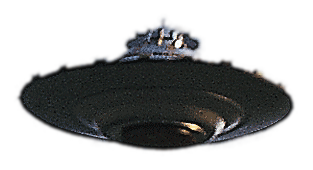
The account as it exists today reached the public through UFO Casebook, where it was archived in 2008 under the title "Reader Recounts 1982 UFO Encounter in Maine." It is a reader submission written by the witness himself, roughly a quarter of a century after the event, not a contemporaneous report and not the product of any field investigation. UFO Casebook published it with a single accompanying digital depiction of the object rather than any photograph, because no photograph was taken. No named investigator interviewed the witness, canvassed the neighborhood, pulled the radio station's logs, or attempted to locate the other callers the DJ described.
The one fragment that looks like outside documentation is not about Eliot at all. A June 1982 catalogue entry places a wedge-shaped object low over a reservoir in Madbury, New Hampshire, about ten miles from Eliot, with body lights, an instantaneous relocation and a red light beam directed at a house and a car. That entry is a separate report of a different shape variant on a different night, and nothing ties it evidentially to the Eliot account beyond geography and season. So the official record here is a blank. Whatever weight the case carries, it carries entirely on testimony, with no document, instrument trace or government finding behind it.
What did the witnesses think it was?
The entire case rests on one person. The witness identifies himself only as Chris F., withholding his full name, and says he was fourteen years old in the summer of 1982, a week before his family moved from Eliot, Maine to Alaska. He describes himself as having gone on to work as an engineer, a detail he offers to signal that he is a measured, technically minded adult rather than a fantasist, and the tone of his account is sober and specific rather than embellished. He does not claim contact, missing time, or any message, only that he saw a structured object behave in a way no aircraft he knew could match, and that the memory stayed with him for a quarter of a century before he set it down. He believed then and believes now that what he saw was real and physical, close enough that he could make out small protrusions on its surface, and that it was not a plane, a helicopter, or a balloon. The one element that would have widened the witness pool is the radio broadcast he describes, in which a DJ said he was being flooded with calls about an object in the sky. By the witness's own admission he phoned the station and told them very little, so even on his own telling he did not become a documented caller, and the other callers, if they existed, were never identified, interviewed, or recorded. No family member, neighbor, or second observer is named in support. His mother, father, and siblings are placed in the household by the relocation detail but none is quoted as having seen anything, and he does not say he told them at the time. That leaves the report exactly as sincere and exactly as uncorroborated as a single honest recollection can be: one credible-sounding adult, recalling a vivid childhood event decades later, with nothing and no one to check the memory against.
Is the Eliot Wedge real? The two-pass assessment
Pass one, the ordinary readings. The most economical explanation for a single uncorroborated report like this is misperception or memory drift over twenty-five years. A fourteen-year-old at dusk, later reconstructing the scene as an adult, can compress, sharpen and geometrize a fleeting sighting; the crisp wedge with instrument protrusions may be a hardened version of something seen for seconds in failing light. Conventional candidates exist for the raw stimulus: a low aircraft or helicopter seen at an odd angle, a hang glider or ultralight, or a dark balloon or kite drifting against trees, any of which the wind and parallax can make seem to dart and stop. The silent four-second hover and the no-turn reversal are harder to fit to any of those, but they rest entirely on a single memory with nothing to check it against. The radio-station detail, if it were ever verified, would be the one thing that lifts this above one person's recollection, yet that detail too comes only from the witness, and unconfirmed it cannot do corroborative work. There is no photograph, no physical trace, no second named witness, and no contemporaneous record, so nothing here can be tested.
Pass two, if it happened as described. Then a fourteen-year-old watched a structured, automobile-sized object hold a fixed altitude while making instantaneous right-angle direction changes, hover dead silent at close range, and then accelerate from a standstill without rotating, all without visible propulsion, lights or control surfaces. That is the black wedge or flying triangle pattern that recurs across New England and beyond in the 1980s, and the independent Madbury, New Hampshire report of a wedge-shaped object with the same instantaneous-relocation behavior about ten miles away in June 1982 sits squarely inside that pattern. None of it is debunked. There is simply no apparatus that ever examined it.
This case has no official narrative, no counter-explanation advanced by any named analyst with a shown method, and no authenticated material to verify. It also has no contemporaneous documentation that would let it qualify as officially recorded and unexplained. It stands or falls on the testimony of one person and one unverified secondhand claim of other callers. That is the definition of the Unknown tier: a case carried entirely by its witness, with no official story to dispute and no proof to confirm. It is filed as Unknown.
Sources
- web.archive.org/web/20231129023112/https://www.ufocasebook.com/2008c/1982eliotmaine.html
- web.archive.org/web/20221111124011/https://www.ufocasebook.com/2008c/1982eliotmaine.jpg
- www.thinkaboutitdocs.com/1982-june-ufo-alien-sightings/
- nuforc.org/subndx/?id=lME
More cases from this region: UFO sightings in United States