The Devon Flying Cross
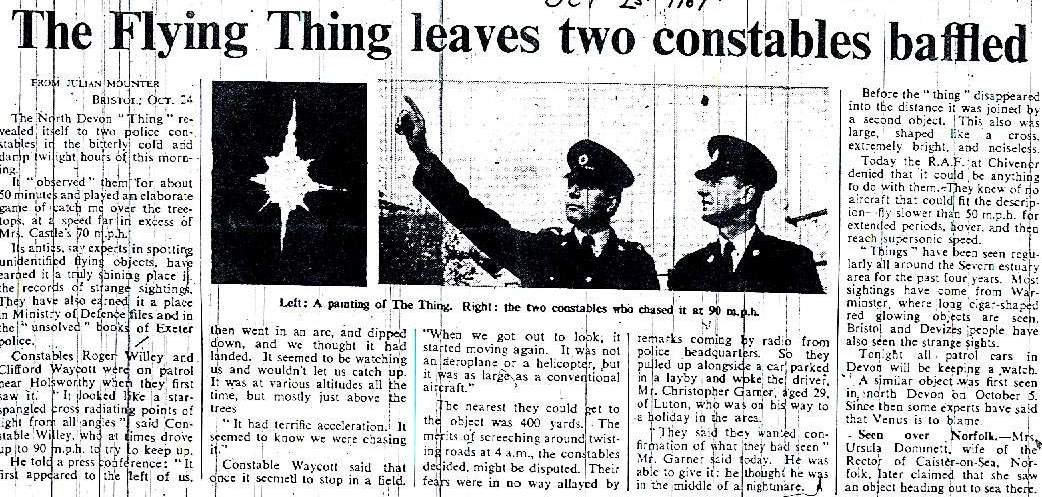
In the early hours of 24 October 1967, two Devon and Cornwall police constables, Roger Willey and Clifford Waycott, were on night patrol in car Delta Nine, based at Okehampton, working the A3072 between Hatherleigh and Holsworthy. This case file covers what witnesses reported, the official narrative, and a two-pass assessment with its evidence tier.
What did witnesses see at A3072 between Hatherleigh and Holsworthy?
In the early hours of 24 October 1967, two Devon and Cornwall police constables, Roger Willey and Clifford Waycott, were on night patrol in car Delta Nine, based at Okehampton, working the A3072 between Hatherleigh and Holsworthy. At one minute past four in the morning they saw a brilliant object hanging at about treetop height ahead of them. Willey described it to the press as looking "like a star-spangled cross radiating points of light from all angles." On camera for ITN, he was more specific: the object "was like unto a cross, although the inner parts were somewhat similar to the points of a compass, and they were quite blurred, the inner parts of the cross. But it was brilliant, brilliant white, brilliant light."
Willey said his first instinct was to give chase. "Constable Willey just said 'Here we go then,' and we drove off after it." The two men pursued the light along winding country lanes at speeds reported up to ninety miles an hour, but they could never close on it. The closest they came was about four hundred yards. "We drove towards it and it moved away," Willey told reporters. "It then led us on a chase as if it was playing a game with us." On the newsreel he added, "the acceleration away from us was terrific. So really, we didn't get under it to hear any sound." There was no engine noise at any point beyond the noise of their own car.
Both officers were adamant the thing was real and structured, not a star or an illusion. "There was no question whatsoever that this was a figment of the imagination," Willey said. "It was definitely there, it was definitely either manned by some sort of being or remotely controlled." Pressed by the interviewer on whether they felt watched, both men answered, "Definitely. Yes." Waycott, the more guarded of the two, said he was "a bit sceptical, but this was definitely no star," and judged the object roughly the size of a conventional aircraft while insisting it was neither an aeroplane nor a helicopter.
The chase covered roughly fourteen miles. Reports describe a second, identical cross-shaped object appearing later in the episode, around 4:23 in the morning, before the lights moved off and faded. The officers were not alone. A motorist named Christopher Garner of Hatherleigh independently saw the cross-shaped light that morning and said he thought he was having a nightmare. Beyond Devon, the Member of Parliament for Torrington, Peter Mills, later told the House of Commons that "two police officers and engineers at Hessary Tor" had reported low-flying objects moving over the area for more than an hour, which puts further corroborating witnesses on the high ground of North Hessary Tor on Dartmoor.
What is the official explanation?
The case was the most high-profile sighting in a country-wide British UFO flap in October 1967. The two policemen were interviewed by an investigator from the Ministry of Defence's Defence Intelligence branch DI55. The MoD's own report on the incident was withheld for more than thirty years and only became public when the relevant file was opened at the National Archives at Kew in 1998. The file reference is AIR 20/11612.
The DI55 assessment is blunt. As quoted from that file, the investigator wrote: "It was apparent that the policemen had rehearsed their story several times as a result of interviews with the Press. By this time they had drawn certain conclusions from their observations, eg that they had seen a spaceship, which were quite unsupported by their factual account of events. Venus is still a plausible explanation for what they saw." Summing up the whole month for his superiors on 30 October 1967, the head of the MoD secretariat S.4(Air), James Carruthers, wrote to the Under Secretary of State for the RAF, Merlyn Rees, that "There is nothing in any of this current series of reports to alter our basic attitude to UFOs," a line also held in AIR 20/11612.
The matter reached Parliament. On 8 November 1967 the Member for Torrington, Peter Mills, asked the Secretary of State for Defence about the North Devon reports. Answering for the government, Merlyn Rees said: "We received a number of reports of objects seen in the sky over North Devon in October. After investigation, some proved to be aircraft and some were lights. Of the lights, the majority were the planet Venus; but the source of a few lights has not been positively identified. I can say, however, that none of these unidentified lights was an alien object." When Mills pressed him on the police and engineers at Hessary Tor who had watched low-flying objects for over an hour, Rees pointed to "complete radar coverage to a very great height over all these islands" that showed nothing, and added that the department had "access to scientists of high repute" and "also to psychologists" who had been consulted. The nearest RAF station, Chivenor in north Devon, stated it had no aircraft over the area that could account for the sighting, which removed the obvious conventional-aircraft explanation and left the MoD pointing at Venus.
This was not an isolated official finding. The same October flap produced a second cross-shaped UFO reported by police in Cheshire three days later, on 27 October 1967, the MoD file for which (AIR 20/11890) carries a handwritten note that "The facts are consistent with Venus being viewed through semi-transparent clouds," and a Welsh sighting near Castle Peak that the MoD also logged as Venus (AIR 20/11889).
What did the witnesses think it was?
Willey and Waycott both believed they had chased a genuinely anomalous, controlled craft. Willey's on-record position was that the object "was definitely either manned by some sort of being or remotely controlled" and "definitely being controlled to view our car." Waycott, the self-described sceptic, still insisted it was "definitely no star" and that what he saw was a real object of roughly aircraft size that was not an aeroplane or a helicopter. Their conviction was strong enough that the DI55 investigator complained they had, after repeated press interviews, hardened into the belief they had seen "a spaceship."
The officers were corroborated by independent witnesses. The motorist Christopher Garner of Hatherleigh reported seeing the same cross-shaped light that morning and described his disbelief. The Member of Parliament for Torrington, Peter Mills, told the Commons that police officers and engineers at Hessary Tor on Dartmoor had watched low-flying objects in the area for over an hour, placing further observers on the high moor that same night.
How firmly the two constables held their belief over time is itself disputed, and this is where the witness record gets interesting. The astronomer Howard Miles of the British Astronomical Association, who interviewed the two men, told Ian Ridpath that the officers "accepted completely my explanation of the apparent motions of Venus as being due to travelling along a bending road" and "seemed quite satisfied." Ridpath records a similar acceptance when the Venus explanation was laid out for them. So the witnesses' own later position is not a clean claim of an unexplained craft. By the accounts of the astronomers who spoke to them, they came round, at least for a time, to the idea that they had been fooled by a very bright planet.
The dispute
The dispute is a positive identification, not a vague guess, and it goes at the core of the sighting rather than a side detail. The object has been identified as the planet Venus by named, independent, civilian astronomers, and the Ministry of Defence reached the same view. Venus was a brilliant morning star in the eastern dawn sky over Devon at four in the morning on 24 October 1967, in the direction and at the time of the chase. The optical mechanism was demonstrated to the witnesses: a bright fixed light near the horizon, watched from a car driven fast along bending country lanes, appears to keep pace, dart, hover over the trees, and shoot away as the road curves, because the eye reads a distant point as a nearby object. The cross or "star-spangled" shape is the standard appearance of a very bright point source seen through atmospheric turbulence near the horizon, a windscreen, or a watering eye.
Who advanced it matters, because this is more than an official line. Arthur Smith, science correspondent of the Daily Mirror, recognised the "flying cross" as Venus at the time. Howard Miles of the British Astronomical Association investigated the case, interviewed both constables, and reported to Ian Ridpath that they "accepted completely my explanation of the apparent motions of Venus as being due to travelling along a bending road" and "seemed quite satisfied." Ridpath records the same acceptance. Independently, the MoD's Defence Intelligence branch DI55 concluded in file AIR 20/11612 that "Venus is still a plausible explanation for what they saw," and three days later a near-identical cross-shaped UFO reported by Cheshire police was filed (AIR 20/11890) with the handwritten note that "The facts are consistent with Venus being viewed through semi-transparent clouds." The whole October 1967 flap of "flying crosses" resolved the same way, which is real corroboration that this was a class of misperception with one cause.
Where the dispute falls short of closing the case is that none of it is a demonstrated closure. The DI55 file says Venus is "still a plausible explanation," which is the language of a leading hypothesis, not a proof; Merlyn Rees told the Commons the same day that "the source of a few lights has not been positively identified." Neither constable ever recanted, there is no confession, and no prop was recovered, so the supposed acceptance rests on Miles's account alone, against the officers' standing on-record insistence that the object was "definitely either manned by some sort of being or remotely controlled" and Waycott's refusal to call it a star. The astronomy is not fully answered either: at four in the morning Venus stood only a few degrees up, heavily dimmed by the atmosphere, with the bright planet Jupiter close by in the same patch of sky, yet the officers reported one dominant object and, in some accounts, a second cross around 4:23. A planet does not divide. The "just above the trees" placement and the "terrific acceleration" are a stretch for a body tens of millions of miles away, and the independent witnesses, the motorist Christopher Garner and the Hessary Tor observers reported by Peter Mills, are not dissolved by the Venus account. It is a positively identified, central real-world cause carried by named analysts who showed their method, set against genuine objections it does not entirely close, which is why the case is logged Barely Disputed and largely stands.
Is the Devon Flying Cross real? The two-pass assessment
Pass one, the ordinary explanation. The dominant counter-explanation, advanced by named civilian astronomers and not merely asserted by the MoD, is the planet Venus. On the morning of 24 October 1967 Venus was a brilliant morning star in the eastern dawn sky, in the direction the chase ran and at the time the officers were out. The mechanism is well understood and was demonstrated to the witnesses: a very bright point of light low on the horizon, watched from a moving car on bending lanes, appears to pace the car, dart, hang over the trees, and accelerate away when the road turns, because the driver unconsciously reads a distant fixed light as a nearby moving object. The "star-spangled cross" with "points radiating from all angles" is the classic visual signature of a bright object seen through an out-of-focus or watering eye, a windscreen, or atmospheric turbulence near the horizon. Arthur Smith, science correspondent of the Daily Mirror, recognised it as Venus at once. Howard Miles of the British Astronomical Association reached the same conclusion and told Ian Ridpath the two constables accepted it when he walked them through the geometry. The MoD's DI55 file (AIR 20/11612) independently landed on Venus, the nearest RAF station at Chivenor ruled out its own aircraft, and three days later a near-identical "flying cross" reported by Cheshire police was logged (AIR 20/11890) with the note that the facts were "consistent with Venus being viewed through semi-transparent clouds." A Welsh sighting near Castle Peak (AIR 20/11889) was filed as Venus too, and a whole October flap of these crosses resolved the same way. Answering in the Commons, Merlyn Rees said the majority of the lights were "the planet Venus." This is a positively identified, specific, real-world cause with a shown method, not a vague guess, and it targets the core of the sighting rather than a side detail.
Pass two, what survives. The Venus identification does not actually close the claim, and several hard things sit outside it. The MoD's own DI55 wording is the language of a leading hypothesis, not a demonstration: "Venus is still a plausible explanation for what they saw." Rees told Parliament the same morning that while most lights were Venus, "the source of a few lights has not been positively identified." Neither officer ever recanted, and there is no confession and no recovered prop. The supposed witness acceptance is itself contested: Miles's claim that they "accepted completely" and "seemed quite satisfied" is the report of one investigator, not a signed walk-back, and the constables' on-record position stayed that the object "was definitely either manned by some sort of being or remotely controlled," with Waycott, a self-declared sceptic, refusing to call it a star. The astronomy has unanswered friction. At four in the morning Venus stood only a few degrees above the horizon, where atmospheric extinction cuts its brightness sharply, and the bright planet Jupiter was nearby in the same part of the sky, yet the officers reported a single dominant object and, in some accounts, a second cross around 4:23. A planet does not split in two. The "just above the trees" placement and the "terrific acceleration" are hard to reconcile with a body tens of millions of miles away. The corroboration also stands: the motorist Christopher Garner of Hatherleigh saw the same cross, and the MP Peter Mills told the Commons that police and engineers at Hessary Tor on Dartmoor watched low objects for over an hour.
Weighing the two passes, the Venus identification is the strongest single counter-explanation on the site, named analysts with a shown optical method, aimed squarely at the core claim. What it lacks is closure. It is a contested, hedged astronomical attribution ("still a plausible explanation," "a few lights has not been positively identified"), not a confession, not a recovered hoax prop, and not a positive demonstration that disposes of the low altitude of Venus, the unmentioned nearby Jupiter, the reported second cross, the treetop placement, or the "terrific acceleration." The supposed acceptance by the witnesses is contradicted by the witnesses' own standing testimony. For those reasons this case is filed as Barely Disputed rather than Strongly Disputed: the counter-explanation is real and central, but none of the three closure tests is met, so the core anomaly still stands.
Sources
- api.parliament.uk/historic-hansard/commons/1967/nov/08/unidentified-flying-object-north-devon
- ufologie.patrickgross.org/press/times24oct67.htm
- www.ianridpath.com/ufo/flyingcross.html
- www.ianridpath.com/ufo/octoberflap.html
- www.metabunk.org/threads/devon-flying-cross-of-1967-uap.12987/
- ufologie.patrickgross.org/press/pics/bristol24oct67.jpg
More cases from this region: UFO sightings in United Kingdom