The Fort Hood (Camp Hood) 1949 Wave
Over roughly three months in the spring of 1949, soldiers guarding the atomic stockpile at Killeen Base, the high-security nuclear weapons site tucked inside Camp Hood in central Texas, logged a long run of nocturnal lights and objects. This case file covers what witnesses reported, the official narrative, and a two-pass assessment with its evidence tier.
What did witnesses see at Killeen Base?
Over roughly three months in the spring of 1949, soldiers guarding the atomic stockpile at Killeen Base, the high-security nuclear weapons site tucked inside Camp Hood in central Texas, logged a long run of nocturnal lights and objects. The cluster opens on the night of 6 March 1949. Around 9 p.m. Army Sergeant Hubert Vickery and Private First Class John Ransom, on patrol at the Armed Forces Special Weapons Project nuclear weapons storage site, watched a blue-white oblong object roughly two feet by one foot in apparent size move south, tracked from 286 degrees to 279 degrees azimuth at an elevation of 5 degrees 45 minutes. Other patrols reported lights through the rest of that night, from about 8:30 p.m. until 2 a.m.
Two nights later, in the early hours of 8 March, infantrymen posted about half a mile apart saw separate lights: a witness named Payne saw a white one, while Corporal Luke Sims tracked a yellowish-red light flying level and crossing about 60 degrees of sky in roughly five seconds. The most striking night came on 17 March 1949. At 7:52 p.m. Captain Horace McCulloch, the Assistant G-2 (intelligence officer) of the 2nd Armored Division stationed at the weapons site, was actually in the middle of trying to debunk the reports. He had set up to test-fire flares to prove the recent sightings were misidentifications. Instead he and his men saw the real thing. Trained artillery observers logged seven separate sightings from different positions, and because the observers were spread out, they were able to triangulate the objects in near real time. They described large green, red and white flare-like objects flying in generally straight lines for about an hour.
The run kept going. On 31 March, just before midnight, Lieutenant Frederick Davis, on patrol east of Killeen Base, watched a reddish-white ball of fire pass horizontally over the base airstrip, and noted interference on his field telephone afterward when he called it in. On the night of 27 April, two soldiers southeast of the base saw a blinking violet object only about an inch and a half across, ten to twelve feet away and a few feet off the ground, drifting through tree branches before it vanished. Minutes later, two miles off, four more men watched a four-inch bright light with a short metallic cone trailing behind it approach silently from the northeast at low level, perhaps 60 to 70 miles per hour, then disappear. The next night, 28 April, several security patrols reported a variety of slow-moving lights shifting color from white to red to green, one with a red blinking light and one with the same cone-shaped trailing feature.
By early May the Army had formalized the response. It stood up a dedicated UFO observation network using its own artillery observers and plotting equipment, established around 4 May, and on 6 May it tracked its first object. On 7 May at 7:40 p.m. Lieutenant Mardell Ward, working the observation post with at least one other station, fixed a brilliant white diamond-shaped object by triangulation at about 15,000 feet distant and 1,000 feet altitude, heading northwest. They held it for 57 seconds as it covered some 20 miles, shifting from white to reddish to greenish as it dropped and dimmed, with no sound. On the night of 8 May, from 10:08 to 10:17 p.m., Ward and two other posts tracked another brilliant diamond moving northwest or northeast at about 1,600 feet, slowly descending, with severe radio interference during the sighting that stopped once it left. The wave closed on 6 June, when observers named Williams and Jones and others in the triangulation network tracked a hovering orange object 30 to 70 feet across, about a mile up and three miles south of the post, that suddenly accelerated into level flight and then exploded in a shower of particles.
What is the official explanation?
These were not anonymous tips. They moved through the chain of command as classified military intelligence at one of the most sensitive installations in the country. Killeen Base, sometimes called Site Baker, sat inside Camp Hood and was one of the original National Stockpile Sites where assembled nuclear weapons were stored under the Armed Forces Special Weapons Project, with the high-security inner area known as the Q Area. The guards reporting the lights were the men whose entire job was to watch the sky and perimeter around America's atomic stockpile, which is exactly why their reports were taken seriously rather than waved off.
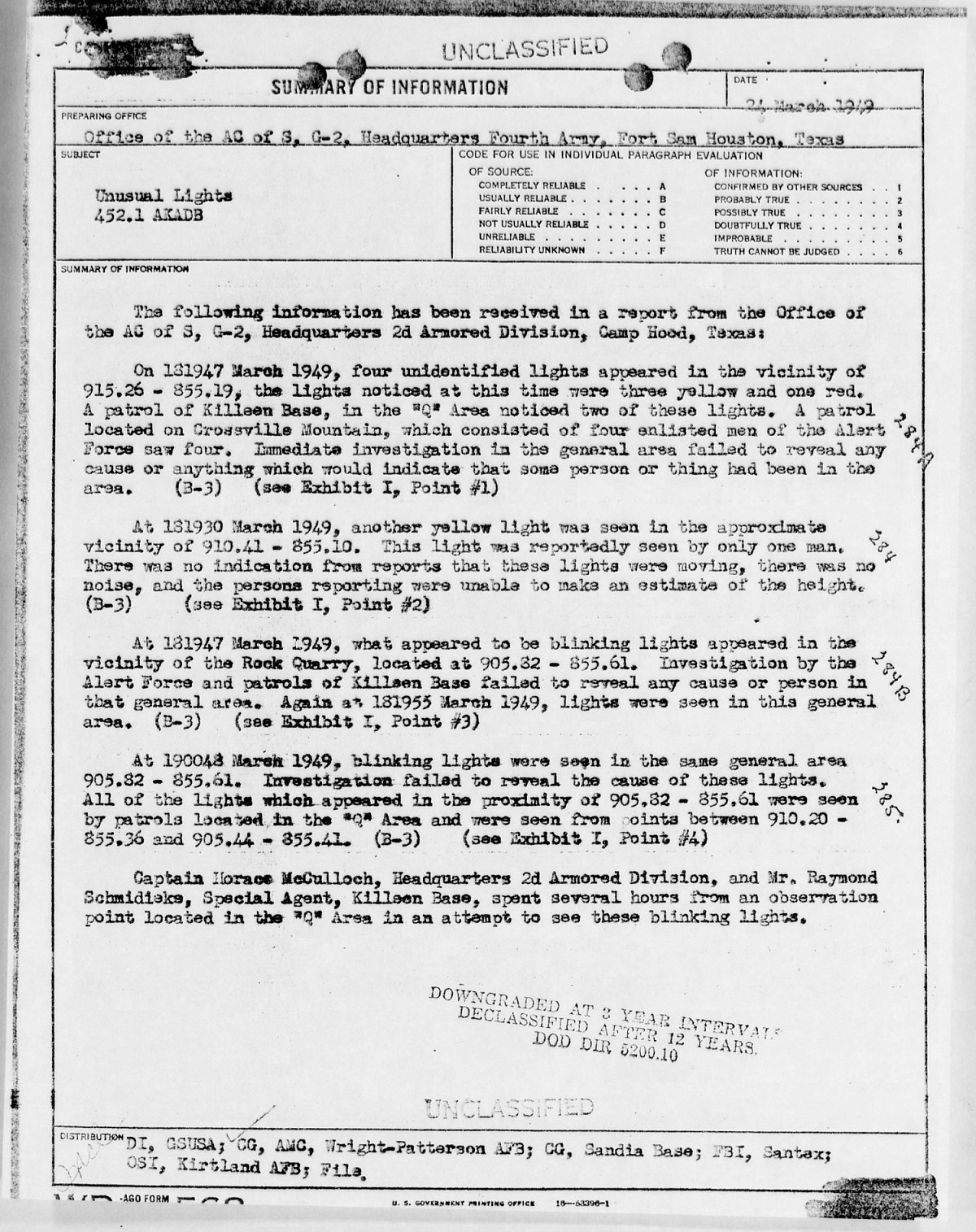
The contemporaneous paper trail survives. The earliest surviving primary document tied to the wave is a memorandum from the Office of the Assistant Chief of Staff, G-2, Headquarters Fourth Army, Fort Sam Houston, Texas, dated 24 March 1949, headed with reports of unidentified objects over the Q Area nuclear storage at Killeen Base. The individual incidents were worked up as Air Force Office of Special Investigations case files, numbered in sequence (the March cases fall in the AFOSI 28 to 39 range, with the 31 March fireball logged as AFOSI case 46), and were later released under the Freedom of Information Act. The same files were indexed by the Fund for UFO Research and worked through in detail by researchers Jan Aldrich and Brad Sparks.
The official handling is the strongest part of this case. The 17 March McCulloch triangulation was carried into the federal UFO program's own books as an unexplained event. In Brad Sparks' Comprehensive Catalog of 1,500 Project Blue Book UFO Unknowns, the entry reads, verbatim: "March 17, 1949. Killeen Base, Camp Hood, Texas. 7:52 p.m. Capt. Horace McCulloch, Asst. G-2 of the 2nd Armored Division at the nuclear weapons storage site, was preparing the test firing of flares in order to prove recent sightings were mistakes when he and his men themselves saw aerial phenomena, 7 separate sightings by trained artillery observers in different locations enabled rapid triangulation of large, green, red and white flare-like objects flying in generally straight lines." That entry carries Blue Book case number 319 and sits in the catalog of cases the Air Force itself left classified as Unidentified, not the much larger pile it explained away.
The Texas wave also overlapped, in time and in pattern, with the green fireball flap then unfolding over New Mexico's atomic sites at Los Alamos and Sandia, which the Air Force was already struggling to explain. Dr. Lincoln LaPaz of the University of New Mexico, brought in to investigate the New Mexico fireballs, plotted their paths, found no meteorite fragments, no craters and no debris, and concluded they did not behave like ordinary meteors. That unresolved investigation fed into Project Twinkle, the green-fireball observation effort set up in December 1949, which never produced a clean answer. Jan Aldrich is the researcher who explicitly tied the Camp Hood Texas events into that same nuclear-site green fireball context. No official report has ever produced a positive identification of the Killeen Base objects.
What did the witnesses think it was?
The witnesses here were not random civilians who glimpsed a light and drove on. They were soldiers whose profession was observation, posted at a nuclear stockpile and trained to call out and track aerial threats. That changes how their accounts read. Sergeant Vickery, Private First Class Ransom, Corporal Sims, Lieutenant Davis, Lieutenant Ward and Captain McCulloch were the security apparatus of an atomic weapons site reporting what crossed their airspace, and the descriptions are consistent across many different men on many different nights: colored lights, diamond and oblong shapes, silent flight, color shifts, and on several occasions electromagnetic interference with telephones and radios precisely while the object was in view.
Captain Horace McCulloch is the pivotal witness because of his starting position. As the division's assistant intelligence officer he was a skeptic by job description, and he went out specifically to demonstrate that the reports were mistakes by firing flares for comparison. The fact that the man running the debunk ended up logging seven triangulated sightings of objects he could not call flares is the heart of why this case endured. His own corroboration came from the multiple trained artillery observers spread across the site, whose independent fixes from different angles is what allowed the triangulation in the first place. Triangulation matters because it removes the single biggest weakness in light-in-the-sky reports: it gives an actual distance and altitude rather than a guess, and it requires several separated observers to agree on the same point in space at the same instant.
Lieutenant Mardell Ward's May trackings are the most technically loaded. Working a purpose-built observation post with other stations, Ward's team produced numbers, not impressions: a 57-second track over about 20 miles on 7 May at a computed 1,000 feet altitude, and a nine-minute observation on 8 May with severe radio interference that cut out the moment the object left. The June closeout, tracked by observers Williams and Jones through the same plotting network, ended with an object that accelerated and then burst apart in a shower of particles. Taken together the witnesses believed they were watching real, structured objects maneuvering over the stockpile, fast, silent, and capable of disrupting their communications, and that belief was shared up and down a military hierarchy that found the reports credible enough to stand up an entire observation and triangulation network to catch the things, the same instinct that drove the parallel green fireball investigations in New Mexico.
Is the Fort Hood (Camp Hood) 1949 Wave real? The two-pass assessment
First pass, the mundane reading. Spring 1949 over central Texas offers several ordinary candidates, and they should be named plainly. Some of the brief, low, close-in lights, the inch-and-a-half violet glow drifting through tree branches a few feet off the ground, are small enough and near enough to be insects, ground lights, or static discharge, and honest cataloguers flag those as weak. Bright fireballs crossing the sky fit meteors or bolides, which were genuinely common in this region and era and which seeded the whole New Mexico green fireball panic. Flares are the obvious match for slow colored lights over a military range, which is exactly why Captain McCulloch went out to fire them. Aircraft, balloons, and the planet Venus account for a share of any three-month run of night-sky reports by tired sentries. Misidentification, suggestion, and a jittery nuclear garrison primed by the New Mexico flap would inflate the count. Any responsible read has to concede that a fraction of these dozens of reports were probably ordinary.
But the mundane reading runs out before the best events do. The flares explanation collapses on its own author: McCulloch fired flares to prove the sightings were mistakes and instead logged seven triangulated objects he classed as phenomena, which means the comparison object was present and the unknowns still did not match it. Meteors do not hold for 57 seconds over a measured 20-mile track, do not hover and then accelerate into level flight, and do not knock out field telephones and radios in the instant they pass overhead while leaving the sets working before and after. The triangulation is the part that resists deflation: multiple separated, trained artillery observers fixing the same point gives real distance, altitude and speed rather than a lone witness's guess, and that is hard to reconcile with a balloon, a planet, or a star.
Second pass, if real. What the Killeen Base files describe is structured craft, diamond and oblong and spherical, operating silently at low altitude directly over America's atomic stockpile in 1949, capable of high speed, hovering, color change, and electromagnetic interference. This sits inside the exact pattern the era's own investigators were chasing: unexplained objects clustering on nuclear facilities, from the green fireballs over Los Alamos and Sandia that defeated Dr. Lincoln LaPaz, to the storage sites at Camp Hood. The Army's response, standing up a dedicated observation and triangulation network to catch the objects, is itself evidence the military treated them as real, physical, and worth instrumented pursuit.
The tier is Verified Unexplained. This is not a single grainy photo or one excitable witness. It is a documented military wave with FOIA-released Army and AFOSI case files, multiple trained observers, real-time triangulation yielding hard numbers, recorded electromagnetic effects, and a flagship event carried in the Air Force's own books as Blue Book Unknown case 319. No independent, civilian, method-shown analysis has ever identified the specific objects or demonstrated a hoax. The official apparatus did not explain it away; it logged it as unidentified and tried to catch more. The material is authenticated and the objects remain unexplained, which is the definition of this tier.
Sources
- www.fcoiaa.it/wp-content/uploads/Data/Ufo/USA/BBook/BB_Unknowns_1_7.pdf
- www.theufochronicles.com/2012/05/ufos-nukes-declassified-document-ufos.html
- www.globalsecurity.org/wmd/facility/killeen.htm
- www.history.com/articles/ufos-green-fireballs-nuclear-facilities-new-mexico
- www.nicap.org/nmexico/newmexicosightings.htm
- www.nicap.org/hood490317dir.htm
More cases from this region: UFO sightings in United States