The Portland Police Disc Flap of July 1947
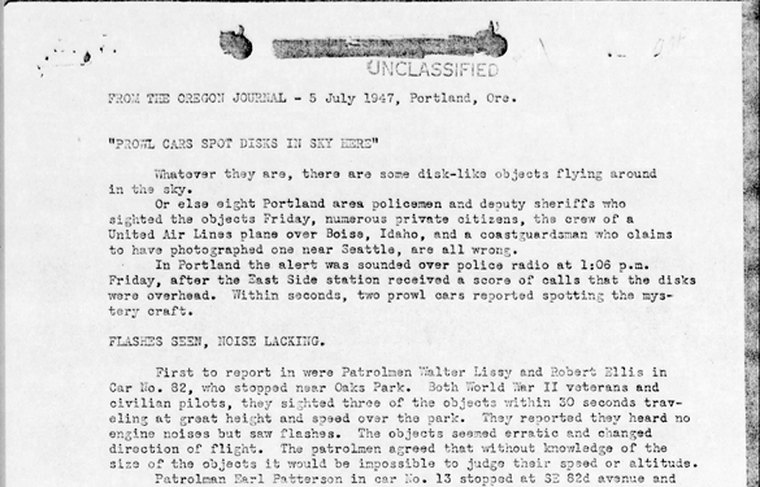
Just after 1 p.m. on Friday 4 July 1947, Portland police patrolman Kenneth A. McDowell was feeding pigeons in the lot behind the Kenton precinct on the north side of the city when the birds suddenly flushed and scattered. This case file covers what witnesses reported, the official narrative, and a two-pass assessment with its evidence tier.
What did witnesses see at Portland?
Just after 1 p.m. on Friday 4 July 1947, Portland police patrolman Kenneth A. McDowell was feeding pigeons in the lot behind the Kenton precinct on the north side of the city when the birds suddenly flushed and scattered. McDowell looked up and saw five large disc-shaped objects to the east, two of them heading south and three heading east, all of them "dipping up and down in an oscillating motion" and moving very fast before they were gone within seconds. He could not fix their color. He radioed it in, and police radio officer Dick Haller put out an all-car alert at about 1:05 p.m. That alert turned a single officer's report into one of the best-witnessed police flaps of the entire 1947 wave, because over the next several minutes officers across Portland, a state police sergeant, the city harbor patrol, and sheriff's deputies across the river in Vancouver all looked up and reported the same kind of objects.
In Bloecher's case numbering, patrolmen Walter A. Lissy and his partner in Car 82 (logged as Andrew Fox in Bloecher, reported as Robert Ellis in The Oregonian) saw three flat round discs flying at terrific speed near Oaks Amusement Park; Lissy, a World War II veteran and private pilot, later told atmospheric physicist James McDonald they had actually counted six or seven objects making sharp-angle turns no aircraft could perform. Patrolman Earl Patterson in Car 13, a former Army Air Corps pilot, watched a single aluminum-colored disc cross from the northeast to the southwest in a fast arc, with no sound and no vapor trail, and was adamant it was not a plane. Oregon State Police Sergeant Claude Cross, watching from headquarters at 9200 S.E. McLoughlin Boulevard in Milwaukie, reported two or three objects, "almost pure white," moving at terrific speed.
The Portland harbor patrol gave one of the most quoted descriptions of the day. Captain K. A. Prehn, harbor pilot A. T. Austad, and patrolman K. C. Hoff watched three to six disc-like objects pass south near the Globe Mills at roughly 10,000 feet. As the Oregon Journal printed their words: "The disks would oscillate and sometimes we would see a full disk, then a half-moon shape, then nothing at all. The objects looked more like shiny chrome hub caps off a car which wobbled, disappeared and reappeared." Across the Columbia River in Vancouver, Washington, Clark County sheriff's deputies including Fred Krives, John Sullivan, Joe Kurth and Bill Giles watched twenty to thirty objects streak southwest over the courthouse in evenly spaced intervals, "like a flight of geese," and several of them reported hearing a low humming sound or drone. The day closed in the air: United Airlines captain E. J. Smith, first officer Ralph Stevens and stewardess Mary Morrow, flying the Boise-to-Portland run, watched a string of flat circular objects for roughly twelve to fifteen minutes after takeoff, with Smith telling reporters "they weren't aircraft, they were bigger than aircraft and flat and circular," and "no object I know of could disappear so quickly as these things."
What is the official explanation?
The July 1947 Portland sightings were absorbed into the United States Air Force flying-disc investigation that became Project Blue Book, and the case carries an unusual distinction: it was officially carried as an "unknown." The Blue Book file, a page of which survives as a scanned US Air Force document, records the numbered Portland and Vancouver incidents and states plainly: "There is no astronomical explanation for this incident, nor for numerous others which occurred in and near Portland on the Fourth of July, 1947." That is the Air Force's own evaluator conceding that the standard reach-for explanations, a planet, a star, a meteor, did not fit.
The only mundane candidate the file floated came with the investigator's own hedge attached. Because it was Independence Day, the evaluator wrote, it was possible that small aluminum-looking pieces had been dropped from a plane during a celebration, and that such foil would flutter and "give the illusion of being a fast moving disc." He then immediately undercut his own idea, writing that "the above is not to be regarded as a very likely explanation but only a possibility." That matters under this archive's rules: an official body offered a guess, then refused to stand behind it, and still logged the case as unidentified. No specific aircraft, no specific celebration flight, and no recovered foil were ever produced to convert the speculation into an identification.
The case was reviewed again by Blue Book's longtime astronomical consultant, Dr. J. Allen Hynek. Hynek did not accept the "unknown" label and placed the Portland events in his file of non-astronomical incidents, associating them in his notes with possible rockets, flares, or falling bodies. His disagreement is recorded as a classification preference rather than a demonstrated identification; the published accounts give no quoted Hynek analysis pinning the Portland discs to a specific rocket launch, a specific flare drop, or a specific falling object, and the contemporary witnesses, several of them pilots, explicitly described powered, maneuvering, formation-keeping objects rather than ballistic or falling debris. Beyond the federal file, the events entered the serious civilian record through Ted Bloecher's "Report on the UFO Wave of 1947," which catalogued the Portland reports as cases 231 through 236 with named officers and car numbers, and through the contemporaneous front-page coverage in The Oregonian and the Oregon Journal of 5 July 1947.
What did the witnesses think it was?
The Portland witnesses were, to an unusual degree, exactly the people a skeptic would want: trained, sober, on duty, and used to identifying things in the sky. Kenneth McDowell, the first to report, was a uniformed city patrolman who acted on what his own pigeons noticed before he did. Earl Patterson was a former Army Air Corps pilot. Walter Lissy and his partner were World War II veterans and private pilots. The harbor patrol men were professional rivermen accustomed to judging distance and motion over open water, and it was they who reached for the homely "shiny chrome hub caps" comparison rather than anything sensational. None of these men described little green men or beams; they described fast, flat, oscillating discs that held loose formation, made turns that aircraft could not, and vanished too quickly to be conventional planes.
The corroboration is the strongest part of the case. This was not one excited observer but a cascade triggered by a radio alert, with independent confirmations coming in from separate parts of Portland, from Milwaukie to the south, and from across the Columbia in Vancouver, all within a short window and all describing the same general phenomenon of multiple white or aluminum discs moving at high speed. Earl Patterson's stated conviction that the object "would have to be radio controlled" if it was anything man-made captures the witnesses' shared position: these looked engineered and directed, not like drifting trash. Years later Walter Lissy stood by his account to physicist James McDonald, sharpening rather than retracting it, telling McDonald the objects made sharp-angle turns no aircraft of the day could survive. The believing witnesses here are not fringe figures; they are the very category of observer, law-enforcement and aircrew, whose testimony Blue Book itself rated highly, which is part of why the file landed on "unknown."
The dispute
The dispute attached to this case is narrow and weak, which is why it sits at Barely Disputed rather than anything stronger. The single mundane explanation in the official record is the Blue Book investigator's suggestion that small pieces of aluminum-looking foil, dropped from a plane during Fourth of July festivities, could have fluttered and "given the illusion of being a fast moving disc." This is an investigator-level speculation, not a finding. The same investigator wrote in the same breath that it "is not to be regarded as a very likely explanation but only a possibility," and the file's overall verdict remained "unknown." No specific aircraft, no celebration flight, no flight plan, and no recovered foil were ever identified to turn the guess into an identification of the actual objects.
The foil hypothesis also fits the testimony badly. Fluttering scraps of falling aluminum do not hold a V-formation across a river valley, do not make ninety-degree turns, do not travel "from northeast to southwest in an arc" against the wind, and would not be described by an experienced pilot as moving faster than anything he had seen. Multiple independent groups of trained observers, several of them aviators, reported powered, directed, formation-keeping motion over a span of minutes and across miles of separated vantage points, which is the opposite of confetti drifting down over one spot.
The secondary dispute is Dr. J. Allen Hynek's later refusal to accept the "unknown" classification, when he filed the Portland events as non-astronomical and tied them in his notes to possible rockets, flares, or falling bodies. Hynek's disagreement is real and is logged here, but it is a stated preference rather than a demonstrated identification. The published record does not show him matching the Portland discs to any specific traced rocket launch, flare drop, or falling object, and the witness descriptions of maneuvering, formation-keeping discs do not match ballistic or falling debris. Because the only counter-explanations are an official's self-hedged guess and a consultant's unproven reclassification, with no confession, no recovered prop, and no positively identified real-world object, the case largely stands and is tiered Barely Disputed.
Is the Portland Police Disc Flap of July 1947 real? The two-pass assessment
Pass one, the fully ordinary reading. The summer of 1947 was the height of the flying-disc craze that followed Kenneth Arnold's 24 June Cascades sighting, and excited people were primed to read anything in the sky as a saucer. Fourth of July traffic could put aircraft, banners, balloons, and celebratory debris overhead, and the Blue Book investigator's aluminum-foil idea trades on exactly that. Reflections of sunlight off distant aircraft, weather balloons (which is what a separate Seattle photograph by Coast Guardsman Frank Ryman that same day was later judged to be), high-altitude debris, and the simple difficulty of judging size, distance and speed against a bright sky could in principle account for individual fragments of the day. A radio alert that put every patrol car on the lookout could also produce a cascade of suggestible reports, where one officer's call primed the rest to interpret ordinary specks as discs.
Pass two, if the objects were real and unidentified, what the record actually supports. The mundane reading runs into the quality and independence of the witnesses. These were trained police officers, a state police sergeant, professional harbor patrolmen, sheriff's deputies, and a veteran airline crew, several of them pilots, distributed across Portland, Milwaukie and Vancouver, reporting within the same short window. They described flat circular objects holding loose formation, oscillating and "wobbling," changing direction sharply, and moving faster than aircraft, with one airline captain insisting the objects were larger than aircraft and disappeared too fast for any plane. Falling foil and drifting balloons do not keep formation, do not turn ninety degrees, and do not outpace airliners. If genuine, this is a daylight mass observation of multiple structured, maneuvering discs over a major American city, recorded by exactly the class of witness an investigator most trusts.
The official apparatus closing this case does not weigh against it; under the rules of this archive an official debunk is evidence the case needed closing, and here the apparatus could not even close it. Project Blue Book carried the Portland flap as "unknown," its own investigator conceded "there is no astronomical explanation," and the only mundane candidate offered was disowned in the same sentence as unlikely. The lone push toward a prosaic verdict is Hynek's later, unproven reclassification, which never identified a specific rocket, flare, or falling object. With no confession, no recovered hoax material, and no positively identified real-world cause, and with strong multi-witness law-enforcement and aircrew corroboration intact, the case largely stands. Tier: Barely Disputed.
Sources
- oregonmufon.com/index.php/oregon-history/44-articles-from-portland-newspapers-1
- www.oregonmufon.com/index.php/oregon-history/45-articles-from-portland-newspapers-1947-2
- rr0.org/time/1/9/6/7/Bloecher_Report1947UfoWave/s3/police/index.html
- openminds.tv/blue-book-unknown-multiple-witness-ufo-sightings-in-oregon-and-washington-on-july-4-1947/
- nicap.org/waves/Wave47Rpt/ReportUFOWave1947_SectionIV.htm
- www.historylink.org/File/871
- www.openminds.tv/wp-content/uploads/Blue-Book-File-OR-Paper.jpg
More cases from this region: UFO sightings in United States