The Wright Field Craft and Creatures Claim
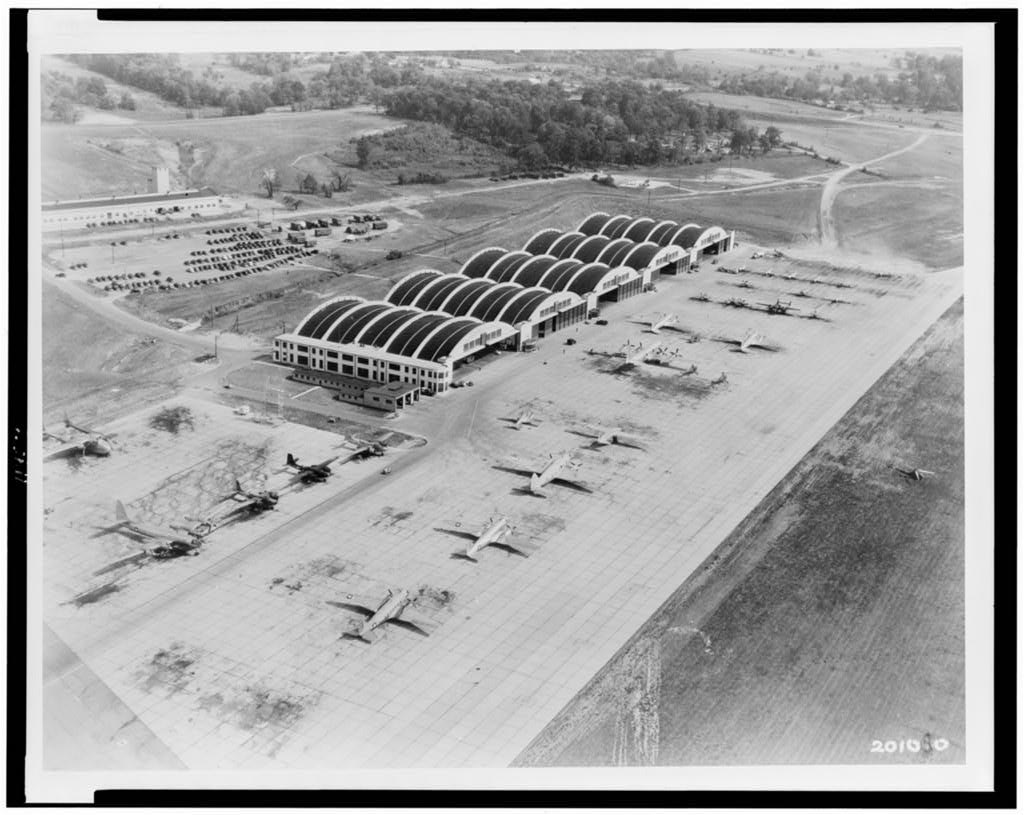
The "craft and creatures" core of this case is a single, second-hand account. This case file covers what witnesses reported, the official narrative, and a two-pass assessment with its evidence tier.
What did witnesses see at Wright Field (now Wright-Patterson Air Force Base)?
The "craft and creatures" core of this case is a single, second-hand account. As told to Brian Vike's HBCC UFO Research and reposted on UFO Casebook, a man assigned to a film unit at Wright Field, Dayton, Ohio in 1947 was ordered without warning, along with another cameraman, to grab their 16mm movie cameras and follow an officer. They were taken into a heavily guarded hangar. Inside was a badly damaged circular craft and, by the account, roughly an acre of debris spread out on a canvas tarp. The officer told them to film everything in sight. They were then walked to a refrigerated unit at the rear of the hangar, where two storage bins held the bodies of two small creatures. The witness described them as gray and thin, with large eyes and no eyelids. One showed severe wounds; the other had no visible injuries. When the case holding the bodies was opened for filming there was a smell likened to dead fish. When the work was finished the cameras were confiscated rather than sent back to the lab for processing, and the men were sworn to secrecy. The detail most often repeated is the punchline of how it first came out: leaving a 1957 screening of the film "Earth vs. the Flying Saucers" with his son, the quiet man said the movie had gotten one thing wrong, that the beings "were too big." He said no more about it until late in life, and the son submitted the story anonymously after his father's death.
That hangar account is the most cinematic strand, but it is not the only thing people claim was "seen" at Wright Field. The broader lore rests on what the most senior witness, retired Brigadier General Arthur E. Exon, described to investigators. Exon was a lieutenant colonel and student at the Air Force Institute of Technology at Wright Field in July 1947, and from 1964 to 1966 he commanded Wright-Patterson Air Force Base, the very installation to which the Roswell material is said to have been flown. In interviews recorded by Kevin Randle and Donald Schmitt between 1989 and 1991, Exon said the material came to Wright Field and was run through the laboratories there, with "everything from chemical analysis, stress tests, compression tests, flexing." He described pieces that were thin yet extraordinarily strong, foil-like but impossible to dent with heavy hammers, and material that the analysts found genuinely strange. In Randle's transcription of the 19 May 1990 session, Exon spoke of a site "where apparently the main body of the spacecraft was, where they did say there were bodies there," recovered in fairly good condition, and said the strongest information was that the recovered material and bodies "were brought to Wright-Pat."
What is the official explanation?
There is no official report that confirms any of this, and that absence is itself part of the documented record. No Project Sign, Project Grudge, or Project Blue Book file logs a recovered disc, a refrigerated body store, or confiscated 16mm film at Wright Field in 1947. The Air Force's own later position, set out in its 1990s Roswell reports, was that the New Mexico debris was a balloon train from the classified Project Mogul and that the "bodies" tales conflated later anthropomorphic test dummy drops, a position that explains away the New Mexico end of the story and says nothing that confirms the Dayton hangar scene. So the only "official" texture this case has comes not from a document but from two senior officers reacting to questions about a room.
The most quotable of these is Senator Barry Goldwater, a major general in the Air Force Reserve who chaired the Senate Intelligence Committee. Goldwater repeatedly described trying and failing to get into a secured room at Wright-Patterson where UFO material was rumored to be held. In a letter to researcher Lee Graham dated 11 April 1979 he wrote, "It is true that I was denied access to a facility at Wright-Patterson." In a follow-up dated 20 May 1981 he recounted that General Curtis LeMay "told me very emphatically that nobody could go in those rooms, not even he." He told the same story for the public for years. In the 1988 New Yorker profile he said people kept asking him to get into the room "because that's where the Air Force stored all the material gathered on UFOs. I once asked Curtis LeMay if I could get in that room, and he just gave me holy hell. He said, 'Not only can't you get into it but don't you ever mention it to me again.'" On Larry King's CNN program in 1994 he repeated that he had asked LeMay, "General, I know we have a room at Wright-Patterson where you put all this secret stuff. Could I go in there?" and that LeMay "got madder than hell at me, cussed me out, and said, 'Don't ever ask me that question again.'"
Exon's testimony is the other piece that reads as quasi-official, because it comes from a base commander. But Exon himself bracketed it. In a letter to Randle dated 24 November 1991 he wrote, "Although I believe you did quote me accurately, I do believe that in your writings you gave more credence and impression of personal and direct knowledge than my recordings would indicate on their own." He stressed he had "no direct responsibility" for any of it. The strongest official-sounding line in the whole case, in other words, was hedged by the man who said it.
What did the witnesses think it was?
The witnesses split into two very different classes, and the difference is the whole case. On one side is the anonymous film-unit cameraman, who clearly believed he had filmed a real downed craft and two real non-human bodies. His sincerity is suggested by the detail his son remembered most, the offhand correction that the movie aliens "were too big," and by the fact that he sat on the story for decades and let it out only near the end of his life. The trouble is that nothing about him can be checked. He is unnamed, he is dead, the second cameraman is also unnamed, the footage was taken from him, and the only person speaking for him is a son passing the story to a researcher long after the fact. As testimony it is heartfelt; as evidence it is unverifiable.
On the other side is General Arthur Exon, a named, traceable, senior officer with a real and relevant posting history, and he is the reason the Wright Field story carries any institutional weight at all. Exon plainly believed something unusual reached the labs there. He volunteered, without prompting from Randle, that an oversight group ran the secret, a committee he called "the Unholy Thirteen" only because he did not know its real name, and he attached names to it including President Truman, General Carl Spaatz, Secretary of Defense James Forrestal, and Stuart Symington. But Exon also told researcher Karl Pflock in a September 1992 telephone conversation that his statements about bodies and debris at Wright Field were based on rumors he had heard from colleagues at the field and nothing more, and that the New Mexico sites he had flown over were on later, unrelated missions. He never said he had been misquoted; his complaint, in his own 1991 letter, was that the writeups made his second-hand knowledge sound first-hand. That is a witness who believed the rumors were real but was careful to say he was repeating them, not confirming them.
Goldwater belongs to a third category, a credible witness to a bureaucratic fact rather than to the contents of any room. He never claimed to have seen craft or bodies. What he testified to, consistently and in writing, was that he was refused entry and that a four-star general he counted as a friend reacted with unusual fury. He believed there was something there worth that secrecy, but he was honest that he never got in to find out. Taken together the witnesses range from sincere and uncheckable, to senior but self-qualified, to credible but only about a locked door.
The dispute
The dispute is not a single debunk but a structural weakness plus one witness's own retreat. The structural weakness is that not one element of this case survives on physical evidence. The anonymous film-unit account, the most lurid strand, is uncorroborated, second-hand, and anonymous: the cameraman is unnamed and deceased, his son is the sole narrator, the supposed footage was confiscated and has never surfaced, and the disclosure was prompted by a 1957 screening of the science-fiction film "Earth vs. the Flying Saucers," whose flying discs and small crews mirror the account. Skeptics, including researcher Karl Pflock, treat this profile as the signature of an unverifiable anecdote rather than evidence of a recovery.
The sharper, more specific counter comes from inside the case's own best witness. General Arthur Exon, who was at Wright Field in 1947 and later commanded Wright-Patterson, told Randle and Schmitt the New Mexico material reached the field and puzzled the labs, but he qualified this in a letter of 24 November 1991, writing that the published accounts "gave more credence and impression of personal and direct knowledge" than his recordings warranted. In a September 1992 telephone conversation with Pflock he said plainly that his comments about bodies and debris at Wright Field were based on rumors from colleagues and nothing more, and that his New Mexico overflights were unrelated post-1947 missions. That is the central named insider stepping back from first-hand knowledge to hearsay.
What keeps this at Barely Disputed rather than Strongly Disputed is that the retreat weakens the testimony without closing the case, and that the counter-explanations remain assertions rather than demonstrations. No confession exists, no hoax prop has been recovered, and no one has positively identified the specific real-world object or the specific fabrication behind any single element. Kevin Randle further notes that Pflock's 1992 call left no reviewable recording and that Exon never claimed to have been misquoted, only that the interpretation overstated his certainty. The Goldwater material cuts both ways: his 1979 and 1981 letters genuinely document that he was refused entry to a Wright-Patterson facility and that Curtis LeMay reacted with anger, which the ordinary reading must still explain, even though that denial proves a closed room, not its contents. The case stands on sincere but untestable testimony, dented by its own key witness, and that is exactly the shape of a barely disputed claim.
Is the Wright Field Craft and Creatures Claim real? The two-pass assessment
Pass one, the ordinary reading. Strip the case to what can be tested and very little remains. The hangar scene has no surviving film, no named witness, no recovered body, no contemporaneous paperwork, and a disclosure triggered by a 1950s science-fiction movie about flying saucers and small alien crews, which is exactly the kind of cultural prompt that can seed or reshape a memory. The "very thin but awfully strong" foil that Exon described is the same trope that recurs across crash-retrieval lore and matches nothing exotic on its own. Goldwater's locked room is real but proves only that Wright-Patterson, the Air Force's central foreign-technology and intelligence campus, held compartmented material that an unauthorized senator could not see, which is true of countless rooms there for entirely terrestrial reasons. And Exon, the one heavyweight witness, told Pflock outright that his bodies-and-debris claims were colleague rumor. An ordinary account fits: an unverifiable family anecdote dressed in genre imagery, plus a senior officer relaying base gossip, plus a politician describing normal compartmentalized secrecy.
Pass two, if real. If real, this is the storage and reverse-engineering end of a 1947 crash retrieval, the place where a recovered disc and its occupants were taken to be photographed, refrigerated, dissected, and run through stress, compression, and chemical testing under a control group so secret that a future presidential nominee was cussed out for asking about it. That is the version the witnesses sincerely advanced, and the materials descriptions, the body store, and the oversight committee all point the same way if any single witness is taken at full strength.
The verdict is Barely Disputed. The case is not discredited: there is no confession, no recovered hoax prop, and no positive identification of a specific real-world object or a demonstrated fabrication of any element, so it does not meet the bar for Strongly Disputed. What pulls it off "Unknown" and into the disputed band is concrete and specific, the central named insider, General Exon, walking his own most important claims back from first-hand knowledge to colleague rumor in 1991 and 1992, sitting alongside the total absence of physical trace. Those are real dents, but they weaken the testimony rather than close the case, which is the definition of barely disputed. The Wright Field craft and creatures claim stands as sincere, persistent, institutionally textured testimony with nothing material under it, dented by its own best witness.
Sources
- roswellproof.homestead.com/exon.html
- kevinrandle.blogspot.com/2022/03/the-general-exon-quotes-are-accurate.html
- ufology.patrickgross.org/rw/w/_arthurexon.htm
- kevinrandle.blogspot.com/2008/05/barry-goldwater-and-curtis-lemay.html
- www.theufochronicles.com/2012/06/opening-door-to-blue-room-where-ufo.html
- web.archive.org/web/20250802051651/https://www.ufocasebook.com/wrightfield1947.html
- www.thinkaboutitdocs.com/1947-craft-two-aliens-at-wright-field-dayton-ohio/
- www.loc.gov/item/95510266/
- tile.loc.gov/storage-services/service/pnp/cph/3c10000/3c14000/3c14500/3c14588v.jpg
More cases from this region: UFO sightings in United States