A White Object Filmed at Last Light over Georgetown, Kentucky
The camera's own clock agrees with the witness to within two minutes, which is rarer than it sounds on a sighting form. What the camera cannot settle is whether the pale shape above the treeline was moving at all.
What did witnesses see at Georgetown?
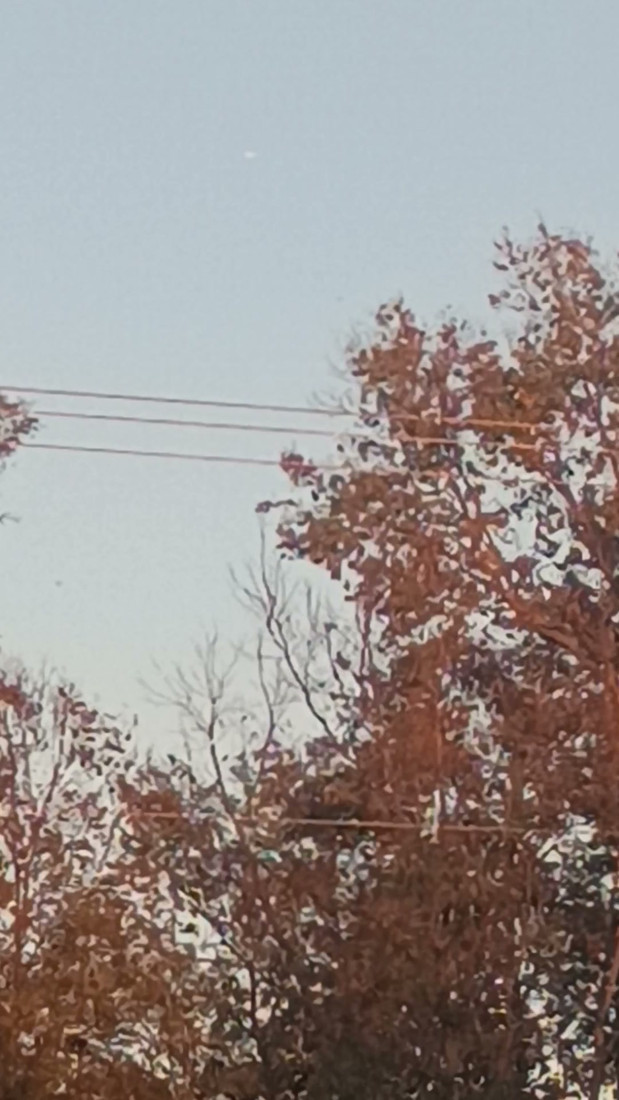
A Georgetown resident recorded a small white object in the western sky at last light on 17 October 2026. He was standing outside talking with a neighbour when he noticed it, and he filmed for about nineteen seconds while zooming in.
The structured filing submitted through ufosighting.report gives the time as 6:50 PM EDT, the duration of the sighting as three minutes, and the number of witnesses as two. It describes a single object of changing shape, apparently as distant as the horizon, about the size of a pea held at arm's length, moving randomly and smoothly. The reporter answered yes to sudden extreme acceleration and to flight without visible means of lift, and no to wings, rotors, exhaust plume and noise.
The archive copy of the recording is unusually informative, because it has not been stripped the way these files normally are. It runs 18.76 seconds at 1920 by 1080, and its container still carries the original Android capture tags: a creation time of 2026-10-17T22:48:42Z, which is 6:48:42 PM local, and a device string reading motorola moto g - 2025. Both match the filing. The device matches the capture device the reporter named, and the clock sits one minute and eighteen seconds before the time he typed on the form.
That is worth stating plainly because the opposite is the usual finding. On several cases in this archive the filing's stated time has been wrong by hours, and only the instrument's own clock or the sky in the frame exposed it. Here the two independent records agree.
More footage and images of this sighting
What is the official explanation?
No official body has commented on this sighting. No police report, aviation authority statement or agency assessment is known to exist, and the archive has found no news coverage of the event.
The filing carries an automated sky-context block which states that no bright satellites were visible overhead, computed from a 2026-10-17 orbital catalogue. That block is not load bearing here and the archive has not relied on it. The sighting happened in daylight, when satellites are not visible at all, so the question it answers is not the question the case raises.
What did the witnesses think it was?
The reporter's own account is short. He writes that before going somewhere he was talking to his neighbour, then saw a white blob in the sky, and immediately started recording, zooming in and capturing what he describes as its shifts and teleportations.
Asked on the form why the object could not be something ordinary, he answered that he lives near several airports, knows their flight paths, and knows that aircraft make noise. He adds that he captured the object disappearing on the recording, and that planes do not do that.
A second witness is recorded on the filing but has not given a separate account, so there is one testimony here rather than two.
Is the A White Object Filmed at Last Light over Georgetown, Kentucky real? The two-pass assessment
Pass one, the mundane reading. The physical conditions are all favourable to a prosaic explanation and two of them are measured rather than assumed.
The sky was clear. The Lexington ASOS station, about 20 km south, reported CLR with 10 statute miles of visibility and a wind from 030 at 4 knots at 18:54 EDT, six minutes after the camera's timestamp, and CLR again an hour earlier. There was no cloud deck to put a ceiling on the object or to hide anything behind.
The lighting geometry is the important part. JPL Horizons puts the Sun at azimuth 257 and an elevation of about plus 0.9 degrees at the moment the camera clock records, so the Sun was roughly one degree above the horizon and effectively setting. That is visible in the footage itself as the strong warm light on the tree trunks. An object of any height above the ground at that moment is lit from almost directly side on by reddened low sunlight while the ground below has already gone into shadow, which is the classic condition for something ordinary and high to appear as a bright white shape against a still bright sky.
Birds are a live candidate and the scale of the candidate can be quantified rather than waved at. BirdCast's radar record for Scott County on the night of 17 October 2026 shows nocturnal migration lifting off almost exactly when the recording was made: 4,013 birds aloft at 19:00 local, eleven minutes after the sighting, rising to 5,368 at 19:10 and 21,915 at 19:20, with a peak of 159,548 at 22:10 and a cumulative total of 1,444,119 for the night. Mid October is the heart of the Kentucky fall passage. Daytime soaring birds, which that radar product does not count, are also ordinary at last light.
The planetary explanation is excluded. At the time of the recording Venus stood at an elevation of minus 0.1 degrees and was setting, Jupiter was 24 degrees below the horizon, and nothing of planetary brightness was above the horizon in the direction filmed.
Pass two, what the record will actually support. The object is real in the sense that it is not noise or compression. Measured against a blurred background in the open sky region of each frame, it sits about 17 grey levels above the local sky with a sky noise floor near 1.1 grey levels, which is roughly a 15 sigma detection, and it is present continuously across the tracked window.
Beyond that, the honest answer is that very little survives. The object is unresolved. At native frame rate it measures about 14 pixels wide by 9 pixels high, its area varies with a coefficient of variation of 29 percent, and its width to height ratio swings between 1.00 and 3.14. That rules out the crisp rigidity measured on some other cases in this archive, where a genuinely rigid body held its area to within a few percent, but at this pixel scale the variation is also what thresholding noise alone produces on a blob barely a dozen pixels across. No shape claim is supportable in either direction.
A wingbeat was looked for directly and was not found. Sampling the silhouette at the native 29.92 frames per second across 59 consecutive samples and running a spectrum on the height, width and area series gives dominant peaks with peak to median power ratios of 1.68, 1.59 and 2.21. A control that shuffles the same height series at random and repeats the test 200 times returns a mean ratio of 2.29 and a 95th percentile of 3.26. The observed periodicity is therefore weaker than what random noise produces on the same data, so no flapping signature is demonstrated. The bird candidate remains open on context and is not supported by the footage itself.
The motion claims cannot be tested, and this is the limitation that decides the tier. The reporter describes teleportations and sudden extreme acceleration. The object does trace a straight path across the frame, moving at about 46 pixels per second horizontally with a residual scatter of under 4 pixels about a straight line over 2.1 seconds. But the camera was being zoomed by the operator's own account, and zoom is a change of scale that translation based registration cannot measure. Phase correlation between frames returns correlation peaks of only 0.034 to 0.083, against values around 0.6 on footage from a genuinely locked off camera. Masking the object and repeating the test barely changes those peaks, so the weakness is in the material and not in the object. Camera motion is simply unmeasurable here, which means the apparent track cannot be separated from a pan, and neither the reporter's description of erratic motion nor any claim that the object moved smoothly and steadily can be supported.
The case is tiered Disputed rather than Strongly Disputed on purpose. The conditions favour an ordinary object, strongly, and the archive is not able to demonstrate which one. One test would close it: historical ADS-B playback for the minute recorded on the camera clock, which needs an interactive browser session this run did not have.
Sources
- www.reddit.com/r/UFOs/comments/1x8nwa7/white_blob_changing_shape_moved_randomly_and/
- ufosighting.report/sighting/13149/white-blob-changing-shape-moved-randomly-and-smoothly-over-g
- mesonet.agron.iastate.edu/request/download.phtml?network=KY_ASOS
- ssd.jpl.nasa.gov/horizons/
- dashboard.birdcast.org/region/US-KY-209
More cases from this region: UFO sightings in United States