The Hanbury Dome Encounter
Late on the afternoon of 20 November 1968 a Yugoslavian family, Milin Milakovic, his wife Doris and their eleven-year-old son Slavic, were driving home to 432 Cannock Road, Hednesford, after a day spent house-hunting in the countryside. This case file covers what witnesses reported, the official narrative, and a two-pass assessment with its evidence tier.
What did witnesses see at Farm road near Hanbury?
Late on the afternoon of 20 November 1968 a Yugoslavian family, Milin Milakovic, his wife Doris and their eleven-year-old son Slavic, were driving home to 432 Cannock Road, Hednesford, after a day spent house-hunting in the countryside. Their route had taken them out through Rugeley and Abbots Bromley, and they had stopped near Hanbury, on the Staffordshire and Derbyshire border between Uttoxeter and Burton-on-Trent, to look at an old house that was for sale. Dusk was coming on as they continued, somewhere between 5:30 and 5:45 p.m., on a farm road with fields on both sides.
The first thing they noticed was a rabbit darting across the road from left to right, then several more rabbits bolting out of a hedge on the left and fleeing across in front of the car. Glancing toward the field on their left to see what had startled the animals, the family saw a brilliantly lit object low over the ground. It rose slowly out of the field and moved across the road, passing over or near their stopped car and drifting toward a house on the right, roughly a hundred yards away, where it hung in the air. At that distance it looked as wide as the house beneath it.
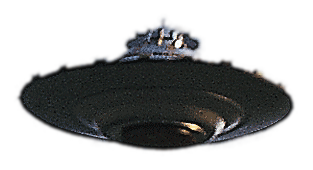
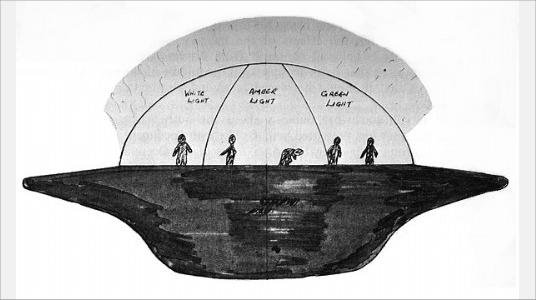
The witnesses described a craft with a dark, bowl-shaped lower hull and a clear, transparent dome on top. The dome was divided into three vertical sections side by side. One third glowed white, the middle third amber, and the far third green. Inside the lit dome the family saw several humanoid figures, about five of them, moving about. The figures walked from side to side and now and then bent down, as though looking at something below the rim of the dome. This part of the encounter went on for roughly five minutes.
Two physical sensations stood out in the account. As the object passed overhead the witnesses felt a distinct warmth, a rise in the air temperature. Then, as the object began to move upward in a pulsating, jerky motion and its light grew much more intense, Mr Milakovic felt a burning sensation in his eyes. Badly frightened, he bundled his wife and son into the car and drove off fast. Throughout the whole sighting the object made no sound at all.
What is the official explanation?
There was no government investigation of this case. The United States Air Force Project Blue Book had no jurisdiction over a British sighting, and the United Kingdom in 1968 had no equivalent public investigating body that took the report. The only investigation on record was civilian. Two British researchers, N. M. H. Turner and Wilfred Daniels, looked into the sighting and wrote it up for Flying Saucer Review, the leading British UFO journal of the period, in Volume 15, Number 1, dated January and February 1969. The article carried a drawing of the object made to the witnesses' description, showing the dark dished hull and the domed top labelled across its three sections as white light, amber light and green light, with small figures standing inside.
The same year the case was picked up by the American group NICAP, the National Investigations Committee on Aerial Phenomena, then directed by Major Donald E. Keyhoe with Gordon I. R. Lore Jr. as assistant director. They placed it in their 1969 special report Strange Effects from UFOs, on pages 29 to 30, in a section dealing with physiological effects, citing the heat felt as the object passed over and the burning of the eyes when the light intensified. NICAP at that time was the most conservative, nuts-and-bolts UFO organisation in the field, and its inclusion of an occupant-and-effects case like this one marked part of the wider turn toward close-encounter reports in the late 1960s.
Jacques Vallee then catalogued the sighting in Passport to Magonia (Contemporary Books, 1969), in his appendix A Century of UFO Landings, the standard scholarly listing of close encounters up to 1968. The case has since been logged in Patrick Gross's URECAT catalogue as URECAT-000081 and in Albert Rosales' 1968 humanoid sightings compilation. None of these later entries adds an official finding; they all trace back to the Turner and Daniels investigation and the NICAP report. No identified aircraft, balloon, rocket or other conventional object was ever named by any investigating party as the cause.
What did the witnesses think it was?
The Milakovic family were the only known witnesses, and there were three of them: Milin Milakovic, his wife Doris and their son Slavic, who was eleven at the time. They were a Yugoslavian family living at Hednesford in Staffordshire, and on the day in question they were ordinary house-hunters caught out by dusk, not UFO enthusiasts looking for something to see. The investigators recorded that Milin Milakovic was normally a brave man, and that what made the encounter so striking was how thoroughly it frightened him, to the point that he pushed his wife and son into the car and fled rather than watch the object leave.
The family clearly believed they had seen a genuine structured craft under intelligent control, with living occupants inside it. The detail they kept returning to was the figures in the dome, moving about and bending down as if working or watching something below the rim, which is why the case is classified as a close encounter of the third kind. They were specific and consistent about the colours, a dome split into white, amber and green thirds, and about the sequence, the fleeing rabbits first, then the object, then the heat, then the burning light, then their flight. The behaviour of the rabbits, bolting from the hedge moments before the object appeared, was treated by later researchers, including the animal-reaction specialist Joan Woodward, as an independent animal corroboration of something physically present in the field.
There were no other named human witnesses and no photograph was taken, so the case rests entirely on the family's testimony and on the contemporary investigation by Turner and Daniels. What weighs in the family's favour is that the account was investigated and published within weeks, that it contains the kind of incidental, hard-to-invent detail (the rabbits, the warmth, the eye-burning) that recurs across unconnected close-encounter reports, and that the witnesses had nothing obvious to gain and walked away frightened rather than seeking publicity.
Is the Hanbury Dome Encounter real? The two-pass assessment
Pass one, the ordinary explanations. With a single family as the only witnesses and no photograph, physical trace or instrument reading, this case cannot be authenticated as a material event, and several mundane possibilities have to be weighed honestly. The setting matters: Hanbury sits beside the old RAF Fauld site, a wartime underground munitions depot about two miles to the north-west, the same place that produced Britain's largest non-nuclear explosion in 1944. The wider area held an Army Central Workshop about three and a half miles north-west and a small wartime airfield about two miles south. A low, lit aircraft or helicopter on approach to a nearby strip, seen head-on at dusk through a windscreen, can look domed and can seem to hang still. Marsh gas, distant lights refracted at the horizon, or a misread reflection are the usual stand-ins for a glowing low object. None of these, though, accounts for the whole package the family described together: a silent craft as wide as a house, a clear dome divided into three coloured thirds with several figures moving and bending inside it, felt heat, and burning eyes. Honest pass-one reasoning has to record that no investigator has ever named a specific aircraft, balloon or other object and shown that it produced this report. The alternative is misperception or invention by the witnesses, but the encounter was investigated and published within weeks, the family sought no publicity, and a hoax leaves no method shown.
Pass two, if the report is taken at face value. Then the Milakovics saw a structured, domed craft under intelligent control, with about five occupants visible inside the lit dome, that radiated enough energy to be felt as heat and to sting the eyes as its light intensified, and that moved without any sound. The fleeing rabbits would be a genuine animal reaction to that physical presence, which is why the animal-behaviour researcher Joan Woodward later treated the case as a creature-response example. The coloured dome and the working figures put it squarely in the close-encounter-of-the-third-kind category that NICAP, Vallee and later cataloguers placed it in.
Weighing the two passes, this is not an authenticated, materially documented case, so it does not reach Verified Unexplained, and there is no photograph or recovered object to anchor it. But neither has anyone advanced a counter-explanation with a method behind it, no named aircraft, no confessed hoax, no recanting witness, so it is not disputed in any meaningful sense. It is a contemporaneously investigated, multi-witness occupant report with no official narrative attached, standing on the testimony of the three witnesses and the 1969 Turner and Daniels investigation. That places it at Unknown: unexplained, uncorroborated by hard evidence, and never honestly closed.
Sources
- ufologie.patrickgross.org/ce3/1968-11-20-uk-hanbury.htm
- ufologie.patrickgross.org/ce3/pics/1968-11-20-uk-hanbury.jpg
- www.ufoevidence.org/cases/case17.htm
- www.scribd.com/document/482269089/Strange-Effects-from-UFOs-A-NICAP-Special-Report-1969
- www.mysterywire.com/documents/strange-effects-from-ufos-a-nicap-special-report-1969/
More cases from this region: UFO sightings in United Kingdom