The St. Clair County Police Triangle
In the pre-dawn dark of 5 January 2000, a chain of police officers across southwestern Illinois reported tracking a single enormous, silent, low-flying object, and they did it on a recorded county radio channel that was later released under FOIA. This case file covers what witnesses reported, the official narrative, and a two-pass assessment with its evidence tier.
What did witnesses see at St. Clair and Madison Counties?
In the pre-dawn dark of 5 January 2000, a chain of police officers across southwestern Illinois reported tracking a single enormous, silent, low-flying object, and they did it on a recorded county radio channel that was later released under FOIA. That recording is what separates this case from almost every other triangle report.
The first witness was a civilian. Melvern Noll, owner of a miniature golf course in Highland, Illinois and an off-season truck driver, had just finished a delivery run and stopped around 4:00 a.m. to check on his property. He noticed what he took to be a "bright star" in the northeast sky, went inside, came back out, and realized it was moving toward him. As it closed, the bright white light resolved into part of a much larger structure. In David Marler's account for the MUFON Journal, Noll described a rectangular object "comparable to the size of a football field," very tall, "like a two-story house," with a series of lighted "windows" running down the side arranged in two floors of two windows each, and a large number of dim red lights underneath. He guessed the exterior was black or dark gray, estimated the altitude at roughly 500 feet, and watched it for about five minutes as it moved northeast to southwest, slowing as it passed before regaining speed. Noll drove straight to the Highland police station, reasoning that nobody would believe him unless a neighboring department could confirm it.
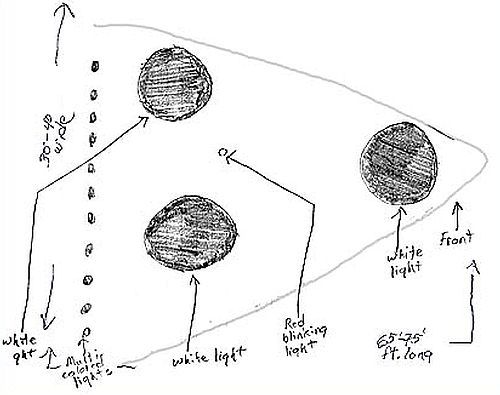
The Highland dispatcher relayed the report to the St. Clair County dispatch center, CENCOM, which put out a call. Officer Ed Barton of the Lebanon Police Department took it around 4:10 to 4:15 a.m. He asked the dispatchers if they were joking; they said they were not. Driving north then east out of Lebanon, Barton spotted two brilliant white lights so close together they nearly touched, radiating outward like the rays on the Japanese Rising Sun flag. As he watched, the two lights appeared to merge into one. The single light then looked like an elongated cigar, hovering over nearby Summerfield. Barton pulled over, shut off his engine, lights, and radio to listen, and heard nothing. The object resolved into a massive narrow triangle, longer than it was wide, with a huge bright white light at each corner pointing straight down without lighting the ground, plus one smaller red flashing light set toward the rear on the centerline. He estimated it was no more than 100 feet away and about 1,000 feet up, and watched it blot out the stars as it passed. Then it pivoted in mid-air, flat and level, with no bank, from a southerly to a southwesterly heading. As Barton radioed CENCOM, the object dramatically accelerated, so fast he could barely follow it with his eyes. By his account it relocated to near Shiloh, roughly 6 to 8 miles away, in the few seconds it took him to make the transmission.
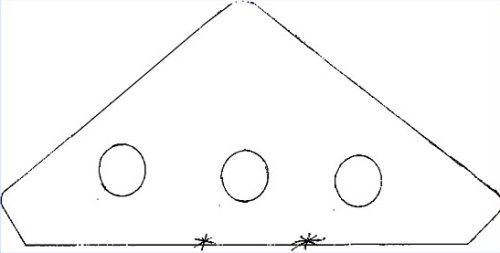
Exactly 51 seconds after Barton put the object near Shiloh, at dispatch timecode 4:23:57 a.m., Shiloh Officer David Martin radioed that he saw "something" but did not know what it was. Driving east, Martin saw an extra-wide triangle or arrowhead with three brilliant white lights shining downward (again not lighting the ground) and small red and green lights on the rear. He put it around 1,000 feet up, a quarter mile off, and 75 to 100 yards wide, with a bottom surface that was not flat but irregular and blocky, like the superstructure of a naval battleship or pieces of "plumbing." He rolled down his window, heard no sound, and as he prepared to step out for a better look the object shot away westward at what he estimated jumped from about 15 mph to 80 to 100 mph.
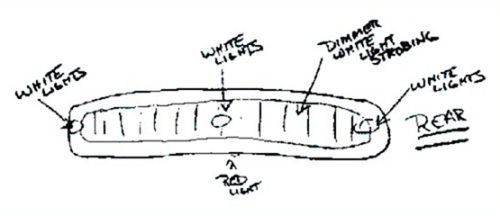
In Millstadt, Officer Craig Stevens had heard the radio chatter and parked at Liederkranz Park on the north end of town. At 4:28 a.m. by his watch he saw a roughly triangular object pass slowly to his left, only 500 to 1,000 feet up. He told the dispatcher he could see it; she asked if he was kidding, and he answered "It's huge." Stevens described an arrowhead shape with a concave rear carrying a horizontally moving strobing light and a full bank of white light across the aft surface, with a single red light underneath. At that low altitude he could just make out a faint buzzing, like the hum of a power transformer on a utility pole. He pulled his Polaroid from the trunk, but in the 15-to-20-degree cold the camera barely worked; the single exposure he got showed only smears of light blurred by camera motion. The object banked slowly away toward St. Louis and vanished over the trees.
About five minutes later, Officer Matt Jany of the Dupo Police Department, watching from the southwest, reported a high, distant array of lights that he viewed through binoculars: white lights at the extreme ends, red in the middle. Unlike the others, Jany put the object high, at the altitude where commercial traffic approaches Lambert-St. Louis International, and said it stayed east of Dupo on a north-northeasterly heading. When Lambert tower called him to ask if he still saw it, he said yes, and was told there was nothing on radar in his area. Two later witnesses extended the morning: O'Fallon detective Mark Lopinot, who told Barker in a 2002 interview he had seen five silent, perfectly synchronized amber lights spanning more than a 747 wingspan make a sharp directional change, and Centreville school teacher Stephen Wonnacott, who at about 6:50 a.m. in first light saw a stationary triangular object with two very bright white lights and many smaller ones, an account he gave to the St. Louis Riverfront Times.
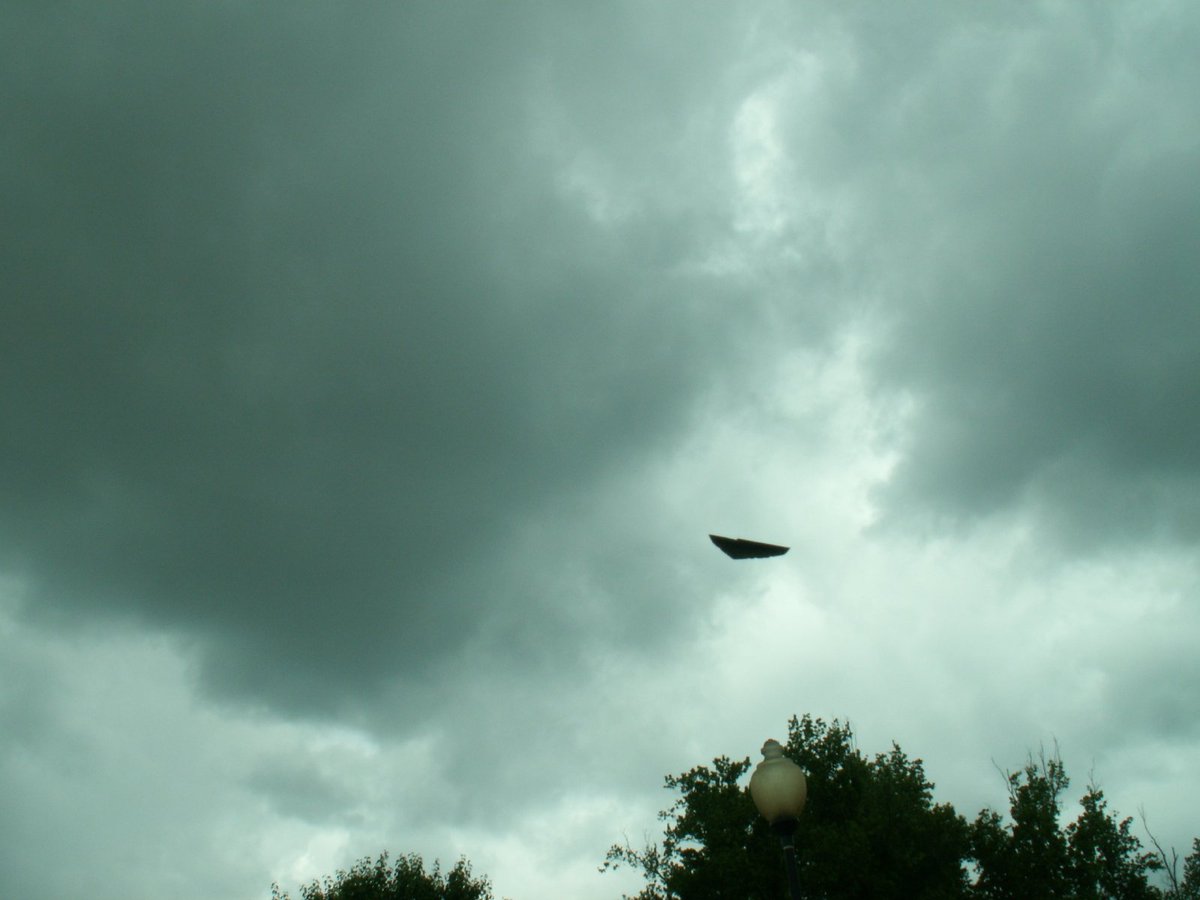
More footage and images of this sighting
What is the official explanation?
There was never an Air Force investigation of this case in the Project Blue Book sense, because Blue Book closed in 1969. What exists instead is a paper trail of official non-engagement and a single documented counter-explanation, neither of which closes the matter.
The most important official document is the St. Clair County Sheriff's dispatch tape itself. Darryl Barker, who produced the 2001 documentary "The Edge of Reality: Illinois UFO, January 5, 2000," obtained the CENCOM dispatch timecode log under a Freedom of Information Act request filed in February 2000, and his groundwork cleared the way for the Discovery Channel to access the radio recordings. The transcript, reproduced in David Marler's MUFON Journal No. 383 (March 2000) report "Illinois police officers track UFO near Scott AFB," is plain and unglamorous. The Highland call comes in describing "a flying object" that "looks like a two-story house" with "white lights and red blinking lights." A Lebanon officer responds half-joking, asks "if I happened to find it, what am I supposed to do with it," then turns serious: "there is a very bright white light east of town. It looks like it's just east of Summerfield, and it keeps changing colors... It doesn't look like an aircraft, though... It's not the moon, and it's not a star." The dispatcher is asked to phone Scott Air Force Base. The Shiloh officer: "I see something, but I don't know what the heck it is." The Millstadt officer: "I've got that object in sight also... It's kind of V-shaped." Then, telling, one officer hums the theme to "The Twilight Zone" over the radio, the Millstadt officer says "This object was above me about 500 feet. And it was huge," while the Dupo officer insists "it's probably 20 or 30,000. It's about where planes usually are. It's not low at all." The transcript records, in real time, both the multi-jurisdiction tracking and the central disagreement about altitude.
Scott Air Force Base, headquarters of Air Mobility Command, sat roughly two miles off the reconstructed flight path. Marler wrote the base a formal letter of introduction with four questions and received a courteous but uninformative reply stating that (1) the only calls the base received were from the media, (2) no ground observers at the base had come forward, (3) the base tracked nothing on radar because radar services are provided by the FAA at Lambert-St. Louis International, and (4) the base was operating no craft resembling the reports. When a NIDS investigator interviewed Scott personnel and remarked that he could not recall which officer first went public, one Air Force officer reflexively answered "the Millstadt officer," which Barker took as evidence the base knew the details it otherwise disclaimed. Officers at nearby departments told Barker that Scott's radar "almost never stops rotating," contradicting the base's account of having no active radar.
The case drew a serious civilian investigation almost immediately. The National Institute for Discovery Science (NIDS), Robert Bigelow's Las Vegas research organization, sent a team headed by John Velier and published interviews with eight witnesses. NIDS did not resolve the object; over 2002 to 2004 it floated and then walked back a hypothesis that the large triangles were a US Department of Defense black program, noting in an August 2004 report that "the behavior of these triangular aircraft does not conform to previous patterns of covert deployment of unacknowledged aircraft."
The one concrete conventional identification on record is the advertising blimp. Writing in the St. Louis Riverfront Times about three months after the event, reporter William Stage said the FAA had advised him the object reported was an advertising blimp. Science writer Brian Dunning developed this into the standing skeptical account in Skeptoid episode 4435, "The St. Clair Triangle UFO." Dunning notes the sightings occurred not far from operations of the American Blimp Company (later acquired by the Van Wagner Airship Group), that the roughly 55-kilometer Highland-to-Dupo span took about an hour, consistent with a blimp's 35-to-40-mph transit speed, and that such blimps cruise near 1,000 feet with bright landing lights, red bottom lights, white strobes, navigation lights, and on some 2000-era models side arrays that can spell messages. He concluded he "couldn't find a single significant difference between the St. Clair object and an advertising blimp in transit." Crucially, Dunning also concedes the gap in his own case: "nobody at Van Wagner knew of any records showing the details of times and dates of blimps in transit from one event to another back in 2000." No flight record placing any blimp over Illinois that night has ever been produced.
What did the witnesses think it was?
The witnesses in this case were, overwhelmingly, on-duty police officers, and that is the whole reason it became one of the most cited triangle sightings in the United States. None of them claimed to know what the object was. They were careful, often reluctant, and several were openly embarrassed.
Officer Ed Barton of Lebanon filed a written report with sketches showing a large triangle, white lights at each corner, a red blinking light on the centerline toward the rear, and a band of blended multicolored light across the aft surface. His drawing carries the handwritten annotation "65'-75' ft. long." Barton compared the rear of the object to the Millennium Falcon and was visibly struck by the flat, non-banking pivot and the instantaneous relocation toward Shiloh. He went on the Art Bell radio program to describe the encounter. Barton died in January 2004; Barker maintains a memorial page for him. Officer David Martin of Shiloh filed his own report and sketch and reached for a naval-architecture analogy to describe the irregular, blocky underside. Officer Craig Stevens of Millstadt filed the report and sketch that, once posted on the Millstadt Police Department website, pushed the story into the mainstream press. Stevens drew the recessed rear with its bank of white light and the single red light below, and he was the one who tried, and failed, to photograph it with a cold Polaroid. The Dupo officer, Matt Jany, gave a notably different account, a high and distant object, and that divergence is part of the record rather than something smoothed over.
What the officers believed varied. Most resisted drawing any conclusion. The reconstructed flight path passing within a couple of miles of Scott AFB led several toward the idea that it was something military, and Detective Lopinot of O'Fallon assumed at the time it was "something from Scott" and said nothing until he heard the news. The civilian investigators were more willing to speculate. Forest Crawford, then assistant state director of Illinois MUFON, was quoted in early coverage suggesting an experimental government craft, though he later told Barker he had been misquoted. David Marler, the Illinois MUFON state director who wrote the most detailed first-generation report, was scrupulous about the disagreements between witnesses. He explicitly listed the prosaic possibility first, that "witnesses can be wrong in their interpretations," and worked through perspective effects, the chance of multiple objects, and even shape-change, before concluding only that the timing and the flat local terrain favored a single object tracked town to town, and that Scott AFB "may have more detailed information."
The officers paid a social cost for talking. Marler's report and Barker's investigation both describe intense ribbing from fellow officers, and Barker says one officer witness told him he was visited by two men who advised him to "stop talking about the sighting," whom the officer took to be some kind of federal agents. The St. Louis Post-Dispatch ran two even-handed pieces in early January 2000 (Valerie Schremp on 9 January, Heather Ratcliffe on 12 January) followed by two dismissive ones. A 21 January op-ed by a local biology professor compared the witnesses to children who want to believe in Santa Claus, while conceding "police are high-quality observers" and that the object was probably "real," likely an experimental military aircraft. A 25 January article, "Recent UFO sightings in area lack credibility to scientists," quoted astronomer and former Air Force pilot James McGaha saying "you can't put any credibility into their reports, even police, because they are not trained to observe anything in the sky," and veteran skeptic Philip Klass calling the case "bogus." Barker says that when he met Klass at the 2000 MUFON conference in St. Louis, Klass denied having said "bogus" and admitted he had not interviewed the witnesses, though Klass later proposed the object was the planet Venus, which NIDS rebutted. These hostile assessments came from people who never interviewed a single witness, and under the standard that motivated debunk testimony is weighed as such, they do not close the case.
The dispute
The standing counter-explanation is that the St. Clair County police triangle of January 5, 2000 was an advertising blimp. The page attributes the developed version of this claim to Brian Dunning of Skeptoid, who built it on real and specific points: the American Blimp Company operated near the area, the roughly 55-kilometer Highland-to-Dupo span took about an hour and is consistent with a blimp's 35-to-40-mph transit speed, and blimps cruise near 1,000 feet carrying bright landing lights, red bottom lights, white strobes, and navigation lights. Dunning concluded he could not find a single significant difference between the St. Clair object and an advertising blimp in transit. The original seed of this explanation is older: reporter William Stage of the St. Louis Riverfront Times wrote, about three months after the event, that the FAA had described the object as an advertising blimp.
By this archive's method the blimp account is a serious argument, not a weak one, because the lighting, altitude, and average speed genuinely line up. But it carries two holes its own author concedes. First, no flight record has ever been produced. Dunning himself admits that nobody at the operator (Van Wagner) knew of any records showing the times and dates of blimps in transit between events back in 2000, so the central physical claim, that a specific blimp was over those five towns that morning, rests on plausibility rather than a documented flight. Second, a blimp cannot perform the maneuvers the two closest officers describe. The FOIA dispatch tape timecodes a 51-second window in which Officer Ed Barton reported the object covering 6 to 8 miles toward Shiloh, with sudden acceleration from a near-hover and a flat, level, non-banking pivot, motion no lighter-than-air craft can execute.
The remaining skeptical voices are assertions without a shown method. Philip Klass called the case bogus and later floated the planet Venus; astronomer and former Air Force pilot James McGaha simply dismissed the police officers' credibility as sky observers; a biology professor's op-ed likened the witnesses to people who believe in Santa Claus. None of these reconstructs the event or addresses the dispatch-tape timing. On the official side, Scott Air Force Base stated only that it received media calls, had no ground observers, tracked nothing on FAA-provided radar, and flew no such aircraft. Per this archive's standard that is an apparatus denial, a claim rather than a verdict, and it does not explain what the officers saw.
Taken together, the dispute does not close the case. The blimp hypothesis is the strongest ordinary candidate but remains unverified by any flight record and cannot account for the timecode-confirmed multi-mile relocation and the flat pivot reported by named, on-duty officers. The case accordingly stands as disputed: a real conventional explanation is on the table, yet it leaves the core anomalies unexplained.
Is the St. Clair County Police Triangle real? The two-pass assessment
Pass one, the entirely ordinary reading. The strongest conventional candidate is an advertising blimp in transit, the explanation traced to an FAA remark reported by William Stage in the Riverfront Times and built out by Brian Dunning in Skeptoid. It is not a weak argument. Large advertising airships of the era cruised near 1,000 feet, carried exactly the kind of lighting the officers described (bright landing lights, a red underside light, white strobes, navigation lights, and on some models side panels that spell messages), are famously quiet, which fits Stevens hearing only a faint buzz, and move at 35 to 40 mph, which fits the roughly hour-long, 55-kilometer drift from Highland to Dupo. The disagreement about altitude, Stevens at 500 feet versus the Dupo officer at 20,000 to 30,000 feet, plus Jany's different heading, is real and could mean some officers were watching ordinary aircraft. A drifting, lit blimp at night is genuinely easy to misjudge for size and distance, and police are not trained aerial observers. A second ordinary possibility is that more than one mundane object was aloft and the radio chatter stitched separate sightings into one "tracked" object.
But the blimp account has two holes its own author admits or implies. First, no flight record was ever found. Dunning concedes that nobody at Van Wagner could produce times and dates for any blimp in transit in 2000, and investigators who checked with American Blimp and Van Wagner came up empty. The identification therefore rests on plausibility and an unsourced FAA aside, not on a documented airship over Illinois that night. Second, and more serious, a blimp cannot do what the two closest officers described. Barton reported the object covering 6 to 8 miles toward Shiloh in the few seconds of one radio transmission, and the dispatch timecodes back the tight 51-second window between his "near Shiloh" call and Martin's first sighting. Both Barton and Martin described a sudden acceleration from a near-hover to a speed they could barely track, and Barton described a flat, level, non-banking pivot in mid-air. No lighter-than-air craft accelerates like that or pivots without banking, and Dunning offers no account of the acceleration at all. The altitude discrepancy cuts both ways: it is equally consistent with the witnesses watching a single object that genuinely changed altitude and that the Dupo officer caught at a different phase.
Pass two, if the reports are accurate to the object. Then what crossed Metro East that morning was a single, very large, near-silent craft, on the order of a football field, that flew at low speed and low altitude with downward-pointing lights that did not illuminate the ground, performed a flat pivot, and made at least one apparently instantaneous relocation of several miles, all within roughly two miles of a major Air Mobility Command base whose radar the officers said was running and which told investigators it saw nothing. NIDS examined and could not confirm exotic and semi-exotic possibilities (a speculative "stealth blimp," a developed Aereon hybrid airship, zero-point or warp-style propulsion) and ultimately judged that the flight behavior did not match known patterns of covert US aircraft deployment. The officers themselves leaned, when they leaned at all, toward "something military," but no such craft has ever been produced, and the unexplained accelerations remain unexplained on any conventional or acknowledged-classified hypothesis.
Verdict: Disputed. A specific, named counter-explanation exists and is taken seriously here, the advertising blimp, and the altitude and heading disagreements between officers are a genuine weakness in the witness picture. But that explanation is unverified by any flight record and cannot account for the timecode-confirmed multi-mile relocation and the flat mid-air pivot reported by the two nearest officers. The FOIA dispatch tape, multiple independent on-duty police witnesses, and contemporaneous filed reports give the case unusually strong evidentiary footing, while the unresolved conventional explanation keeps it from "Verified Unexplained." It sits, honestly, as contested.
Sources
- www.ufoevidence.org/cases/case277.htm
- web.archive.org/web/20260519151610/http://www.dbarkertv.com/default2.htm
- skeptoid.com/episodes/4435
- thedebrief.org/the-st-clair-triangle-ufo-incident-of-2000-a-fresh-look/
- www.ufoevidence.org/cases/pictures/Barton1.jpg
- www.ufoevidence.org/cases/pictures/Stevens2.jpg
- www.ufoevidence.org/cases/pictures/Martin1.jpg
More cases from this region: UFO sightings in United States