The Varginha Incident
Varginha is a coffee-trade city of roughly 120,000 people in southern Minas Gerais, Brazil. This case file covers what witnesses reported, the official narrative, and a two-pass assessment with its evidence tier.
What did witnesses see at Jardim Andere?
Varginha is a coffee-trade city of roughly 120,000 people in southern Minas Gerais, Brazil. The events span about a month in early 1996, not a single afternoon, and that multi-day spread is the first thing the older, three-witness version of this file got wrong.
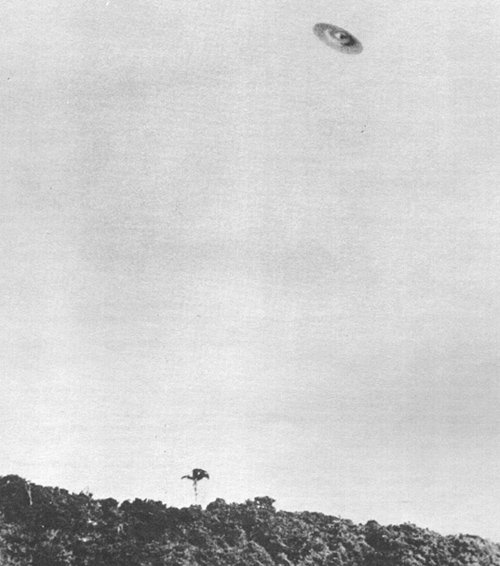
The earliest reports are rural and aerial. A geography teacher, Carlos de Souza, says that before dawn on January 13, 1996, while driving toward Varginha, he watched a cylindrical object cross the sky at a shallow angle, trailing white smoke from a torn flank. He described it on camera as "a long little cigar, the size of a minibus, seven or eight meters," coming down "as if losing power and altitude." At the spot where he believed it came to ground he reported an overpowering smell, "a basin of ammonia full of rotten eggs," army vehicles already on site, and a soldier who pressed a rifle to his chest and told him he had "seen too much." On a smallholding beside the BR-491 road, caretaker Eurico de Freitas and his wife Oralina de Freitas reported, around 1 a.m. on January 20, a smoking object the size of a minibus drifting at five meters or less over their pasture for some forty minutes while the cattle panicked; Oralina likened the shape to "a smoking submarine, no shine to it."
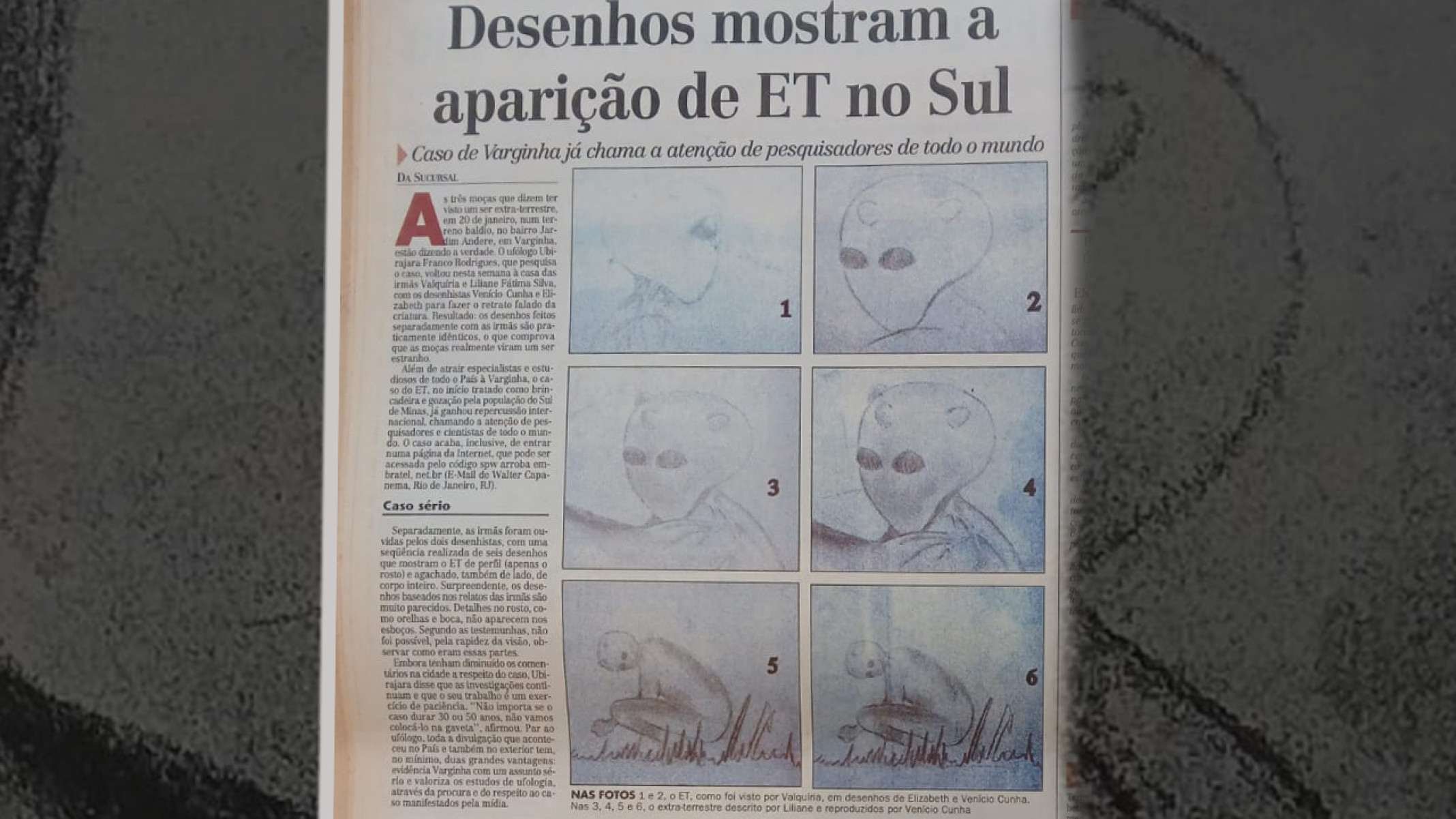
The most famous sighting is the urban one. On the afternoon of Saturday, January 20, 1996, in the Jardim Andere neighborhood, three young women, sisters Liliane Fatima Silva and Valquiria Aparecida Silva and their friend Katia Andrade Xavier (variously reported as ages 14 to 22), came upon a creature crouched by a wall on a vacant lot. They described a being roughly 1.5 meters tall: hairless, with dark brown oily skin that looked wet, a large head with three bumps or protrusions, thin arms and legs, large feet, and big red eyes. Thirty years on, the three still say it was neither animal nor human, and even skeptics concede their fright was genuine.
What raises this above a single creepy sighting is the claim, pushed by local investigators within days, that emergency and military personnel captured one or more of these beings, alive, the same day, and that the captures and the aerial event are linked.
What is the official explanation?
There is a real official record here, and it is uniformly negative. The Brazilian Army opened investigative procedures in 1996 and 1997 that resulted in a Military Police Inquiry (the Inquerito Policial Militar, cited in the Minas Gerais press as IPM 18/97), forwarded to the military court auditing office in Juiz de Fora and closed with the inquiry's conclusion. The Army has stated flatly that "there are no documents dealing with matters of Ufology in the Brazilian Army's archives."
The inquiry's interpretation, later popularized as the "Mudinho" explanation, holds that the three women mistook a local man with an intellectual disability, who habitually walked hunched over, for an alien; the commander of the 24th Police Battalion presented photographs of this man, arguing that a dirty, crouching figure seen by three frightened girls after heavy rain was misread as a space creature. The inquiry also recast every "capture" element as ordinary business misperceived: firefighters in Jardim Andere on routine calls, army trucks parked near a dealership for scheduled maintenance, and Sergeants' School (EsSA) vehicles on normal movements, all "real facts incorrectly interpreted" as the capture and transport of a creature.
For the 30th anniversary in January 2026, the Superior Military Court (STM) released the full inquiry to the public to counter conspiracy claims. International coverage (El Pais, Brazil edition) described it as roughly two volumes and about 600 pages and summarized its bottom line as the conclusion that the story was fictitious, with the court's text asserting that the military personnel cited by the press "did not participate in any operation transporting any type of cargo" and that "the media are mistaken, publicizing untrue events." On the death of the soldier, the inquiry and the official medical line gave acute respiratory failure, septicemia, and bacterial shock, and found no link between his death and any capture.
So the apparatus is unambiguous: no crash, no creature, no transport, a misidentified disabled man, and routine troop movements. The question this file has to weigh is whether that apparatus actually shows its work, or simply denies.
What did the witnesses think it was?
The witness body is far larger than three girls, which is the central correction this rewrite makes. Investigators and, later, James Fox's 2022 documentary "Moment of Contact" and the journalist Ross Coulthart assembled a chain of named first-hand accounts.
The central tragic figure is Marco Eli Chereze, a young military police soldier said by ufologists to have helped seize a creature with his bare hands during a second capture near Jardim Andere, with direct skin contact and no gloves. He fell ill within days and died on February 15, 1996, twenty-six days after January 20, at age 23. His sister, Marta Tavares, says he told her he took part in the capture and believes he had skin contact with the being; his widow, Valeria, reported being unable to obtain his records freely, with the hospital demanding payment and some pages missing when documents finally arrived. Fox's film features the doctor who tended Chereze (credited as Cesario Lincoln Furtado) and presents his medical records.
The capture-and-transport witnesses are the spine of the pro-side. Fox's investigation, mapped chapter by chapter in the Julian Dorey Podcast episode 139 (March 2023), runs through Carlos de Souza (the crash), the three women, the Freitas family overhead-craft witnesses, "what the live creature told the Humanitas Hospital doctors," a radiologist who says he X-rayed the creature, an air-traffic or radar witness who says he detected U.S. military aircraft entering Brazilian airspace, and "Military X," a serviceman who says he helped transport the creature to a base before American personnel took custody. Chereze's police partner, identified as Eric Lopes, and personnel at the Sergeants' School (EsSA) in Tres Coracoes feature in on-camera confrontations. The named institutional through-line, asserted by lead investigator Ubirajara Rodrigues, was that a captured creature left a Varginha hospital for the EsSA in Tres Coracoes and was then taken by convoy toward Campinas and the State University (Unicamp); the Unicamp forensic figure of the era, Fortunato Badan Palhares, acknowledged a mysterious phone call at the time but says nothing arrived.
Newer testimony continued to surface around the anniversary. A neurologist at the Hospital Regional de Varginha, Italo Denelle Venturelli, said in January 2026 that he had hidden for thirty years what he saw of a strange being during unusual hospital activity, "I know what I saw." In the Fox-adjacent 2025 to 2026 round, a Brazilian neurosurgeon went on record claiming a roughly four-minute, face-to-face, even telepathic encounter with a live being at the hospital. And the earliest recorded non-girl witness was a firefighter whose 1996 cassette statement, taped by investigator Vitorio Pacaccini, described a half-meter creature with one big red eye placed by the fire brigade into a wooden box, "it is not of this world."
The pro-side's own strongest framing, in Fox's words, is that there is no single witness who saw everything; there are many credible witnesses each holding a piece, and the pieces interlock.
The dispute
The dispute is unusually sharp because some of the people who built the case are now among its loudest doubters, and because the official explanation, while assertive, leaves real gaps.
The "Mudinho" explanation. The Army's IPM, advanced by the 24th Police Battalion command and later embraced publicly by Ubirajara Rodrigues, holds that the three women saw Luiz Antonio de Paula, a local man with an intellectual disability who walked crouched and was dirty from heavy rain. Method behind it: photographs of the man said to match the description, plus the argument that frightened teenagers misread him. Why it does not fully close the case: the man was never produced for a controlled identification against the women's detailed account (red eyes, three head bumps, oily skin), and the explanation addresses only the Jardim Andere sighting, not the independent rural craft reports or the capture testimony.
The recantation question, handled carefully because the brief flagged it. Verification against primary Brazilian press of record (G1/Globo, January 2026) confirms that lead investigator Ubirajara Franco Rodrigues, the lawyer and ufologist who first told the three women "you saw an extraterrestrial," did publicly recant. He began signaling doubt in a 2010 Fantastico report and, after years of silence, said on camera in the Globo documentary series "O Misterio de Varginha" (aired January 6 to 8, 2026, directed by Ricardo Calil and Paulo Goncalves): "I don't believe any of this anymore," that there is no proof or even indication of a craft or being, that what survives as authentic "is only the testimony of the three women," and that the rest was "built with suppositions and beliefs." To El Pais and in the Globo series he framed it as "conjectures, falsehoods, and sheer nonsense," and said taking that public stance made him persona non grata in ufology. Important nuance the older file flattened: Rodrigues recants the creature and the cover-up, but he has never called the three women liars; he still treats their fright as real, and earlier told authorities "their psychological shock was very visible, they did not seem to be lying in any way." So the recantation is real and load-bearing, but it is a recantation of the alien interpretation and the capture narrative, not of the women's sincerity. The older article was therefore right that Rodrigues recanted; its only error was vaguely citing "a 2026 documentary" without naming the Globo series and without preserving this nuance.
The paid-testimony confession. In the final episode of the Globo series (January 8, 2026), a former Army soldier who in the 1990s had dramatically claimed troops captured and transported the creature said on camera that he invented the account after a ufologist offered him 5,000 reais; "the ET of Varginha does not exist," he said, calling the cover-up story "one of the biggest hoaxes ever." Of the original taped military-adjacent witnesses revisited, reporting indicates the firefighter and the soldier now say their accounts were fabricated, while a corporal has stood by his original story. Method behind it: a first-person admission of payment, which directly undercuts the capture-and-transport chain. Why it does not close everything: it impeaches specific transport testimony, not the sighting core or the Chereze illness, and competing investigator Vitorio Pacaccini still maintains a creature was captured and points to his 1996 cassette recordings as evidence.
The Chereze cause-of-death dispute. Skeptics and the official record attribute his February 15, 1996 death to ordinary, if severe, sepsis: a small skin lesion (officially associated with a cyst or abscess and described in the autopsy as an axillary abscess) seeded Staphylococcus schleiferi, leading to pneumonia, septicemia, and bacterial shock, with the IPM finding no connection to any capture. The pro-side counters that the bacterium is rare in humans and usually clinical in origin, that it was abnormally aggressive and drug-resistant, that Chereze's immune tests were normal so he should have recovered, and that the family was obstructed from getting clean records. Neither side has produced a finding that converts "unusual fatal infection" into either "routine cyst surgery gone wrong" or "alien pathogen," so this remains genuinely open.
The hoax and mass-hysteria allegations. The Globo series and some researchers argue the larger tale was inflated by attention-seeking ufologists, ratings-chasing producers, and witnesses paid to embellish, with the official report attributing the spread to mass hysteria linking ordinary events (animal deaths, routine troops) to the ET reports. The method here is largely inference plus the recantations; it is persuasive against the superstructure but does not explain away the convergent independent first sightings.
Net: an official denial that does not show all its work, a partly self-demolished pro-side, and a death that no one has cleanly explained. The case stays genuinely open and disputed.
Is the Varginha Incident real? The two-pass assessment
First pass, take the strong version at face value. If the capture witnesses, the hospital staff, the radiologist, the transport soldier, and Chereze's contact-then-death are all what they appear, this is a multi-witness, cross-institutional event with a physical body, a chain of custody, and a death plausibly linked to handling it. That is a serious case, and it is why Varginha is called the Roswell of Brazil. The medical detail around Chereze is the part that resists easy dismissal: the pathology summary translated from his autopsy gives septicemia from Staphylococcus schleiferi seeded by an axillary (armpit) lesion, a bacterium described as rare in humans and usually hospital-acquired, yet here unusually virulent and antibiotic-resistant, in a 23-year-old whose immune-competence tests came back normal. A fit young man dying of an aggressive infection that should have responded to treatment is, at minimum, unexplained.
Second pass, apply pressure. The capture-and-transport spine rests heavily on testimony gathered and, in some cases, paid for by interested investigators, and at least one of those testimonies has now been recanted by the witness himself (see The dispute). The official medical cause of Chereze's death is a known, if nasty, sepsis pathway, not an established alien pathogen; "the bacteria was under the ET's fingernail" is a doctor's striking phrase, not a lab finding. The aerial and physical-trace claims (soil, isotopes "not of this earth") trace to the same advocacy chain and have not been independently confirmed. And the single most authoritative civilian investigator of the case spent his later years walking it back.
Where that leaves the verdict matters. The official explanation is broad but thin: it asserts misidentification and routine movements without producing the disabled man for a clean side-by-side, without explaining the convergent independent rural and urban sightings, and without accounting for why an institution that says it has no ufology documents needed two volumes and 600 pages to close the matter. A denial of that shape suppresses rather than explains. But the pro-side has lost load-bearing pillars to recantation and to its dependence on paid or single-source testimony. This is therefore a genuinely contested case where neither side closes it: the multi-witness sighting core (the three women, the Freitas couple, Carlos de Souza, the Chereze illness) survives, while the capture-and-transport superstructure is badly compromised. It belongs in the Barely Disputed tier, not because the dispute is weak, it is not, but because the dispute, for all its force, lands on the capture-and-transport superstructure rather than on the core. The sighting itself, the Freitas overflight, Carlos de Souza, and the unexplained death of a healthy young soldier survive every recantation, and the official explanation never shows enough of its work to close them.
Development, 2026: three decades on, the case has re-entered official channels in Washington. On 7 July 2026, Representative Eric Burlison of Missouri, a member of the House task force on the declassification of federal secrets, wrote to CIA Director John Ratcliffe requesting an accounting of any U.S. government records tied to the Varginha and Campinas events of 14 to 28 January 1996, following an earlier 1 May 2026 letter to FBI Director Kash Patel. Burlison asked specifically about U.S. flights, material transfers, and coordination with Brazilian authorities in that window, writing that Congress has a duty to determine whether classification is being used narrowly to protect genuine national security interests or more broadly to shield decades-old information from appropriate review. The letters cite recent public statements attributed to former Brazilian Defense Minister Aldo Rebelo, who has said the incident was real. No records have been released in response as of this writing, and a congressional request is not evidence of a craft. It is, however, the first time the U.S. government has been formally asked, on the record, to say what if anything it holds on Brazil’s Roswell.
Sources
- g1.globo.com/mg/sul-de-minas/noticia/2026/01/08/ufologo-que-ajudou-a-projetar-caso-et-de-varginha-diz-que-historia-nao-existiu-nao-acredito-em-mais-nada.ghtml
- g1.globo.com/mg/sul-de-minas/noticia/2026/01/08/caso-varginha-30-anos-depois-ex-militar-diz-que-inventou-relato-sobre-et-apos-oferta-de-r-5-mil-de-ufologo-historia-nao-aconteceu.ghtml
- g1.globo.com/mg/sul-de-minas/noticia/2026/01/07/cilindrica-com-fumaca-e-cheiro-de-amonia-como-testemunhas-do-caso-et-de-varginha-descrevem-suposta-nave.ghtml
- g1.globo.com/mg/sul-de-minas/noticia/2026/01/21/por-que-foram-removidos-boletins-de-ocorrencia-rasurados-alimentam-duvidas-sobre-registros-do-caso-varginha.ghtml
- g1.globo.com/sp/campinas-regiao/noticia/2026/01/08/et-de-varginha-na-unicamp-trinta-anos-depois-perito-relembra-ligacao-misteriosa-mas-afirma-nao-chegou-ate-hoje.ghtml
- g1.globo.com/mg/sul-de-minas/noticia/2026/01/20/medico-diz-que-escondeu-relato-sobre-suposta-criatura-em-hospital-de-varginha-ate-da-familia-eu-sei-o-que-eu-vi.ghtml
- g1.globo.com/mg/sul-de-minas/noticia/2026/01/20/et-de-varginha-30-anos-o-que-se-sabe-e-o-que-nunca-foi-explicado-sobre-o-caso.ghtml
- www.em.com.br/gerais/2026/01/7327600-linha-do-tempo-o-que-aconteceu-em-janeiro-de-1996-em-varginha.html
- www.em.com.br/gerais/2026/01/7327576-et-de-varginha-30-anos-do-caso-que-marcou-a-ufologia-brasileira.html
- english.elpais.com/international/2026-01-20/the-et-of-varginha-captivates-brazil-30-years-after-sighting-dismissed-by-a-military-investigation.html
- www.theguardian.com/science/2026/mar/21/anniversary-et-of-legend-varginha-alien-incident-musuem-documentary
- www.imdb.com/title/tt21451264/
- www.youtube.com/watch?v=5Zit-08rtkE
- tv.apple.com/us/movie/moment-of-contact/umc.cmc.eq4hi5uneea0v3a7e1sqrq9f
- burlison.house.gov/media/press-releases/burlison-presses-cia-and-fbi-records-related-1996-brazil-uap-incident
- www.newsnationnow.com/vargasreports/ufo-files-roswell-of-brazil/
More cases from this region: UFO sightings in Brazil