The Allagash Abductions
On Friday 20 August 1976, four young men drove out of Boston for a two-week canoe and camping trip on the Allagash Wilderness Waterway in far northern Maine. This case file covers what witnesses reported, the official narrative, and a two-pass assessment with its evidence tier.
What did witnesses see at Eagle Lake?
On Friday 20 August 1976, four young men drove out of Boston for a two-week canoe and camping trip on the Allagash Wilderness Waterway in far northern Maine. Three of them, identical twins Jack and Jim Weiner and their friend Chuck Rak, were students or recent students at the Massachusetts College of Art in Boston. The fourth, Charlie Foltz, was a fellow artist and a US Navy veteran. All four were trained observers used to looking closely and sketching what they saw, a detail that becomes central to the case.
By Thursday 26 August the group had reached Eagle Lake. They wanted to fish at night, so before paddling out in their canoe they built a large bonfire on the shore, deliberately stacking heavy logs they expected to burn for two or three hours so they could find their campsite again in the dark. They pushed off with Jim and Jack, Chuck and Charlie aboard.
Not long after they started fishing, Chuck Rak said he got the feeling of being watched. He turned and saw, in his own later words, "this very, very bright globe of light in the sky." The object was a large sphere, estimated at roughly 80 feet across, hovering soundlessly two to three hundred feet above the southeastern rim of the cove. It glowed and shifted colour, which Rak described as changing "from white to red to green in a liquid kind of melding motion," with a roiling, churning surface. Jim Weiner compared it to a miniature sun that lit the treetops up like daylight.
Charlie Foltz grabbed a flashlight and signalled at it. According to the account the men gave Fowler, the moment the light flashed the object stopped its drifting motion and began moving toward the canoe. A tube-shaped beam of light then erupted from the sphere and struck the surface of the lake, throwing a bright ring with a dark centre onto the water. The four men paddled hard for shore as the beam swept across the lake straight at them. The last thing they consciously remembered was the beam reaching the canoe, then standing on the bank watching the object hang over the lake for a few minutes before it shot upward into the stars and vanished in a second.
The unsettling part came when they looked at their fire. The big logs they had set to burn for hours were already collapsed to red coals. By their reckoning the whole sighting had lasted fifteen or twenty minutes at most, yet far more time than that had passed. None of them could account for the gap. They finished the trip, went home, and for years said little about it beyond the strange lights and the burned-down fire.
What is the official explanation?
There is no contemporaneous government file on the Allagash event. The men did not make an official report in 1976; there was no Air Force, Project Blue Book (which had closed in 1969), or police investigation at the time, and to this day no US government inquiry into the case has surfaced. The "official" record of Allagash is therefore not a state document but the civilian investigation conducted by the Mutual UFO Network, and the case stands or falls on that work and on the witnesses themselves.
The investigation began more than a decade after the trip. Around 1988, after Jim Weiner suffered a traumatic fall that left him with seizures and temporal-lobe epilepsy, he began reporting frightening nighttime experiences: figures in his room, a sense of paralysis, being levitated. A doctor familiar with such reports pointed him toward UFO researcher Raymond E. Fowler, a veteran MUFON investigator and author. Jim approached Fowler at a conference in 1988 and described both the seizure-related episodes and the 1976 lake sighting.
Fowler opened a formal MUFON investigation in January 1989, working with MUFON field investigator and solar physicist David Webb and a hypnotist, Anthony "Tony" Constantino, a high-school teacher who served as a MUFON consultant. Over roughly two years the team put all four men, separately, through a series of regressive-hypnosis sessions, around fifteen sessions in total. Constantino reportedly called it the most intense experience of his career.
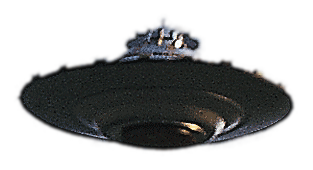
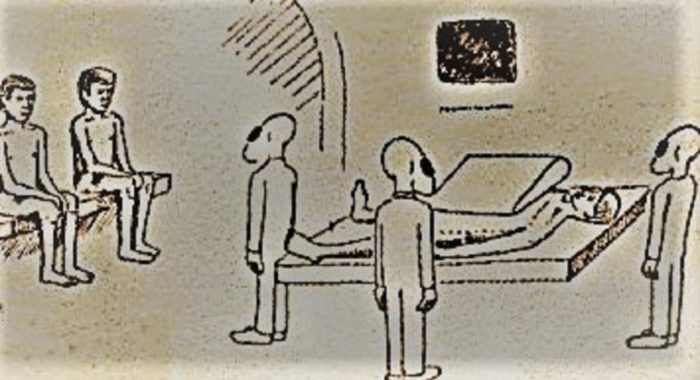
Under hypnosis the four men produced accounts of what they said happened in the missing time. They described the beam lifting them out of the canoe and into the sphere, a passage through a tube filled with sparkling dust-like particles, and a bright, low-lit chamber. They said they were made to undress and sit on a bench, then examined one at a time on a table by tall, thin grey beings with large heads and big dark elliptical eyes. The men described instruments probing their eyes and mouths, a harness that flexed their limbs, and the collection of saliva, skin scrapings, blood, and other biological samples. They were then, they said, returned down the beam into the canoe in shallow water near their camp. Because all four were artists, Fowler had them draw what they remembered, and the resulting sketches of the craft, the beam, the examination room and the beings became the visual core of his 1993 book, "The Allagash Abductions: Undeniable Evidence of Alien Intervention" (Wild Flower Press, 347 pages). Fowler argued that the moral character of the witnesses, the consistency of their independently regressed accounts, and the correlation with other abduction reports amounted to strong evidence the experience was objectively real.
The case then went to a wide public audience. The four men appeared on "The Joan Rivers Show" and the incident was dramatized on "Unsolved Mysteries," with reenactments and interviews. That television exposure, rather than any official ruling, is what made Allagash famous.
What did the witnesses think it was?
For decades after 1976 the four men were consistent that something real had happened on Eagle Lake. They agreed on the bright colour-shifting sphere, the flashlight signal, the beam, and the burned-down fire. The abduction details were not part of their conscious memory; those emerged only under hypnosis in 1989, and the men's belief in them was built on that recovered material plus the recurring dreams Jim and Jack Weiner reported having independently before they compared notes. Jack Weiner described the beings as right in his face, saying inside his head, "Don't be afraid." Chuck Rak compared trying to focus on the beings to tuning in a fuzzy radio station, a perceptual haze he could not sharpen.
The witnesses' identities matter to how the testimony is weighed. These were not publicity-seekers with a prior interest in UFOs. They were art-school friends, one of them a Navy veteran, and Fowler stressed that none of them had any history of UFO enthusiasm before the trip. Their training as artists is the reason the case carries such detailed drawings of the craft, the cone of light over the canoe, the examination scene, and the grey beings with elliptical eyes and thumbless hands.
The picture changed in 2016. Chuck Rak, by then estranged from the others after what he called a falling out, told reporter Jessica Potila of The County, a northern Maine newspaper, that the abduction never happened. He was careful in how he put it. He did not call the lights fake, "Oh yes, I saw the craft," he insisted, and he stood by the night-fishing sighting of the bright colour-shifting globe. What he disowned was the abduction story built on top of it. "I don't call it a hoax, just brilliant storytelling," he said. "It's not the truth, but I have to admire the storytelling ability of these guys." He named money as the motive: "The reason I supported the story at first was because I wanted to make money," and "We were compelled to stay together, all speculating that this thing could go into the millions of dollars for each of us. We made very little." In later interviews Rak also said the group had used hashish on the trip, a claim the others dispute.
The other three did not follow him. Jim Weiner, Jack Weiner and Charlie Foltz have continued to stand by their accounts, and they characterize Rak's reversal as the bitterness of a man who, by their telling, grew angry when they would not embellish the story further for profit. Raymond Fowler likewise defended the original investigation. So the witness pool is split three to one, with the single dissenter being an estranged former friend who still affirms the underlying sighting and only repudiates the hypnosis-derived abduction. His recantation is motivated testimony from a hostile party and is weighed as such, not as a clean confession that closes the case, but it is also a serious crack in a story whose abduction core never had any support beyond the men's own recovered memories.
The dispute
The dispute does not touch the original sighting, which the page documents as undebunked but uncorroborated. The four canoeists, Jack Weiner, Jim Weiner, Charlie Foltz, and Chuck Rak, consistently described a bright color-shifting sphere over Eagle Lake on August 26, 1976, a beam of light, and a fire that had burned down to coals, and no skeptic on the page produces an identified object, a balloon, an aircraft, a flare, or any conventional source to account for it. What the skeptics attack is the abduction narrative, the claim of being taken aboard by tall grey beings, which did not exist in 1976 and surfaced only under regressive hypnosis conducted by civilian MUFON investigator Raymond E. Fowler starting in 1989, thirteen years after the trip.
The strongest counter-line is a method critique rather than a positive explanation. As stated on the page, regressive hypnosis is well documented to manufacture confident, detailed, internally consistent false memories shaped by the expectations of the session and the surrounding culture, and grey-alien imagery had saturated popular media by the late 1980s when the sessions occurred. A second, witness-specific point is that Jim Weiner has temporal-lobe epilepsy, a condition known to produce vivid hallucinatory experiences of presence, paralysis, and dread, the exact symptom cluster that first sent him to a UFO researcher. On the page this skeptical case is attributed in named form to Tom Burby of Strange New England; no Air Force, Project Blue Book, or police investigation ever examined the event, so there is no official ruling at all, only a civilian methodological objection.
The closest thing to a confession is partial and self-undercutting. Chuck Rak, one of the four, recanted the abduction in 2016 to reporter Jessica Potila of The County, calling it not a hoax but brilliant storytelling, saying the reason he supported the story at first was to make money, that the group speculated the thing could go into the millions, and that the group had used hashish on the trip. Crucially, in the same breath he affirmed the sighting itself, Oh yes, I saw the craft, so his recantation discredits the abduction story and a financial motive behind it while leaving the underlying anomalous object standing.
Taken together this is a method-and-motive dispute, not a debunk. The hypnosis critique and the epilepsy point are real reasons to distrust the abduction memories, and Rak's reversal supplies a money motive, but none of it identifies what was seen over the lake, and three of the four witnesses have held to the account for nearly fifty years. There is no physical evidence and no demonstrated ordinary source for the sphere. The abduction layer rests on a discredited memory-recovery method and is fairly called unsupported, while the sighting layer remains undebunked, which is why the case sits as Disputed rather than resolved.
Is the Allagash Abductions real? The two-pass assessment
Pass one, the ordinary explanations. The Allagash story has two separable layers, and they fail very differently under scrutiny. The conscious layer is the night sighting: a bright, colour-shifting globe over a remote lake, a beam, and a burned-down campfire. A glowing object that changes colour and hovers can be a number of prosaic things, a bright planet or star distorted by atmosphere, an aircraft, or a misjudged light, and the "missing time" rests entirely on the men's own estimate that the event felt like fifteen minutes against logs they expected to burn for hours, which is a soft, subjective anchor rather than a clock. No instrument, photograph, ranger log, or third-party report from 1976 corroborates the sighting, so even the undisputed layer is testimony only.
The abduction layer is far weaker, and here a method-shown problem is real. Every specific of the abduction, the tube, the grey beings, the examination table, the samples, came not from memory but from regressive hypnosis conducted in 1989, thirteen years after the trip, by a high-school teacher rather than a clinician. Regressive hypnosis is not a reliable way to recover memory; it is well documented to manufacture confident, detailed, internally consistent false memories shaped by the expectations of the session and the surrounding culture. Skeptics, including writer Tom Burby of Strange New England, argue the abduction narrative is fatally compromised by that method and by Jim Weiner's temporal-lobe epilepsy, a condition known to produce vivid hallucinatory experiences of presence, paralysis and dread, which is exactly the symptom cluster that first sent Jim to a UFO researcher. The cultural-source critique adds that grey-alien imagery saturated popular media by the late 1980s. And then there is Chuck Rak's 2016 recantation: one of the four told a Maine newspaper the abduction was "brilliant storytelling," not truth, that money was the motive, and that the group had used hashish on the trip. That is the closest thing to a method-shown collapse the case has, but it is testimony from an estranged participant, not an independent demonstration that the original lights were a known object, and Rak still affirms the sighting.
Pass two, if the core event is real. Take the witnesses at their strongest. Four trained observers with no prior UFO interest, one a Navy veteran, independently described the same colour-shifting sphere, the same beam, and the same anomalously burned-down fire, and they produced striking drawings of all of it. Three of the four have held to the account for nearly fifty years through public scrutiny. If the night sighting happened as described, it is an unexplained aerial object that pursued and beamed light onto a canoe, and no official body ever offered a counter-explanation because no official body ever investigated. The abduction, if genuine, would make this one of the most detailed multiple-witness abduction reports on record. But that "if" is doing enormous work, because the abduction exists only inside the hypnosis transcripts.
This is the textbook Disputed case. The unexplained sighting stands on undebunked but uncorroborated witness testimony; the abduction that made Allagash famous rests entirely on a discredited memory-recovery method, was never supported by any independent evidence, and was partly recanted by one of the four. None of that is an official-apparatus debunk that would count in the case's favour; it is independent, civilian, method-aware criticism that genuinely undercuts the abduction claim. Yet it does not reach the bar for discredit either, because no analyst has shown the original lights to be a specific mundane object, the recantation is motivated testimony from a hostile former member rather than a method demonstration, and three witnesses still affirm. The case is therefore Disputed: a real and undebunked anomalous sighting wrapped in an abduction narrative that the evidence cannot support.
Sources
- thecounty.me/2016/09/21/houlton/how-much-of-a-famed-1976-ufo-abduction-is-true-4/
- archive.org/details/allagashabductio0000fowl
- www.ufoevidence.org/cases/case466.htm
- thinkaboutitdocs.com/1976-the-allagash-abductions/
- ryansprague.substack.com/p/the-allagash-abduction
- mysterydelver.com/aliens-at-allagash/
- uapedia.ai/wiki/allagash-abductions-1976-maines-wilderness-encounter/
More cases from this region: UFO sightings in United States