The Judy Doraty Abduction

In May 1973, Judy Doraty was driving home to Texas City, Texas, after a night of playing bingo in the Houston area, having just dropped friends near Alta Loma. This case file covers what witnesses reported, the official narrative, and a two-pass assessment with its evidence tier.
What did witnesses see at Texas City and the Alta Loma area near Houston?
In May 1973, Judy Doraty was driving home to Texas City, Texas, after a night of playing bingo in the Houston area, having just dropped friends near Alta Loma. In the car with her were her teenage daughter Cindy, Judy's mother, and a sister-in-law, with a brother-in-law also present. Doraty noticed a strange light in the sky that paced the car and would not change. Her own words, recorded later under hypnosis and preserved in the transcript published by Linda Moulton Howe, were: "It was like a large spotlight, like they were looking for something. But it wasn't moving, it was stationary in the sky." Her brother-in-law in the back seat suggested it was a helicopter bound for the Galveston airport, but Doraty doubted it: "I, for some reason, didn't think it was a helicopter and I kept turning and looking at it and it would never change in size, it stayed the same." She tested the idea: "I thought if it's a helicopter I would be able to hear it. So, I rolled my window down in the car and I couldn't hear anything." She finally pulled over and stepped out: "And I stepped outside the car and I could see like it had fiber or it had substance. It was a light, but it had substance."
What she then described is the heart of the case. In the beam she saw an animal being drawn upward: "I see a light. It has substance. Particles. And as I move closer, I can see it moving, moving, swirling. An animal is near the top, squirming. Almost like being sucked in." Sprinkle asked if there were ropes or chains; she said no, nothing, the animal was simply being pulled into the object. She identified it as "a baby calf," spotted brown and white, more brown than white. She described the light itself as a soft, pale yellow, "like a search light, but it wasn't bright."
Doraty then reported watching the calf taken into a small round chamber and methodically taken apart by two small beings. "I get nauseated at watching how they excise parts. It's done very quickly, but the calf doesn't die immediately. For some reason, the calf's heart isn't taken. It seems like it's still living and that upset me very much." She described the calf later being lowered back to the ground, dead and motionless. She watched the dissection done with instruments "like a knife, but they have different kinds of handles, more like a razor," with "long tubes that take the samples," and several scooped-out basins holding excised tissue. Pressed for what she saw in the basins, she answered: "I just see like tissue, like a tongue. And like the insides. And it's like it's been sliced and dissected," and then, specifically, "Eyes. Testicles." The tongue, she said, was cut crosswise, "not cut lengthwise, but this way, up and down." The removed parts she named, the tongue, the eyes and the testicles, match exactly the organs repeatedly reported missing from real mutilated cattle of that era.
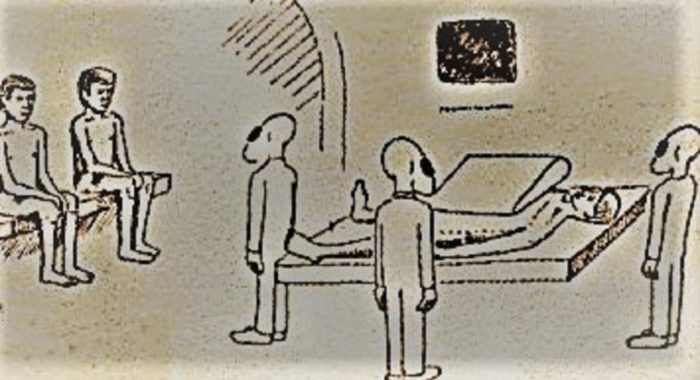
Crucially, Doraty insisted she experienced the whole episode as if in two places at once: still standing beside her car on the roadside, and at the same time inside the craft watching the procedure. Toward the end, working through the timeline, Sprinkle pressed her on where her daughter Cindy had gone. Doraty broke down, pounding the arm of the chair and crying out, "I'm afraid they're going to do to her what they did to the animal." She then described seeing Cindy on a table while the beings took "scrapings" from inside her mouth, and being told the girl would be all right, which she did not believe. She said the beings somehow blocked her from seeing the rest, and that she was returned to the car with no memory that Cindy had even been gone.
What is the official explanation?
There is no government investigation file for this case in the conventional sense. By May 1973 the United States Air Force had closed Project Blue Book (December 1969) and accepted no new UFO reports, so unlike the classic 1950s and 1960s cases there is no Blue Book card, no Air Force memo, and no official ruling on Doraty. The case lived entirely inside the civilian UFO research community of the period, which during the mid-1970s cattle mutilation panic across Texas and the western states functioned as the de facto investigative apparatus in the absence of any official body willing to take the reports.
The documented investigative chronology is anchored to named researchers and dated artifacts. R. Leo Sprinkle, Ph.D., then Director of the Division of Counseling and Testing at the University of Wyoming and the best-known academic practitioner of UFO regression hypnosis of the era, took up the case at the end of the 1970s. The earliest dated artifact is a sketch Doraty drew of the entity she said she saw, which she mailed to Sprinkle and which was received on 24 September 1979, six months before the filmed session. Sprinkle then conducted a regression on 13 March 1980. That session was filmed by investigative journalist Linda Moulton Howe for her documentary "A Strange Harvest," which won a regional Emmy in 1980. Howe later published the full transcript of the Sprinkle regression as Appendix 12 of her 1989 book "An Alien Harvest," and it is from that published transcript, quoted with page numbers, that the load-bearing quotations in this file derive (via Richard Bonenfant's 2014 analysis, which reproduces the dialogue verbatim with Howe's pagination). A separate, earlier hypnosis session is reported to have been conducted by Rose Tennant, an investigator associated with the Aerial Phenomena Research Organization (APRO), at Doraty's later home in Yuma, Arizona; that session is referenced in the secondary record but is not independently documented to the standard of the Sprinkle material and should be treated as a claim rather than a verified event.
The closest thing to an official-apparatus note is the often-repeated detail, traceable to the case literature rather than to a released document, that the original sighting was reported to Ellington Air Force Base near Houston and that there were as many as sixteen witnesses to the craft, a figure Doraty herself gave in a written statement dated February 2003. Neither the Ellington report nor the witness count is confirmed by any primary military document that could be opened for this file, so both are logged as claims. In short, the official record is a void: no agency examined, endorsed, or debunked this case, and what stands in for an investigation is the named, dated work of Sprinkle and Howe.
What did the witnesses think it was?
Judy Doraty maintained for the rest of her life that the experience was real. She came to the investigators not seeking fame but for relief, having developed severe headaches and crippling anxiety in the years after the drive home, which is what led to the referral to Sprinkle in the first place. Her account is notable for what it does not claim: she did not present herself as physically taken aboard in the ordinary sense, but described the dual-location or out-of-body quality of being simultaneously by her car and inside the craft, an unusual and self-complicating detail that a person constructing a tidy abduction story would be unlikely to invent. She described the beings in consistent, specific terms across the session: roughly three feet tall, thin, with oversized heads, very large unblinking eyes with vertical pupils "just like a cat," pasty, near-translucent skin, long curved fingers with dark claw-like nails, and a body suit "like it was made on them." She said they communicated without moving their mouths, "they talk, but not with their mouth," in a nasal, almost sing-song voice, and that they treated her with contempt, "like older kids playing with younger kids," answering her questions only by pointing to a screen and refusing to explain what she "wouldn't understand."
The strongest corroboration is her daughter. Cindy, fourteen at the time, later underwent her own hypnotic regression and, according to the case record, described the same core events her mother had, including being on a table inside the craft. Mother and daughter recalling the same calf, the same craft, and the same separation independently is the corroborating witness element of this case. Doraty also stated there were additional witnesses to the light, up to sixteen people who saw the craft though not all recalled an abduction, a figure she put in writing in 2003.
The emotional texture of the testimony is consistent and hard to dismiss as performance. The transcript records Doraty repeatedly nauseated at the calf's dissection, distressed that the animal "doesn't die immediately," and then, when Sprinkle steered her to her daughter, physically pounding the chair, sobbing and refusing to look, crying that she feared they would do to Cindy "what they did to the animal." Linda Moulton Howe, watching the filmed regression, described the moment that convinced her the mutilation phenomenon was real: "That really got me. I said, my God, it must be true." Judy Doraty never recanted. She died in January 2005; per Richard Bonenfant, her husband afterward requested that no further inquiries be made into her abduction. There is no documented deathbed recantation and no record of her ever withdrawing the account.
The dispute
The dispute is methodological, not physical, and it is advanced by mainstream psychology and by UFO-skeptical researchers rather than by any official body. The entire abduction narrative, the calf in the beam, the dissection, the grey beings, the dual location, the daughter on the table, exists only because it was recovered under hypnotic regression conducted by R. Leo Sprinkle in March 1980, roughly seven years after the claimed May 1973 event. The scientific consensus, reflected in long-standing positions of bodies such as the American Medical Association, is that hypnotically refreshed memory is unreliable and dangerously suggestible: a hypnotized subject readily incorporates leading cues, prior reading, and cultural expectation into vivid, confidently held "memories" that feel real but are partly or wholly constructed. Doraty's account surfaced at the peak of public saturation with both the cattle mutilation panic and the Betty and Barney Hill abduction story, and the specific organs she named as removed (tongue, eyes, testicles) are precisely the ones the mutilation press of the 1970s had made notorious.
The sharpest single piece of evidence behind this critique is Alvin Lawson's 1977 "imaginary abductee" experiment at California State University, Long Beach. Lawson hypnotized eight subjects who had no UFO knowledge and asked them to imagine being abducted. He reported that the invented accounts showed "no substantive differences" from those of supposedly real abductees, sharing the same image constants, including beams of light used to levitate a person or animal into a craft. Doraty's calf-in-the-beam imagery is exactly that constant. Lawson's work does not prove Doraty fabricated anything, but it demonstrates that an account structurally identical to hers can be generated under hypnosis by someone who experienced nothing, which removes the narrative's richness and consistency as proof of reality.
What the dispute lacks is anything case-specific and method-shown. No independent investigator has produced a confession from Doraty, recovered hoax materials, identified the original roadside light as a specific aircraft (the helicopter suggestion came from a family member at the scene, not from a traced tail number), or demonstrated a fabrication of her particular testimony. The corroboration by her daughter Cindy came through the same hypnotic channel and so carries the same weakness rather than independently defeating it. Because the counter-explanation is a general and powerful critique of the retrieval method rather than a positive identification of what actually happened in May 1973, it weakens the case without closing it. That keeps the case at Barely Disputed: the abduction content cannot be treated as established, but no one has shown it to be false either.
Is the Judy Doraty Abduction real? The two-pass assessment
Pass one, the ordinary readings. The single largest vulnerability of this case is its method of retrieval. Everything beyond the roadside light, the calf in the beam, the dissection, the two beings, the dual location, the daughter on the table, comes from hypnotic regression conducted six to seven years after the claimed event. Hypnosis is not a memory-retrieval tool; it is a suggestion-amplifying one. The definitive period demonstration is Alvin Lawson's 1977 "imaginary abductee" experiment, in which eight subjects with no UFO background were hypnotized and asked to imagine an abduction. Lawson reported "no substantive differences" between these invented accounts and those of "real" abductees, with the same recurring imagery, including beams of light that levitate a subject or animal into a craft. The Doraty narrative is built from exactly those stock elements, and it surfaced in 1979 and 1980, after years in which the cattle mutilation wave and the Betty and Barney Hill abduction story were saturating the culture. A skeptic can reasonably argue the calf, the beam, the grey beings and the removed tongue and eyes and testicles are precisely the constants a mind would assemble under leading hypnosis, especially since the missing organs she named are the very ones the mutilation press of that decade had made famous. The original roadside light itself has a mundane candidate offered at the scene by Doraty's own brother-in-law: a helicopter bound for the Galveston airport. No contemporaneous 1973 report, photograph, soil sample, or physical trace exists to anchor any of it, and the corroboration by daughter Cindy came through the same hypnotic channel, which can transmit a shared expectation as easily as a shared memory.
Pass two, if it is real. Taken at face value, this is one of the very few abduction accounts that claims to explain the cattle mutilation epidemic from the inside: a witness watching the actual extraction and vivisection of a calf aboard a craft, performed with surgical speed by small grey entities, with the tongue, eyes and testicles removed and the carcass dropped back to the ground, which is the exact signature of real mutilated carcasses found across the West in that era. The internal detail is unusually rich and coherent for a fabrication: the calf left briefly alive, the heart deliberately not taken, the tissue placed in scooped basins fed by tubes, the snappy precision of the operators, the telepathic, contemptuous communication. The dual-location framing is the kind of detail that argues against tidy invention. And the official apparatus is conspicuously absent rather than dismissive: with Blue Book closed, no agency ever tried to debunk Doraty, which means the case never attracted the kind of mandated closure (a Grudge or Robertson Panel style effort) that in older cases counts as evidence a sighting was real enough to need burying.
Weighing it: a counter-explanation exists and it is serious, namely the well-demonstrated unreliability of hypnotic regression and the matching imagery in Lawson's control experiment. But that is a general critique of the method, not a method-shown debunk of this specific case. No independent investigator has produced a confession, a recovered prop, an identified helicopter tail number, a traced balloon, or a demonstrated fabrication of Doraty's particular account. Her testimony is emotionally consistent, never recanted, partially corroborated by a second witness, and supported by a dated artifact (the September 1979 sketch) that predates the filmed regression. The skepticism is real and weakens the evidentiary value of the abduction content, but it does not close the case or positively identify a conventional cause. That is the definition of Barely Disputed, and that is the tier.
Sources
- hybridsrising.com/Articles/Bonenfant-Doraty-Mutilation.pdf
- www.deseret.com/1990/2/25/18848124/could-e-t-the-extraterrestrial-be-a-m-the-animal-mutilator/
- web.archive.org/web/20170630074750/http://www.thinkaboutitdocs.com/1973-doraty-abduction/
- hybridsrising.com/Articles/Hybrids-Rising-Abductee-Account-of-Calf-Mutilation-on-ET-Craft-Art.html
- archives.lib.purdue.edu/repositories/2/archival_objects/25484
- web.archive.org/web/20260418185213/https://www.ufocasebook.com/doratyabduction.html
More cases from this region: UFO sightings in United States