The Kirtland AFB Encounter (1980)
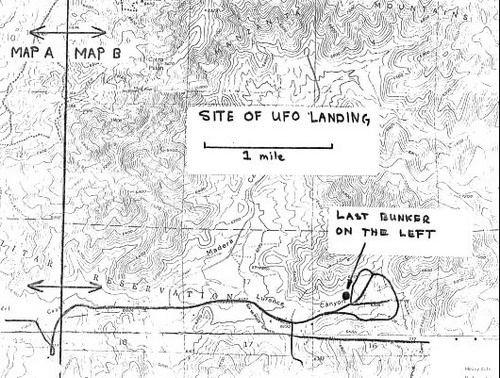
On the night of 8 August 1980, three United States Air Force security policemen assigned to the 1608th Security Police Squadron were on duty inside the Manzano Weapons Storage Area at Kirtland Air Force Base, a fenced and guarded nuclear weapons storage complex southeast of Albuquerque. This case file covers what witnesses reported, the official narrative, and a two-pass assessment with its evidence tier.
What did witnesses see at Manzano Weapons Storage Area and Coyote Canyon?
On the night of 8 August 1980, three United States Air Force security policemen assigned to the 1608th Security Police Squadron were on duty inside the Manzano Weapons Storage Area at Kirtland Air Force Base, a fenced and guarded nuclear weapons storage complex southeast of Albuquerque. The three men named in the official report are Staff Sergeant Stephen Ferenz, the area supervisor, Airman First Class Martin W. Rist, and Airman Anthony D. Frazier. At approximately 2350 hours, while posted in Charlie Sector on the east side of Manzano, the three watched a very bright light in the sky to their north-northeast. The light came down from the sky and, in the words of the AFOSI complaint, descended into the Coyote Canyon area, a stretch of the Department of Defense restricted test range that abuts the storage area. The men first thought it might be a helicopter, but they reported no rotor sound, and they observed the light travel roughly north to south before it dropped into the canyon.
The more striking observation came a few minutes later and was relayed up the chain by Sandia. On 11 August 1980, Russ Curtis of Sandia Laboratories security advised AFOSI that on 9 August 1980 a Sandia security guard had had a close encounter in the same area. At approximately 0020 hours the guard was driving east on the Coyote Canyon access road, on a routine building check of an alarmed structure, when he saw a bright light near the ground beyond the canyon's perimeter. As he approached, the light resolved into a round, disc-shaped object that had landed. The guard, a former Air Force helicopter mechanic, was close enough to give it a shape rather than just a glow. He tried to radio for a backup patrol, but his radio would not work. He continued toward the object on foot, and as he got near it the object took off straight up, departing in a vertical direction at a high rate of speed. The guard's account, as logged in the AFOSI document, is the core of the case: a structured craft on the ground inside a nuclear weapons reservation, then a vertical departure no conventional aircraft of 1980 could match.
The sightings did not end there. The same AFOSI report notes that on 22 August 1980 three other Kirtland security policemen observed the same aerial phenomena, again over the Coyote Canyon area, moving from north to south and then back north before it disappeared. So inside a roughly two-week window the restricted test range and the nuclear storage area drew at least three separate observations by trained, on-duty security personnel, two of them by multiple witnesses at once. The reported behavior was consistent across the events: a very bright light, controlled movement over the canyon, and, in the closest encounter, a landed disc that left vertically at speed.
What is the official explanation?
The official record of this case is itself an official document, which is what makes it unusual. The Air Force Office of Special Investigations, Detachment 1700 at Kirtland, opened a complaint under district file number 8017D93-0/29. The subject line reads "Alleged Sighting of Unidentified Aerial Lights in Restricted Test Range." The preparing agent was Special Agent Richard C. Doty. The form records the three named Manzano witnesses, the 2350-hour sighting in Charlie Sector, the Sandia guard's 0020-hour landed-disc encounter relayed by Russ Curtis on 11 August, and the 22 August follow-up by three more security policemen. It is a routine investigative complaint form, not a sensational account, and that mundane bureaucratic tone is part of its evidentiary weight.
The document also sets the location in its true context. It notes that Coyote Canyon is part of a large restricted test range used by the Air Force Weapons Laboratory, Sandia National Laboratories, the Department of Energy, and the Defense Nuclear Agency. In 1980 the Manzano Weapons Storage Area, historically Manzano Base or Site Able, was one of the largest underground nuclear weapons storage facilities in the country, and Sandia, sitting next door, was a core Department of Energy nuclear weapons engineering laboratory. This is not a cornfield sighting. It is an official report of an unidentified object landing inside one of the most heavily secured pieces of ground in the United States, recorded by the agency whose job was to investigate exactly such intrusions.
What the report does not contain is an explanation. There is no line attributing the object to a known aircraft, a helicopter, a balloon, or a flare. The Sandia guard's detail that his radio failed and that the object rose vertically at high speed is logged without comment. AFOSI's stated follow-up was modest: the document indicates AFOSI declined to pursue an extensive investigation, in part because the Department of Energy's own Central Security Control had been looking into the larger pattern of intrusions and sightings at the Manzano area. Researcher Bruce Maccabee, who obtained the file through the Freedom of Information Act, has argued that there is strong circumstantial reason to think a fuller follow-up report exists and was withheld, since AFOSI would not normally let a reported landing inside a nuclear storage zone close on a single complaint form. The released document, file 8017D93-0/29, is authenticated and is in the public domain through the NICAP and CUFON FOIA archives.
The wider official story is darker and is the reason this case is famous. At the same time these sightings were logged, a civilian named Paul Bennewitz, an Albuquerque physicist and electronics businessman whose home in the Four Hills district overlooked the base, was photographing and filming anomalous lights over the Manzano and Coyote Canyon area and intercepting unusual electronic signals. Bennewitz took his data to Kirtland. AFOSI's response, run substantially through Richard Doty, was not to investigate Bennewitz's lights as a security question alone but to feed him an escalating stream of fabricated documents and stories about aliens, underground bases, and human abductions. The independent confirmation of this is unusually firm: at the 1989 Mutual UFO Network symposium at the Sands hotel in Las Vegas, UFO researcher William L. Moore publicly confessed that he had worked with Doty and AFOSI in the disinformation operation against Bennewitz, telling the audience he had agreed "to play the disinformation game" and that the assembled ufologists had been "had by elements of United States counterintelligence." Doty himself has since acknowledged his role in the Bennewitz operation in interviews and in documentary appearances. AFOSI's own FOIA-released material on Doty's activities is filed under the same office, and the Doty file has been obtained and published by researchers including Alejandro Rojas.
What did the witnesses think it was?
The Manzano and Sandia witnesses were not UFO enthusiasts. They were on-duty federal security personnel guarding nuclear weapons, the kind of witnesses whose training is built around correctly identifying aircraft, helicopters, and ground intruders. Staff Sergeant Stephen Ferenz, Airman First Class Martin W. Rist, and Airman Anthony D. Frazier reported what they saw to their chain of command, which is why it ended up on an AFOSI form rather than in a tabloid. The Sandia guard who saw the landed disc was, by the account in the file, a former Air Force helicopter mechanic, which matters because he specifically ruled out a helicopter, the most obvious mundane candidate for a hovering light at night. The corroboration on 22 August by three additional security policemen seeing the same behavior over the same canyon strengthens the pattern rather than leaning on a single observer.
Russ Curtis of Sandia security treated the guard's report seriously enough to pass it directly to AFOSI, and Richard Doty, whatever his later record, logged the accounts as given rather than dismissing them. That internal seriousness is itself a form of witness testimony: the people closest to the events, inside the security apparatus, did not write them off.
Then there is Paul Bennewitz, the most consequential civilian witness to the broader Kirtland phenomenon. From 1979 onward Bennewitz believed he was recording real, unexplained objects over the nuclear storage area, and the official reaction he provoked is telling. If his lights had been nothing, there would have been no reason for AFOSI to run a years-long psychological operation against him. Bennewitz became convinced, in the end, of an elaborate alien narrative, much of which he had been deliberately fed by Doty and Moore, and he suffered a breakdown and hospitalization. Under any fair reading he is a damaged witness whose later beliefs were corrupted by the disinformation aimed at him. But the disinformation was aimed at him precisely because he had stumbled onto real activity over a sensitive site, and on that narrow point, that something genuinely anomalous was being observed over Manzano and Coyote Canyon in 1980, his original observation lines up with the security police reports captured independently in the AFOSI file.
Is the Kirtland AFB Encounter (1980) real? The two-pass assessment
Pass one, the ordinary explanations. The honest mundane candidates are a helicopter, a conventional aircraft, a flare or test munition from the range, a misperceived planet or bright star, or a piece of classified hardware tested on the very range the canyon belongs to. Coyote Canyon was an active test area for the Air Force Weapons Laboratory and the Defense Nuclear Agency, and the obvious suspicion is that the security police saw something secret and military, a drone, a remotely piloted vehicle, an early stealth or optics experiment, or a directed-energy test, and were simply not cleared to know what it was. That is a real possibility and it is the strongest non-exotic reading. But it runs into the specific testimony. A trained former helicopter mechanic, close enough to call the object a round landed disc, watched it rise straight up at high speed, which does not fit a tethered test rig or a parked aircraft, and his radio failed at the moment of the encounter. Three security policemen on 22 August saw controlled flight that reversed direction over the canyon. The AFOSI form itself, written by the agency that would have known about an authorized test, attributes the object to nothing and records no aircraft in the vicinity. If this had been a sanctioned program, the simplest closure would have been a one-line note saying so, and that note is absent.
Pass two, if it was not ordinary. If the witnesses described real objects accurately, then in August 1980 a structured, disc-shaped craft repeatedly approached and on at least one occasion landed inside the restricted airspace of a major American nuclear weapons storage complex, demonstrated near-instant vertical acceleration, and apparently interfered with a security radio, then departed at will. That is the classic signature of the nuclear-facility UFO incursions documented across the Cold War, where unidentified objects showed sustained interest in weapons storage and missile sites. The official response supports, rather than undercuts, the seriousness of the events. The disinformation campaign against Paul Bennewitz, confirmed in William Moore's own 1989 confession and in Richard Doty's later admissions, is an official-apparatus action, and under symmetric skepticism that counts as evidence the underlying activity was real enough to need managing and obscuring, not as a mark against the case. An air force does not spend years feeding fabricated alien stories to a civilian who recorded nothing.
The tier rests on what is authenticated. The AFOSI Complaint Form, district file 8017D93-0/29, is a genuine, FOIA-released government document, and the object it describes is left officially unexplained within it, recorded by trained security witnesses guarding nuclear weapons, with independent corroboration two weeks later and an official disinformation operation surrounding the wider phenomenon. The strongest mundane reading, a classified test, is plausible but is contradicted by the document's own silence and by the landed-disc and vertical-departure specifics. On the strength of an authenticated official record describing an object that remains undetermined, the case is rated Verified Unexplained.
Sources
- www.nicap.org/foia_003.htm
- www.openminds.tv/wp-content/uploads/DOTY-FOIA-ATR-1.pdf
- openminds.tv/william-moore-ufo-opportunist-agent-disinformation/
- paglen.studio/2023/05/10/doty/
- archive.org/details/projectbetastory0000bish
- www.dtra.mil/Portals/125/Documents/History/Defenses-Nuclear-Agency-1947-1997.pdf
More cases from this region: UFO sightings in United States