The La Serena Livestream Object (2 August 2026)
A skywatching channel in La Serena was streaming its night sky live to YouTube when something elongated and bright crossed the frame. The archive traced the clip to the archived broadcast, read the on screen clock, and found the raw feed unstable at exactly that minute.
What did witnesses see at La Serena?
At 20:23 on the evening of Sunday 2 August 2026, a fixed low light camera pointed at the sky above La Serena, in Chile's Coquimbo Region, was streaming live to YouTube when a small bright object crossed its field. The camera belongs to TIO OVNI CHILE, a skywatching channel that broadcasts long unattended night sky sessions from La Serena and carried about 19,600 subscribers when this file was written. That night's broadcast, titled Emision 02-08-26, went live at 18:57:44 local time and ran 2 hours 3 minutes.
About eighty minutes after the capture, at 01:44:20 UTC on 3 August, the channel posted a 41.9 second clip to its X account. The text reads: "A las 20:23 hrs de hoy, durante nuestra transmisión en vivo en YouTube (Tío Ovni Chile), captamos un extraño objeto de apariencia alargada que, por un instante, parece realizar un llamativo 'quiebre'." It closes by asking readers "¿Qué crees que pudo haber sido?" Quiebre means a break or a snap, an abrupt change of direction.
The archive went through that clip frame by frame. It runs 41.9 seconds at 720 by 1280 portrait, H.264 with an AAC track, and it does not open on the sky. It opens on a produced title card reading ¡HIZO UN QUIEBRE! over a red circle and a red arrow drawn onto a small bright object, so what circulated is a packaged promotional cut, not raw footage. The body of the clip is a near black sky full of faint stars, and for most of its length nothing is visible except that starfield.
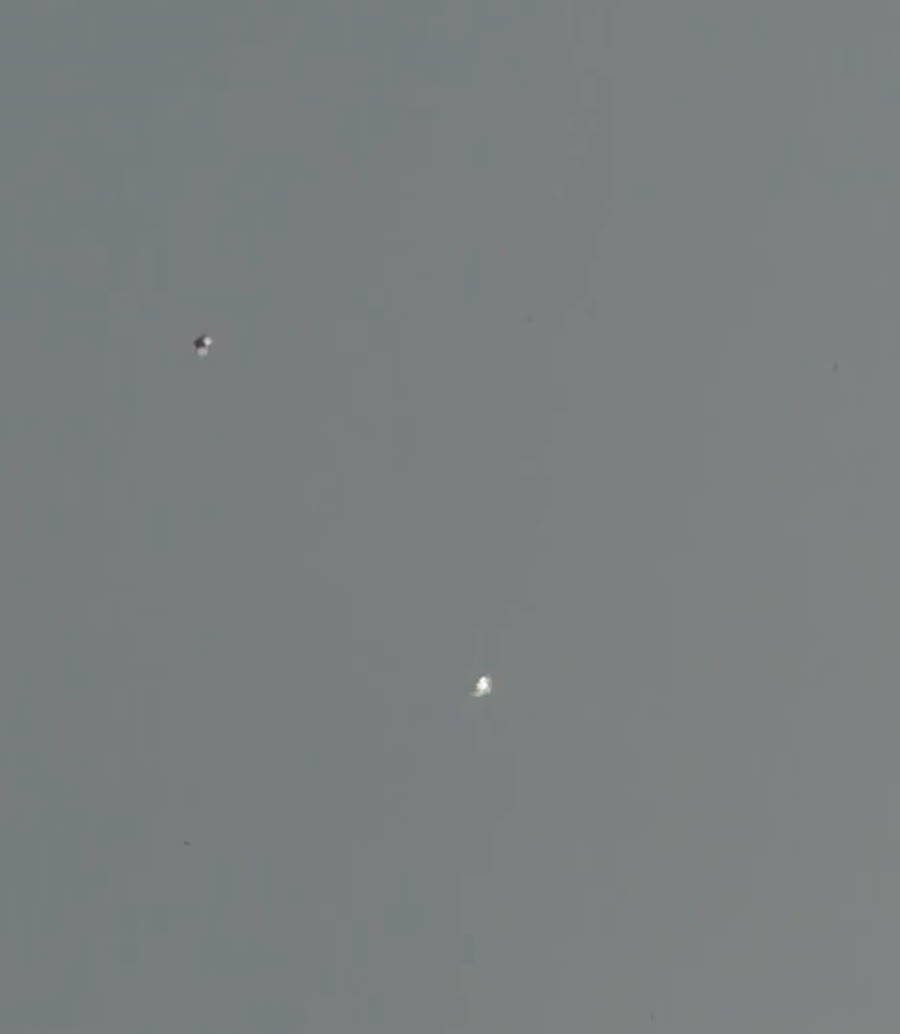
The object sits at frame 348 of 2,511, about 5.8 seconds in. Enlarged and contrast stretched it is not merely a dot. It is a distinctly elongated bright body, roughly three to four times longer than it is wide, with a hard bright core and a fainter, tapering, slightly curved extension running off one end at an angle to the long axis. That extension is what the channel calls the quiebre. It spans perhaps thirty pixels on its long axis at native resolution. There is no structure, no navigation lights, no colour separation, no landscape or horizon, and no scale reference of any kind.
What is the official explanation?
Chile is one of the very few countries with a standing official body for this class of report, which makes the silence here worth stating precisely. The Direccion General de Aeronautica Civil created the Comite de Estudios de Fenomenos Aereos Anomalos, CEFAA, on 3 October 1997 by Resolucion Exenta 01599. That resolution was repealed on 18 October 2021 by Resolucion Exenta 04 / 3 / 0113 / 1385 and the office became the Seccion de Estudios de Fenomenos Aereos Anomalos, SEFAA. It takes reports from the public, leans heavily on photographic and video evidence, and returns a conclusion directly to the citizen who filed. By DGAC's own account it had received 1,675 reports by September 2021.
None of that machinery engaged. The archive found no SEFAA or DGAC statement or published conclusion touching a 2 August 2026 sighting at La Serena, and no sign the channel filed a report with the body whose whole purpose is to answer this question. That is not an official denial. It is an absence, and it is why this file carries no official narrative to weigh.
The press record is equally empty. Searches across the Chilean outlets that would normally carry a Coquimbo Region sighting, including Diario El Dia of La Serena, El Observatodo, BioBioChile and Meganoticias, returned nothing for 2 or 3 August 2026. No second camera, no other witness account and no independent recording of the same object at the same minute has surfaced anywhere the archive could reach. The event exists in one place, the channel's own feed.
What did the witnesses think it was?
There is no witness here in the usual sense. The witness is an unattended camera on a fixed mount, and the account comes from the person running the broadcast rather than from anyone who looked up. That cuts both ways. No memory, distance estimate or excitement sits in the chain, which removes a whole family of ordinary errors, but nobody was there to say whether the thing was overhead or ten metres from the lens.
The channel did not overclaim. The post describes an object of elongated appearance that for an instant appears to make a striking break, then asks viewers what it could have been. It does not say craft, it does not say alien, and it asserts no distance.
The commercial interest belongs on the record with no accusation attached. TIO OVNI CHILE sells paid memberships, solicits donations and runs an Amazon affiliate storefront for skywatching gear, and the version that travelled opens on a clickbait card with a red circle drawn on the object. That is presentational, not evidence of tampering, and none is alleged. It means only that the raw feed, not the package, is the better evidence.
La Serena cuts both ways too. The city sits beside Chile's observatory belt, so its sky is genuinely dark and genuinely crowded with satellite traffic. It is also a UFO tourism centre, home to the Museo Ovni, run by the journalist Cristian Riffo and registered in March 2024 as the first UFO museum recognised by Chile's national heritage service. The archive checked whether the channel is connected to that museum or to the separately listed Tio Ovni venue and could not establish any link. A shared nickname is not evidence of one.
Is the La Serena Livestream Object (2 August 2026) real? The two-pass assessment
PASS ONE, how this could be entirely ordinary. The most useful thing the archive did was stop reading the promotional cut and go to the source, because the full broadcast is public and the minute in question is viewable. The raw feed shows two things the package hides.
First, this sky was busy. Stacking the raw broadcast at four frames per second across the two minutes bracketing the capture renders every moving light as a dotted trail, and at least two of them cross the field in straight lines at a steady rate in that window, one descending at left and one entering at upper right. Straight, constant rate tracks crossing a wide field over tens of seconds are what satellites and spent rocket bodies look like from a dark site, and they brighten and fade as they tumble.
Second, the sensor was not steady. Across the same window the camera gain visibly rises and the star images smear from points into short dashes. On a high gain night camera, an elongated bright body with a tapering curved tail is exactly what a point source looks like when the exposure lengthens or the mount is nudged, and an apparent break in a smear is exactly what happens when motion changes direction partway through it. The quiebre may be a property of the camera rather than of anything in the sky.
The rest was checked and does not settle it. A meteor fits badly for a body that persists across frames rather than flashing. A launch plume is not supported by the schedule, since the nearest Falcon 9 missions were 4 August from Vandenberg and 5 August from Cape Canaveral, both after this event. Distant aircraft would normally betray themselves by strobe cadence and colour separation, and neither is present. That leaves the candidate that most often produces this exact shape, a bird or a moth lit from below by city light and crossing close to the lens. Nothing here excludes it, because nothing here sets a distance: no horizon, no foreground, no second camera, no parallax.
PASS TWO, what resists that reading. The timestamp is independently verifiable, which is rare for a single clip case, because the moment sits inside a published, archived, continuous broadcast whose start time and on screen clock both agree with the claim. The capture was passive, with nobody pointing at anything. And the resolved morphology is a real object in frame with a hard core and a structured tail, not a compression block or a single frame sensor hit. Against that stands the absence of corroboration in a city of roughly two hundred thousand ringed by professional observatories, and a camera demonstrably unstable at the reported instant.
No official body has spoken, no counter explanation has been demonstrated on this specific footage, and the archive has not positively identified a satellite pass, a meteor or an aircraft that accounts for it. A real, brief, elongated luminous object crossed a verified live feed above La Serena at 20:23 on 2 August 2026. The likeliest causes are a glinting satellite smeared by a gain change, or something near the lens. Neither has been shown. That is Unknown.
Sources
- x.com/OvniChile1/status/2084092974237880704
- www.youtube.com/watch?v=pJ72K1N0wZM
- www.youtube.com/@TIOVNICHILE
- sefaa.dgac.gob.cl/quienes-somos/
- www.dgac.gob.cl/cefaa-un-modelo-investigativo-de-fenomenos-aereos-anomalos/
- museoovni.cl/museo/
More cases from this region: UFO sightings in Chile