The Bonnybridge Sighting Wave and the Falkirk Triangle (From 1992)
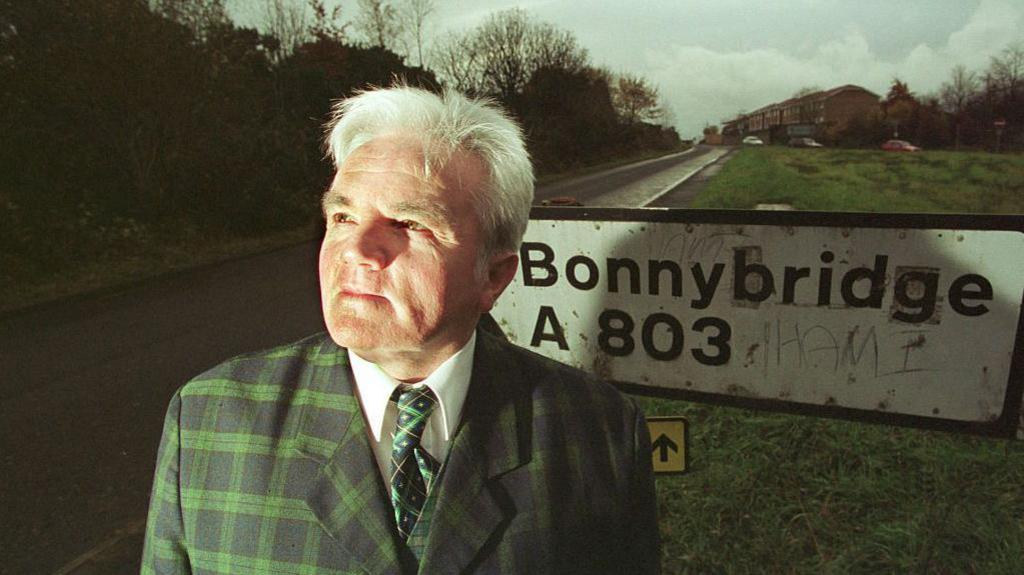
For more than thirty years a village of about six thousand people in central Scotland has carried the title of the UFO capital of Britain, on the back of a reported sighting count that nobody has ever shown a method for. This is the case file on what was actually reported, what the councillor actually sent to government, what the Ministry of Defence actually logged, and where the famous number of three hundred sightings a year comes from.
What did witnesses see at Bonnybridge?
Bonnybridge is a village of about 6,000 people in the Falkirk district of central Scotland, sitting close to the main Edinburgh to Glasgow railway line and the Forth and Clyde canal. Its brickworks, sawmills, paper mills and iron foundries are long gone. As BBC Scotland put it in August 2025, it was a quiet, tucked-away part of the country and was probably on few radars until 1992, when locals started reporting strange lights in the skies.
The report usually treated as the start of the wave is that of a local businessman named James Walker. Driving on a road between Falkirk and Bonnybridge, he was stopped by a brightly shining star-shaped object hovering above the road ahead of him. The object then took off at high speed and vanished, and Walker left the area quickly. That is the account carried by Sky History, by The Scotsman, and in outline by the Falkirk Herald, which places the first report in 1992 on the Falkirk Road. No source consulted for this file gives a day or a month for it, and no contemporary 1992 press cutting of it has been recovered here, so the origin event is honestly dated to the year and no further.
What followed was not one incident but a stream of them. Councillor Billy Buchanan began collecting reports from constituents who said they had seen strange lights and objects they did not recognise and could not explain, and by the end of that same year, 1992, he had recorded more than 200 incidents. That figure comes from the BBC's 2025 account and is the single most defensible early number in the whole case, because it is attached to a named collector, a defined area and a defined period.
The reports covered a wide spectrum. The BBC describes a motorist who reported lights in the form of a cross hovering above a road before morphing into a triangle, and a family who watched a bright circle of light come down into a field. The Falkirk Herald summarises what Buchanan heard over three decades as bright hovering lights, cigar-shaped flying objects, and in some cases claims of abduction and physical examination. Vice, reporting from the town in November 2014, states that more than 600 reports were made between 1992 and 1994 alone.
The best-documented multiple-witness episode in the public record is one described by The Scotsman in February 2005. In October 1994 three cleaners on their way to work said they saw five unidentified objects. When they arrived they told their manager what had happened, and to his surprise a number of other employees then came forward to say that they too had seen flashing lights and strange orange orbs glowing in the vicinity over the previous week. The witnesses are unnamed and the account is a retelling published eleven years after the fact, which limits how much weight it can carry, but the shape of it matters: a report volunteered first, and independent confirmation from the same workplace afterwards.
A handful of Bonnybridge and Falkirk reports also survive in the Ministry of Defence's own published lists, which is the closest thing this case has to a contemporaneous official record of what was seen. On 29 May 1999 at 22:30 the MoD logged a report from Bonnybridge, Stirlingshire, described in its entirety as a very large, bright, star-shaped object, low in the sky and hovering. On 17 August 2003 at 23:45 the MoD logged a Bonnybridge report whose description reads only that the caller said there had been a sighting. Falkirk entries appear on 7 February 1997, 18 July 1997, 14 January 1998, 16 April 1998, 5 March 1999 and 24 March 1999, describing among other things one object the same size as the moon going vertically through cloud, an oval object showing five searchlight-type lights, and a dozen stationary revolving objects in red, green, blue and white. A Grangemouth report of two bright orange objects was logged on 26 September 2009.
The wave never formally ended. Malcolm Robinson, the investigator most closely associated with the case, told the BBC in 2025 that he estimates there are still about 45 to 60 UFO reports in the Falkirk Triangle every year. Public skywatches continue: Vice attended one on the night after Halloween 2014, when around 35 people from across Britain drove out to an unlit spot near Craigburn Woods, saw the Ochil Hills and a good many stars, and went home without a close encounter.
More footage and images of this sighting
Ministry of Defence, UFO Reports 1999, showing the logged Bonnybridge report of 29 May 1999 at 22:30 described as a very large, bright, star-shaped object, low in the sky and hovering. View source
The National Archives catalogue entry for DEFE 24/1954, Ministry of Defence UFO reports for 1992, the year the Bonnybridge wave began. View source
What is the official explanation?
There is an official record here, and it is worth being precise about what it does and does not contain, because this case is routinely described as one the British government was forced to address. It was not.
The reporting route was real and routine. Craig Lindsay was a Ministry of Defence press officer in Scotland during the period and told the BBC that when he started work at RAF Pitreavie Castle in 1989 he quickly discovered that nearly always in the evening there would be someone calling about lights in the sky. His words on where those calls came from are worth quoting exactly: "Nearly always around Falkirk, Bonnybridge, to the point that we actually had what you call a pro forma form." Controllers filled the form in when they were not busy and sent it to London. When they were busy the call was diverted to Lindsay, who took the details and faxed them south, and, in his words, "we never heard anything more about them". His own private view was blunt: "It was just, to be blunt, folks coming out of the pub and seeing things." Lindsay is the same official who handled the Calvine photograph in 1990, so he is not a hostile or careless witness to the MoD's own procedures.
Those faxes went into files that now sit at The National Archives at Kew. The Ministry of Defence UFO material was released there in a public programme, and the catalogue confirms that the paperwork covering exactly these years survives: DEFE 24/1954 (UFO reports, 1992), DEFE 24/1957 (UFO correspondence, July to November 1992), DEFE 31/181 (UFO incidents, 20 February 1992 to 26 April 1993), DEFE 24/1959, DEFE 24/1960 and DEFE 24/1961 (UFO reports for 1993, 1994 and 1995), DEFE 31/183 (UFO incidents, October 1993 to January 1994) and DEFE 24/2047 (UFO press coverage, 1996 to 2004). The National Archives research guide records the department's own destruction policy as background: "Until 1967 Ministry of Defence policy was to destroy UFO files at five yearly intervals, so many records have been lost. Since 1970 most surviving Ministry of Defence UFO files have been reviewed for eventual release at The National Archives because of public interest in the subject." This archive has not read the contents of those files, and the catalogue descriptions do not name Bonnybridge, so no claim is made here about what is inside them. What can be said is that the files exist, that they cover the wave precisely, and that anyone who wants to settle this case at documentary level knows where to go.
The MoD's own published sighting lists are a harder and more useful document, because they are complete for the years they cover. The Ministry of Defence has published its UFO report lists for 1997 to 2009 on gov.uk, giving date, time, town, area and a brief description for every report it logged. Across those thirteen years, the number of entries naming Bonnybridge, Falkirk or Grangemouth is nine. The annual UK-wide totals for the same years run to roughly 431 reports in 1997, 244 in 1998, 243 in 1999, 191 in 2000, 200 in 2001, 99 in 2002, 93 in 2003, 89 in 2004, 129 in 2005, 77 in 2006, 99 in 2007, 189 in 2008 and 620 in 2009. In seven of those thirteen years the Falkirk district appears not once. That is what the reporting looked like from the department's side of the fax machine.
On the parliamentary paper trail, the honest answer is that there is none. A search of the Hansard record for the phrase "Falkirk Triangle" returns zero results in either House across the entire published record. A search for "Bonnybridge" between 1992 and 2005 returns seven contributions, and every one of them concerns something else: the ReChem toxic waste plant, an E coli death in Forth valley, the oil industry, school bus safety. The only Hansard debate titled for the village is the Bonnybridge to Larbert bypass, in November 1961. The Bonnybridge sightings were never debated, never the subject of a written answer, and never raised on the floor of the Commons or the Lords by any member. The parliamentary UFO questioning of that era exists, but it belongs to Lord Hill-Norton in the Lords, asking about file classification and file destruction, not about central Scotland.
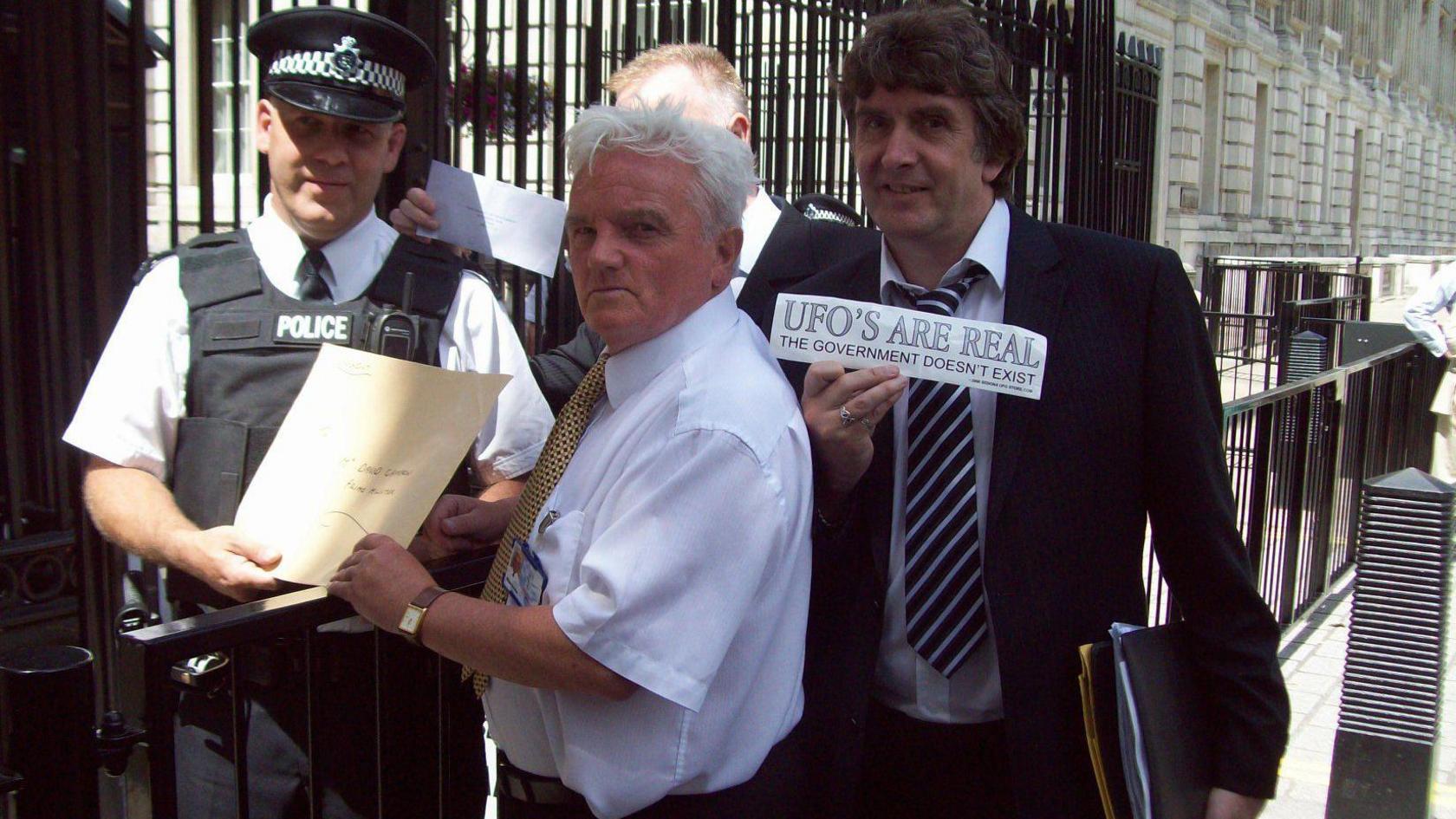
What Buchanan actually did was write. The Scotsman recorded in 2005 that he had begged the MoD to visit and track the phenomenon and had written to Margaret Thatcher, John Major and Tony Blair. Buchanan told Vice in 2014: "Malcolm and I have contacted every prime minister since 1992, asking for answers. We don't seem to be getting any closer to the truth of the matter." The 1997 prime-time programme Strange But True filmed him discussing a letter to the newly elected Tony Blair demanding an investigation, and the BBC records that the request was declined. He also took the question to the Scottish Parliament after devolution. No text of any reply from Downing Street, the Scottish Office or the MoD has been recovered for this file, and no released MoD file has been identified as holding the correspondence. The archive states that plainly rather than implying a documentary record it has not seen.
The department's formal position has never moved. The MoD closed its UFO desk in 2009 on the ground that it served no defence purpose, and gave BBC Scotland News this statement in 2025: "The MoD has no opinion on the existence of extra-terrestrial life and no longer investigates reports of sightings of Unidentified Aerial Phenomena or Unidentified Flying Objects. This is because, in over 50 years, no such reporting to the department indicated the existence of any military threat to the UK, and it was deemed more valuable to prioritise MoD staff resources towards other defence-related activities." That is a statement about defence significance. It is not an identification of anything anyone saw over Bonnybridge, and it does not claim to be.
There is one late and revealing entry in the official record. Nick Pope, who ran the MoD's UFO desk for three years in the 1990s, apologised on a Talk TV documentary in December 2023 to Buchanan and to the people of Bonnybridge. He told the programme: "Billy Buchanan, the local people in Bonnybridge, perhaps the British people as a whole deserve a corporate apology. I don't buy into every conspiracy theory on UFO's but it was policy for decades to play down all of this." Asked to expand, he told the Falkirk Herald that it had been MoD policy for decades "to play down the true extent of our interest and involvement in UFOs, and to fob people off with standard responses telling them the subject was of little or no defence significance", and that this reflected "corporate embarrassment" rather than a cover-up of an alien presence. Buchanan rejected the apology and called Pope an agent provocateur still working for government, an accusation Pope categorically denies. A former desk officer confirming that the standard no-defence-significance reply was a managed line, not an analytical finding, is a material fact about how this case was handled.
What did the witnesses think it was?
The two people at the centre of this case are both named, both on the record for more than thirty years, and both easy to check.
Billy Buchanan has been the councillor for the area for more than three decades, has served as Provost and is a Baillie of Falkirk Council. He is not a ufologist by trade. He began as a local politician whose surgeries filled up with constituents describing things in the night sky, and his response was to log them and to escalate. He has been candid about the cost. "We've faced mass ridicule over the years," he told Vice in 2014. "I remember going to our local MP and telling him I had about 130 people who had seen something that they could not explain. He told me it was electoral suicide." His public position has always been carefully short of a claim about aliens. "How do we know aliens aren't walking about?" he asked The Scotsman in 2005. "How do you define an alien anyway? And when people say to me why Bonnybridge? I say, Why Bethlehem? I have no doubt that Bonnybridge is part of something exciting." In 2023 he told the Falkirk Herald that "the Bonnybridge phenomenon has over the years continued to gain credibility world wide and now, with the whistleblowing in the US, the truth is definitely out there."
Malcolm Robinson founded Strange Phenomena Investigations in 1979, lives at Sauchie in Clackmannanshire and has spent his life on Scottish UFO and paranormal cases, including the 1979 Dechmont Woods encounter which this archive carries separately. He came to Bonnybridge in 1992 by accident: "I heard about it on a local radio station. Billy Buchanan, the local councillor, was on there talking about these UFO sightings and I went: 'Wow, by God I really need to get in touch with him and see if I can lend any assistance'." His published account of the wave is the book The Bonnybridge UFO Enigma (A Modern Day Mystery), written with the Scottish researcher Ron Halliday, and the wave also features in his UFO Case Files of Scotland series.
Robinson's method, as he describes it, was to follow up what people said they had seen and to check air traffic, police and military records. That matters, because it makes him the only person to have run anything resembling a systematic check on these reports, and because his own conclusions are far more restrained than the headlines the case generated. He told The Scotsman in 2021: "In Falkirk people are aware of flight paths to Edinburgh, Glasgow and Cumbernauld, and are well used to navigation lights. Many reports of UFOs in general can have natural explanations or be the result of a misperception, but that few per cent which can't, are the fly in the ointment, and can be bona fide." He is also the source of the sharpest warning about the numbers attached to his own case: "The problem we got is that some members of the media community were hyping things up. So if it was 100 sightings it suddenly became 1,000 sightings." Asked at a 2014 skywatch whether he believed there was something in the skies above Bonnybridge, he answered: "You better bloody believe so. I wouldn't be here if I didn't think there was something very real, very tangible occurring."
Other named participants fill out the picture. Dave Hodrien, chairman of the Birmingham UFO Group, co-organised the 2014 skywatch. Craig Lindsay, the MoD press officer, is a witness from inside the apparatus who confirms the reporting was heavy and repeatedly from this district while privately attributing it to closing time. Dr Gavin Miller of the University of Glasgow is now conducting a Royal Society of Edinburgh funded study of Scottish UFO practice, grant RSE 2840, and is working with Falkirk Libraries to preserve the large collection of press clippings from the Triangle period held at Bonnybridge Library. His project explicitly does not ask whether the objects were extraterrestrial. It asks what happened in Bonnybridge and why, which is a question this archive regards as legitimate and separate.
The town itself has never been of one mind. The Falkirk Herald notes that many villagers are embarrassed by the association and remain firmly sceptical. Kevin Schofield, now chief political correspondent of the Sun and a Bonnybridge native who filed regular sighting stories as a local reporter in the mid 1990s, told Vice: "I've lost count of the number of times people reply, 'Ah, the UFO capital of Scotland,' when I tell them I'm from Bonnybridge. I find it quite funny, but I'm probably in the minority in the village, where folk would probably rather not be reminded of it."
And the wave produced at least one episode that damaged the case badly. On Monday 9 October 1995 around 700 people paid two pounds each to fill Falkirk Town Hall for what was billed as an explanation of the sightings. Miller's research establishes that the event was preceded by months of press coverage built on an error: a locally produced paranormal magazine, Enigmas, had mistakenly attached the name Zal-us to a man who claimed knowledge of an alien body called the Council of Nine and who had been in contact with Councillor Buchanan, and the national press then upgraded Zal-us into an alien who would address the meeting. The man was in fact Geri Rogers of Edinburgh. The lecture, delivered alongside the American psychic Phyllis Schlemmer and the researcher Ken McFarlane, did not live up to the billing, and a television item preserved by Robinson records walkouts and a member of the audience asking why everybody was so bored. Witnesses who had reported lights over their houses in 1992 had by 1995 been folded into that.
Is the Bonnybridge Sighting Wave and the Falkirk Triangle (From 1992) real? The two-pass assessment
PASS ONE. How could this be entirely ordinary, and specifically ordinary for this piece of ground.
Start with the air. Bonnybridge sits in the narrowest part of the Scottish central belt, under the busiest airspace in the country. Cumbernauld Airport lies roughly four miles to the south west. It is a general aviation field with an 820 metre asphalt runway opened by the Cumbernauld Development Corporation in 1988, four years before the wave began, and it operates as a training and reliever airfield, which means light aircraft and helicopters circling, holding, and pointing landing lights at the ground at all hours. Edinburgh Airport is about twenty miles east and Glasgow Airport about twenty three miles west, and traffic between them and to the north passes overhead constantly. An aircraft on approach with landing lights on, seen head-on from a country road, is a brilliant white light that appears to hover, holds still for a long time, then abruptly moves off and vanishes. That is a near-exact description of the object attributed to James Walker. The strongest statement of this candidate does not come from a debunker: it comes from the case's own chief investigator, who told The Scotsman that people in Falkirk are aware of the flight paths to Edinburgh, Glasgow and Cumbernauld and are well used to navigation lights.
Then the ground. About seven miles east of Bonnybridge sits the Grangemouth petrochemical complex, and this is a serious, specific and under-discussed candidate for a whole class of Falkirk Triangle reports. INEOS's own community guide to flaring states that "the high level flares at Grangemouth, over 100m in height, are a feature of the site's skyline", that flaring after a shutdown, restart or plant upset "typically lasts several hours" and that some events "may last up to 48 hours or longer". Flaring at Grangemouth has repeatedly been reported as lighting up the night sky and being visible for many miles, including from central Edinburgh some twenty five miles away, and the Falkirk Herald has covered week-long flaring events as routine local news. A stationary orange or white glow low on the eastern horizon, sometimes with an audible roar carried on the wind, sometimes throwing light onto low cloud, is exactly what a hundred-metre flare stack seven miles away produces. It is not a trivial point that the earliest photograph the BBC attaches to the Falkirk Triangle is captioned as a silent craft seen over the Grangemouth refinery in November 1991.
Military activity belongs in this list too, and honesty requires saying that the archive found no documented exercise, flare drop or trial matching any specific Bonnybridge report. Central Scotland carries low-flying training and the 1990s were thick with speculation about the American Aurora programme and Machrihanish, but as the BBC notes, no evidence links that base to any secret programme and the United States has never admitted the aircraft existed. Treating an unproven black project as an explanation is not scepticism, it is a different faith.
Atmospheric effects are a real mechanism in this valley. The Forth valley floor between the Ochils and the Campsies is prone to temperature inversions and low cloud, which can lift, distort and duplicate distant light sources, including refinery flares and airport lighting, and can make a fixed light appear to move. That is a mechanism, not a demonstrated cause of any particular report here, and it is offered as no more than that.
Chinese lanterns must be handled carefully, because they are the most abused explanation in British ufology. They cannot touch 1992 to 1994. They were only sporadically seen in Britain in the 1990s and became common at weddings, festivals and funerals in the middle and later 2000s. The MoD's own published lists show the shape of that arrival: the UK-wide count runs at roughly 99 reports in 2007, 189 in 2008 and 620 in 2009, and the 2008 list contains a report from West Yorkshire whose description is simply that the objects looked like Chinese lanterns. For the modern tail of the Falkirk Triangle, and for the orange-glow reports of the late 2000s, lanterns are a strong candidate. Applying them backwards to the origin of the wave would be a straightforward falsification of the timeline, and this file does not do it.
Now the uncomfortable part, which has to be stated plainly. Bonnybridge became a UFO destination, and that is an incentive problem. Dr Gavin Miller's work at Glasgow documents what grew up around the sightings: local investigator groups, UFO weekend breaks sold by Falkirk hotels, ticketed public lectures in Falkirk Town Hall, a proposed mushroom-shaped glass UFO visitor centre, and a proposed UFO theme park with leisure attractions housed in flying-saucer buildings, all of it modelled on the idea that a de-industrialised town could be regenerated by a cultural attraction. The National Enquirer ran "TOWN IN PANIC OVER 2,000 UFO SIGHTINGS" on its US edition in June 1995. Miller records a 1995 story of a couple walking into the tourist information centre to ask when the best night was to see the UFOs and whether they could see them next Wednesday. The BBC states the underlying dynamic without editorialising: those who study UFOs know that media reporting leads to greater public awareness and more sightings, and that certainly happened around Bonnybridge. A place known for sightings generates more sightings, more reports, more coverage and more visitors, and every one of those loops back into the next year's total.
None of that means the people who reported things were lying or foolish. The residents of a small town who told their councillor they had seen something they could not identify were doing the sane, civic thing. The incentive problem sits with the numbers, the publicity and the projects, not with the witnesses, and this file keeps those apart.
Which brings us to the figure. The claim that Bonnybridge and the Falkirk Triangle produce about 300 UFO sightings a year is everywhere. The Scotsman printed it in 2005 with no attribution, Sky History repeats it as nearly 300 a year over three decades, and the Falkirk Herald repeats it as around 300 a year since 1992. The Scotsman also printed that 2,000 of the town's 5,500 residents claim to have seen something. This archive has tried to trace the figure to a counter, a period and a method, and cannot. Nobody has published a log, a definition of the area, a definition of what counts as a sighting, or a year-by-year table. Three things point the other way. First, the man who has actually kept the records told the BBC in 2025 that he puts the total number of sightings in the region at about 350 between 1982, the year he began recording incidents, and today, and that there are still about 45 to 60 reports a year, which is an order of magnitude below the press figure. Second, the same investigator says the media inflated his own numbers by a factor of ten. Third, the Ministry of Defence's published lists for 1997 to 2009 contain nine entries naming Bonnybridge, Falkirk or Grangemouth in thirteen years. That last point cuts only so far, because a report made to a councillor, to SPI or to a newspaper never reached the MoD at all, and the department's totals are a measure of what was escalated rather than of what was seen. But taken together the position is clear: 300 a year is a press number of unknown provenance that hardened into a fact through repetition, and this archive will not repeat it as one. The defensible figures are Buchanan's more than 200 incidents logged by the end of 1992, his own count of about 130 witnesses taken to his MP, the more than 600 reports in 1992 to 1994 cited by Vice, and Robinson's roughly 350 since 1982.
It is also worth holding two things at once. A genuine cluster of unexplained reports and a media-amplified flap are not alternatives. The most likely reading of Bonnybridge is that both happened, that a real and locally unusual run of reports in 1992 drew press attention, and that the press attention then manufactured a much larger volume of reporting on top of it, of which the great majority will have ordinary causes. Separating the first from the second thirty years later, without the original report forms, is the actual problem.
PASS TWO. What survives if the core reports are taken at face value.
The strongest thing in this case is not any single object. It is the reporting behaviour of an identifiable community to an identifiable public official who put his name and his seat at risk to log it. More than 200 incidents were recorded by Buchanan before the end of 1992, which is before the international press arrived in force and before there was any tourism to protect. He took roughly 130 named witnesses to his own MP and was told the subject was electoral suicide, which is evidence that he was not being rewarded for this at the time. Craig Lindsay independently confirms, from inside the MoD, that evening calls about lights in the sky were arriving nearly always from around Falkirk and Bonnybridge, and that this was already the pattern when he arrived at RAF Pitreavie in 1989. Two people with no common interest, one a campaigning councillor and one a press officer who thought the callers had been in the pub, agree that this district generated an unusual volume of reports.
The October 1994 workplace cluster is the best multiple-witness item in the public record: three cleaners reporting five objects on the way to work, and colleagues at the same site independently saying they had been seeing flashing lights and orange orbs for a week. It is weakened by the absence of names and of an exact date, and by the fact that the surviving account is a 2005 newspaper retelling.
And the Ministry of Defence did log Bonnybridge, and did not explain it. Its own published list carries a report from the village on 29 May 1999 at 22:30 of a very large, bright, star-shaped object low in the sky and hovering, with no annotation, no identification and no follow-up. That description is also striking for a different reason: it is the same star-shaped, hovering form as the 1992 report that started the wave, seven years later, from the same village.
Against all of that, the case is thin where it most needs to be strong. No radar corroboration has been published. No photograph or film from the wave has a provenance chain this archive can verify, and the one image the BBC reproduces is captioned as a craft over an oil refinery, which is precisely where a mundane explanation lives. There is no physical trace, no named multiple-witness event with a fixed date and identified witnesses, and no independent instrumented record of any kind.
TIERING. The only official position ever taken is that reporting to the department did not indicate a military threat to the United Kingdom. That is an assertion about defence significance made by the apparatus that wanted the subject closed, with no method shown for any Bonnybridge report, and a former officer of that same desk has since said on the record that fobbing people off with the little-or-no-defence-significance line was policy rather than analysis. Under this archive's binding rules an official-apparatus dismissal is logged in pass two as evidence that the matter needed closing, and never counted against the case. No named civilian analyst has published a method-shown identification of the specific cause of any specific Bonnybridge report. Grangemouth flaring, aircraft on approach to three airfields, temperature inversions and, for the later years only, Chinese lanterns are strong, specific and geographically grounded candidates, and this file expects them to account for most of the volume, but candidates are not identifications and the archive does not promote a reconstruction to a verdict. The wave is real, the report count is not what the press says it is, and the individual reports remain unresolved. The tier is Unknown.
Sources
- www.bbc.co.uk/news/articles/cjwngn293pvo
- www.falkirkherald.co.uk/news/people/apology-to-ufo-councillor-and-people-of-bonnybridge-from-former-mod-officer-who-once-dismissed-sighting-claims-4456346
- www.scotsman.com/whats-on/arts-and-entertainment/bonnybridge-ufos-2461341
- www.scotsman.com/news/people/bonnybridges-ufo-cases-explored-in-new-tv-documentary-3168006
- www.vice.com/en/article/ufo-watching-in-bonnybridge-scotland-456/
- ufos.ac.uk/bonnybridge/
- ufos.ac.uk/the-cosmic-agenda-lecture/
- ufos.ac.uk/bonnybridge-and-falkirk-libraries/
- www.gov.uk/government/publications/ufo-reports-in-the-uk
- assets.publishing.service.gov.uk/media/5a79bcace5274a684690bbc2/UFOReport1999.pdf
- assets.publishing.service.gov.uk/media/5a75c656e5274a545822e1ea/UFOReports2003WholeoftheUK.pdf
- assets.publishing.service.gov.uk/media/5a758d2fe5274a6faebebd11/ufo_report_1997.pdf
- assets.publishing.service.gov.uk/media/5a789e38ed915d042206403a/ufo_report_2008.pdf
- assets.publishing.service.gov.uk/media/5a7582c440f0b6397f35efcb/ufo_report_2009.pdf
- discovery.nationalarchives.gov.uk/details/r/C11483067
- discovery.nationalarchives.gov.uk/details/r/C11496717
- www.nationalarchives.gov.uk/help-with-your-research/research-guides/ufos/
- hansard-api.parliament.uk/search.json?queryParameters.searchTerm=%22Falkirk%20Triangle%22
- www.ineos.com/globalassets/ineos-group/grangemouth/community/4429_ineos_flaring_dec12_v2.pdf
- www.falkirkherald.co.uk/business/seven-days-of-ineos-flaring-set-to-light-up-the-night-sky-in-grangemouth-4359715
- www.cumbernauldairport.org/about
- www.history.co.uk/articles/why-is-a-small-village-in-scotland-the-uk-s-ufo-hotspot
- www.alloaadvertiser.com/news/25486000.malcolm-robinson-releases-new-book-ufos-scotland/
More cases from this region: UFO sightings in United Kingdom