The Roestenberg Close Encounter, Ranton, Staffordshire (21 October 1954)
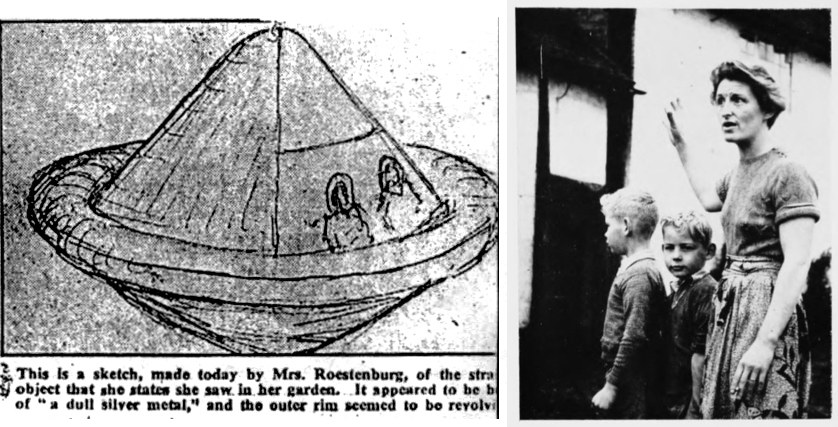
A Staffordshire housewife told a local reporter the next morning that a silver disc had hung over her cottage roof and that two long-haired figures had looked down at her and her children through a transparent panel. She told substantially the same story for the next sixty years, and no official body ever tested it.
What did witnesses see at Vicarage Farm?
Before anything else, the record needs correcting, because this case circulates under at least three wrong labels. It did not happen at Rowley Regis, and it did not happen in 1957. It happened on Thursday 21 October 1954 at about 4:45 in the afternoon, at Vicarage Farm in the village of Ranton, roughly three and a half miles west of Stafford in Staffordshire. The oldest traceable published account is in the Wolverhampton Express and Star of 22 October 1954, the very next day, under the headline "Midland Woman says flying saucer terrified her", and it places the event at "Ranton, near Stafford". The Rowley Regis attribution belongs to a different West Midlands case entirely, the Jean Hingley encounter of 4 January 1979. The 1957 date has two innocent parents: the Roestenburg family reported further sightings over Stafford on 10 January and 13 May 1957, the first of which Flying Saucer Review wrote up as "Flying Cigar at Stafford" in its issue for January and February 1957, and separately a Birmingham housewife named Cynthia Appleton reported encounters with a tall fair-haired figure at Aston in late 1957. The forename "Jennie" comes from a fourth error: Charles Bowen's summary in the 1966 Flying Saucer Review Special, The Humanoids, called her Jennie rather than Jessie and misspelled both the place name and the family name, and researcher Curt Collins has traced that single mistake forward through Jacques Vallee, the Lorenzens and Jenny Randles. The family spelled themselves Roestenburg. Gibbons wrote Roestenberg, and most of ufology has followed him ever since.
In October 1954 Jessie Roestenburg, then in her late twenties, lived at Vicarage Farm with her Dutch-born husband Tony, who worked as an assistant architect in Stafford, and their three children: Anthony, eight, Ronald, six, and Karin, two. The cottage was whitewashed brick, old, and had neither electricity nor indoor plumbing. The Express and Star noted that the next house was about two miles away. That afternoon Jessie was indoors with Karin. The two boys were home from school and playing in the garden.
Her own account of the onset, given decades later to investigators John Hanson and Dawn Holloway, begins fifteen minutes early: "At about 4.30 pm., I experienced a peculiar sensation, like a tingling in my nose and throat, as if I was going to catch a cold". Then came the sound. The 1954 newspaper describes it as "a noise like a crashing aircraft". Loren Gross, working from the period material, renders it as "A tremendous hissing, like water being poured on a hot stove". Jessie's own later phrasing was "what sounded like a giant cauldron of water being poured into a fire". She ran outside expecting an aeroplane to come down and found her sons flat on the ground. In her own words, "They shouted to me, 'Look, Mummy, Mummy, there's a flying saucer!' I told them not to be silly and get up but realised, from their facial expressions that something had frightened them." That ordering matters and is worth holding on to: the children reported the object before their mother had seen it.
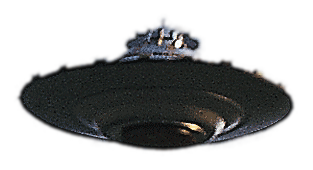
What the Express and Star printed on 22 October is the closest thing this case has to a contemporary document. "Above the children was a huge, saucer-like object with a dome, the front part of which was transparent, stated Mrs. Roestenburg. Staring at the children from the machine were two 'unsmiling, human-like creatures, with long faces and long hair.'" The same story quotes her calling them "two long-haired human-like creatures in tight-fitting jerseys", and gives the object's size, in her words, as "about 15 to 20 feet in diameter". The paper printed a drawing she had made that morning, captioned "This is a sketch, made today by Mrs. Roestenburg, of the object that she states she saw in her garden. It appeared to be of 'a dull silver metal,' and the outer rim seemed to be revolving." The sketch shows a broad lens-shaped hull with a tall conical dome and two small figures visible inside it.
Gross's reconstruction adds the structural detail that makes the encounter geometrically coherent. The bottom section of the object was stationary; just above it a section was revolving; the top was a fixed dome with two large windows; and the whole thing was tilted at an angle, which is what let her see in and let the occupants see out. Gavin Gibbons, who interviewed the family about three weeks afterwards, recorded her description of the occupants as follows: "they looked very like Earthly men, with white skins and long hair down to their shoulders. Their foreheads seemed immensely high, with the features almost entirely in the bottom half of their faces. Their heads were enclosed in what appeared to be some sort of transparent helmet and they were dressed in clothes of turquoise blue that resembled ski suits that Mrs. Roestenburg had seen."
The encounter was short. The Express and Star says the object moved over the house, hovered for about fifteen seconds, and shot off at high speed. Gibbons gives a two-part departure: the craft "began to move, flashing a purply blue light from the front of it as it did so", rose at about forty-five degrees in silence, and Jessie ran inside to find a pencil to draw it. The boys called out again, she came back out, and the object was returning from north to south. It "circled the house in an anti-clockwise direction one and a half times and then streaked skywards". Gross adds that it left behind a thin dark ribbon of vapour and departed faster than any jet she had ever seen. The family dog, in Gibbons' telling, "shot off howling down the track that led into the village", and Gordon Creighton later recorded in Flying Saucer Review that the animal was never seen again.
Her late-life account to Hanson is fuller in one respect and quieter in another. She describes being "in some way drawn, or compelled, to the top of the garden", seeing the object "hovering 40-50 feet above the roof of the house", and a thought arriving unbidden, "God will wipe away all tears", after which the fear left her. She said she had never disclosed that detail before because of its religious significance. She also says that when the object had gone she gathered the children, hid with them under the kitchen table, and waited for Tony to come home.
What is the official explanation?
There is no official investigation of this case, and that is the honest headline. No British government file on the Ranton encounter has ever been published, no service or ministry ever offered an explanation, and no named official ever adjudicated it. What the record does contain is one point of contact with the apparatus, and one very good reason why nothing survives.
The point of contact is the police. Loren Gross records that when Tony Roestenburg came home from Stafford and heard what had happened, "The local constable was summoned to investigate, and after interrogating the witnesses, came away convinced there may be something to the flying saucer business afterall. It was the constable that passed the story on to the press." Jessie's own later account to Hanson and Holloway is considerably larger: she says Tony questioned each boy separately, then telephoned the police at Stafford, who "sent a Sergeant and five Police Constables to the house". Those two versions are not the same event at different resolutions, they are different in scale, and this archive flags the discrepancy rather than choosing. What is common to both, and what matters, is that the report reached the police the same evening and that the press account followed from the police contact rather than from any approach by the family. No police record has been produced.
The reason nothing else survives is documented, and it is documented by the state itself. The National Archives research guide to unidentified flying objects, written with the historian David Clarke, states that official reporting, analysis and recording of UFO sightings in Britain "commenced in the early 1950s, but substantial records at the National Archives begin in 1962". It then explains the gap: "Until 1967 MoD policy was to destroy UFO files at five yearly intervals because they were deemed to be of 'transitory interest'; as a result a large number of records dating from the period before 1962 have been lost." That policy was only rescinded after pressure from the MP Sir John Langford-Holt in 1970. The same guide confirms that a real machine existed in October 1954 to receive a report like this one: "From 1953 reports from all sources were sent to DDI (Tech) for 'examination, analysis and classification'", with advice sought from Fighter Command, the Meteorological Office and the Royal Greenwich Observatory, and an annual summary submitted to the Air Staff. None of those summaries survive before 1956. An analysis of eighty reports up to 1954 was condensed into an article in the Air Ministry Secret Intelligence Summary, volume 10, number 3, of March 1955, classified "Secret - UK Eyes Only". The surviving file that would most plausibly have held a Ranton report is AIR 20/7390, which the guide describes as containing reports of unidentified objects made to the Air Ministry between 1950 and 1954. Nobody has published a Ranton entry from it. The absence of an Air Ministry finding on this case is therefore an absence of paper, not a verdict, and this archive logs it that way.
Civilian investigation, by contrast, was immediate and is well documented, but it was not neutral. Gavin Gibbons reached the family roughly three weeks after the sighting and wrote it up first as "Full Report on the Ranton Affair" in Flying Saucer News for the winter of 1954 and 1955, then at length in two chapters of his 1956 book The Coming of the Space Ships, where he called it "the most informative and, in some ways, astounding of all the sightings". Gibbons spoke Tony's native Dutch, became a family friend, visited repeatedly, and returned to them at their new home on the southern edge of Stafford in March and May of 1955. He was also a committed believer in the contactee accounts of the day, preferred the Sanskrit-derived word vimana to "flying saucer", and read Jessie's disc as a scout ship and Tony's later cigar as its mother ship, which is the Adamski schema exactly. He concluded of the family that he "could see no motive for a hoax". A second investigator worked the case at the same time: Wilfrid Daniels of Stafford, who interviewed Jessie and who published "Flying Saucers and the Psychic" in Flying Saucer Review, volume 1, number 3, for July and August 1955, disclosing her longstanding self-description as a psychic. Gibbons, who disapproved of mixing spiritualism with saucers, left all of that out of his books.
Everything after that is re-interview rather than contemporaneous investigation, and the distinction is load-bearing. Charles Bowen condensed the case for the 1966 Flying Saucer Review Special, The Humanoids, introducing the errors described above. Gordon Creighton returned to it in Flying Saucer Review in 1970 and again in 1993, in an article titled "The Roestenburg Story (1954)". Jenny Randles interviewed Jessie on 6 August 1987, thirty-three years after the event, and published the results in Abduction in 1988. Timothy Good published a further interview in Alien Base in 1998, which is where the medical claims first appear in print. John Hanson and Dawn Holloway interviewed her several times for their Haunted Skies series from about 2006, and filmed her in 2015 when she was ninety. She died on 12 May 2017. It is also worth stating plainly that BUFORA, which is often loosely credited with this case, did not exist when it happened: by its own account the British UFO Research Association was formed at an inaugural meeting in Kensington in 1962, out of bodies including the British Flying Saucer Bureau and the London UFO Research Organisation, eight years after Ranton.
What did the witnesses think it was?
Jessie Roestenburg never claimed to have spoken to anyone, never claimed a ride, never received a message, and never built a career on it. What she claimed was eye contact, and she claimed it consistently. Her 1977 telling on the BBC documentary Out of This World is the version most people have seen. She described the object as a huge Mexican hat, the occupants as "beautiful people with long golden hair" with coverings over their heads like a "transparent fishbowl", and the moment itself like this: "They just looked, and I was absolutely paralytic with fear. I couldn't move, although my mind was taking over. And they seemed so sympathetic that I was mesmerized, seemed to be oh, ages, but it could have only been seconds." Three years later, on the "U.F.O.s" episode of Arthur C. Clarke's Mysterious World, broadcast 4 November 1980, she gave an account so similar it runs word for word in places: "To my amazement there, suspended on the top of the roof of this old farm, was this object that I can only describe as a huge Mexican hat. It was that shape, without the bobbles." Of the occupants: "They were very beautiful people. They had long golden hair, and they just looked at us. Their eyes, the expression in their eyes, were full of compassion." To Jenny Randles in 1987 she said, "It felt like hours passed, but it must have been seconds. Time was suspended. I was also paralysed. It was like I was in a vice. But my mind was working overtime."
Because this archive treats consistency across decades as evidence, it has to be reported precisely rather than flattered. The core is genuinely stable across sixty years: the date and time, the hissing sound, the boys already on the ground and already frightened, a low silent disc with a transparent upper section, two long-haired fair humanoids looking down, her own paralysis, the object leaving and returning to circle the house before shooting straight up. Against that, three details drifted, and one of them drifted a long way. The size grew. In the newspaper the day after she said fifteen to twenty feet across, and her own sketch depicts something room-sized; Wilfrid Daniels gave twenty-five feet in 1955; by 1980 she was describing an object that covered the whole roof and was "about sixty feet" in circumference. The helmets came and went: present in Gibbons in 1956 and in the 1977 fishbowl description, absent from the 1980 account. The exit changed from one and a half anti-clockwise circuits in Gibbons to three circuits on television and in her late-life account. The pencil-fetching interlude, which is in Gibbons and in Gross, disappears from the television versions, in which she stays outside throughout. Curt Collins, who is the researcher who assembled and compared these versions, treats the size inflation as the biggest single problem in the case, and he is right to.
The other witnesses are the weakest part of the file, and it is not the family's fault. Anthony, eight, and Ronald, six, were outside, closer to the object than their mother and looking at it before she arrived. They were never independently interviewed as witnesses in their own right; the press, Gibbons and every later writer treated them as scenery. Gibbons noted only a year or so afterwards that it was "an experience now largely forgotten by the children". Randles, in 1987, found that they "do remember the events, but only vaguely". Neither son is known to have given an adult account, and Collins, searching specifically for one, could not find a credible source. Karin, two, was indoors. Tony was not present; he came home from Stafford afterwards, questioned the boys separately and called the police. The dog bolted and, according to Creighton, never came back.
There is one possible independent witness thread, and it is double-edged. Gross records that the only support Gibbons could find outside the family was a belated report in the Express and Star from witnesses at a St Mary's Catholic school in the Stafford area, who described a speeding reddish-brown circular domed object at around the time of the Ranton incident, passing overhead at an estimated five thousand feet and "making a noise like a regular airplane". If that is the same object it puts a second, unconnected set of eyes on something over Stafford that afternoon. It also describes something high, fast and audibly conventional, which is not what Jessie described at all.
The family's own later sightings are better witnessed than the famous one. Gibbons records Tony seeing an enormous cylindrical object on Sunday 24 October 1954, with Jessie and an unnamed visiting friend called out to watch it, and a slow ball of fire on or about 15 December 1954 that darted away as an aircraft approached. In his 1957 sequel They Rode in Space Ships he footnotes three more: a bright orange disc over their Stafford home on 5 December 1956, seen by Jessie, Karin and neighbours; an orange glowing cigar over Stafford towards Stoke-on-Trent on 10 January 1957, seen by Tony, Jessie, Karin and Mrs Daniels, the wife of the investigator; and a silvery object over the west of Stafford on 13 May 1957 seen by Jessie, a neighbour named Mrs Violet Wilding and several others. Six sightings in three years by one family is a pattern that cuts against them, and it is dealt with in the assessment.
What she believed is easy to state. She thought they were real, physical, intelligent and benign, and she resented the popular imagery. She told Randles that after seeing Close Encounters of the Third Kind, "when those little funny aliens came on I almost stood up and shouted, 'They're not like that!' I don't believe in little green men. Not after what I've seen." She told a Staffordshire Newsletter reporter in 1996, "To this day I don't know what they were, I don't believe they wanted to do us any harm. They are far more intelligent than we are." And to Randles she said the thing that reads least like a fabulist: "The saddest part to me is that I have never been able to fully understand the greatness of this thing." There is a medical claim attached to the case which has to be handled carefully. From 1998 onward she described a rash, sharp weight loss, and a blood count so low that, in her account, a haematologist told her, "If it didn't sound so ludicrous, I would say you have been exposed to a massive dose of radiation." No medical record has ever been produced, and Gibbons, writing in 1956 from interviews conducted weeks after the event, records the rash but attributes it, in her own words at the time, to "Just nerves. The same as my edginess and bad temper." A radiation-sickness account that surfaces forty-four years later and contradicts the contemporaneous one cannot be treated as evidence for the object.
Is the Roestenberg Close Encounter, Ranton, Staffordshire (21 October 1954) real? The two-pass assessment
Pass one. Could this have been entirely ordinary?
Start with aircraft, because 1954 Britain genuinely was full of strange ones. Boulton Paul at Wolverhampton, about fifteen miles south of Ranton, had built the P.111 and P.120 delta research aircraft, and Avro was flying the delta Vulcan prototype from Cheshire. A large delta seen head-on and low really does read as a disc, and that misperception is well attested. But the P.111 and P.120 were tiny single-seat jets, and every one of these machines was extremely loud and none of them could stop. The one British aircraft of that year that could actually hover was the Rolls-Royce Thrust Measuring Rig, the Flying Bedstead, which made its first free flight on 3 August 1954 at Hucknall in Nottinghamshire, about fifty miles east. It is now in the Science Museum, and anyone can see what it is: an open steel frame with two Nene jets pointing down, deafening, tethered to its own airfield, with no skin, no dome and nowhere for a passenger to sit and be seen. There was no classified British disc. What is genuinely awkward for the case here is the Gross corroboration item, the St Mary's school report of a domed circular object at five thousand feet "making a noise like a regular airplane". That description an aeroplane can satisfy. If it is the same object, then the ordinary explanation covers the Stafford witnesses and the parts unique to Ranton, the rooftop range and the occupants, are the parts left needing support.
Weather next. A lenticular cloud is the classic saucer mimic and late October in the West Midlands is a plausible season for one. It fails on every specific: a lens cloud does not sit forty to fifty feet above a roof, does not have a revolving rim, a purple-blue flashing light or a transparent panel, does not hiss on arrival, does not depart and return to circle a house, and does not contain two people. Nothing in any version of the account describes cloud.
A hoax by third parties is easier to state than to support. A kite, a lit model or a towed device at rooftop height over an isolated garden two miles from the nearest house is physically possible, but nobody in seventy years has named a candidate operator or a motive, and the object was reported by two small children before their mother saw it, which is a hard audience to stage for. Gibbons, hostile to nothing except spiritualism, could see no motive for a hoax by the family either, and he had the best access to them of anyone.
A hoax by the witnesses is the live version of that objection, and there are real points on its side. The Roestenburgs reported six sightings in three years. Tony's second and third sightings both arrived after he announced a hunch that it was his turn, which Gross flagged at the time as exactly what an experienced investigator should be uneasy about. Jessie had described herself as psychic for years before the sighting, a fact Wilfrid Daniels published in Flying Saucer Review in 1955, and her later interviews add extrasensory perception, glimpses of the beings in her house and a religious element. Against all that: the family made no money, produced no book and gave no lecture tour, Tony grew visibly weary of the notoriety and, in Gibbons' words, "certainly did not seek money", the first account was given within a day to a local reporter and a constable rather than to a saucer club, and Randles came away in 1987 convinced she had read nothing on the subject since 1954.
Now the objection that actually has teeth, and it must be stated without softening. The description Jessie gave is the contactee template of that exact moment. Adamski and Desmond Leslie's Flying Saucers Have Landed had been in British bookshops since late 1953 and its Venusian is long-haired, fair, high-browed and benign. Worse, and this is the specific dated fact: Cedric Allingham's Flying Saucer from Mars, in which an Englishman meets a human-looking Martian, was published on 11 October 1954, ten days before Ranton, and it got heavy press attention in Britain and abroad. Loren Gross names it directly as a possible inspiration and writes that to Gibbons and to any competent researcher "the possible flaw in the 'strange affair at Ranton' was that it had a George Adamski smell". Allingham was itself a fabrication: Christopher Allan and Steuart Campbell established in Magonia in 1986 that Allingham never existed, and Peter Davies admitted posing as him. So a fortnight before Jessie Roestenburg described two golden-haired humanoids, the British press had been full of two separate accounts of exactly that being, one of which was a deliberate hoax written to expose the credulity of British saucer enthusiasts. And the man who documented her case three weeks later was himself a contactee believer who immediately fitted her disc and her husband's cigar into Adamski's scout-ship and mother-ship scheme. That is a serious contamination argument and this archive does not wave it away.
Finally, memory. The 1977 and 1980 television accounts are twenty-three and twenty-six years after the event, Randles is at thirty-three years, Hanson at more than fifty. The size figure demonstrably inflated over that span, from fifteen to twenty feet across in the newspaper and in her own drawing to an object covering the whole roof. That is textbook narrative drift, and it means the later tellings can only be used to test the consistency of the core, never to add detail.
Pass two. If the testimony is taken at face value, what is left?
A structured craft is left. Not a light: a tilted hull with a stationary lower section, a rotating mid-section, a fixed dome with two windows, a dull silver metal skin, a purple-blue light flashing from the front, and two occupants visible from the waist up. It arrived with a hiss and then made no sound at all, hovered at rooftop height, left at forty-five degrees, came back, circled the house and went straight up. That is a coherent, mechanically specific object drawn the following morning by a woman who had no reason to expect she would be asked to defend it for the rest of her life.
The witness order is left. Two children reported the object to their mother before she had seen anything, which means her perception cannot be the origin of theirs. The police attendance the same evening is left, and with it a constable who, on Gross's account, came away thinking there might be something to it and who passed the story to the press himself. A same-week drawing is left, and it is modest: room-sized, not house-sized, which is the opposite of what an inventor embellishing for effect would produce. A possible second sighting over Stafford the same afternoon is left, imperfectly matched. And a witness is left who told one story for sixty years, refused the contactee career that was hers for the taking, publicly rejected the popular alien imagery, and said the saddest part was never understanding it.
What is not left is anything material. No photograph of the object, no trace, no radar, no surviving official file, no medical record, and no adult testimony from either boy. Every physical claim in the case rests on recollection, and the one physical claim that could in principle have been documented, the low blood count, surfaces forty-four years later and contradicts what she told Gibbons in 1956.
The tier is Unknown. No official body ever investigated this event or offered a finding; Air Ministry files for the period were destroyed as a matter of policy, so there is no state narrative to weigh either way. No named analyst has ever produced a positive identification of a real object, a demonstrated fabrication, a recovered prop or a witness recantation. The strongest case against it, the contactee-template argument built on Adamski and on the Allingham hoax published ten days earlier, is a contamination argument: it explains persuasively where the shape of the story could have come from without establishing what happened in that garden, and under this archive's rules that is not enough to move a case into a disputed tier. It is, however, the first thing any honest reader should weigh, and the size inflation is the second. Unknown, with the objections on the page.
Sources
- www.blueblurrylines.com/2018/10/jessie-roestenburgs-1954-ufo-encounter.html
- www.blueblurrylines.com/p/continued-from-jessie-roestenburgs-1954.html
- thesaucersthattimeforgot.blogspot.com/2020/04/jessie-roestenburgs-1954-ufo-encounter.html
- sohp.us/collections/ufos-a-history/pdf/GROSS-1954-Oct.pdf
- sohp.us/collections/ufos-a-history/doc/1954-Oct.php
- cdn.nationalarchives.gov.uk/documents/aug-2011-research-guide.pdf
- hauntedskies.blogspot.com/2011/09/special-blog-to-celebrate-volume-3.html
- beamsinvestigations.org/1954%20Ranton,%20Staffordshire,%20UK%20Witness%20of%20Aliens%20in%20Flying%20Saucer.htm
- www.youtube.com/watch?v=58R7JAQm_yQ
- archive.org/details/theyrodeinspaces0000gavi
- archive.org/details/alienbaseearthse0000good
- magoniamagazine.blogspot.com/2013/10/allingham.html
- www.bufora.org.uk/about
- collection.sciencemuseumgroup.org.uk/objects/co29091/the-rolls-royce-vertical-take-off-thrust-measuring-rig-1954
More cases from this region: UFO sightings in United Kingdom