Four White Lights Filmed over Lake Galena Dam, Illinois
The clip does contain four lights. The measurement that matters is whether they move relative to each other, and they do not.
What did witnesses see at Lake Galena Dam?
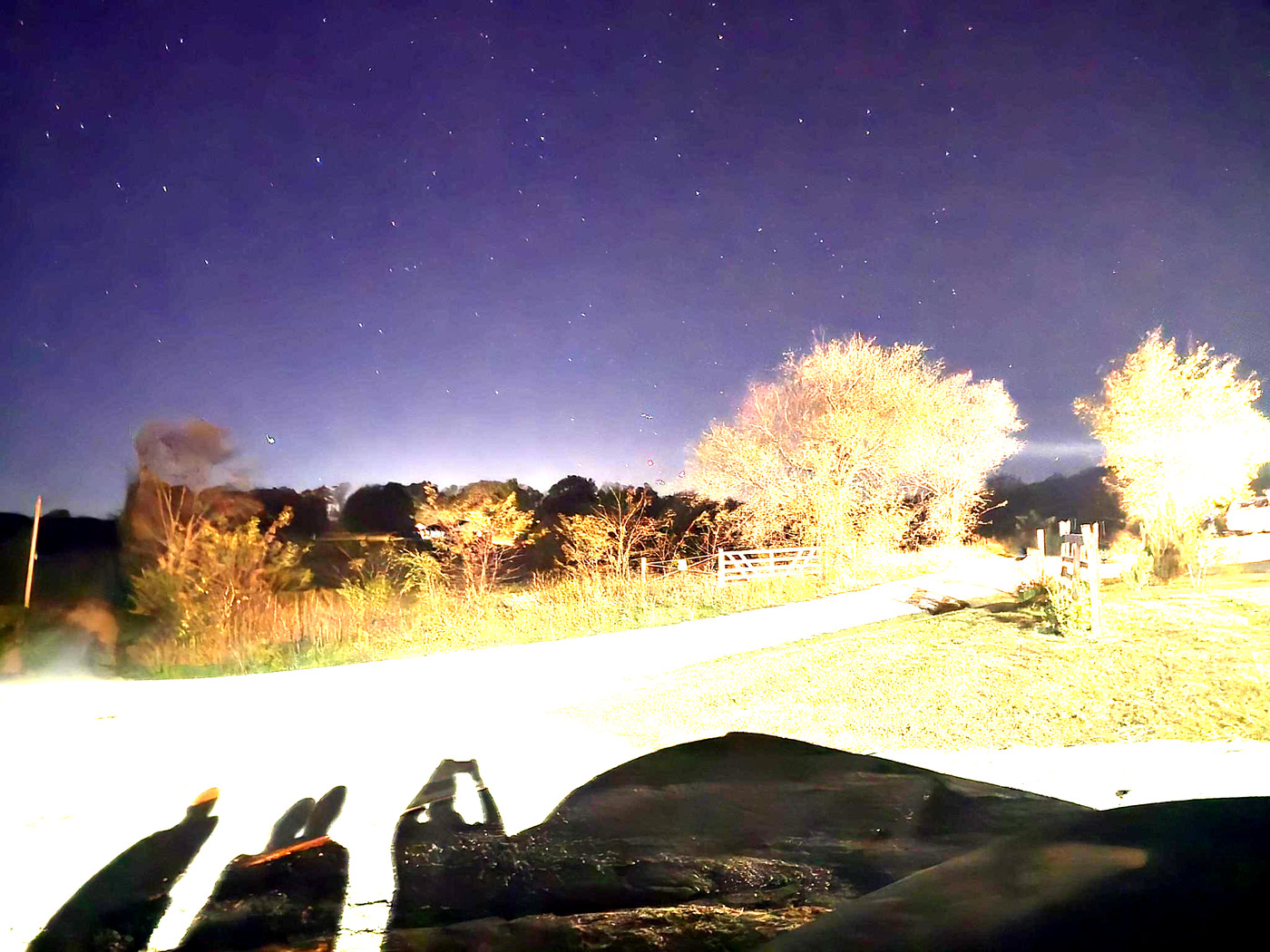
A woman arriving at Lake Galena Dam in north west Illinois reported four white lights circling one another in the evening sky on 17 October 2026. Her son filed the report and the footage two days later.
The filing puts the sighting at 7:38 PM CDT on 17 October 2026, at coordinates the reporter asked to have randomised to within about five kilometres of the true spot, in East Galena Township, Jo Daviess County. Three people were present. The recording was made on an iPhone 16 Pro and runs two minutes and fifteen seconds at 720 by 1280 after Reddit re encoded it. The reported duration of the event is three minutes, the observer was facing south west, and the lights are described as being as high as a star and the apparent size of a pinhead at arm's length.
The account is second hand and says so. The structured form carries the line that the submitter is relaying a family member's sighting rather than their own, and the witness is the reporter's mother. Her words, as passed on, are that the group had just got out of the car for a trip to look at stars, that she first took the lights for a Starlink train, and that she changed her mind when they appeared to move around each other. One light, she said, would hold still, then travel left until it met another light, then change direction and move up and down. Four were visible by the end. The group then went indoors.
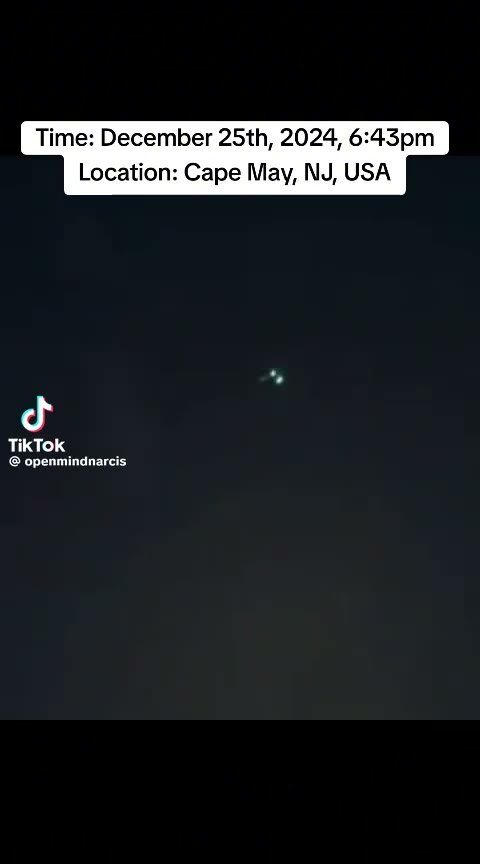
What the footage actually contains is four or more bright point sources in a dark sky. Sampling every third frame across the clip, the frame typically holds 4.24 sources bright enough to clear a 20 grey level threshold, with a median of 4, which matches the witness's count exactly. The brightest of them sits between 27.6 and 190.9 grey levels above the local sky against a noise floor of 0.28 grey levels, so it is a real source by a margin of roughly 291 standard deviations and not a compression artefact.
What is the official explanation?
No agency has commented and none would be expected to. No air traffic control record, police report or military statement exists for this sighting, and the archive found no news coverage of it in any language.
The one piece of automated analysis attached to the report comes from the reporting site itself, which computed a sky context block from a 2026-10-18 orbital catalogue and flagged a Starlink train overhead: five satellites from a single launch, toward the south, south south east and south west, at around 00:26 UTC. That block is a lead rather than a verdict, and it carries two problems. It is computed for 00:26 UTC while the sighting is filed for 00:38 UTC, twelve minutes later, so it describes a different minute of sky. And the launch cadence does not support a fresh train: querying the Launch Library for every Starlink launch between 1 and 18 October 2026 returns exactly one, Falcon 9 Block 5 carrying Starlink Group 15-25 on 13 October at 00:28 UTC, four and a half days before the sighting. A group that old has spread along its orbital plane and no longer presents as the tight string people photograph.
What did the witnesses think it was?
The thread did not accept the account. One commenter wrote that they saw no four lights circling, only slow blinking in a straight line with no other lights besides stars, and that it looked like an aircraft. A second, who has analysed several reports in that subreddit, suggested the object flies past the star Alpheratz and noted that the file posted is a shared copy of the original and carries no accurate metadata, so the exact location and time cannot be recovered from the video itself.
That metadata point is worth keeping. The coordinates in the filing were deliberately randomised at the reporter's request, the timestamp is typed by a person two days after the fact, and the video file has been through at least one re sharing step before reaching Reddit. Nothing in this case is pinned by an instrument.
The sky above the site was not the problem. Dubuque Regional Airport, about 26 kilometres south west of the stated position, reported CLR and ten statute miles visibility at 00:53 UTC, fifteen minutes after the sighting, with the wind from 190 degrees at six knots. Chicago Rockford, about 110 kilometres east, reported the same CLR and ten miles at 00:54 UTC. It was a cloudless night and the stars were fully on display.
Is the Four White Lights Filmed over Lake Galena Dam, Illinois real? The two-pass assessment
Pass one, how could this be mundane. The decisive test does not require knowing the location, the focal length or the exact minute, because it is internal to the footage. If four lights are genuinely manoeuvring around one another, their positions relative to each other must change. If they are fixed stars and the apparent motion is a handheld phone, then every bright point in the frame shares one displacement and the pattern stays rigid.
Every bright source was located to sub pixel precision by subtracting a Gaussian blurred background and taking the intensity weighted centroid of each compact peak. For pairs of frames a fixed interval apart, each source was matched to its nearest counterpart and the single common displacement taken as the median of all the matches. The question is then how far each individual source departs from that common value.
Between adjacent frames, 0.03 seconds apart, the typical source departs by 0.20 pixels and the worst source in the frame by 0.49 pixels. At a one second separation those figures are 0.82 and 1.91 pixels. At three seconds they are 1.61 and 25.79 pixels, and at five seconds 1.86 and 105.0 pixels. The control, in which sources are paired at random instead of by proximity, gives a median departure of 300.9 pixels. So the bulk of the field holds together to within about two pixels even across five seconds, which is a star field, and the apparent motion across the clip, a cumulative pan of several hundred pixels in both axes, belongs to the phone.
That result contradicts the central claim. The four lights do not move around each other. They hold station relative to each other to within a couple of pixels over intervals long enough that a genuine manoeuvre would be obvious, and the lights that appear and disappear through the clip do so as the camera swings them in and out of frame, which also explains why the witness saw their number grow from one to four.
Two honest limits. First, the worst single source per pair does deviate by tens to hundreds of pixels at the longer baselines, and a frame to frame method cannot separate a genuinely moving object from a source entering or leaving the frame and being matched to the wrong neighbour. Something crossing the field is possible and is not established here. Second, an attempt was made to identify the asterism. The Great Square of Pegasus is the only four star figure of comparable brightness standing high in the eastern sky from this site at that hour, with Alpheratz at azimuth 87.4 and altitude 43.2, Scheat at 100.6 and 54.6, Markab at 115.7 and 46.0, and Algenib at 100.8 and 33.9, all within 0.76 of a magnitude of one another. Its true angular separations run 12.88, 13.95, 14.21, 16.51, 20.20 and 20.62 degrees, a ratio set of 1.00, 1.08, 1.10, 1.28, 1.57 and 1.60. The measured pixel separations give 1.00, 1.18, 1.48, 1.88, 2.21 and 2.59, a mean ratio mismatch of 0.451. The identification fails, and the measurement that tests it is itself unreliable because source identity is not stable across the clip. No specific asterism is claimed here.
Pass two, if it is real. For four objects to be genuinely flying in formation and still produce this measurement, they would have to hold their mutual angular separations to within roughly two pixels for five seconds at a stretch while the phone swung across several hundred pixels. That is what a fixed background does. It is not impossible for distant formation flight to look that way over short intervals, but nothing in this file supports it, and the one claim that would have distinguished the two readings, that the lights changed position relative to each other, is the claim the footage refutes.
Tiered Disputed rather than Strongly Disputed, deliberately. The archive has demonstrated that the reported relative motion did not happen and that most of the field is a rigid star pattern. It has not identified the lights, it has not excluded a moving object crossing the field, and the surviving open question, whether the aircraft a commenter described is in the clip, needs historical ADS-B playback for the minute, which this environment cannot run. The witness is relaying a genuine observation under a genuinely clear sky, and an honest misreading of a star field is not a hoax.
Sources
- www.reddit.com/r/UFOs/comments/1xags92/4_white_lights_circling_each_other_steadily_over/
- ufosighting.report/sighting/13157/4-white-lights-circling-each-other-steadily-over-lake-galena
- mesonet.agron.iastate.edu/request/download.phtml?network=IA_ASOS
- ssd.jpl.nasa.gov/horizons/
- ll.thespacedevs.com/2.2.0/launch/
More cases from this region: UFO sightings in United States