The Lake Isabella Photograph
In 1957 a man identified only by the initials "B.C." was riding a Harley Davidson through the southern Sierra Nevada with his fiancee. This case file covers what witnesses reported, the official narrative, and a two-pass assessment with its evidence tier.
What did witnesses see at Lake Isabella?
In 1957 a man identified only by the initials "B.C." was riding a Harley Davidson through the southern Sierra Nevada with his fiancee. They turned off the main highway near Lake Isabella in Kern County, California, found an old dirt road down onto a dry lakebed, and stopped to take a few scenic color photographs. Neither of them saw anything unusual at the time. They shot their pictures and rode on.
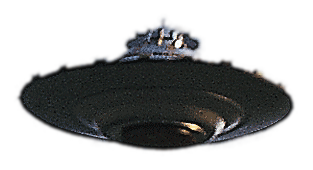
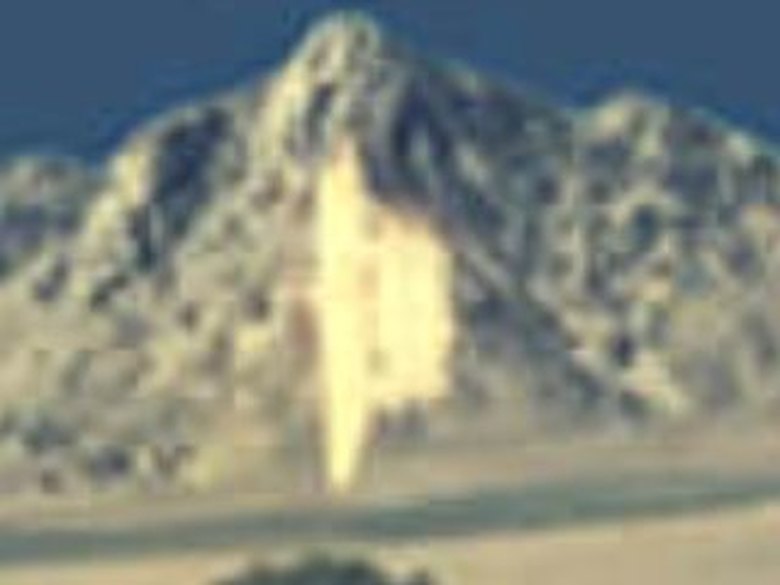
The strangeness appeared only after the film came back. B.C. shot color slide film and sent it to Kodak. When the developed slides returned, one frame carried something invisible to his eye when he pressed the shutter. Above an old oak tree on the dry lakebed sat a tilted, saucer-shaped object, described as "a sideways, saucer-shaped UFO which appeared to be parked above an old oak tree." The disc reads as canted on its axis rather than flat to the camera, with a glow or color fringe around it, sitting over the tree in otherwise ordinary daylight desert scenery.
B.C.'s first reaction was suspicion of the lab, not wonder. According to the account passed down through the family, his first thought was that "someone at the Kodak film lab must have been playing a trick on him." That detail matters, because the photographer himself first assumed a processing prank or artifact rather than a genuine craft. Only when that did not hold up did the frame begin to circulate as a real anomaly. There was no second witness to a craft, no radar, no ground trace, nothing but the single exposed slide and the chain of people who handled it afterward.
What is the official explanation?
There is no official government file on this photograph. It does not appear in Project Blue Book as a named case, carries no Air Force investigation number, and is tied to no FOIA-released document, because the object was never reported as a sighting at the time. B.C. saw nothing to report. What stands in place of an official record is a claimed media authentication and a separate body of institutional UFO activity in the same corner of California, and both deserve to be stated plainly with their limits.
The authentication claim runs as follows. After copies and enlargements were made, the original slide was taken to the Los Angeles office of Time-Life Magazine. According to the account, the Los Angeles staff held the slide a few days, ran their own tests, and concluded the image was genuine, summarized in the line that "it was not a lens flare, an acid splash or a double exposure." Those three are exactly the in-camera and darkroom faults a picture desk checks first. The account then states that the Los Angeles office was "instructed by their main office in New York not to run the story or the photo," on the stated ground that publishing such material was not the magazine's policy. A parallel claim, repeated in the secondary write-ups, holds that Kodak labs also deemed the slide authentic. The hard problem with both is documentary. No memo, no internal Time-Life correspondence, no named editor, and no Kodak report has ever surfaced. The verdict survives only as oral testimony relayed through the slide's owner, not as a paper trail anyone can pull and read.
The second strand of context is real and checkable in outline, even if it does not bear on this specific frame. Lake Isabella sits just southwest of the Naval Ordnance Test Station at China Lake, the Navy's main weapons proving ground. Dr. Elmer Green, a physicist who worked at China Lake from 1947 to 1957, later told the scientist and author Richard Thompson that during range testing the tracking cameras repeatedly caught objects flying into frame, and that he personally knew "some 40 to 50 professional people who had some connection with UFO sightings" at the station. Green described one daylight sighting he shared with the base photographic officer, Jack Clemente, while watching an AJ bomber come in: "As the airplane flew over, we saw an object about 16 feet in diameter flying about 400 feet below the bomber. It remained there, pacing the plane for a few seconds and then it flew away at great speed, vanishing from sight in 2 or 3 seconds." That testimony is about China Lake range activity, not B.C.'s slide, and should be read as background to the region rather than confirmation of this photograph.
What did the witnesses think it was?
The photographer of record is anonymous. He is named in every account only as "B.C.", a friend of the family of researcher Robert Stanley, and his fiancee is unnamed as well. That anonymity is a real evidentiary weakness and should be stated up front: there is no way to interview the man, examine his camera, or independently confirm where and when the frame was shot. What he is reported to have believed is modest. He did not claim to have seen a craft. His own first instinct was that the Kodak lab had pulled a trick on him. He came to take the image seriously only after it failed to explain away as a lab error.
The man who carries the case is Robert M. Stanley, and his belief in it is firsthand insofar as the object he holds is concerned. Stanley received the original color slide as a gift from his father on his twenty-seventh birthday. His father had obtained it directly from B.C. and had copies and enlargements made, and according to Stanley both his father and B.C. were members of the Self-Realization Fellowship who had attended the UFO contactee gatherings at Giant Rock airport in the Mojave Desert in the early 1950s. Stanley is not an anonymous poster. He is a former corporate journalist for Honda Research and Development, the editor of UNICUS magazine, and the author of the UFO books "Close Encounters on Capitol Hill" and "Covert Encounters in Washington, D.C." He has stated that he possesses the physical original, that it was examined by Time-Life, and that over the years the slide deteriorated when it sat unprotected in an office drawer under a leaking skylight and grew mold, though the image of the object stayed visible through the damage.
The corroborating witness in the wider story is Dr. Elmer Green, with the base photographic officer Jack Clemente named alongside him for the AJ bomber sighting. Green is a credible figure, a physicist later known for biofeedback research, and his account to Richard Thompson lends weight to the claim that strange objects were being filmed around China Lake in exactly this period. But Green never spoke to B.C.'s slide. He corroborates an environment, not this exposure. So the witness picture is layered: a named, public researcher who holds and vouches for the original, an anonymous photographer behind it, and a respected scientist who confirms the regional pattern without ever touching the photograph in question.
The dispute
The dispute is not a named debunker versus a named defender. It is a structural weakness in the case that any skeptic can press, and it was first voiced by the photographer himself. When B.C. got his color slides back from Kodak and saw a tilted, glowing disc over the oak tree, his immediate conclusion was that "someone at the Kodak film lab must have been playing a trick on him." In other words the man who took the picture assumed an artifact before he assumed a craft. The ordinary candidates are exactly the ones a picture desk checks: a sun-angle lens flare or internal reflection, a film or emulsion defect, a processing splash or contaminant, a dust spot, or a light leak. A canted luminous blob floating in bright daylight, on a frame where neither photographer saw anything at the scene, is the classic signature of an optical reflection. Because the object was never seen by eye and appears on a single slide with no second frame, the artifact hypothesis cannot be excluded and remains live.
The counterweight offered against that reading is the claim that Time-Life Magazine's Los Angeles office tested the slide and found it "was not a lens flare, an acid splash or a double exposure," and that Kodak likewise deemed it authentic. If those analyses existed in documentary form they would push this case toward Verified Unexplained. The trouble is that neither has ever been produced. There is no Time-Life memo, no named editor or photo analyst, no Kodak report, and no internal correspondence. The verdict survives only as oral testimony relayed through the slide's current owner, Robert Stanley, who received the original from his father, who in turn got it from the anonymous B.C. A chain of trust three people long, with the originating photographer unidentifiable, is not a record a skeptic is obliged to accept, and the convenient detail that New York headquarters supposedly suppressed the story removes the one thing that would have created a public, datable paper trail.
Crucially, no independent civilian analyst has ever performed and published a method-shown debunk of this specific image. Nobody has reconstructed the sun angle and lens to reproduce the flare, recovered a hoax method, or positively identified the disc as a particular reflection, object, or defect. The skeptical case is therefore strong in principle but unproven in practice: a plausible natural explanation that fits the photographer's own first instinct, set against an authentication claim that cannot be checked. That is what keeps this in the Barely Disputed band rather than the Strongly Disputed one. There is a credible counter-explanation and a credible reason to doubt the authentication, but there is no confession, no recovered prop, and no demonstrated identification of the actual cause of this frame.
Is the Lake Isabella Photograph real? The two-pass assessment
Pass one, the ordinary explanations. The photographer himself supplied the leading one: a lab artifact. He shot color slide film, did not see anything at the scene, and assumed the Kodak processor had introduced the object. That is a sober first guess and it covers a family of mundane causes, a lens flare or internal reflection thrown by the sun off the camera optics, a film emulsion defect, a processing splash or mark, a dust or contaminant flaw, or a double exposure or light leak. A tilted, glowing, disc-shaped blob hanging in clear daylight over a tree is precisely the silhouette a sun-angle lens reflection tends to produce, and a single anonymous slide with no second frame, no auditable chain of custody, and no witness to a craft is the weakest possible evidence object. The claimed Time-Life and Kodak authentications, which supposedly ruled out flare, acid splash, and double exposure, would matter a great deal if they existed on paper, but no document, memo, or named analyst has ever been produced, so an independent skeptic is free to revive the lab-artifact reading the photographer himself started with. On top of that, the only fixed fact is the year 1957, and even that comes from the slide's owner rather than any dated record.
Pass two, if the object is real. Then a solid, opaque, tilted disc was physically present above the lakebed and simply moved or behaved in a way that escaped two people's notice while their camera caught it, which fits the recurring claim from that exact region that objects appeared on film without being seen by eye. The China Lake testimony is the strongest part of this reading. Dr. Elmer Green, a working physicist, described tracking cameras repeatedly catching objects during weapons tests a short distance away, and recounted with the base photographic officer Jack Clemente a 16-foot object pacing an AJ bomber 400 feet below it before vanishing in two or three seconds. If genuine, B.C.'s slide would be one more instance of the same phenomenon being recorded photographically in the Sierra Nevada in the late 1950s, near a major Navy weapons range, by an instrument that registered what human eyes missed.
The verdict. There is no confession, no recovered prop, no positive identification of a specific aircraft, balloon, drone, or reflection traced to this exact frame, and no independent civilian analyst has ever published a method-shown debunk of the actual image. What exists is a plausible-but-unproven natural-artifact reading, the lens-flare or lab-defect hypothesis the photographer first reached for, set against an unverifiable single-family provenance and an undocumented media authentication. A reasonable counter-explanation is on the table but no one has demonstrated it on this photograph, and the authentication that would settle it the other way is equally undocumented. That balance, a real but unproven mundane explanation against a case that otherwise stands on one slide, is the textbook profile of Barely Disputed. The photograph remains genuinely unresolved, leaning skeptical on weight of evidence but not closed.
Sources
- www.theblackvault.com/casefiles/1957-lake-isabella-ufo-photograph-still-mystery/
- robertstanley.substack.com/p/ufo-photo-phenomenon
- web.archive.org/web/20250130094935/https://www.ufocasebook.com/1957lakeisabella.html
- www.thinkaboutitdocs.com/1957-lake-isabella-ufo-photograph-still-a-mystery/
- web.archive.org/web/20250802051656/https://www.ufocasebook.com/lakeisabellasmall.jpg
More cases from this region: UFO sightings in United States