The Old Saybrook Occupant Sighting
In the early hours of 16 December 1957, between two and three in the morning, Mrs. Mary M. Starr was alone in her home in Old Saybrook, Connecticut. This case file covers what witnesses reported, the official narrative, and a two-pass assessment with its evidence tier.
What did witnesses see at Old Saybrook?
In the early hours of 16 December 1957, between two and three in the morning, Mrs. Mary M. Starr was alone in her home in Old Saybrook, Connecticut. She had gone to bed on the night of 15 December. She was awakened by a bright light shining into her bedroom. Looking out the window toward her back garden, her first impression was of a crippled airplane that had come down between the house and the tool shed. When her eyes adjusted she saw instead a cigar-shaped object, brightly lit and lined with square portholes, hovering just above her clothesline, only a few feet above the ground and roughly ten feet from the house.
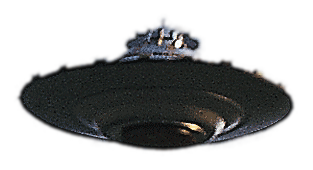
She estimated the object at about twenty to thirty feet long. It was double-ended and lens-shaped in profile, dark gray or black, with no wings, tail, or any visible means of propulsion. Several large square windows ran along its side and glowed brightly. In her own sketch she drew the craft as a pointed oval with four square portholes in a row, marking the spot where an antenna would later appear.
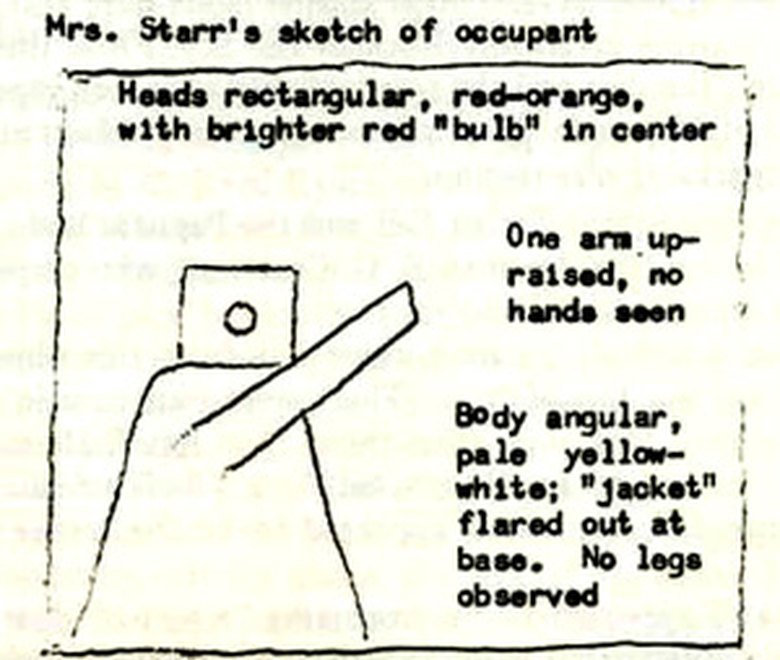
Through the lighted windows Mrs. Starr saw figures moving. At first there were two. They walked back and forth and passed one another, each with its right arm raised. She said they could not have been more than three and a half to four feet tall. Their heads were the strangest feature: square or rectangular, red-orange in color, with a brighter red bulb or lamp glowing in the center, which she thought might be helmets. Their right arms were up but no hands were visible at the ends of the sleeves. They wore jacket-like garments, pale yellow-white and angular, that flared out at the base like a short skirt. She could see no legs. A third figure appeared a little later.
As she leaned closer to watch, the portholes faded and the entire shell of the object began to glow with a scintillating brilliance. From the nearer end a thin structure she likened to a television antenna, about six inches long, rose up, then began to spin and sparkle. This lasted several minutes. The antenna sank back into the body of the craft. The object then drifted off slowly and unevenly, dipping toward a blue spruce and appearing to follow the contour of the marshy ground, before it tilted sharply, changed to a more oval shape with small circular lights now ringing its rim, came back toward her, and finally shot straight up into the sky at tremendous speed and vanished. The whole encounter was completely silent.
What is the official explanation?
No United States Air Force investigation is on record for this case. It does not appear in the Project Blue Book master index as an Air Force file, and Mrs. Starr did not report it to the Air Force or to the press at the time. By her account she told no one at all for roughly nine months. The only formal investigation was civilian.
The case was worked by the National Investigations Committee on Aerial Phenomena (NICAP). The two named investigators were Richard Hall, NICAP's former Assistant Director and at the time its Research Consultant, and Isabel Davis, then of the NICAP staff and previously a leading figure in Civilian Saucer Intelligence of New York. Davis was one of the more rigorous and skeptical investigators of the era, and the account was first published in the Civilian Saucer Intelligence of New York newsletter dated 15 July 1959. NICAP later carried the material into its own files, and Richard Hall placed the case in The UFO Evidence, the 1964 NICAP compendium assembled in Washington, D.C.
The investigators' published assessment was cautious and is quoted in essentially the same words across the NICAP and CSI material. They noted that Mrs. Starr was a former teacher who held a graduate degree from Yale, that she had been the sole witness because most of the houses in her neighborhood were seasonal and stood empty in December, and that she expected no corroboration and sought no publicity. Their conclusion was that, given her background and the absence of any conceivable motive to invent or embellish the story, neither Miss Davis nor Mr. Hall could find any reason to dismiss her report out of hand. They did not claim to have explained the object, and they did not claim physical proof. They logged it as an unexplained close encounter with occupants and left it on the record as such. No official body ever produced a competing identification.
What did the witnesses think it was?
The single witness was Mrs. Mary M. Starr of Old Saybrook, Connecticut, a former schoolteacher holding a graduate degree from Yale. She was alone in the house on the night in question. By every account she gave, she believed she had seen a real, solid, structured craft hovering over her own back garden at close range, occupied by small figures she could watch moving about through its windows. She was firm that it was not an airplane, which had been her very first thought before she looked properly.
Two details show how literally she took the experience. She made her own pencil sketches, one of the object and one of an occupant, and annotated them carefully: the craft drawing marks the four square portholes and the point where the antenna later rose, and the occupant drawing is labeled with the rectangular red-orange head and its brighter red bulb, the single raised arm with no hand, the angular pale yellow-white body, the jacket flared at the base, and the note that no legs were observed. These were the witness's own drawings, not an artist's reconstruction, and they match her verbal description point for point.
She also waited. She did not report the sighting to anyone for roughly nine months, only coming forward in 1958 and giving the full account that reached print in 1959. She explained that she had no corroborating witnesses, since the surrounding seasonal homes were shut up for winter, and she had not expected to be believed. That reticence, rather than any eagerness for attention, is part of why the NICAP investigators treated her as credible. There were no secondary or supporting witnesses to the event itself; the strength of the case rests entirely on the witness's standing, the internal consistency of her account, and her contemporaneous sketches.
The dispute
The dispute is not an official finding and not a method-shown debunk. It is a skeptical reading that circulates in the secondary literature and rests on the structure of the case rather than on any identified object. The core of it is this: Mrs. Starr was the only witness, she was woken from sleep between two and three in the morning, there was no corroborating observer because the neighboring seasonal homes stood empty in December, and there is no photograph, no physical trace, and no instrument record. From that, skeptical commentators argue the encounter could have been a hypnagogic or hypnopompic episode, a vivid waking dream of the sort that commonly occurs at the edge of sleep and is experienced as fully real, perhaps seeded by an ordinary light glimpsed through the window.
No specific person has put their name to a worked debunk of this case, and crucially no one has ever identified the supposed real-world stimulus. There is no named aircraft, no traced balloon or re-entry, no star or planet fixed to the time and bearing, and no demonstration that the imagery was copied or invented. The dream hypothesis is an argument about the witness's mental state at the moment of waking; it is plausible, but it remains an assertion rather than a shown mechanism, which is the difference between a case that is strongly disputed and one that is only barely disputed.
Weighing against the dispute is the investigation itself. NICAP's Richard Hall and Isabel Davis, the latter known for a hard, critical approach, examined the report and concluded that given Mrs. Starr's background as a Yale-educated former teacher and her complete lack of motive to invent or embellish, they could find no reason to dismiss it. She made and annotated her own sketches of both the craft and an occupant, waited roughly nine months before reporting, and sought no publicity. None of that proves an object was present, but it does mean the dream explanation has to override a careful contemporaneous account from a credible witness, with no positive evidence that a dream is what happened. The counter-explanation therefore does not close the case; it leaves it standing with an open and reasonable doubt, which is why this is filed as Barely Disputed rather than Strongly Disputed or Verified Unexplained.
Is the Old Saybrook Occupant Sighting real? The two-pass assessment
Pass one, the ordinary explanations. With a single witness, no photograph, no physical trace, and no radar or second observer, the case cannot be closed in the witness's favor on hard evidence alone, and that is the honest starting point. The sighting happened between two and three in the morning when she was woken from sleep, which is the classic setting for a hypnagogic or hypnopompic experience, a vivid waking dream that feels completely real. Skeptical readers have leaned on exactly this: one witness, just woken, no corroboration, therefore possibly a dream or a misperception built up from a half-glimpsed light. A bright light through the window could in principle have begun as something mundane, a vehicle, a reflection, a star or planet low over the marsh, with the structured craft and the little figures supplied by an imagination still half in sleep. The trouble is that none of this has ever been demonstrated for this case. No specific stimulus has been identified, no plane, no light source, no traced object, and the dream argument is an assertion about her state of mind, not a shown mechanism. There is no confession, no recantation, no recovered prop, and no one has reproduced or sourced the imagery. So the ordinary-explanation column contains a plausible psychological hypothesis and nothing that closes it.
Pass two, if it was real. If Mrs. Starr saw what she described, then a structured, double-ended, lens-shaped craft about twenty to thirty feet long hovered a few feet over her clothesline, lit from within through square portholes, carrying three figures under four feet tall with glowing rectangular heads, raised arms, and skirted jackets, and it departed by rising silently and shooting vertically at high speed after extending and spinning a small antenna. That is squarely an occupant or close-encounter event of the kind NICAP's own investigators, including the famously hard-nosed Isabel Davis, found they could not dismiss. The witness sketches are unusually specific and self-consistent, the behavior of the object (the changing shape, the rim lights, the terrain-following drift, the antenna) is oddly elaborate for a simple light-in-the-sky misperception, and the witness gained nothing, waited months, and avoided publicity.
The competing accounts here are a credible NICAP-investigated single-witness occupant report on one side, and on the other a never-substantiated suggestion that it was a waking dream. An official-apparatus silence (no Air Force file) is not a debunk; it counts for nothing against the case. The only counter-explanation is weak, unsourced, and rests on the witness's having just woken rather than on any identified object or shown method. That is precisely the profile of a case that largely stands while carrying an unresolved question mark. The tier is Barely Disputed: the report is documented and investigated and remains unexplained, but it is a single uncorroborated witness, and a plausible-but-unproven natural explanation hangs over it without ever being demonstrated.
Sources
- www.nicap.org/newlook/section_VII.htm
- web.archive.org/web/20250130112548/https://www.ufocasebook.com/oldsaybrookconnecticut1957.html
- www.nicap.org/ufoe/UFO%20Evidence%201964.pdf
- www.ufoevidence.org/Cases/CaseSubarticle.asp?ID=962
- web.archive.org/web/20230506031955/https://www.ufocasebook.com/oldsaybrook.jpg
- www.ufocasebook.com/oldsaybrook2.jpg
- ufoac.com/connecticut-ufo-with-passengers-on-board-1957-old-saybrook.html
More cases from this region: UFO sightings in United States