The Lake Powell 1998 Photograph
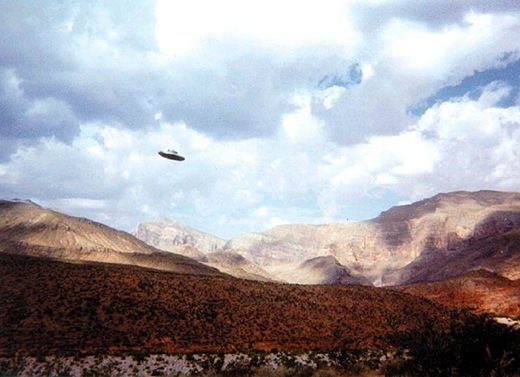
A silvery disc gliding through a cloud-stacked sky over red rock canyons, credited to Joe Clower at Lake Powell in April 1998, won first prize in UFO Magazine's first annual photo contest in 1999. The photographer was real. He was also a career fine artist, and one third of an art collaborative whose UFO Polaroid archive deliberately blurred the line between the factual and the fictional.
What did witnesses see at Near Lake Powell?
The photo shows an elongated metallic disc at mid-distance over desert canyon terrain under dramatic cumulus clouds. The ufoevidence.org catalog entry quotes Clower directly: photo taken near Lake Powell, Utah, using a 35mm disposable camera, no unusual circumstances at the time of the shooting, and notes the photo won first prize in UFO Magazine's first annual photo contest, Spring 1999. The entry's listed source is El Disco, with a link to the original eldisco.com slide.
What is the official explanation?
No official involvement of any kind. The photo's public life ran through UFO Magazine's photo contest and hobbyist archives, never through any investigative body.
What did the witnesses think it was?
Joe Clower (1937-2024) is the only named source, and he was not a random tourist. He was a Denver-based artist with an MFA from CU Boulder, exhibitions at the Whitney and the Denver Art Museum, and, from 1987 on, one third of El Disco, the collaborative whose UFO Polaroid archive Rule Gallery describes as documenting events both factual and presumed. His bland it-was-just-there caption is consistent with the project's deadpan method, and by his own account he saw nothing unusual at the time of shooting.
The dispute
The dispute here is not a balloon, drone, flare, or aircraft identification, and it is not an official ruling. The page documents no official involvement of any kind: the photo's only public life ran through UFO Magazine's photo contest and hobbyist archives, never through any investigative body, so there is no agency finding to weigh. The counter-explanation is instead one of provenance and authorship. The image is read as an art-world intervention rather than a genuine sighting, and that reading is advanced not by an outside skeptic but by the source material itself. The photographer, Joe Clower (1937 to 2024), was one third of El Disco, the art collaborative whose UFO Polaroid archive Rule Gallery describes as documenting events both factual and presumed, with the gallery's curator pointedly declining to say whether the photographs are real, a hoax, or a joke.
The strongest single fact against authenticity comes from the photographer himself. By his own account he saw nothing unusual at the time of shooting, meaning nobody, including the man holding the camera, ever claimed to have actually witnessed a UFO. The provenance backs this up: the image is slide 247 on the Wayback-archived eldisco.com, hosted in El Disco's own archive as lakepowell.jpg by April 2001 under Clower's own first-person caption, with ufoevidence.org itself crediting El Disco as the source. The disc lives inside a deliberately ambiguous art archive whose own creators decline to call it real, and the man who photographed it says he saw nothing. Taken together, that is a real and serious challenge to treating this as an observed unidentified object.
Here is where the counter-explanation stops short. What is missing is a demonstrated mechanism. No analyst has shown the disc to be a model or an insertion, no model match or photo-analysis has been produced, and not a single measurement closes the loop on how the object was put into the frame. There is no confession to a fabrication technique. The creators' refusal to call the work real, a hoax, or a joke is not a recantation, it is the deliberate ambiguity of the project, and it leaves the central question open rather than answering it. No prop or rig tied to this photograph has ever surfaced. So the art-world case is built entirely on inference from authorship and on the photographer's no-sighting admission, not on a reproduced or proven hoax method.
That is why the case is Barely Disputed rather than Strongly Disputed or Discredited. The provenance and the no-sighting statement substantially erode the sighting claim, and on the balance of it this looks far more like an art-archive artifact than an aerial phenomenon. But the core claim, that the object in the image was fabricated, has never been positively closed. There is no confession, no recovered prop, and no positive identification of the disc as a specific known object. The counter-explanation is strong but it remains inferential and method-free, so the central anomaly is not formally settled. The case largely stands as Disputed, leaning toward an art-world intervention, without being demonstrably debunked.
Is the Lake Powell 1998 Photograph real? The two-pass assessment
Pass one, the claim on its face. A well-composed single frame from a 35mm disposable camera, with the photographer himself reporting nothing unusual at the time of shooting. That last detail is fatal to it as a sighting: nobody, including the man holding the camera, ever claimed to have actually witnessed a UFO. On its own that caps the case at a curiosity. Then the provenance deepens the problem. The image is slide 247 on the Wayback-archived eldisco.com, hosted in El Disco's own archive as lakepowell.jpg by April 2001 under Clower's own first-person caption, and ufoevidence.org itself credits El Disco as the source. Joe Clower (1937-2024) was not a random tourist but a founding member of the collaborative, a Denver fine artist with an MFA from CU Boulder and exhibitions at the Whitney and the Denver Art Museum. Rule Gallery's 2025 exhibition frames the El Disco archive as contemporary art that documented events both factual and presumed, with the line deliberately blurred. A UFO photograph living inside its photographer's own fact-blurring art practice, entered by him into UFO Magazine's first photo contest and winning first prize in Spring 1999, is a serious authenticity problem. The ordinary reading is plain: this is an art-world artifact, not an observed object in the sky.
Pass two, what the debunk does not close. The art-world reading is inference, not demonstration. No analyst has shown the disc to be a model or a digital insertion, produced a model match, or taken a single measurement that pins down how the image was made. El Disco never declared the photograph a fabrication, and the gallery's own curator pointedly declines to say whether the works are real, a hoax, or a joke. That refusal cuts both ways: it is exactly the opposite of a recantation. Clower's caption that he saw nothing unusual is a no-sighting statement, not a confession to staging or compositing anything. There is no recovered prop, no rig, no described technique, no walk-back. So the central question, whether the object in the frame was fabricated, is answered only by reasoning from who took it and where it ended up, never by anyone demonstrating the fabrication itself.
Verdict: Barely Disputed. The counter-explanation is substantial and points hard toward an art-world intervention rather than a sighting, with the photographer's own no-sighting statement doing most of the damage. But it is inferential provenance evidence, and it falls short of the closure Strongly Disputed requires: there is no confession, no recantation, no recovered prop or rig tied to this event, and no positive identification of the disc as a specific model or insertion. This archive previously ran the case as Discredited; under the site's rule that Discredited requires the imagery itself to be demonstrated false, that overstated the evidence and was corrected on 2026-06-12. The same logic forbids Strongly Disputed, which also demands demonstrated closure and does not have it here. The provenance wounds the sighting claim badly. It does not formally kill it.
Sources
- www.ufoevidence.org/photographs/section/latestadditions/Photo18.htm
- web.archive.org/web/20010425214212/http://www.eldisco.com/showslide.cfm?ID=247
- rulegallery.com/wp-content/uploads/2025/01/El-Disco-Charged-Particles-in-the-Vicinity-Press-Release-FINAL.docx
- rulegallery.com/exhibition/el-disco-charged-particles-in-the-vicinity-ufo/
- www.cpr.org/2025/03/06/colorado-arts-spotlight-ufos-denver-restaurant-week-first-friday/
More cases from this region: UFO sightings in USA