The Maslin Beach Photographs
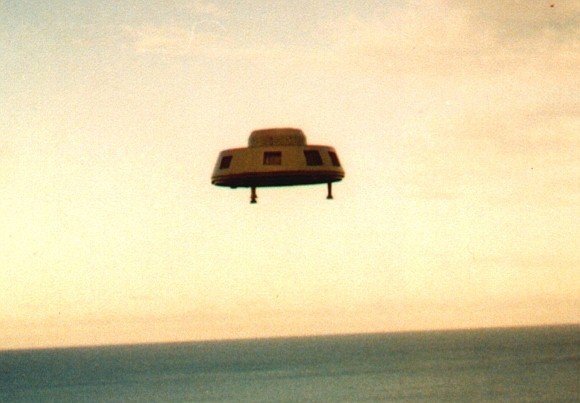
At dawn on a clouded-out morning south of Adelaide, a 69 year old retiree with a forty dollar fixed-focus camera says a 40 metre disc rose out of the sea in front of him, took a smaller sphere aboard, and flew away dripping water. The four colour photographs he eventually produced are among the sharpest daylight UFO images ever offered, which is exactly why they divide researchers to this day.
What did witnesses see at Maslin Beach?
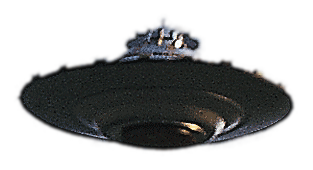
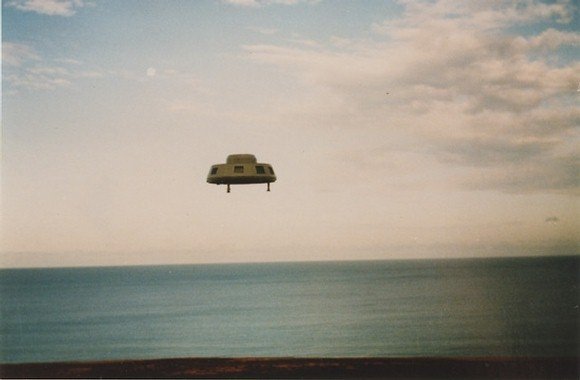
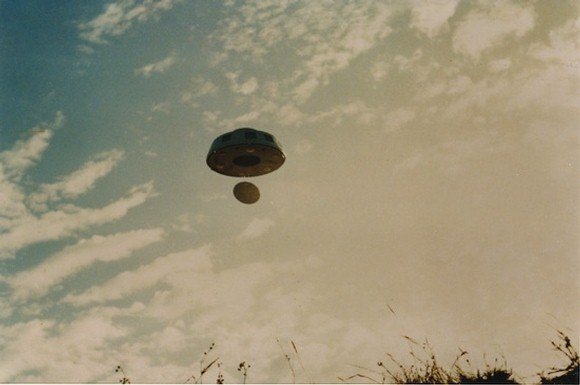
Four 35mm colour frames show a light grey, domed disc against sky and sea off Ochre Point. The first frame catches the object low over the water with three landing legs extended beneath the hull and a row of dark rectangular portholes along the rim. Later frames show the disc from below with a smaller spherical object hanging beneath it, which Thomason said he watched rise up and dock into a recess in the larger craft, accompanied by three external lights. The final close frame shows the disc with windows and leg struts plainly visible. The detail is so crisp that critics call the images too good, while supporters note they match the witness narrative frame by frame.
More footage and images of this sighting
What is the official explanation?
There is no official narrative. No RAAF, police, or government investigation of the photographs is on record, and the case appears in no released Australian government UFO file. The only laboratory examination claimed is an analysis of the negatives said to have been done by Kodak in Adelaide after a UFO enthusiast named Mark Tarrot submitted them, but no Kodak report has ever been published and Thomason himself told investigators he never learned the result. Everything known about the case comes from civilian researchers.
What did the witnesses think it was?
Eric Thomason, then 69 and living at Maslin Beach, set out before 6 am on Wednesday 10 March 1993 to shoot the sunrise from Ochre Point, a 60 metre cliff near the old Maslin sand quarry, hoping to enter a photo contest run by the Southern Times Messenger. The sunrise was clouded out. Turning to the sea, he says he saw what looked like the tower of a submarine break the surface about 2 kilometres out, then rise as a spinning disc with three legs that retracted as it approached to within roughly 400 metres. Fearing abduction, he climbed a few metres down the cliff face and kept shooting with his son's Kodak S50 loaded with Fuji 100 film. He says a second, smaller object arrived, paused, then rose into an opening in the larger craft, and that when the big disc finally passed over him he felt water dripping from it. He told no one, not even his wife, finished the roll at his leisure, and only had the film developed and came forward in May 1994 after watching a UFO program on television. He filed a detailed report form with Colin Norris's Australian Flying Saucer Research Society, the case ran in the PRA Journal in March 1995, and Swedish investigator Clas Svahn interviewed him at length in 1996. Thomason never wavered: asked directly whether the photos were genuine, he answered yes, absolutely.
The dispute
The dispute over the four Maslin Beach photographs is not an official ruling at all. There is no RAAF, police, or government investigation of the images on record, and the case appears in no released Australian government UFO file. The only claimed laboratory work was a Kodak analysis of the negatives, but no report was ever published and the witness, Eric Thomason, never learned the results. So the challenge to this case comes entirely from civilian research, not from any state apparatus, and there is no official verdict to weigh.
The substantive counter-explanation is the small model hypothesis advanced by Clas Svahn and UFO-Sweden, published in UFO-Aktuellt in 1996. This is a genuine method-shown argument rather than a bare assertion. Svahn's strongest point is photographic and rests on the known optics of the camera used: the Kodak S50 is a fixed-focus instrument set at infinity with a large depth of field, so a 40 metre disc at roughly 400 metres and the horizon behind it should both render sharp. Instead the first frame shows the object in focus while the horizon is fuzzy, which is the signature of a small object held or thrown close to the lens rather than a large craft far out to sea. Svahn added supporting circumstantial points: a tight timeline between roughly 5:45 and 6:00 am that leaves little room for Thomason to dress, fetch his dog, walk to the site and climb down; a bright blue sky in frame one that conflicts with a dawn reported as cold and fully clouded; and a noted resemblance, raised by UFO-Aktuellt readers, between the object and a marine ventilation cowl from a private boat.
Where the debunk falls short is in closing the loop. No analyst ever produced an exact matching part, built or photographed a demonstration model, or reproduced the focus anomaly with a tossed object, so the cowl resemblance and the small model reading both remain inferences rather than identifications. Thomason himself never recanted; asked directly whether the sighting was real he answered yes, absolutely. There is no confession, no recovered prop, and no replication. The depth-of-field argument is the kind of concrete, testable claim this archive respects, and it gives the skeptical case real footing, but on its own an unreproduced inference does not amount to a settled identification.
Net, the small model hypothesis is the best explanation on offer and it is methodologically credible, yet it stops short of solving the case. The imagery remains unexplained as imagery, the identification was never demonstrated, and the witness never admitted a hoax, so the case largely stands as disputed rather than closed.
Is the Maslin Beach Photographs real? The two-pass assessment
Pass one, the mundane case. The only analyst on record who applied a stated method to this specific imagery is Clas Svahn of UFO-Sweden, who investigated for UFO-Aktuellt in 1996. Svahn's photographic point is concrete: the Kodak S50 is a fixed-focus camera set at infinity with large depth of field, so a 40 metre object at 400 metres and the horizon behind it should both be sharp, yet in the first frame the object is in focus while the horizon is fuzzy, which is what you would expect if the object were actually small and close, like a hand-held or tossed model. Svahn also showed the internal timeline strains belief, since the 15 minutes between the 5:45 alarm and the 6:00 first photo must cover dressing, fetching the dog, the walk, and the climb, and the bright blue sky in frame one sits poorly with a cold, fully clouded dawn. After publication, UFO-Aktuellt readers pointed out the object's strong resemblance to a marine ventilation cowl from a private boat, though no one ever produced an exact matching part and no named analyst ever demonstrated a model toss, so the popular it was a thrown model claim remains an inference, not a finding. The 14 month sit on the film cuts both ways: damning as a hoaxer's incubation period, or ordinary behaviour for a non-photographer who doubted anything had come out. Pass two, if real. Then this is a structured craft roughly 40 metres across performing a water egress, a daylight close pass with landing gear cycling, and a docking operation with a smaller sphere, all within 400 metres of a witness, which would make it one of the most complete photographic records of a transmedium object and a craft-to-craft recovery anywhere in the literature, and the dripping water detail would corroborate the sea emergence. Verdict: the imagery is genuinely unexplained as imagery, but Svahn's named, method-based focus analysis and the timeline problems give the small model hypothesis real footing, so the case stands as Disputed rather than verified.
Sources
- www.ufoevidence.org/cases/case1045.htm
- www.ufoevidence.org/photographs/section/1990s/Photo420.htm
- www.ufocasebook.com/maslinbeach1993.html
- ufosa.files.wordpress.com/2011/05/south_australian_ufo_story.pdf
- www.thinkaboutitdocs.com/1993-the-1993-maslin-beach-photo-case/
More cases from this region: UFO sightings in Australia