The McMinnville Trent Farm Photographs
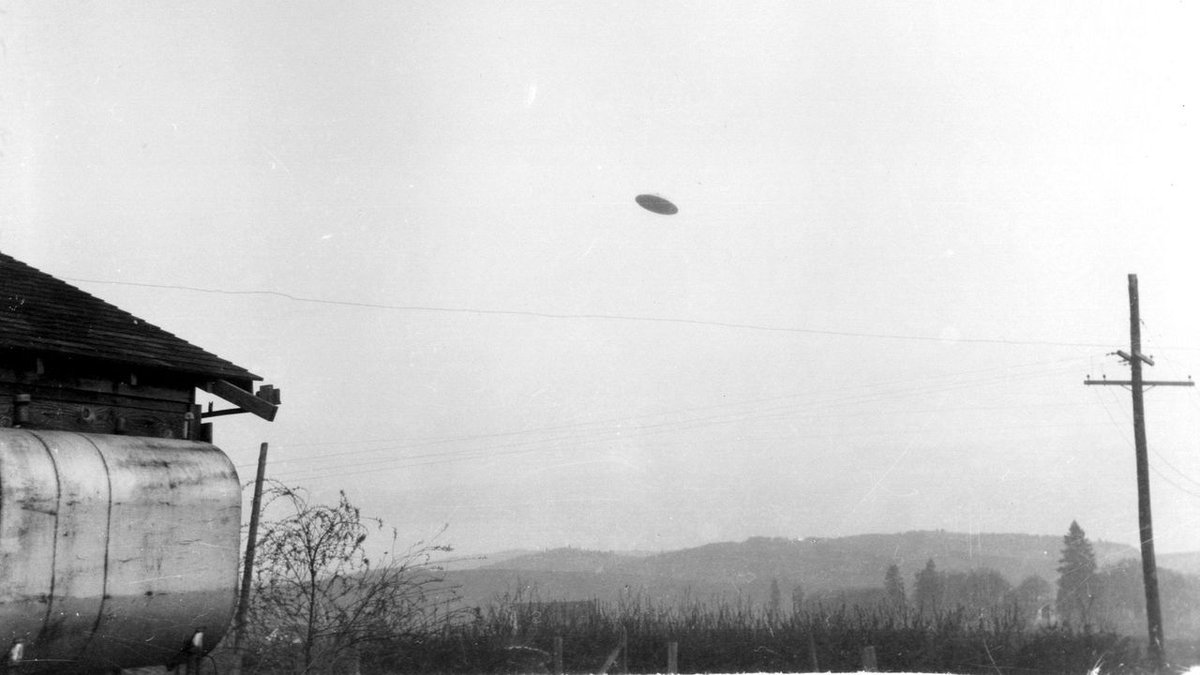
On a gray May evening in 1950, an Oregon farm wife feeding her rabbits looked up and shouted for her husband to grab the camera. The two frames Paul Trent clicked off in about thirty seconds became the most analyzed UFO photographs ever taken, the only ones a US government scientific study walked away from calling consistent with an extraordinary flying object. Seventy-five years on, credentialed analysts are still publishing dueling measurements of the same two negatives.
What did witnesses see at Trent farm?
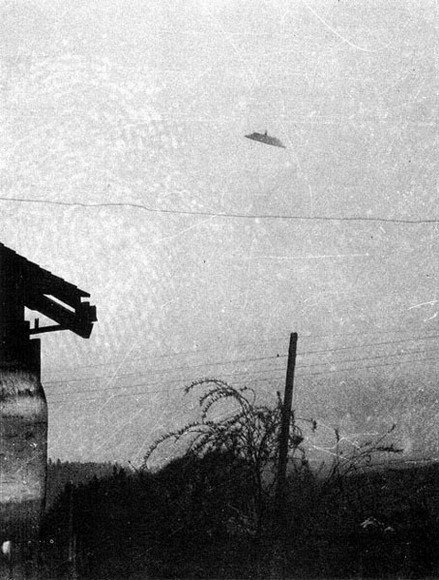
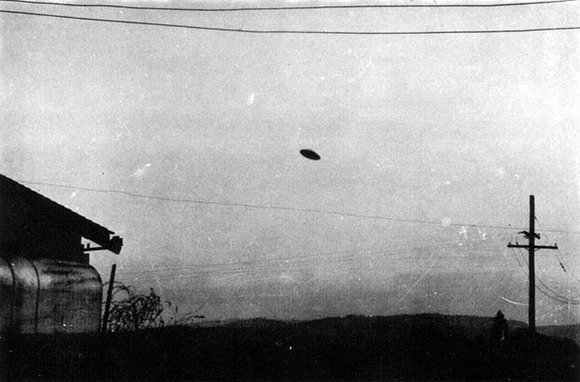
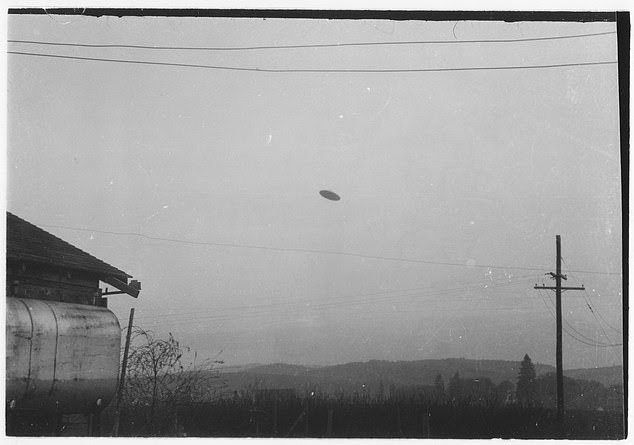
Around 7:30 pm on Thursday, 11 May 1950, Evelyn Trent was feeding the rabbits behind the farmhouse she shared with her husband Paul off the Salmon River Highway near Sheridan, Oregon, when she saw a large, silent, metallic disc in the evening sky. She yelled for Paul, who found their Roamer folding camera and shot one frame, wound the film as fast as he could, moved to his right, and shot a second as the object tipped, gathered speed, and slid away to the west-northwest. Trent, who figured he had photographed some secret government hardware and wanted no trouble, left the roll undeveloped for weeks and finished it on family snapshots. He eventually showed the prints to his banker, Frank Wortman, who tipped off the McMinnville Telephone-Register. Reporter Bill Powell interviewed the Trents separately, fished the negatives out from under the davenport where the kids had shoved them, and ran both pictures on the front page on 8 June 1950. Portland and Los Angeles papers picked the story up within two days, INS and AP wired it worldwide, and LIFE magazine reprinted the photos in its 26 June 1950 issue. The Trents told their story on the New York TV program We the People on 7 July 1950; the show borrowed the negatives and the Trents never got them back.
More footage and images of this sighting
What is the official explanation?
The case received its formal scientific treatment as Case 46 of the Air Force-funded University of Colorado study, the Condon Report. Investigator William K. Hartmann visited the farm in June 1967, after the long-lost negatives surfaced in a UPI file, and ran geometric and photometric tests on them. His photometry found the shaded underside of the object too bright for a small nearby thing: through miles of atmospheric haze a distant object's shadow gets filled in and lightened, exactly what the negatives showed, with the object's surface measurably brighter than the dull aluminum-painted tank beside the garage. His geometric test found the object in photo 2 was the same object as photo 1 seen tipped at about 21.6 degrees, with its off-center pole displaced the same way in both frames, arguing against a spinning model. Hartmann's published conclusion has been quoted ever since: this is one of the few UFO reports in which all factors investigated, geometric, psychological, and physical, appear to be consistent with the assertion that an extraordinary flying object, silvery, metallic, disk-shaped, tens of meters in diameter, and evidently artificial, flew within sight of two witnesses. He flagged caveats himself, including illumination on the distant house gables from the east that could suggest a daylight exposure, and noted the evidence could not positively rule out fabrication. The Air Force and FBI had also visited and questioned the Trents in the early years without exposing discrepancies, and when the negatives came home to the News-Register in 1970 they had been cropped by unknown hands along the way.
What did the witnesses think it was?
Paul and Evelyn Trent were exactly what they appeared to be: a young farm couple of modest means, well regarded around Sheridan and McMinnville, with no history of publicity seeking before or after. They sat on the photos for nearly a month because Paul was, in his words, kinda scared of it. They never copyrighted the images, never charged for them while the world reprinted them endlessly, and never saw their negatives again after a TV show misplaced them. They retold the sighting to reporters and investigators for almost five decades and the core account barely moved, something even hostile reviewers had to work around rather than through. In his last interview in 1998 Paul was still shrugging the whole thing off: I took the pictures, but I don't want them. Evelyn agreed she would never take another picture, just too much publicity. Evelyn died in 1997 and Paul in February 1998, both insisting to the end that they photographed exactly what they said they saw.
The dispute
The dispute is over whether the two 1950 Trent farm photographs show a distant metallic disc or a small model suspended near the camera. Several named skeptics advanced the mundane reading. Robert Sheaffer analyzed the shadows under the garage eaves and argued they indicate a morning exposure rather than the claimed 7:30 pm, which would mean the witnesses lied about the circumstances. Philip Klass proposed the object was a small model, perhaps a truck mirror, hung from the overhead power wires. Joel Carpenter calculated that Paul Trent's lens sat roughly 36 to 40 inches off the ground, kneeling height, and read this as deliberate framing of a nearby prop against open sky. None of these is a confession or a produced model; they are reconstructions and inferences, and each rests on an interpretation the witnesses and later analysts contested.
The strongest single counter-claim is the IPACO study of 2013 to 2014, in which Antoine Cousyn, Francois Louange, and Geoff Quick ran line-detection analysis on high-resolution scans and reported detecting a suspension thread above the object in both frames, concluding flatly that the McMinnville UFO was a model hanging from a thread. This is the one debunk on the page that shows a method and points at a specific physical mechanism, which is why the case is not simply unexplained noise. If the thread were real and conceded, it would close the case as a hoax.
It is not conceded. Optical physicist Bruce Maccabee reexamined the same evidence with densitometry and laboratory-measured veiling-glare corrections, confirmed the large-distance reading, examined the negatives directly, found no evidence of any thread, and formally disputed the IPACO detection. This is independent of the original government finding: William K. Hartmann's photometry for the Condon Report found the shaded underside too bright for a small nearby object, implying a large object kilometers away, and his geometric analysis matched the object across both frames. So the central measurement, near prop versus distant disc, is exactly the point the two camps disagree on, and the suspended-model and thread analyses have never been conceded by the physicists who measured the negatives.
Because the most concrete debunk, the IPACO thread, is contested at the level of the primary evidence by a credible named optical physicist and runs against the Condon photometry, the counter-explanation does not settle the case. It remains a formally investigated photographic case left unexplained, with a real and method-shown skeptical camp on one side and direct negative examination rebutting it on the other, so the case largely stands as disputed rather than resolved.
Is the McMinnville Trent Farm Photographs real? The two-pass assessment
Pass one, the mundane case, and this one has real named teeth. Robert Sheaffer analyzed the shadows under the garage eaves and argued they indicate a morning exposure, not 7:30 pm, which would mean the witnesses lied about the circumstances; he and Philip Klass proposed the object was a small model, perhaps a truck mirror, hung from the power wires that conveniently cross the top of both frames. Klass separately documented inconsistencies in Evelyn's retellings about who saw what first. Joel Carpenter's geometry put Trent's lens at roughly 36 to 40 inches off the ground, kneeling height, a framing choice he read as composing a nearby prop against maximum sky. The strongest counter-claim is the 2013-2014 IPACO study by Antoine Cousyn, Francois Louange, and Geoff Quick, which ran a purpose-built line-detection tool over high-resolution scans and reported a suspension thread above the object in both pictures, concluding flatly that the McMinnville UFO was a model hanging from a thread. Pass two, the other side of the ledger, is just as named and just as methodical. Hartmann's Condon photometry found the underside too bright for a close model, implying a large object kilometers out. Bruce Maccabee, an optical physicist, reran the problem in the 1970s with densitometry, veiling-glare corrections measured in the laboratory, and on-site brightness ratios, and confirmed the large-distance reading; he examined the negatives directly and found no evidence of any thread, and he has formally disputed the IPACO detection. The asymmetric pole tipped the same way in both frames argues against a spinning frisbee-style toss, the two exposures sit mid-roll among snowscapes and Mother's Day picnic shots, and the witnesses spent 48 years not cashing in. Verdict: a genuinely unresolved photographic case, formally investigated and left unexplained by a government-funded scientific study, but held out of the top tier by a credible named counter-camp whose suspended-model and thread analyses have themselves never been conceded by the optical physicists on the other side.
Sources
- files.ncas.org/condon/text/case46.htm
- www.nicap.org/500511mcminnville_dir.htm
- www.nicap.org/trent1.htm
- nicap.org/cufospaper2.htm
- nicap.org/trentphoto.htm
- www.ipaco.fr/ReportMcMinnville.pdf
- www.debunker.com/trent.html
- www.debunker.com/texts/BSMtrentPJK.html
- blog.mcmenamins.com/the-history-of-the-1950-trent-ufo-sighting-in-mcminnville-oregon/
- ufofest.com/wp-content/uploads/2018/10/UFOHistory3.05.pdf
- oregonmufon.com/PDFs/McMinnvillePhotoCase.pdf
- bitterrootmag.com/2019/05/24/70-years-after-famous-sighting-oregon-town-still-believes-in-ufos/
More cases from this region: UFO sightings in USA