The Nashville 1989 Saucer Photographs
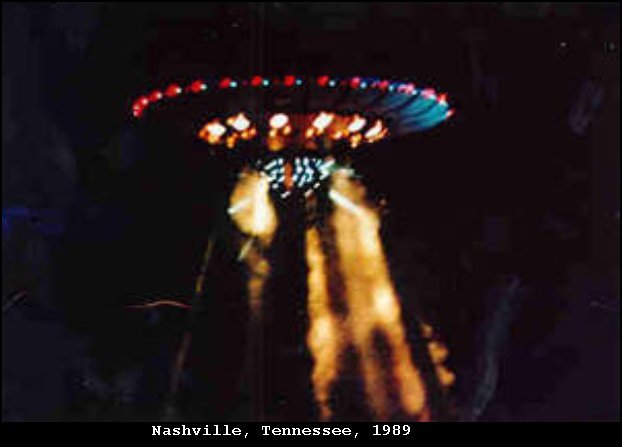
A spectacular night image of a multicolored saucer pouring columns of light toward the ground, circulated for years by retired Navy Commander Graham Bethune on behalf of a photographer friend who never gave his name. It is one of the most dazzling UFO photos in circulation, and one of the hardest to pin to an actual event.
What did witnesses see at Near Nashville?
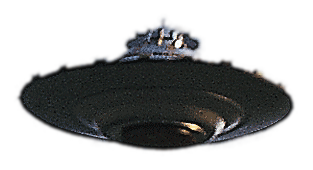
The image shows a disc-shaped object at night ringed by roughly 32 red, white and blue perimeter lights, with an inner cluster of lit panels and several broad columns of orange light projecting downward. Supporters point out that the light columns appear to terminate abruptly in mid-air rather than fading, which they argue real spotlights do not do. The photographer's account, relayed through Bethune, describes shooting with a Canon T-90 carrying a lens package over 2000mm plus a Canon AE-1, on Kodak 400 film push-processed to an effective 3000, after spotting a light coming over a wooded ridge in a remote area near Nashville around 9 PM.
What is the official explanation?
There is no official investigation of any kind on record. The military connection here is purely biographical: Graham Bethune was a retired Navy commander and pilot who vouched personally for his friend the photographer, saying he had known him 24 years and that the man had always told the truth. That is private character testimony from a retired officer, not apparatus attention. No Air Force, FAA, MUFON or NUFORC record tied to this event has surfaced in any verified source.
What did the witnesses think it was?
The photographer has never been publicly identified. Per Bethune's account he was an experienced photographer who declined to come forward because of a heart attack, an auto accident and family circumstances. Everything known about the sighting reaches us secondhand through Bethune, including the date, which the source document itself cannot keep straight: the header says September 27, 1989 and the narrative says July 14, 1989. The photos were also said to have been used to build a model for theatrical events.
The dispute
The prosaic counter-explanation on record was advanced by British researcher James Easton, who in January 2002 concluded that the photographed object was part of a special effects lighting rig of the type used in 1980s stage shows and discos. Easton's collaborator James Neff supported the claim by producing a comparison image of such a rig in stage use. This is the strongest mundane reading the page documents, and it gains some circumstantial traction from the case's own provenance: the photos were said to have been used to build a model for theatrical events, which puts a stage-lighting object squarely in the right context. But the method here is a visual lookalike argument, not an identification. Neff offered a comparison image of a similar rig, not a match to a specific identified fixture, and Easton's conclusion rests on resemblance rather than on any measurement, recovered hardware, or confession. Per this archive's method, a resemblance claim is a hypothesis, not a verdict.
Cutting directly against Easton sits a named analysis on the other side. Bill Sherwood, an optical physicist at Kodak, examined the imagery and estimated the object at roughly five miles distance and around 100 feet in diameter, a reading consistent with a large structured craft and flatly incompatible with a close-range stage rig a few feet across. The page is explicit that these two conclusions cannot both be right, and it does not resolve them in favor of either. So the dispute is not a debunk overpowering a witness account; it is two named experts reaching opposite conclusions from the same photographs, with the skeptical side carrying no more demonstrated proof than the supportive side.
What prevents either explanation from closing the case is the anonymity at the center of it. The photographer has never been publicly identified, everything reaches us secondhand through retired Navy commander Graham Bethune, and the source document contradicts itself on the date by two months (a September 27, 1989 header against a July 14, 1989 narrative) with no location given beyond near Nashville. There is no official investigation of any kind on record; the only military connection is Bethune's private character testimony for a friend, not apparatus attention. With no chain of custody and no identified object, neither the lighting-rig hypothesis nor the distant-craft estimate can be tested. The official-apparatus side is effectively empty, so there is not even a state assertion to weigh, only a contested civilian dispute.
The case is therefore genuinely Disputed rather than debunked. The mundane explanation is a specific and plausible one, but it is an unverified resemblance argument that a credentialed opposing analyst directly contradicts, and the anonymous, self-contradicting provenance leaves it unfalsifiable in either direction. The lighting-rig reading wounds the case but does not settle it.
Is the Nashville 1989 Saucer Photographs real? The two-pass assessment
First pass, the case for it. The supporting analysis has a real name attached: Bill Sherwood, a Kodak optical physicist, examined the imagery and estimated the object at roughly five miles distance and around 100 feet in diameter, and the push-processed film story is technically coherent for the era. Bethune, whatever one makes of his vouching, was a named, findable person who put his reputation behind the photographer. Second pass, the case against. The provenance is anonymous and secondhand, the source account contradicts itself on the date by two months, and the location is unspecified beyond near Nashville. On the imagery itself, the skeptical literature records that in January 2002 the British researcher James Easton concluded the object was part of a special effects lighting rig of the type used in 1980s shows and discos, and that James Neff produced a comparison image of such a rig in stage use. That is a named-analyst identification with a comparison method, though the fullest version of Easton's workup survives only in summaries on archive sites, not in a primary document this research could verify. Sherwood's distance estimate and Easton's rig identification cannot both be right, and with the photographer anonymous there is no way to resolve it. Verdict: a real photograph of something, with named analysis pulling in opposite directions and provenance too thin to settle it. Disputed.
Sources
- web.archive.org/web/20260203222136/http://www.ufocasebook.com/1989nashvillephotographs.html
- thelivingmoon.com/49ufo_files/03files2/1989_Nashville_Tennessee_Photographs.html
- www.thinkaboutitdocs.com/1989-nashville-tennessee-photographs/
- www.checktheevidence.com/wordpress/2016/05/13/old-news-8326/
More cases from this region: UFO sightings in USA