The Lyndia Morel Encounter
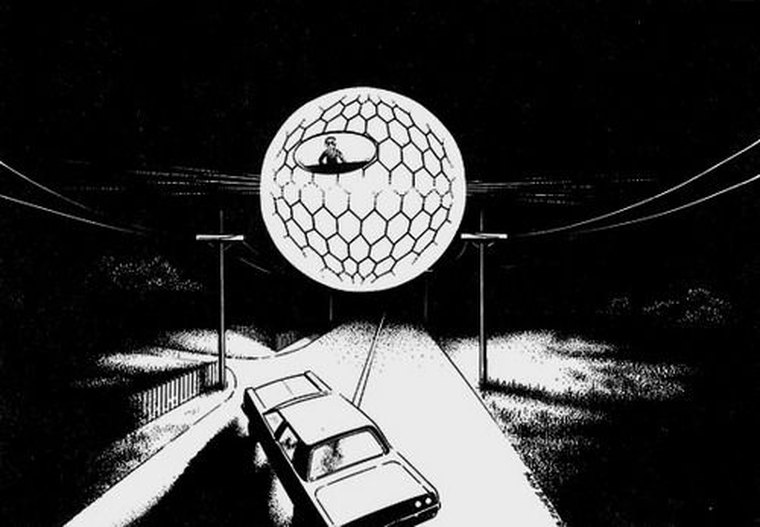
Lyndia Morel, a masseuse at the Swedish Sauna in Manchester, New Hampshire, signed out of work at 2:45 a.m. on Friday 2 November 1973 and started the roughly eight mile drive west on Highway 114 toward her home in Goffstown. This case file covers what witnesses reported, the official narrative, and a two-pass assessment with its evidence tier.
What did witnesses see at Highway 114?
Lyndia Morel, a masseuse at the Swedish Sauna in Manchester, New Hampshire, signed out of work at 2:45 a.m. on Friday 2 November 1973 and started the roughly eight mile drive west on Highway 114 toward her home in Goffstown. As she reached the outskirts of Manchester she noticed a bright light in the sky. It was yellow at first, then it began flashing red, blue and green. She thought it odd but assumed it was a planet and drove on. After about a mile she realised the light was holding its position in her field of view rather than sliding across the sky, and that it was getting brighter. Near the intersection of Highways 114 and 114A she lit a cigarette and the light blinked out, then reappeared once she had passed through the intersection. This pattern of vanishing and returning, each time brighter and closer, repeated as she drove on through Goffstown.
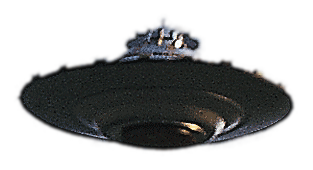
After she passed through Goffstown the light reappeared directly ahead of her, much brighter and closer than before, and now she could make out structure. It was an orange and gold globe, its whole surface covered in a honeycomb design of hexagons, with one oval window of paler colour set on the upper left. Red, green and blue flashes came from a source near the centre of the object, changing back and forth the way a star twinkles. The globe was not fully opaque. It had a peculiar translucent quality. A steady, thin, high pitched whine came from it, and Morel said she did not just hear the sound, she felt it pass through her body as a tingling sensation.
As the object closed in, near a landmark Webb later fixed by speedometer check at about 1,600 feet from where Morel placed the craft, she could see a figure in the oval window. It had a rounded, greyish head with wrinkled skin she compared to an elephant's hide, two large egg shaped eyes with big dark pupils that held her gaze so completely she felt unable to look away, and a slit of a mouth that turned down at the corners. She noticed no nose and no ears. The figure's head, shoulders and arms were visible while a dark horizontal surface, like a console or control board, hid the lower part of it against a white interior. As she stared, she received what she described as a wordless impression telling her not to be afraid. The reassurance did not land. She was terrified.
At the same time Morel found she could not pull her hands off the steering wheel, and felt the car speeding up against her will, as though the object had taken hold of her and the car and was drawing them toward itself. Passing Westlawn Cemetery she fought back enough control to swing into a driveway, leaving the car with its headlights on and engine running. She ran to the door of the house, the home of Mr. and Mrs. Beaudoin, banged on it and shouted for help with her hands over her ears, telling them a UFO was after her. Mrs. Beaudoin called the police.
What is the official explanation?
There was no military or federal investigation of the Morel case. Project Blue Book had been closed in December 1969, so by November 1973 the United States Air Force no longer kept an official UFO desk. The only official body that touched the case was the Goffstown Police Department. Patrolman Daniel Jubinville responded to Mrs. Beaudoin's call and found Morel's car abandoned in the driveway with its headlights on and the motor still running. He listened to her account and recorded in his report that she did not appear to be under the influence of alcohol or drugs. After Jubinville arrived, he, Morel and the Beaudoins went outside together and watched a light in the sky that appeared to move slightly and change colour, and that seemed to go out when a flashlight was trained on it. This is the multi witness phase of the case.
The serious investigation was civilian and was carried out by Walter N. Webb on behalf of the Aerial Phenomena Research Organization. Webb's credentials matter here. He was a professional astronomer who spent 32 years at the Charles Hayden Planetarium in Boston as senior lecturer, assistant director and operations manager, trained early in his career under Dr. J. Allen Hynek in the Smithsonian Astrophysical Observatory's optical satellite tracking program, and he is best known as the original NICAP investigator of the Betty and Barney Hill case in 1961. A man who lectured on the night sky for a living was unlikely to be fooled by a bright planet, which is exactly why his handling of the astronomical question carries weight.
Webb interviewed Morel, drove the Highway 114 route to check sight lines and distances, and fixed the speedometer landmark near where she placed the object. He measured apparent size against coins held at arm's length. He brought in APRO staff artist Brian James, who worked with Webb and Morel to produce the drawings that ran with the report, including the now familiar image of the hexagon covered globe hanging over the road above her car. Webb published the case as "Occupant Encounter in New Hampshire" in the APRO Bulletin 22 (January to February 1974), pages 5 to 7. The case was later catalogued by David F. Webb in his analysis "1973: Year of the Humanoids", which placed the Morel encounter at the head of a cluster of New Hampshire reports that autumn.
On the one part of the case that could match a conventional object, Webb was openly cautious. He confirmed that the planet Mars was near its brightest at that time and stood in the western part of the sky where Morel first saw the light. In his evaluation he wrote that "the multiwitness phase of the sighting, in my judgment, must be ruled ambiguous and therefore nonsupportive of the Morel sighting because (1) the object, as described by all four observers, matched the appearance and behavior of both the planet Mars and the UFO (the latter when seen at a distance) and (2) the planet's known position was too close to the UFO's estimated position to entirely dismiss the planet from contention." He did not extend that doubt to the close range encounter itself, which involved the honeycomb structure, the window, the figure, the sound and the physical effects, none of which a planet can produce.
What did the witnesses think it was?
Lyndia Morel believed she had seen and very nearly been taken by a structured craft carrying an intelligent occupant. She did not present herself as a practised UFO witness chasing publicity. The opposite. In early newspaper accounts she barely mentioned the figure in the window at all, because she thought the occupant detail was so unbelievable that it would discredit the rest of what she had seen. That reticence is the behaviour of someone protecting a real experience, not promoting an invented one, and it is part of why Webb took her seriously. She gave a consistent, specific account across her police statement and her later interviews with Webb: the colours, the honeycomb hexagons, the single oval window, the twinkling red, green and blue flashes from the centre, the high pitched whine she felt in her body, her hands locked on the wheel, the car accelerating on its own, and the small grey figure with its huge dark eyes and downturned slit mouth.
The detail she found hardest to repeat, the wordless message not to be afraid, is one she clearly experienced as coming from outside herself rather than as her own reassuring thought, because it failed to calm her. She remained terrified throughout and her terror was still obvious to the Beaudoins and to Officer Jubinville minutes later. Her conviction was strong enough that she let an APRO artist reconstruct the scene with her, scrutinising the drawing of the occupant and the globe until it matched what she said she had seen.
The corroboration is partial but real. Mr. and Mrs. Beaudoin witnessed her arrival in a state of genuine panic. Officer Jubinville found the physical scene exactly as a fleeing driver would leave it, lights on, engine running, car abandoned mid turn into a stranger's driveway, and judged her sober and sincere. Then all four of them watched a light in the sky together. That shared sighting is the weakest link evidentially, because Webb himself could not separate it from Mars, but it still means Morel was not the only person who saw something unusual overhead that night. Beyond her own case, the encounter did not stand alone in the area. Webb's catalogue records a further Goffstown sighting just two days later, on 4 November 1973, when Rex Snow reported a silver craft, part of a wider run of New Hampshire and New England reports that autumn that researchers grouped as the 1973 humanoid wave. Morel's account fits that pattern of close range, occupant bearing encounters rather than sitting outside it as a lone oddity.
The dispute
The dispute attaches to one phase of the case, not the whole of it, and it was raised by the case's own investigator. Astronomer Walter N. Webb of APRO noted that the planet Mars was near its brightest in early November 1973 and stood in the western sky exactly where Lyndia Morel first saw a coloured, twinkling, seemingly pacing light. In his APRO Bulletin report he wrote that "the multiwitness phase of the sighting, in my judgment, must be ruled ambiguous and therefore nonsupportive of the Morel sighting because (1) the object, as described by all four observers, matched the appearance and behavior of both the planet Mars and the UFO (the latter when seen at a distance) and (2) the planet's known position was too close to the UFO's estimated position to entirely dismiss the planet from contention." In plain terms, the light that Morel, Officer Daniel Jubinville and the two Beaudoins watched together after police arrived cannot be separated from a bright low planet, and so it cannot count as independent corroboration.
A bright planet near the horizon, seen through unstable air by a frightened driver, genuinely can flash colours, appear to keep pace with a moving car, and seem to blink out and return as it passes behind trees, utility poles and buildings. That explains the opening stretch of Morel's drive and the final shared sighting fairly well, and it is the strongest natural reading of the case. A secondary, weaker line of doubt is psychological, that fatigue, fear and the fixation of a lone pre dawn drive could produce the felt paralysis and the sense of an outside presence.
What the dispute does not reach is the close range encounter. Mars does not show a honeycomb of hexagons, a single oval window, a translucent shell, or a small grey figure with large dark eyes at a console, and a planet does not emit a high pitched tone felt as a body tingling. Webb, the one person professionally equipped to retire the case as a planet, deliberately limited his Mars caveat to the ambiguous multi witness light and left the structured object and its occupant standing. There is no confession, no recovered prop, no demonstrated hoax method and no identification of a specific real world craft. Because the counter explanation is partial and covers only one phase while the heart of the encounter remains unexplained, the case is Barely Disputed rather than strongly disputed.
Is the Lyndia Morel Encounter real? The two-pass assessment
Pass one, the ordinary explanations. The single strongest conventional candidate is the planet Mars, and the investigating astronomer raised it himself. In late October and early November 1973 Mars was near opposition and exceptionally bright, sitting low in the western sky, precisely where Morel first noticed a coloured light that twinkled and seemed to pace her car. A bright low planet seen through turbulent air does flash red, green and blue, does appear to follow a moving observer because it is effectively at infinity, and does seem to blink out and return as it dips behind trees, poles and buildings. Webb was honest enough to conclude that the final, calmer, four witness phase of the sighting could not be told apart from Mars and so could not be counted as support. The disappearing and reappearing light during the early part of the drive is also consistent with an astronomical object repeatedly occulted by roadside obstructions. A second ordinary thread is psychological. A tired woman driving alone at three in the morning, fixated on a bright unexplained light, is a textbook setup for fear driven misperception, highway hypnosis and a stress response that can produce a feeling of paralysis and a sense of an outside presence. None of that requires deception on her part.
Where the ordinary case runs out is the close range core. A planet cannot present a honeycomb of hexagons, a single oval window, a translucent surface, a high pitched tone felt as a body tingling, or a small grey figure with large dark eyes standing at a console. Highway hypnosis and fright do not normally generate a detailed, internally consistent structured object that a witness will then defend in front of an artist and an astronomer, while downplaying its most sensational element to avoid ridicule. No hoax was ever shown. There are no recovered props, no confession, no method demonstrated, no second party admitting to staging lights, and no positive identification of a specific aircraft, balloon or vehicle that fits the description.
Pass two, if real. Taken at face value Morel described a close encounter of the third kind: a low, near silent structured craft of unconventional design, roughly the apparent size her coin estimate and the 1,600 foot landmark imply, exerting an apparent influence over her vehicle and carrying a single small humanoid that communicated a calming impression without speech. It sits squarely inside the 1973 humanoid wave, alongside the nearby Rex Snow Goffstown report two days later, suggesting a localised cluster rather than a one off.
This is the rare case where the official touch and the civilian touch point the same way. The police treated her as credible and sober. A professional astronomer, the very person best placed to dismiss her with a wave at Mars, investigated carefully and explicitly refused to let the Mars explanation swallow the close range event. The dispute is therefore real but narrow. It bites hard on the shared light at the end, which genuinely may have been a planet, and not at all on the structured object, the occupant or the physical effects, for which no conventional cause has ever been demonstrated. Because a partial, investigator acknowledged counter explanation exists for one phase of the sighting, but the core encounter stands unexplained and unrefuted, this is Barely Disputed.
Sources
- www.ufoevidence.org/cases/case303.htm
- www.theblackvault.com/casefiles/1973-ufo-encounter-lyndia-morel/
- www.ufoinsight.com/ufos/close-encounters/the-unsettling-humanoid-ufo-encounter-of-lyndia-morel
- cufos.org/PDFs/books/1973-Year_of_the_Humanoids.pdf
- www.thinkaboutitdocs.com/1973-november-ufo-alien-sightings/
- www.ufoinsight.com/wp-content/uploads/2023/10/APRO22-4.jpg
More cases from this region: UFO sightings in United States