The Loring AFB Overflights
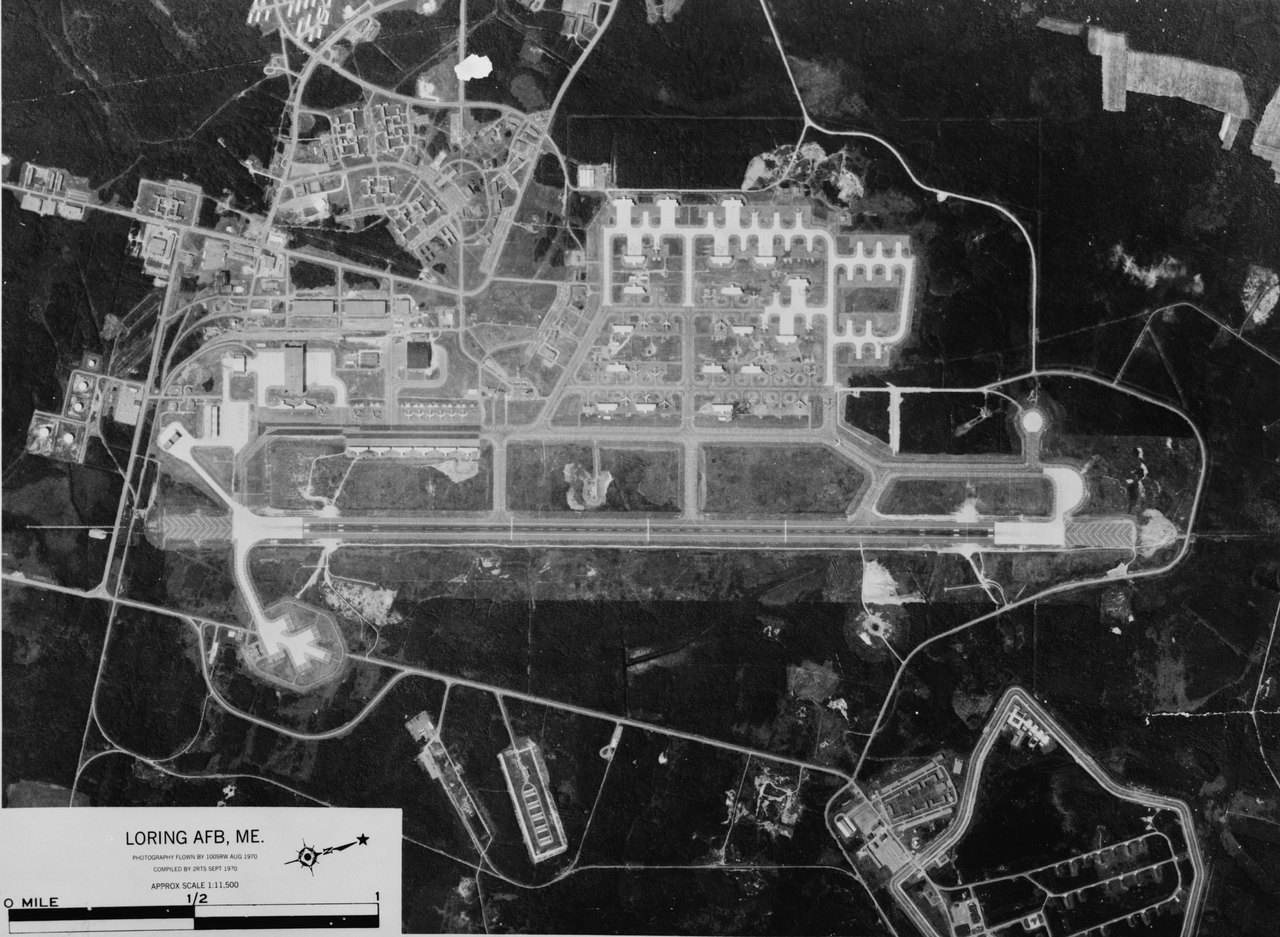
On the night of 27 October 1975, shortly before 8:00 p.m., Staff Sergeant Danny K. Lewis of the 42nd Security Police Squadron was on duty at the nuclear weapons storage area at Loring Air Force Base, a Strategic Air Command bomber base in far northern Maine that at the time held one of the largest atomic stockpiles in SAC. This case file covers what witnesses reported, the official narrative, and a two-pass assessment with its evidence tier.
What did witnesses see at Loring Air Force Base?
On the night of 27 October 1975, shortly before 8:00 p.m., Staff Sergeant Danny K. Lewis of the 42nd Security Police Squadron was on duty at the nuclear weapons storage area at Loring Air Force Base, a Strategic Air Command bomber base in far northern Maine that at the time held one of the largest atomic stockpiles in SAC. Lewis saw an aircraft approaching the base perimeter at low altitude, carrying a red navigation light and a pulsating white strobe. Two other security policemen, Sergeant Clifton W. Blakeslee and Staff Sergeant William J. Long, saw it too. The object came in over the northern boundary and began circling the restricted munitions area at roughly 150 feet, dropping to an estimated 300 feet over the storage area itself. A teletype that went up the chain that night stated flatly that "the A/C definitely penetrated the LAFB northern perimeter and on one occasion was within 300 yards of the munitions storage area perimeter."
Staff Sergeant James P. Sampley of the 2192nd Communications Squadron, working the control tower, picked the intruder up on radar 10 to 13 miles east-northeast of the field and tried to raise it by radio to warn it out of restricted airspace. There was no answer. Sergeant Grover K. Eggleston watched the contact on a radar scope for about 40 minutes as it circled, then it simply dropped off the screen, as if it had landed or descended below radar coverage. Witnesses saw it move off toward Grand Falls, New Brunswick, across the Canadian border about 12 miles away, with radar holding it until contact was lost. Colonel Richard E. Chapman, commander of the 42nd Bomb Wing, was at the command post and put the base into a Security Option 3 alert. Attempts to identify the craft through the Maine State Police, local authorities and the FAA came up empty.
The next night, 28 October 1975, again at about 7:45 p.m., the same thing happened. An object approached the weapons storage area, was tracked on radar maneuvering for more than half an hour, and behaved oddly: its lights would go out and it would vanish, then reappear over the storage area at around 150 feet. Sergeant Steven Eichner, a B-52 crew chief, along with Sergeant R. Jones and other airmen out on the flight line, watched a solid orange and red object hovering near the runway. Eichner described it as shaped like a stretched-out football, roughly four car lengths long, silent, with no visible doors, windows, propellers or engines. He compared the air around it to heat shimmer: "There were these waves in front of the object and all the colors were blending together. The object was solid and we could not hear any noise coming from it." Again it was tracked heading toward New Brunswick, and again it was never identified.
What is the official explanation?
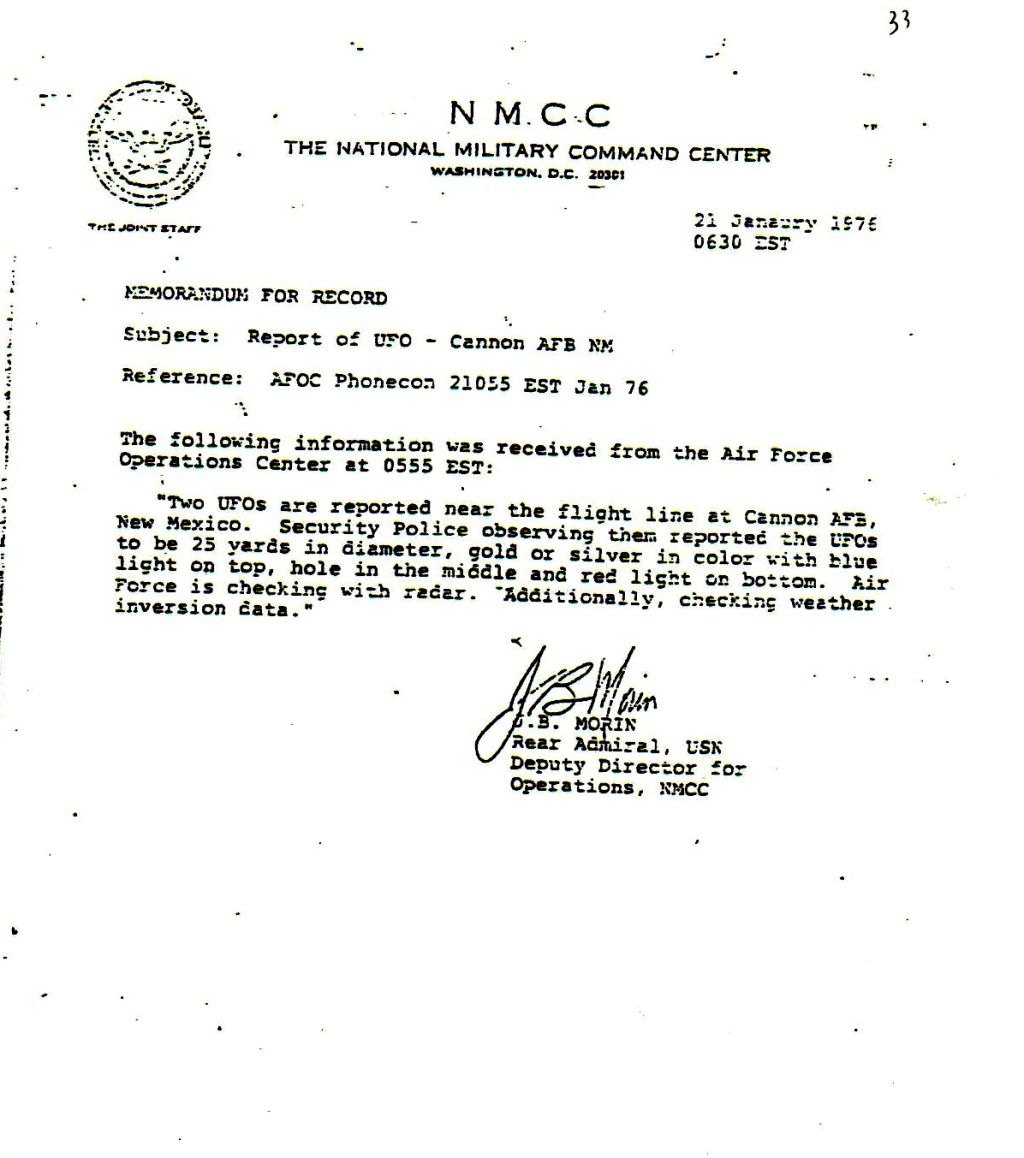
The military response is unusually well documented because the message traffic was later released under the Freedom of Information Act and is preserved in the National Investigations Committee on Aerial Phenomena files and the CIA reading room. The earliest surviving document is a National Military Command Center Memorandum for Record dated 29 October 1975, timed 0605 EST and signed by Brigadier General C. D. Roberts, Jr., Deputy Director for Operations of the NMCC. It reads: "At 290200 EST AFOC informed NMCC that an unidentified helicopter, possibly two, had been sighted flying low over Loring AFB Maine, in proximity to a weapons storage area." The memo records that a Maine Army National Guard helicopter was called in to assist, that NORAD was informed, that authorization was obtained to pursue the intruder into Canadian airspace if needed, and that as of 0404 the Guard helicopter "had not sighted the unidentified helo(s)." It also notes a similar incident the evening before. Three follow-up DDO Updates were filed at 291300, 292200 and 300600 EST as the situation developed.
The CIA holds a related FOIA document catalogued as "UNTITLED (DISCUSSES PENETRATION OF LORING AFB, MAINE)" in its reading room, confirming the incident reached national intelligence channels. The most striking line in the released NMCC material, reproduced from the document scans, states: "It is our opinion that the unknown helicopter has demonstrated a clear intent in the weapons storage area, is smart and a most capable aviator." That phrase, "clear intent," became the title of the 1984 investigation by Lawrence Fawcett and Barry Greenwood, who assembled these documents. Crucially, the same body of paperwork never confirmed the helicopter label. One NORAD document concedes: "Information indicates that the A/C is a helicopter. However, the A/C remains unidentified."
The events at Loring were the opening of a wider flap. A Strategic Air Command message headed "Defense Against Helicopter Assault," dated around 10 November 1975, told commanders that "several recent sightings of unidentified aircraft/helicopters flying/hovering over Priority A restricted areas during the hours of darkness have prompted the implementation of security Option 3 at our northern tier bases." A four-part message from the Commander-in-Chief NORAD on 11 November 1975 summarized the campaign: "Since 28 Oct 75 numerous reports of suspicious objects have been received at the NORAD CU; reliable military personnel at Loring AFB, Maine, Wurtsmith AFB, Michigan, Malmstrom AFB, Mt, Minot AFB, ND, and Canadian Forces Station, Falconbridge, Ontario, Canada have visually sighted suspicious objects." Despite scrambled interceptors held on alert, National Guard helicopters launched repeatedly, radar tracking and hundreds of personnel involved across multiple bases, the Air Force closed the matter without an answer. As the contemporary record and later reporting both put it, subsequent investigations by the Air Force into the sightings at Loring "did not reveal a cause for the sightings."
What did the witnesses think it was?
The witnesses were not civilians prone to misreading the sky. They were security police, communications and radar specialists, and aircraft crew chiefs whose job was to know what flew over a nuclear weapons facility. Staff Sergeant Danny K. Lewis, Sergeant Clifton W. Blakeslee and Staff Sergeant William J. Long made the first visual reports; Staff Sergeant James P. Sampley and Sergeant Grover K. Eggleston held the object on radar; Colonel Richard E. Chapman, the wing commander, took it seriously enough to put a SAC nuclear base on a heightened security posture. Sergeant Steven Eichner, the B-52 crew chief who got the closest look on the second night, was adamant that what he saw over the flight line was a solid, silent, football-shaped object with no engines and no control surfaces, not a helicopter.
A telling piece of corroboration came from the men sent to chase it. Chief Warrant Officer Bernard Poulin, a helicopter crew member with the Maine Army National Guard tasked to track the intruder, later told investigators Larry Fawcett and Barry Greenwood that ground radar "was not painting the object that was being reported" by the troops on the ground, even as those troops were watching it. In other words, what the security police were seeing with their eyes and what the radar was painting did not always match, and the helicopter crews who went up after it never managed a clean visual lock. That detail cuts directly against the tidy "Canadian helicopter" explanation, because a real helicopter would have been a consistent radar target and would have been catchable.
There is also a thread of airmen who felt the affair was being managed quietly. Captain Michael Wallace, a KC-135 pilot, recounted a base briefing attended by some 200 to 250 personnel at which the craft's capabilities were described: it could hover silently, move erratically and fast, and jump almost instantly from place to place around the base. When Wallace later pressed a fellow pilot who had been close to the events, the man told him, "I can't talk about it, Mike. And you wouldn't believe me if I could." Whatever the men of the 42nd Bomb Wing concluded privately, the witnesses who went on record described an object that out-maneuvered everything sent to identify it.
Is the Loring AFB Overflights real? The two-pass assessment
Pass one, the ordinary explanations. The official paperwork itself reached for the most mundane candidate it could, an "unidentified helicopter, possibly two," and SAC framed its entire response around "Defense Against Helicopter Assault." A low, slow, lighted aircraft probing a border base in the dark is, on paper, the profile of a helicopter, perhaps a clandestine flight out of nearby Canada testing the security of a nuclear stockpile during the Cold War. That is a real possibility and the documents took it seriously. But the same documents never closed it. NORAD wrote that the craft "remains unidentified" even while guessing it was a helicopter, and the chase aircraft never confirmed it. The behavior reported, lights blinking out and the object disappearing then reappearing, silent hovering, a contact that dropped cleanly off radar after 40 minutes, and CWO Poulin's account that radar was not even painting what the ground troops were watching, all sit awkwardly with a conventional rotorcraft, which is loud, slow and a steady radar return. A hoax is hard to sustain too: multiple trained observers across two nights, at separate posts, backed by radar operators and a wing commander, with the reports flowing up to the NMCC and the CIA in real time. Nobody confessed, no props were recovered, and no specific aircraft was ever traced to it.
Pass two, if the reports are accurate. What the Loring airmen described over two nights was an object that penetrated the airspace over live nuclear weapons, loitered with apparent purpose ("clear intent... a most capable aviator," in the NMCC's own words), defeated radio challenge, sometimes evaded radar, outran or out-waited the helicopters sent after it, and left toward Canada without ever being identified by any of the military assets pointed at it. The second-night object, as Eichner described it, was a solid, silent, propulsion-less football of orange-red light, which is not the description of any aircraft in the 1975 inventory.
This case earns Verified Unexplained. The standard for that tier is that the material is authenticated or officially documented and the object remains unexplained, and Loring meets both halves cleanly. The evidence is not a blurry photo or a lone witness; it is a chain of declassified NMCC, NORAD, SAC and CIA documents, released under FOIA and preserved in the NICAP and Fund for UFO Research archives, naming the units, the times and the security response. The only counter-explanation on the table, the helicopter, is itself an official label that the official documents explicitly admit was never confirmed, which makes it an unproven assertion rather than a debunk. The Air Force's own conclusion was that its investigation "did not reveal a cause for the sightings." When the institution that scrambled the interceptors and filed the reports says it could not explain what overflew its nuclear weapons, the case stands as documented and unexplained.
Sources
- www.nicap.org/reports/751027loring_1-6.htm
- www.cia.gov/readingroom/document/0005516212
- www.twz.com/35674/the-bizarre-mystery-of-unexplained-aerial-incursions-over-loring-air-force-base
- www.bangordailynews.com/2009/10/02/opinion/the-loring-ufo-episode-revisited/
- ufologie.patrickgross.org/htm/sac.htm
- www.bibliotecapleyades.net/ciencia/ufo_briefingdocument/1975.htm
- www.unexplained-mysteries.com/news/339131/revisited-the-loring-afb-ufo-incursions
More cases from this region: UFO sightings in United States