The Cannon AFB Flight-Line UFOs
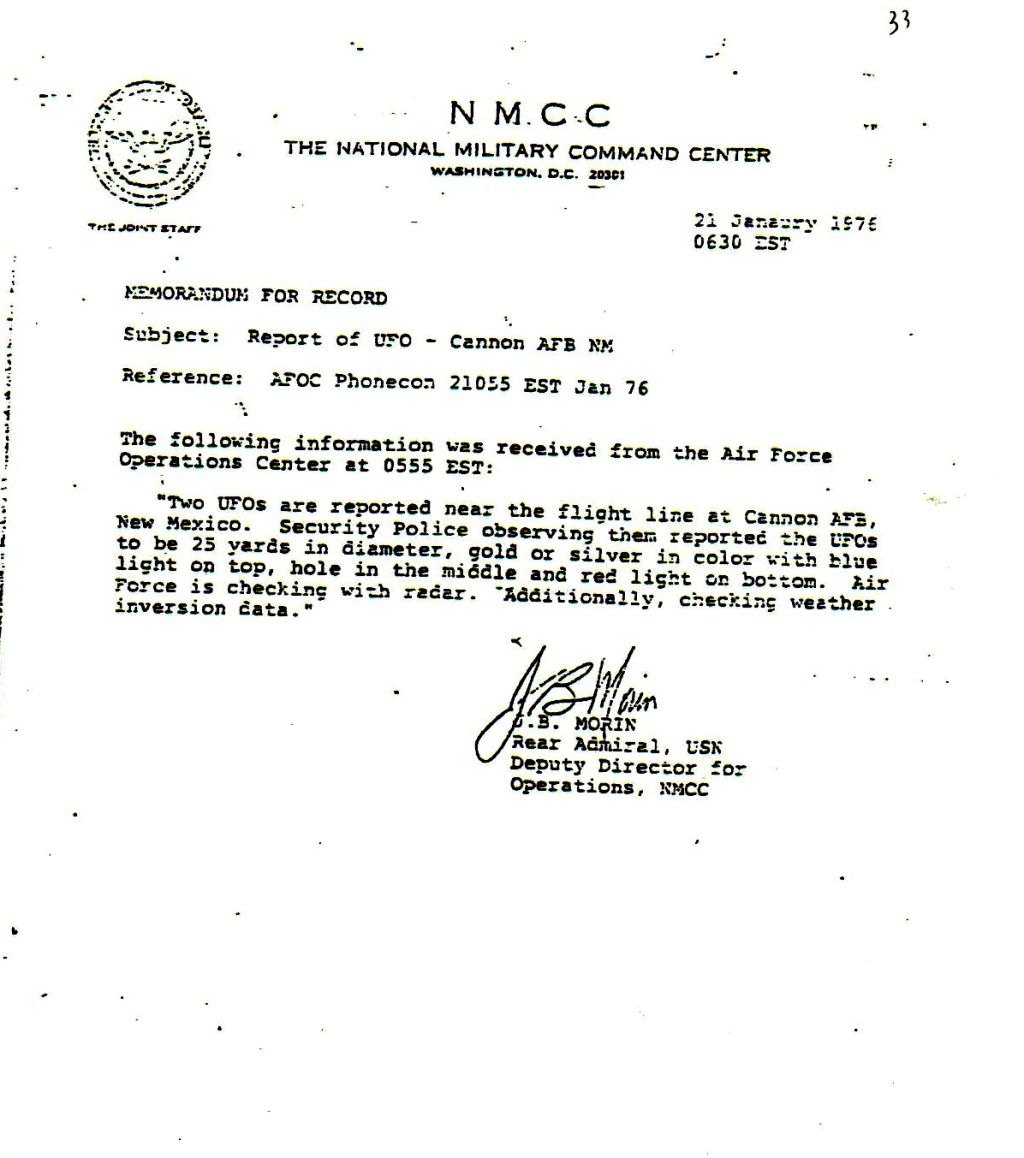
Over two nights in late January 1976, a string of luminous objects was reported in the skies over and around Cannon Air Force Base, the F-111 fighter-bomber base sitting on the high plains a few miles west of Clovis, New Mexico. This case file covers what witnesses reported, the official narrative, and a two-pass assessment with its evidence tier.
What did witnesses see at Cannon Air Force Base and Clovis?
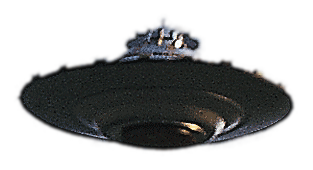
Over two nights in late January 1976, a string of luminous objects was reported in the skies over and around Cannon Air Force Base, the F-111 fighter-bomber base sitting on the high plains a few miles west of Clovis, New Mexico. The single hardest piece of the record is a National Military Command Center Memorandum for Record. Sometime before 3:55 a.m. Mountain time on 21 January 1976, a report reached the NMCC inside the Pentagon, logged there at 0555 Eastern. The memo reads: "Two UFOs are reported near the flight line at Cannon AFB, New Mexico. Security Police observing them reported the UFOs to be 25 yards in diameter, gold or silver in color with blue light on top, hole in the middle and red light on the bottom. Air Force is checking with radar." A follow-on line notes the Air Force was also checking weather inversion data. That is not a witness reminiscence. It is a same-night entry in the United States military's top command-and-control log, describing two structured objects about 75 feet across hovering at the edge of a nuclear-capable bomber base's flight line, watched by the base's own Security Police.
The activity did not stop with that memo. Contemporary press from the same week fills in the surrounding nights. The Las Cruces Sun-News of 25 January 1976 reported that most of the objects seen Thursday night, 22 January, and into the early hours were spotted west of Clovis, with a few to the east and north, and that an Air Force officer from Clovis had telephoned a UFO reporting center to say he had a very close sighting of a maneuvering vehicle unlike any aircraft he had ever seen. Police officer Randy Johnson, quoted in the same period and again in the St. Joseph News-Press of 23 January 1976, said radar at Cannon had reported only a single blip on its scopes during the sightings. Out at Texico, on the Texas line, Town Marshal Willie Ronquillo said he followed a silent object that hung roughly 300 yards above and behind his car, showing green, yellow and blue lights, before it shot away to the north at high speed.
On the night of 22 January the objects were reported moving in and around F-111s that had been put up from Cannon to investigate them, darting clear of the jets, throwing 90-degree turns and pulling away at speeds the aircraft could not match. The sightings did not stay tied to the base perimeter either. Similar reports came in from Portales, New Mexico, about 20 miles south, and from Plainview, Texas, across the state line, in the same window. The objects reported ranged from the two disc-shaped craft of the NMCC memo to strings of pinpoint lights and shifting multi-colored lights tracked by individual lawmen.
What is the official explanation?
The official footprint of this case is unusual precisely because it exists at all. By January 1976 the Air Force had no UFO program. Project Blue Book had closed in December 1969, and the standing public line was that the Air Force no longer investigated sightings. Yet the event still generated a National Military Command Center Memorandum for Record, because two unidentified objects parked off the flight line of a Strategic Air Command-adjacent F-111 base is an air-defense matter, not a hobbyist curiosity. The NMCC memo records the Air Force "checking with radar" and checking weather inversion data, the routine first moves to rule out a tracked aircraft and an atmospheric mirage. Neither check is recorded as producing an identification. The memo is one of a set of roughly a dozen NMCC and military UFO reports from 1975 and 1976, the same cluster that includes the well-known Strategic Air Command base overflights of late 1975, released years later under the Freedom of Information Act and reproduced in declassified-document compilations including the National Security Agency's released UFO file.
The contemporary press carried the official posture in real time. According to the Las Cruces Sun-News of 25 January 1976, the air base and the Federal Aviation Administration facility at Tucumcari, New Mexico, had ruled out the possibility of weather balloons or conventional aircraft for the objects seen over those nights. That is the load-bearing official fact in this case: the responsible aviation authorities looked at the obvious mundane candidates and contemporaneously discarded them, while the radar picture (Randy Johnson's account of a single blip) neither cleanly confirmed nor cleanly dismissed a hard target. Decades later, when the story resurfaced, the deputy chief of Cannon Public Affairs told the Eastern New Mexico News in June 2006 that the base could provide "no information" on the 1976 sightings or on whether anything similar had happened since. A separate FOIA response is cited by later researchers as confirming that jet aircraft were scrambled from Cannon that evening in 1976, with no explanation attached to the scramble. No official body ever issued a positive identification of the objects, and no Project Grudge or Blue Book style debunking apparatus was applied, because by 1976 none existed to apply.
What did the witnesses think it was?
The witnesses to this case fall into two tiers that have to be kept separate, because they carry very different evidential weight. The first tier is contemporary and largely institutional. The Cannon Security Police who filed the flight-line report are anonymous in the surviving memo but are the source of its precise object description. Police officer Randy Johnson and Texico Town Marshal Willie Ronquillo are named lawmen quoted in 1976 press; Ronquillo's account of a silent, multi-colored object trailing his patrol car for several hundred yards before bolting north is the kind of close, mobile, single-observer encounter that the NMCC's terse flight-line note does not capture. The unnamed Air Force officer who phoned a reporting center to describe a close sighting of a maneuvering vehicle "unlike any type aircraft he has ever seen" is, if his account is taken at face value, a trained military observer placing the objects firmly outside the conventional inventory. NICAP, the National Investigations Committee on Aerial Phenomena, treated Clovis as a live site of UFO activity at the time and covered it in its own bulletin, The UFO Investigator, in March 1976, which is the investigating civilian body's contemporary record of the flap.
The second tier is the dramatic narrative that resurfaced almost three decades later, attached to a single witness identified only as "Bruce." In a July 2004 appearance on the Jeff Rense radio program and in June 2006 coverage by the Eastern New Mexico News, Bruce, described as a journalism student then working in the news department at the PBS Channel 3 station in Portales and at radio station KMTY in Clovis, said he watched the objects from a transmitter site and later from a building roof with newsroom colleagues, watched F-111s chase them, and photographed one of the craft on black-and-white film. He said base contacts told him the whole base lost lighting as the objects passed, that Cannon held radar tape of both nights, and that new light towers were trucked in from a SAC base afterward. Bruce also described a threatening late-night phone call in July 2004 ordering him to destroy the photographs, and vehicles with government plates seen near his home. This testimony is vivid and internally consistent, but it surfaced about 28 years after the fact, the photograph has never been published, and copies he said he mailed to researchers Brian Vike, George Filer and Peter Davenport reportedly never arrived. His broad claim that there was a real UFO event at Cannon in January 1976 with fighters scrambled is corroborated by the contemporary record. His specific dramatic claims, the photo, the total base power loss, the intimidation, are not.
Is the Cannon AFB Flight-Line UFOs real? The two-pass assessment
Pass one, the entirely ordinary reading. A military command log calling something a "UFO" means only that it was unidentified at that moment, not that it was exotic. The NMCC memo itself records the two standard mundane checks under way: radar and weather inversion. A strong temperature inversion over the high plains on a cold January night can refract distant ground lights and bright stars or planets into apparently hovering, color-shifting objects, and Randy Johnson's report of only a single radar blip is consistent with there being little or no hard target aloft. The string of pinpoint lights some observers reported could fit aircraft lights, and 1976 was a period of intense regional UFO suggestibility around Clovis, with reports clustering after the first night, which is the classic signature of a social flap amplifying ordinary stimuli. The most cinematic elements, the F-111 dogfight, the base-wide blackout, the confiscated photograph, the threatening calls, rest almost entirely on one witness who came forward decades later and never produced the photo, so under the ordinary reading those are best treated as a later embellishment layered onto a thinner real event.
Pass two, if the core report is taken as what the documents actually say. Strip away the 2004 narrative entirely and a hard residue remains that the inversion theory does not comfortably cover. The base's own Security Police, professional observers standing on a guarded flight line, reported two structured discs about 75 feet across with a specific architecture: a blue light on top, a central hole, a red light beneath, gold or silver bodies. That is a shape description, not a smear of refracted light. The Air Force and the FAA at Tucumcari contemporaneously ruled out balloons and aircraft, per the Las Cruces Sun-News, and never substituted any identification. Texico's marshal tracked a silent object pacing his car at close range. An Air Force officer described a maneuvering craft unlike any aircraft he knew. None of these contemporary observers were chasing a star. The event was real enough to push a same-night memo to the top of the United States military command structure and, by FOIA accounts, real enough to launch fighters.
The case for the strong tier rests on documentation, not drama. This is an officially recorded incident, anchored by a same-night NMCC Memorandum for Record and supported by contemporary newspaper reporting and the contemporary civilian-investigator record, in which the responsible authorities explicitly ruled out the obvious mundane explanations and never produced an alternative identification. There is no confession, no recovered hoax prop, and no method-shown debunk of the documented core; the weather-inversion idea was a line of inquiry the Air Force opened, not a conclusion it reached. The uncorroborated 2004 photo narrative is logged here honestly and weighed as the weak, late-surfacing testimony it is, but it neither carries nor sinks the case. On the documented record, with mundane causes officially excluded and the objects unexplained, this is Verified Unexplained.
Sources
- www.nicap.org/chronos/1976fullrep.htm
- web.archive.org/web/20251204065655/https://www.ufocasebook.com/1976cannonairforcebase.html
- spacetime.forumotion.com/t1572-cannon-air-force-base-ufo-flap-january-1976
- www.ufoinsight.com/ufos/sightings/1976-cannon-air-force-base-ufo
- www.thinkaboutitdocs.com/1976-cannon-airforce-base-ufo-incident/
- www.easternnewmexiconews.com/story/2006/06/17/publishnews/researcher-claims-he-has-photo-of-1976-ufo-over-clovis/72397.html
More cases from this region: UFO sightings in United States