A Saucer Hovers over Lynn, Massachusetts
At 11:10 p.m. on the night of 15 June 1964, William Angelos, a 20-year-old technical school student, was watching television in his family's ground-floor apartment on Henry Street in Lynn, Massachusetts. This case file covers what witnesses reported, the official narrative, and a two-pass assessment with its evidence tier.
What did witnesses see at Henry Street?
At 11:10 p.m. on the night of 15 June 1964, William Angelos, a 20-year-old technical school student, was watching television in his family's ground-floor apartment on Henry Street in Lynn, Massachusetts. He heard a loud, throbbing noise that he described as "similar to a rough-running piston engine," coming from immediately outside the apartment. His mother, who had just gone to bed, heard the same noise.
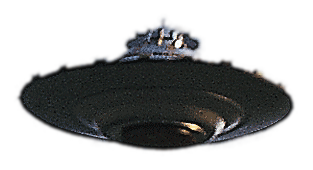
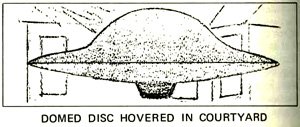
Angelos rushed to the apartment door and looked out into the courtyard that sat between three apartment buildings. He first noticed a red light hovering above the parking lot in the courtyard. As his eyes adjusted, he saw that the red light was mounted on the underside of a large, solid, almost colorless object that was hardly more than 20 feet away from him. The object was shaped like a disc, held in a horizontal position, flat on the bottom with a domed upper surface.
When he first saw it, the domed disc was roughly 12 feet above the pavement, low enough that he could see it silhouetted against the wall of the building on the far side of the courtyard. The object then ascended slowly in a nearly vertical climb toward the west-southwest and disappeared into the WSW sky at an elevation of about 45 degrees. The whole sighting lasted at least a minute. By Angelos's account the thing was close, large, structured, and noisy, not a distant light.
The case did not rest on Angelos alone. When Walter Webb canvassed the apartment complex, he found that several other neighbors had heard the same loud sound at the same time. At least one neighbor reported seeing the red light flashing through her window at roughly the moment Angelos watched the disc climbing away. Other residents of the buildings reported that their televisions suffered interference at the same time, an electromagnetic-effect detail that lines up with the close-range, machine-like character of the report.
What is the official explanation?
There is no official government narrative for the Lynn case, and that absence is itself a documented fact rather than a guess. The case was never entered into Project Blue Book, the U.S. Air Force's UFO program. The Blue Book record for Massachusetts in 1964 lists only one investigated event, the 26 May 1964 Cambridge sighting reported by an ex-Smithsonian satellite tracker, and neither Lynn, nor the date 15 June 1964, nor the name William Angelos appears anywhere in the 1964 Blue Book case material. So there is no Air Force identification, no balloon ruling, no "probable aircraft" stamp, nothing to push against.
The only investigation on record was civilian. It was carried out by Walter N. Webb on behalf of NICAP, the National Investigations Committee on Aerial Phenomena. Webb was not a hobbyist. He was a professional astronomer who had worked under J. Allen Hynek on the Smithsonian Astrophysical Observatory's satellite tracking program in the late 1950s, spent a 32-year career as senior lecturer, assistant director, and operations manager at Boston's Charles Hayden Planetarium, served as NICAP's scientific advisor, and is best known as the original field investigator of the Betty and Barney Hill abduction case of 1961. He also handled NICAP work on the Levelland and Red Bluff cases. His write-up of the Lynn sighting was published in the 1969 NICAP Special Report "UFOs: A New Look," compiled by NICAP figures including Ted Bloecher, Richard Hall, Isabel Davis, Donald Keyhoe, and Gordon Lore, where it appears in Section IV, "Close-Range Sightings; Structural Details." The report quotes Angelos directly, records the rough-running-piston-engine sound, the domed-disc shape, the 12-foot hover height, the roughly 20-foot range, the near-vertical climb to 45 degrees elevation, and the duration of at least a minute, and it carries a NICAP line illustration of the craft captioned "DOMED DISC HOVERED IN COURTYARD."
Because no official body ever assigned a cause, the case has no closing explanation on the record. It was logged by a credentialed investigator as a close-range structural-detail report and left unexplained.
What did the witnesses think it was?
William Angelos was clear about what he believed he saw: a real, solid, machine-like craft at close range, not a star, a plane, or a reflection. He stressed the object's structure, the domed top over a flat bottom, the single red light on the underside, and its near-silence-then-noise behavior, the throbbing engine-like sound that drew him out the door in the first place. He gave his name, his age, his occupation, and his exact address, which is not the behavior of someone trying to stay anonymous behind a tall tale.
His account is anchored by his mother, who heard the same noise from inside the apartment, and by the independent neighbors Webb located afterward. At least one neighbor saw the red light through her own window at the same time, and others noticed their televisions go haywire during the event. That combination, multiple earwitnesses to the sound, a second visual witness to the light, and simultaneous TV interference across the building, is the kind of corroboration that separates a one-person anecdote from a multi-witness incident. None of the witnesses recanted, and no estranged party or rival came forward to dispute the story.
It is worth noting what the witnesses did not claim. There was no report of occupants, no abduction, no landing traces, no contact narrative. Angelos described a craft that arrived, hovered low for under a minute, and climbed away. The restraint of the account, paired with the EM-style side effects on the neighbors' televisions, is part of why a professional astronomer like Webb took it seriously enough to canvass the building and put it in the NICAP structural-details file.
Is the A Saucer Hovers over Lynn, Massachusetts real? The two-pass assessment
Pass one, the ordinary explanations. The obvious candidate for a low, loud, hovering machine with a flashing red light in 1964 is a helicopter. A helicopter would explain the rough-running-piston-engine sound, the red light, and the slow vertical ascent, and rotor downwash plus ignition noise could in principle interfere with nearby televisions. The trouble is the witness geometry: Angelos put the object hardly more than 20 feet away, about 12 feet above the pavement, in an enclosed courtyard hemmed in by three apartment buildings, with a domed-disc body that was flat on the bottom and showed no rotor, no tail boom, and no running lights beyond the single red underside light. A helicopter that low and that close, boxed into a residential courtyard, would be deafening, would generate enormous downwash on parked cars and windows, and would be unmistakably a helicopter to a 20-year-old technical student looking right at it from across a small courtyard. A small private aircraft or an advertising blimp does not hover 12 feet off a parking lot. A balloon does not make a piston-engine roar or climb in a controlled near-vertical line to a fixed 45-degree elevation. A reflection or an astronomical object cannot be a solid silhouette seen against a building wall at 20 feet. No one has ever produced a specific identified aircraft, helicopter tail number, or any other named real-world object for this event, and no hoax method, prop, or confession has ever surfaced. The honest summary of pass one is that a low-flying aircraft is the least-bad prosaic guess, but it does not fit the close range, the silhouette against the wall, the absence of rotor or wings, or the disc shape, and it remains a guess rather than a demonstrated cause.
Pass two, if real. If the report is accurate, then a structured, domed, disc-shaped craft about the size of a vehicle hovered a dozen feet above a Lynn parking lot, threw a single red light on its underside, generated an engine-like throb that woke a building, interfered with multiple televisions, and then climbed away under control in under a minute. That is a classic 1964-wave close-range "structural detail" case, the same flavor of low, near-ground, hardware-looking object that defined that year's flap. The electromagnetic side effects and the multi-witness sound and light push it past a simple misperception.
The tier is Unknown. There is no authenticated physical record, no photograph, no film, and no instrument trace, so this is not a Verified Unexplained case. But there is also no official narrative to dispute and no civilian, method-shown counter-explanation, so it is not Disputed at either level. What exists is a clean, multi-witness, close-range report taken down by one of the most credible field investigators in American ufology, the astronomer who first worked the Hill case, logged in a primary NICAP document and never explained by anyone. It stands on its witnesses, which is exactly what the Unknown tier is for.
Sources
- www.nicap.org/newlook/section_IV.htm
- rr0.org/people/w/WebbWalterN
- www.ufologie.patrickgross.org/htm/bluebooku64.htm
- www.amazon.com/UFOs-National-Investigations-Committee-Phenomena/dp/B0016H1LEK
More cases from this region: UFO sightings in United States