The Tulsa, Oklahoma UFO Photograph (1965)
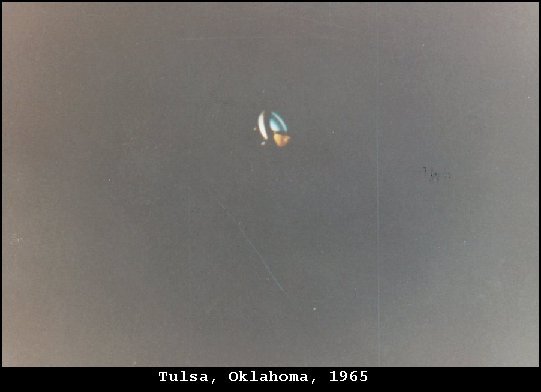
At roughly 1:45 a.m. on Monday 2 August 1965, fourteen-year-old Alan R. Smith was standing in the back yard of his family home in Tulsa, Oklahoma. This case file covers what witnesses reported, the official narrative, and a two-pass assessment with its evidence tier.
What did witnesses see at Tulsa?
At roughly 1:45 a.m. on Monday 2 August 1965, fourteen-year-old Alan R. Smith was standing in the back yard of his family home in Tulsa, Oklahoma. He was not alone. With him were his father, A. L. Smith, a turbine-engine specialist with American Airlines, his eighteen-year-old sister Sherly, his brother-in-law Ron Holt, and a neighbor named Daryl Swimmer. The household had already been watching the sky for several nights. The first time, Alan said, "it came over fairly low, but so fast that it just looked like a bright light about 25 times the size of a star moving from north to south." His father had reported seeing unexplained objects the night before, on 1 August.
This time the object came in slow. The witnesses described a rotating, multi-colored thing that cycled through white, red and blue-green, drifting toward them from across the neighborhood and then pausing in the air. Several of them recalled a whining or humming sound. Estimates of its size from the witnesses on the ground ran to roughly 40 to 60 feet across. Alan had loaded his official Boy Scout box camera (a simple 620-style plastic body) with Kodacolor X color film, which was unusual at the time because most amateurs shot cheaper black-and-white. He raised the camera, pointed it at the hovering object, and clicked the shutter once. He deliberately did not take a second frame. He went inside, then came back out to watch the object accelerate and disappear into the night sky.
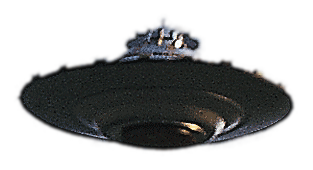
The single color negative, when it was finally developed about a week later, showed a sharply defined egg-shaped or disc-shaped object glowing in yellow, blue and whitish tones against a black sky. Three small finger-like projections stick out from one side of it, which witnesses and later UFO writers speculated might be part of the propulsion or the color-changing mechanism. The frame is famous as one of the earliest, and arguably the first, night-time color photograph of an unidentified flying object. It was taken on a night when a wave of UFO reports rolled across Oklahoma, with sightings logged in Tulsa, Oklahoma City, Norman and other points across the southwest.
What is the official explanation?
The image entered the official record as Project Blue Book case No. 9966, filed under National Archives Record Group 341 (Records of Headquarters United States Air Force). The original film survives in the National Archives Still Picture holdings as the Project Blue Book photographic series 341-PBB, cataloged as "Tulsa, Oklahoma Film, 8/2/1965" (Local Identifier 341-PBB-691) and a "Tulsa, Oklahoma Film Color Closeup, 8/2/1965" (Local Identifier 341-PBB-691-19). The National Archives reproduced both frames in its own "Aliens at the Archives" feature on the Unwritten Record blog.
The USAF Photo Analysis Division examined the negative for Blue Book. Its finding, as carried in the contemporary and follow-up reporting, was that the photograph showed a material object, located less than a mile (about 1.6 km) from the camera, with an apparent diameter of roughly 30 feet (about 10 m). In other words, the Air Force did not call it a fake or a near-camera artifact; its own analysts read it as a real, sizable object out at a distance. In the same breath, the analysts added a cautionary note: the image resembled "the effect obtained by photographing a multi-colored revolving filter flood light." That single comparison is the seed from which every later mundane explanation grew, but as written it was a resemblance, not an identification, and the Air Force still logged the object as unexplained.
The Oklahoma Journal bought the photograph and the negative from the Smith family for fifteen dollars and ran it on its front page on 5 October 1965 under the headline "First Night Color Shot of Flying Saucer Bared." It then spread nationally and was published in Life magazine's UFO issue dated 1 April 1966, alongside the magazine's coverage of the 1966 sighting wave. In 1977, the civilian group Ground Saucer Watch put the image through its photographic and early computer-densitometry process and reached a conclusion opposite to the skeptics: it called the picture a single, solid, three-dimensional object and described it as "an extraordinary flying craft of large dimension." The original negative was later lent to producers of the television program Unsolved Mysteries, and its present whereabouts are reported as unknown, which complicates any modern re-analysis.
What did the witnesses think it was?
Alan Smith stuck to his account for the rest of his life and never claimed to have seen anything supernatural. Interviewed by the Tulsa World in 1985, twenty years after the fact, he drew the line carefully: "I didn't see a flying saucer, or little green men. I saw a UFO." He reported a light, he photographed it, and he refused to inflate the story into a contact tale. The corroborating witnesses were his own family and a neighbor, not strangers: his father A. L. Smith (an aviation professional who knew aircraft lights when he saw them), his sister Sherly, his brother-in-law Ron Holt, and the neighbor Daryl Swimmer, all of whom described the same slow, color-cycling, rotating object on the same night.
The most important thing Alan Smith did as a witness was answer the central skeptical claim head-on. Critics pointed to a contact print of a negative strip, reproduced in a UFO book, that appeared to show the UFO frame sitting in a sequence alongside indoor Christmas photographs, which would imply the picture was shot indoors in winter, not outdoors in August. Smith's response was specific and checkable: he said the roll of film was brand new when he loaded it, and that the strip carrying the UFO frame had been physically cut apart when he had the photograph printed again, so any later strip layout did not represent the original order of exposures. That is a direct rebuttal of the linchpin of the debunk, offered by the photographer himself rather than a third party defending him.
The broader corroboration for the night is strong. The 1 to 2 August 1965 window was one of the most active of the entire 1965 flap across Oklahoma and the southern plains, with church groups and ordinary residents reporting strings of lights that would, in one witness's words, "go a distance, then stop, change color, then go on." Whatever the Tulsa photograph shows, it was not an isolated claim dropped into an empty sky; it sits inside a documented multi-witness wave.
The dispute
The dispute is narrow and specific: a named candidate object and a shown method, advanced mainly by civilian skeptics, not by the Air Force. The leading reconstruction holds that the photograph is not a craft at all but a rotating color wheel of the kind sold in the early 1960s to illuminate aluminum Christmas trees, captured when a flashbulb failed to fire. The most detailed version is by analyst Larry Robinson (midimagic.sgc-hosting.com), who matches the image feature by feature to a Spartus or Penetray color wheel: he argues the three "fingers" are the wheel's arms and cut-out filter segments, that the bright white patch is the lamp housing showing past the rim of the wheel, that two small dots outside the disc are duplicate motor-mounting holes, and that the brightest core has the shape of a reflector bulb spread by film halation. He adds a photometric argument, calculating the object's image as about 5 degrees of angular size, roughly ten times the size the full moon would record under the same conditions, which he says is impossible for a genuinely distant high-altitude craft photographed with Smith's simple camera. His thesis is blunt: "the negative printed was not the negative taken of the sighting." A 2025 Metabunk thread, led by the analyst Z.W. Wolf, reaches the same color-wheel conclusion and proposes the frame was actually exposed during the December 1964 Christmas season on film that then sat in the camera for months.
This is serious, method-shown work, and it is why the case cannot sit in the unexplained tier. But it stops short of the bar for a strong dispute, for three concrete reasons. First, it is a reconstruction with a candidate, not a positive identification of the actual object. Robinson openly states he does not possess the wheel in the photograph; he matches to "a different model" he happens to own and to file photos, noting the lamp base "is not the one in the UFO photo." No one has produced the specific device, the specific failed flashbulb, or a demonstrated re-creation of this exact frame. Second, the official analysis cuts against the artifact reading rather than for it. The USAF Photo Analysis Division concluded the negative showed a real material object out at distance, about 30 feet across and less than a mile away, and Ground Saucer Watch's 1977 study called it a single solid three-dimensional object, "an extraordinary flying craft of large dimension." The Air Force's "revolving filter flood light" line was a resemblance noted in passing, not an identification, and the case stayed on the books as unexplained. Third, the photographer never recanted and directly answered the strip claim that anchors the whole color-wheel theory, saying the roll was new and the strip was cut apart in reprinting. There is no confession, no recovered prop tied to this image, and no demonstrated fabrication of this specific frame. A plausible, well-argued natural explanation that names a candidate object but cannot produce it, and is contradicted by both the official photo analysis and the witness, is exactly the profile of a barely disputed case. The case largely stands on its primary material while carrying a credible, honestly stated challenge.
Is the Tulsa, Oklahoma UFO Photograph (1965) real? The two-pass assessment
Pass one, the ordinary readings. The strongest mundane explanation is the one the skeptics built: a Christmas-tree color wheel photographed indoors when the flashbulb misfired, leaving only the bright rotating filters on the film. The case for this is real. The colors (yellow, blue, white cycling) match a filter wheel, the geometry of arms and cut-outs can be mapped onto a Spartus or Penetray unit, the angular size on film is far too large for a distant craft shot with a box camera, and a strip layout once appeared to place the UFO frame among indoor Christmas pictures. A second ordinary path is simpler: a hoax or a misread of a nearby light source, given that the photographer was a teenager and only one frame exists. The Air Force itself flagged the resemblance to a revolving filter floodlight. None of these, though, has ever been closed. The exact wheel was never produced, the exact frame was never re-created, the strip-order claim was rebutted by the photographer with a specific account of a new roll and a cut strip, and the original negative is now lost, which means the cleanest test (re-scanning the actual film) cannot be run. The ordinary explanations are plausible and partially demonstrated, but they remain reconstructions pointing at a candidate rather than a proven identification of this image.
Pass two, if it is what the witnesses and the official analysts said. Then a multi-witness family, including an aviation professional, watched a slow, rotating, color-cycling object hover at close range during one of the most active nights of the 1965 flap, and a single color exposure caught it. On that reading the USAF Photo Analysis Division and Ground Saucer Watch are both right that the negative records a real, solid object of substantial size at a measurable distance, and the Air Force quietly leaving case 9966 unexplained is itself a signal that its own analysts could not reduce the image to an artifact. The corroborating witnesses, the surrounding wave of reports across Tulsa, Oklahoma City and Norman, and the photographer's consistent, deliberately modest testimony across twenty years all support a genuine anomalous observation.
The verdict is Barely Disputed. The photograph is authenticated as a real Project Blue Book artifact held at the National Archives, the official analysis read it as a real object and left it unexplained, and the witness never recanted. Against that stands a careful, method-shown civilian reconstruction that names a candidate object but cannot produce it, cannot demonstrate the fabrication of this specific frame, and is partly contradicted by the photographer's rebuttal and the official photo analysis. That is a credible challenge that fails to close the case, which is the definition of barely disputed. It is not strongly disputed because there is no confession, no recovered prop tied to this image, and no positive identification of the actual object photographed.
Sources
- unwritten-record.blogs.archives.gov/2017/04/26/aliens-at-the-archives/
- unwritten-record.blogs.archives.gov/341-pbb-691-19/
- ufologie.patrickgross.org/htm/bluebookpics9966.htm
- ufologie.patrickgross.org/press/oklahomajournal5oct1965.htm
- edmondlifeandleisure.com/tulsa-paperboy-made-ufo-history-in-p10411-87.htm
- midimagic.sgc-hosting.com/howituls.htm
- www.metabunk.org/threads/alan-smith-colour-ufo-photo-1965.14368/
- theufodatabase.com/ufos/tulsa-oklahoma-ufo-august-1965
More cases from this region: UFO sightings in United States