A Vehicle Encounters a UFO at Lavonia, Georgia (1964)
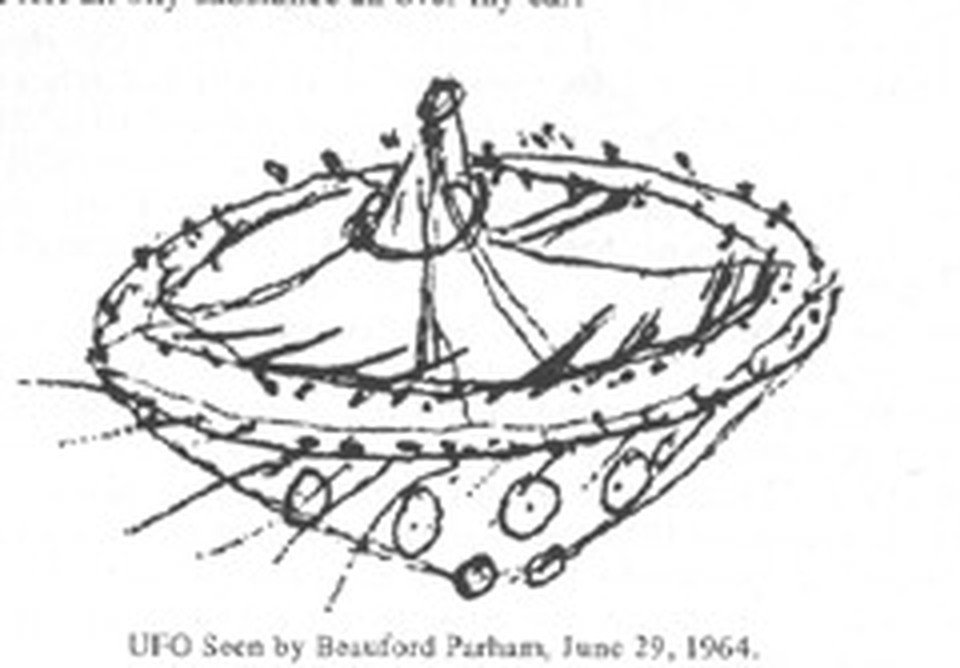
On the night of 29 June 1964, businessman Beauford E. Parham was driving between Carnesville and Lavonia, Georgia, when an amber, top-shaped object with counter-rotating halves and glowing portholes paced his car for a mile, then passed over it and left his arms burning. FAA officials detected radioactivity on the vehicle, the hood was warped and the radiator corroded, and the Air Force closed the case as "ball lightning," a label the witness, NICAP, and the physics all reject.
What did witnesses see at Between Carnesville and Lavonia?
Beauford E. Parham, a businessman, was driving home late on the night of 29 June 1964 on the road between Carnesville and Lavonia, in the northeast corner of Georgia, when he saw a very bright light in the sky moving straight toward his car. In his own words, "I spotted a very bright light in the sky coming directly toward my car. The next instance it was directly in front of my headlights spinning like a giant top."
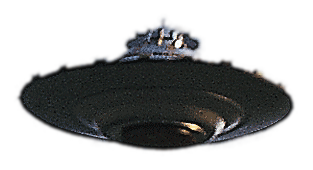
The object was amber colored, shaped like a spinning top, roughly 6 feet tall and 8 feet wide. It carried a mast-like or tower-like projection on top with a dark band, and around the bottom were small portholes through which Parham could see what looked like flames or an internal white glow. The two halves rotated in opposite directions, the top part clockwise and the bottom part counterclockwise, and the thing gave off a hissing sound that Parham compared to "a million snakes."
By his account the object appeared three times during the drive. It came head-on at the car, then planted itself directly in front of his headlights and paced him. "It stayed directly in front of my headlights for at least a mile," he said, "never touching the car but spinning just in front of my lights." It held a distance of about five feet ahead while he was traveling around 65 miles per hour, hovering and darting, seeming to pace and play with the car. On its final approach the car's motor began to miss. Then, as Parham described it, "When the object left it suddenly went up over the top of my car, leaving a strong odor like embalming fluid and a very gaseous vapor which left an oily substance all over my car."
By the time the object was gone Parham was in distress. "By this time, my arms were beginning to burn, and my only thought was to get somewhere and let someone know what I had seen." He drove on to Lavonia and then across the state line to Anderson, South Carolina, where he reported the encounter to FAA officials and to newsmen at the airport. He was adamant the thing was not a weather phenomenon: "There was not a cloud in the sky. Lightning would not rotate at top and bottom as this object did."
What is the official explanation?
The case was reported almost immediately to federal aviation personnel and to the press, and it entered the official record through two channels: the Federal Aviation Agency staff who examined the car, and Project Blue Book, the US Air Force's UFO program.
At the airport at Anderson, South Carolina, two FAA officials named Albert Myrick and Dean Carpenter checked Parham's car. According to the accounts gathered by NICAP and carried in the press, they detected radioactivity on the vehicle but did not disclose the amount, and no formal written report of that radiation check was ever produced or released. The physical damage they and others observed was concrete: the hood was warped, the paint was bubbled up as though it had been hit by intense heat or something corrosive, the radiator was described as "eaten away," a water hose was collapsing, and an oily film clung to the body of the car and would not wash off after repeated cleanings.
The Air Force's disposition, reported by The Anderson (S.C.) Independent, was that the object had been "ball lightning." Project Blue Book carried the case under that evaluation. Notably, the case does not appear on Blue Book's own list of "unidentified" cases for 1964, and the Blue Book entry logged the date incorrectly as 28 June rather than the 29th. NICAP and later researchers including the atmospheric physicist Dr. James E. McDonald, who studied many Blue Book "ball lightning" labels, treated this explanation as singularly weak, because nothing about a luminous, structured, top-shaped object 6 feet by 8 feet that paces a moving car for a mile, leaves an oily residue, and corrodes metal matches what physicists actually mean by ball lightning.
NICAP, the National Investigations Committee on Aerial Phenomena, opened a file and investigated. NICAP adviser Dan Sheridan, a former Marine Corps pilot, interviewed Parham, called him a "very sober individual," and personally documented the warped hood and bubbled paint. Reporter T. F. Acker, who had spoken with Parham, told NICAP he found the witness "intelligent, sincere and sober." Dr. Julian G. Kirchick of NICAP's Medical Panel, of Hempstead, New York, reviewed the burning sensation on Parham's arms and the reported radioactivity and recommended that Parham get an immediate blood count to gauge any radiation dose. The case was published in NICAP's Special Report "Strange Effects from UFOs" (Donald Keyhoe and Gordon Lore, 1969) and appeared in the period UFO literature including FATE magazine (November 1964), Saucer News (December 1964), and Jacques and Janine Vallee's "Challenge to Science" (1966).
What did the witnesses think it was?
Beauford E. Parham, businessman, sole eyewitness to the object; physical aftermath corroborated by FAA officials Albert Myrick and Dean Carpenter, NICAP field investigator Dan Sheridan, and reporter T. F. Acker
The dispute
The only counter-explanation on the record is the official one: the US Air Force, through Project Blue Book and as reported by The Anderson (S.C.) Independent, labeled the object "ball lightning." That is the entirety of the dispute, and it is an official assertion without a shown method rather than a demonstrated identification.
Ball lightning, as defined by the research bodies whose work circulated around this case (Westinghouse Research Laboratories and Rocket Power Inc. were both cited in period analyses of such claims, and Scientific American had treated corona-discharge phenomena), is a small, brief, storm-associated luminous sphere. It does not present as a 6-foot by 8-foot structured top with a mast, a dark band, portholes showing internal flame, and two halves rotating in opposite directions; it does not pace a moving car at 65 miles per hour for a mile in a cloudless sky; and it does not leave behind warped sheet metal, bubbled paint, a corroded radiator, an oily chemical residue, and detectable radioactivity. Parham himself rejected the label on the spot, noting there was no storm and that "lightning would not rotate at top and bottom as this object did." The atmospheric physicist Dr. James E. McDonald, who scrutinized many Blue Book "ball lightning" dispositions, considered them frequently mismatched to what meteorologists actually mean by the term, and this case is a textbook example of that mismatch.
Two further facts undercut the official finding rather than the sighting. Blue Book logged the date wrongly as 28 June when the encounter was the night of the 29th, and the FAA radiation check run by Albert Myrick and Dean Carpenter reportedly detected radioactivity on the car but was never written up in any released formal report. So the "ball lightning" verdict was applied to a case the Air Force did not even document carefully, and it leaves the physical damage, the engine interference, the residue, and the injuries entirely unexplained.
Because the dispute rests on an unmethoded official label that is contradicted by the physical evidence, the witness, and the relevant physics, and because there is no confession, no recovered prop, and no positive identification of any specific real object, the counter-explanation is weak and partial and the case largely stands. That is why it is tiered Barely Disputed rather than Strongly Disputed.
Is the A Vehicle Encounters a UFO at Lavonia, Georgia (1964) real? The two-pass assessment
Pass one, the ordinary explanations. The Air Force's own label was "ball lightning," and that is the explanation to test first. It fails on the physics. Ball lightning, as understood by the very laboratories cited around this case (Westinghouse Research Laboratories, Rocket Power Inc.) and in the Scientific American literature on corona discharge, is a small, short-lived luminous ball, typically seconds in duration, associated with thunderstorms and electrical activity. Parham reported a clear sky with no clouds, an object 6 feet tall and 8 feet wide with a defined structure (a mast, a dark band, portholes, two counter-rotating halves), a duration long enough to pace a car for at least a mile at 65 miles per hour, and lasting physical aftermath. None of that is ball lightning, which is why Dr. James McDonald and NICAP regarded the label as a filing convenience rather than a finding, and why the case never made Blue Book's own "unidentified" list yet was quietly disposed of anyway. A conventional aircraft, a helicopter, or landing lights do not fit either: the object was small, low, structured, counter-rotating, and right on top of the car. A hoax is conceivable in principle, but no method was ever shown, no props recovered, and the damage was inspected by FAA officials and a NICAP field investigator who found genuinely warped metal, bubbled paint, a corroded radiator, an oily residue, and reported radioactivity, which is expensive and odd damage to fake to a working car you still have to drive home.
Pass two, if it was real. Then this is a 1964 close encounter of the second kind: a structured, self-luminous, mechanically behaving object that interacted physically with a vehicle, interfered with its engine, deposited a chemical residue, corroded metal, irradiated the car, and injured the driver. The counter-rotating halves and the portholes with internal glow describe an apparently engineered craft, not a natural plasma. It sits inside the larger 1964 American UFO wave, the same summer as the Lonnie Zamora Socorro landing, and it is one of the better physical-trace and physiological-effects cases of that year precisely because the damage was examined by multiple independent parties.
The dispute that exists is the official "ball lightning" assertion, and it is weak: an unexplained-method label, contradicted by the witness, by the clear sky, by the object's structure and duration, and by the physicists who studied such labels. There is no confession, no recovered hoax prop, and no positive identification of any specific real-world object or cause. Under the tiering rules an official assertion without a shown method, contested and partial, leaves the case largely standing. That places it at Barely Disputed.
Sources
- www.nicap.org/640629lavonia_dir.htm
- www.nicap.org/reports/640629lavonia_report.htm
- www.nicap.org/cat3-1964on.htm
- www.nicap.org/chronos/1964fullrep.htm
- www.thinkaboutitdocs.com/1964-giant-spinning-top-encountered-by-businessman/
- www.ufoinsight.com/ufos/waves/1964-ufo-wave
More cases from this region: UFO sightings in United States