The Marfa Lights: Mitchell Flat, West Texas
Lights have been reported on Mitchell Flat, the basin east of Marfa in West Texas, for well over a century, and the State of Texas built a roadside viewing area to watch them from. A method-shown civilian study established that most of what is seen from that platform is headlights on U.S. Highway 67, refracted across the temperature inversions that form over the desert. The phenomenon's own principal investigator concedes the road. What remains in dispute is whether anything survives once the traffic is subtracted.
What did witnesses see at Mitchell Flat and the Marfa Lights Viewing Area?
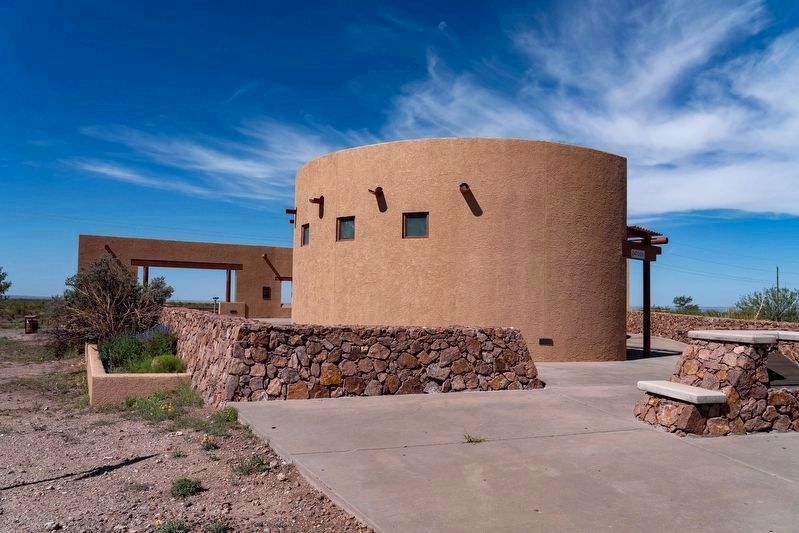
Nine miles east of Marfa, on the north shoulder of U.S. Highway 90, the State of Texas built a roadside park with a viewing platform, restrooms, interpretive plaques and mounted telescopes, and pointed the whole structure south across a basin called Mitchell Flat. On most nights of the year, cars fill the lot after sunset and people stand at the rail looking into a black expanse toward the Chinati Mountains, waiting for something to happen. What they report, and have reported for well over a century, is balls of light out on the desert floor: small at that distance, usually white or amber or orange, sometimes green, sometimes flaring briefly to red. They hang, they pulse on and off, they slide sideways, they divide into two or three and then merge again, and then they are simply gone. Nobody has ever walked up to one.
The traditional first account belongs to Robert Reed Ellison, described as a young cowhand who in 1883 was driving cattle through Paisano Pass, the low saddle on the road between Marfa and Alpine, and saw a flickering light out on the flat. The version fixed on the official marker and repeated in the Texas State Historical Association Handbook of Texas is that he took it for an Apache campfire, that other settlers told him they saw the lights too, and that when men rode out to look for a camp they found no ashes and no sign anyone had been there. Two years later, in 1885, the settlers Joe and Sally Humphreys are recorded as having their own first sighting. The Handbook entry, written by Julia Cauble Smith, also preserves the softer local memory: one Marfa resident said her father credited the lights with steering him toward a cave during a blizzard. The state's second marker at the site adds that the Apache understood the lights as stars falling to the earth.
The lights were taken seriously enough to be hunted by the military twice. The Handbook records that during the First World War observers feared the lights were signals connected to an invasion, and that during the Second World War pilots flying out of Marfa Army Air Field, an advanced multi engine training school established in 1942 directly on Mitchell Flat, searched for the source from the air. Neither search produced a source. The concrete foundations and runway scars of that airfield are still on the flat today, under the same ground the lights are seen over, and the adobe entrance walls stand just east of the viewing area.
The best behavioural description of a good sighting comes from James Bunnell, the aerospace engineer who grew up in Marfa and later spent roughly a decade photographing the flat with automated cameras. On his research site he wrote that the lights typically pulse through varying intensity from very bright down to completely off and back on, that colours run white to amber or orange with occasional transition to brilliant red, and that bright red episodes are short lived and either flare back to very bright or go out entirely. He put typical flying heights in the ten to four hundred feet range above the desert, described a high flying variant he called Type IV that stays entirely above the horizon and is fast but short lived, and noted that the lights divide, sometimes many times over, and then recombine, with the offspring appearing to orbit the parent or dance back and forth. Durations, he wrote, run from milliseconds to more than an hour, with seven hours the longest ever reported to him, while a good showing usually lasts around fifteen to twenty minutes.
Modern first hand accounts collected by local journalists match that shape. In a 2018 piece for Marfa Public Radio, Diana Nguyen recorded a viewer named Missert describing the moment they arrived: white lights, some green, some red, appearing suddenly and very far off. Mike Shurley, a rancher who hosts viewing from Shurley Ranch about twenty two miles south of town, described the genuine article to the same reporter as faint flashes, and reached for the comparison of a sparkler burning two or three football fields away. That is a long way from the fireballs of the tourist literature, and it comes from a man who watches that basin for a living.
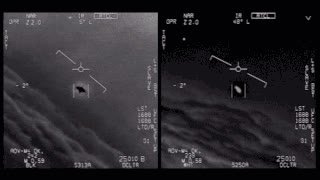
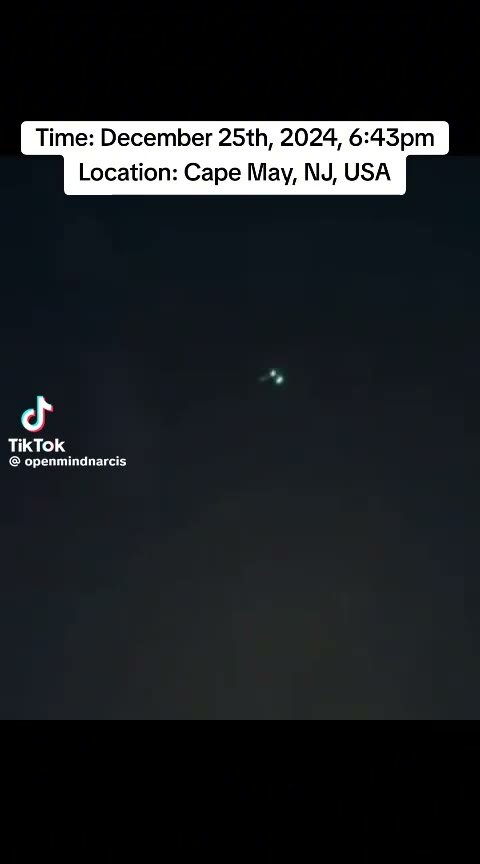
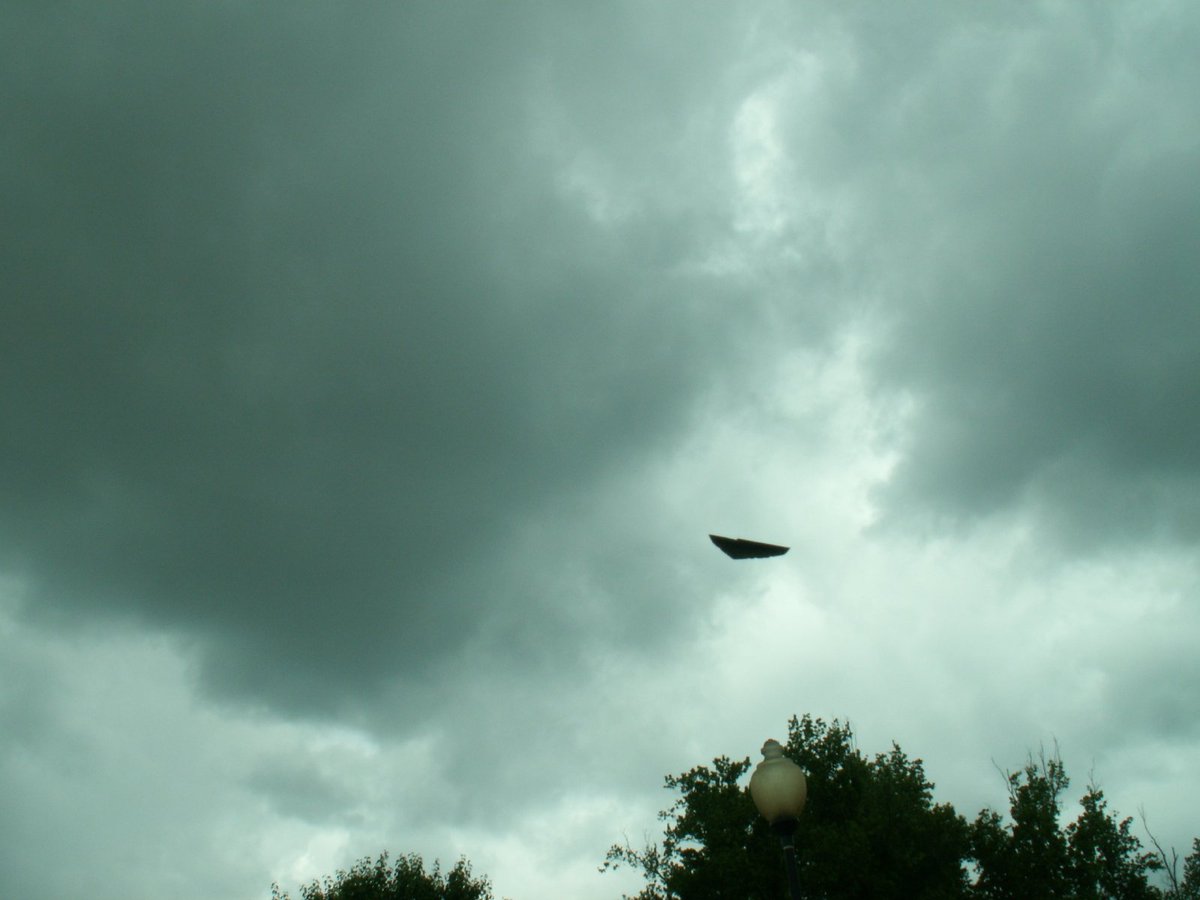
More footage and images of this sighting
What is the official explanation?
There is no federal file on the Marfa Lights. Project Blue Book never opened a Marfa case, no Air Force board ever ruled on the phenomenon, and no government agency has ever been accused of suppressing it. That absence matters, because it inverts the usual shape of a UFO case file. The official apparatus here is not an air force trying to close a case. It is the State of Texas, which has spent public money building infrastructure to help people see the lights and has twice cast the mystery in bronze.
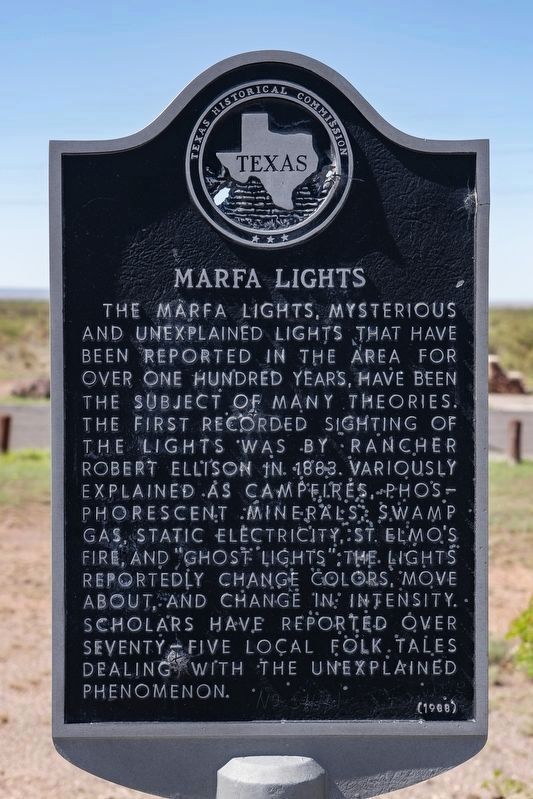
The primary official document is Texas Historical Commission marker number 3208, erected in 1988 and standing beside U.S. Highway 90 at 30 degrees 16.536 minutes north, 103 degrees 52.927 minutes west. Its inscription reads, in full: "The Marfa Lights, mysterious and unexplained lights that have been reported in the area for over one hundred years, have been the subject of many theories. The first recorded sighting of the lights was by rancher Robert Ellison in 1883. Variously explained as campfires, phosphorescent minerals, swamp gas, static electricity, St. Elmo's fire, and 'ghost lights', the lights reportedly change colors, move about, and change in intensity. Scholars have reported over seventy-five local folk tales dealing with the unexplained phenomenon." That is a state government, in 1988, formally describing a phenomenon as unexplained on a permanent public marker. It stands within a few paces of the Site of Marfa Army Air Field marker.
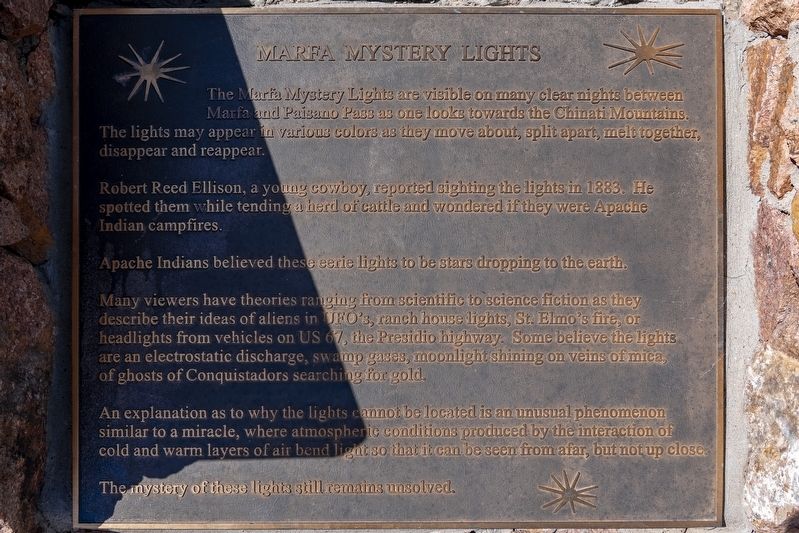
A second interpretive marker at the same site, headed "Marfa Mystery Lights," goes further and is unusually candid for a tourism plaque. It lists the competing explanations by name, and among them it puts, in its own words, "headlights from vehicles on US 67, the Presidio highway," alongside aliens in UFOs, ranch house lights, St. Elmo's fire, electrostatic discharge, swamp gases, moonlight on veins of mica, and the ghosts of conquistadors hunting gold. It then offers the state's preferred physics: that atmospheric conditions produced by the interaction of cold and warm layers of air bend light so that it can be seen from afar but not up close. The transcription of that marker in the Historical Marker Database renders the key word as "miracle," which is almost certainly a reading error for "mirage," since the Handbook of Texas uses nearly identical wording and says mirage. The marker closes by saying the mystery remains unsolved. So the official Texas position, printed on a sign at the viewing area, already concedes that Highway 67 headlights are one of the leading candidates.
The viewing area itself is a Texas Department of Transportation facility. According to James Bunnell, who lives with the site and documented its history on his research pages, the roadside park on U.S. 90 nine miles east of Marfa was significantly expanded in 2003 to add a view shelter and platform, restrooms and informational plaques linked by trails, that the expansion was proposed by Marfa High School students and their teachers, and that the land was donated by Mr. and Mrs. Clayton Williams. Marfa Public Radio dates the Marfa Lights Viewing Area to 2003, consistent with that account.
The other standing official reference is the Handbook of Texas entry maintained by the Texas State Historical Association, authored by Julia Cauble Smith, published on 1 April 1995 and last updated on 7 September 2017. It walks through the sighting history, the two military searches, and the range of proposed causes, and it commits to a preferred explanation in one sentence: "The most plausible explanation is that the lights are an unusual phenomenon similar to a mirage, caused by an atmospheric condition produced by the interaction of cold and warm layers of air." Its bibliography is worth logging because it shows what the official narrative actually rests on: the Dallas Morning News of 4 July 1982, the Fort Worth Star-Telegram of 3 August 1980, the Wall Street Journal of 24 March 1984, Elton Miles's Tales of the Big Bend from Texas A&M University Press, William Edward Syers's Ghost Stories of Texas, and Michael Hall's article "The Truth is Out There" in Texas Monthly for June 2006. Newspapers and folklore collections, in other words, and no instrument data at all.
What did the witnesses think it was?
The most important witness in this case is also its most serious investigator, and he is careful enough to be quoted against himself. James Bunnell grew up in Marfa, spent thirty seven years in aerospace and retired from BAE Systems as director of mission planning systems for Air Force programs. Beginning around 2000 he ran a privately funded, multi year instrumented monitoring programme on Mitchell Flat, installing three automated stations that he named Roofus, Snoopy and Owlbert, carrying a total of nine cameras between them, running every night whether or not anyone was there. He published his results in a run of self issued books including Night Orbs, Seeing Marfa Lights, Hunting Marfa Lights and Strange Lights in West Texas, and posted data summaries, event logs and photographs on his own websites, both of which have since lapsed and been taken over by unrelated commercial squatters, so his own material now survives principally in web archive captures.
Bunnell's position is not that the Marfa Lights are unexplained. It is that a small residue is. On the front page of his research site he wrote that most of the lights a visitor might see on a given night are likely to be car lights, ranch lights, aircraft lights, Iridium satellites, sprites, the Air Force blimp or some other explainable source, and then added his caveat in capitals, that this is not always the case. On his orientation page he was blunter still: vehicle headlights are visible nightly from Highway 67 southwest of the view park, Highway 67 is a winding mountain road that makes them switch on and off and vary in brightness, and in his words they do look mysterious but they are headlights. He told visitors their odds of seeing a genuine event on a random night might be as low as one or two percent. His own book description put the residual at about three percent of observed lights.
His filtering discipline was real and he described it openly. Station cameras were aimed away from U.S. 67, U.S. 90 and state roads 2810 and 169 to keep major traffic out of frame. Any light that started or stopped at a known ranch house, entered at a known road entry point, kicked up dust, or paused at the location of a known ranch gate was automatically logged as a vehicle. Any detectable beam automatically marked the source artificial. Questionable sources went into a separate Unknown Lights database rather than the mystery light log, and he set himself a subjective seventy percent confidence floor before assigning the mystery light label at all, writing that he would rather throw away genuine events than let an artificial light into his saved data. He also revised his own numbers downward over time, noting that as his cameras improved and his knowledge of every ranch light and gate in the basin grew, the apparent event rate fell.
He was equally willing to publish mundane explanations of his own events. One of his two science papers, hosted on his site, opens by discussing the nature of Fata Morgana night mirages and then examines two cases from Hunting Marfa Lights as examples of Marfa light events he believed were mirages. His other paper proposes what he thought the residue might be: that the lights are hot plasma bubbles generated deep underground by stress induced electromagnetic anomalies or hot magma, rising through fault zones, constrained by their own magnetic fields, with light produced not by the plasma itself but by hydrogen crossing its autoignition temperature at the bubble surface and burning in atmospheric oxygen. He put the same idea to Marfa Public Radio in plainer language, saying he believed underground lightning creates dusty plasma clusters that are the energy source for the lights, and he acknowledged in that piece that nobody else had signed off on the theory.
Bunnell did not work entirely alone. Karl D. Stephan, an engineering professor at Texas State University, collaborated with him on instrumented measurement, and the two appear together on two peer reviewed papers: with Sagar Ghimire and William A. Stapleton in the American Journal of Physics in August 2009, and with John Klier and Laurence Komala-Noor in the Journal of Atmospheric and Solar-Terrestrial Physics in August 2011, the latter reporting quantitative intensity and location measurements of an intense long duration luminous object near Marfa. Separately, the electrical engineer Robert Wagers and Judy Wagers published a 262 page book in 2013 arguing the historic observations are consistent with known physical processes.
Local belief is more divided than the tourist trade lets on. Mike Shurley, the rancher who hosts viewing south of town, told Marfa Public Radio flatly that money changes hands to take people out and show them the wrong lights. The state's own marker records that scholars have collected over seventy five local folk tales about the phenomenon, and that the Apache read the lights as stars dropping to earth. Elton Miles gathered a good part of that oral tradition in Tales of the Big Bend, and it is that folklore, not any instrument record, that carried the lights from the 1880s into the twentieth century.
The dispute
The dispute is not about whether anything is seen. It is about what fraction of it is a road. The specific counter explanation is that lights observed from the Marfa Lights Viewing Area, looking south and southwest across Mitchell Flat, are overwhelmingly the headlights of vehicles on U.S. Highway 67 as it winds down from the Chinati Mountains toward Presidio, seen at a range of many miles and distorted by Fata Morgana refraction across the sharp temperature inversions that form over the basin on clear desert nights. The winding road switches the lights on and off as terrain intervenes and as the carriageway swings into and out of alignment with the viewing platform. The inversion layer lifts, stretches, doubles and stacks each point source, which is why a single distant car can appear to hover, bob, brighten, split into two and recombine. Ranch lights, ranch trucks on dirt tracks inside the flat, aircraft, campfires and the occasional satellite flare make up most of the remainder.
Three separate civilian efforts advanced that explanation with method shown. Karl D. Stephan of Texas State University, with Sagar Ghimire, William A. Stapleton and James Bunnell, published a twenty night field study in the American Journal of Physics in August 2009 using a Schmidt-Cassegrain telescope coupled to a CCD array spectrometer, with computer logging of azimuth and altitude, simultaneous video and continuous spectroscopy. Their published abstract states that this combination yields enough data for unequivocal identification of false positives including distant streetlamps, automotive headlamps and fires, and that spectroscopy of the atmospheric molecular oxygen absorption band determines the range of continuum spectrum sources to within six percent or better at distances beyond four kilometres. That is a direct, repeatable technique for proving a given light is a headlamp tens of kilometres away. In 2020 Manuel Borraz Aymerich and Vicente-Juan Ballester Olmos published FOTOCAT Report number 8, "The Marfa Lights: Examining the Photographic Evidence (2003-2007)," 179 pages in the print edition from UPIAR of Turin and released free online, which reconstructed the best available Marfa photographs event by event in space and time using astronomical and geographic software, modelled against traffic on the distant highways and ranch roads, and concluded that headlights plus mirage suffice. David Clarke reviewed it in Fortean Times issue 401 in December 2020 and described it as a classic example of what happens when rigorous scientific methodology meets extraordinary evidence. A four day field exercise by the Society of Physics Students at the University of Texas at Dallas in May 2004, using traffic counters, video, binoculars and chase cars, is credited with correlating sighting frequency against traffic volume on U.S. 67 and with generating a light at the viewing area on command by flashing a chase car's headlights on the highway. I could not open that report and it is therefore recorded here as an unverified secondary claim carrying no weight in the tiering.
What makes this dispute unusually strong is that the case's own principal defender concedes most of it. James Bunnell, the retired aerospace engineer who ran automated camera stations on Mitchell Flat for roughly a decade, wrote on his own research site that vehicle headlights are visible nightly from Highway 67 to the southwest of the view park, that the winding road makes them switch on and off and vary in brightness, and that they do look mysterious but they are headlights. He told visitors their odds of a genuine event on a random night might be as low as one or two percent. He published his own paper examining Fata Morgana night mirages and identifying two events from his own book as mirages. His filtering rules automatically classed as artificial any light that began or ended at a ranch house, kicked up dust, paused at a known gate or showed a beam. When the leading proponent has already conceded the road, the debunk is not an outside assertion being imposed on a witness, it is a shared finding.
What the counter explanation does not close is Bunnell's residual. He claimed roughly three percent of observed lights as genuinely unexplained, derived positions by cross bearings between separated camera stations rather than by eye, and co authored a 2011 paper in the Journal of Atmospheric and Solar-Terrestrial Physics with Stephan, John Klier and Laurence Komala-Noor giving quantitative intensity and location measurements of an intense long duration luminous object near Marfa. He published a 2021 book, In Defense of the Marfa Lights, specifically answering the photographic reanalysis. That is a real, instrumented, long duration, named investigator holding a position, and the archive does not dismiss him. But he is also the phenomenon's chief proponent and its principal commercial author, his proposed mechanism of underground plasma bubbles burning hydrogen at their surfaces has no independent endorsement and he says so himself, and the only outside team to reexamine his strongest photographs concluded they were the highway. Weighed together, a specific real world cause has been positively identified for the mainstream of what is reported, with method shown by independent civilians, and the surviving residue rests on a single interested party. That is Strongly Disputed rather than merely Barely Disputed, and it is short of a discredit, because the residual has not been examined out of existence.
Is the Marfa Lights: Mitchell Flat, West Texas real? The two-pass assessment
Pass one, how could all of this be entirely ordinary. Start with the geometry, because it is decisive and nobody disputes it. From the viewing platform on U.S. 90 you are looking south and southwest across Mitchell Flat toward the Chinati Mountains. U.S. Highway 67 runs down out of those mountains toward Presidio, and stretches of it are directly in your line of sight at a range of many miles. It is a winding mountain road, so a single car climbing or descending presents its headlights to the viewing area intermittently, brightening as the road swings into alignment and cutting out behind terrain, and at that distance the beam structure is invisible and only a point of light survives. Add the atmosphere over the flat, which stacks cold air under warm air on clear desert nights and produces strong temperature inversions, and you get Fata Morgana refraction that lifts, stretches, doubles, splits and stacks that point of light, giving it exactly the vertical bobbing, dividing and merging that observers describe. Two cars passing on 67 become one light passing another. A car braking becomes a light that dims and flares. This is not a hypothetical: the state's own interpretive marker names Highway 67 headlights as a candidate and offers the refraction mechanism, and James Bunnell, the phenomenon's leading defender, told his own readers in his own words that the lights visible nightly to the southwest do look mysterious but are headlights.
The independent work goes further than plausibility. Karl D. Stephan, Sagar Ghimire, William A. Stapleton and James Bunnell published a twenty night field investigation in the American Journal of Physics in August 2009, using a Schmidt-Cassegrain telescope and a CCD array spectrometer. Their published abstract states that combining computer azimuth and altitude logging, video recording and continuous spectroscopy provides enough data for unequivocal identification of false positives such as distant streetlamps, automotive headlamps and fires, and that oxygen absorption band spectroscopy determines the distance of continuum spectrum sources to six percent or better beyond four kilometres. That is a method that can tell you, from the spectrum alone, that the thing you are watching is a tungsten or halogen headlamp burning eighteen miles away rather than a plasma ball hovering over the creosote at four hundred feet. In 2020 the Spanish researchers Manuel Borraz Aymerich and Vicente-Juan Ballester Olmos published FOTOCAT Report number 8, a 179 page monograph issued in print by UPIAR of Turin and released free online, which took the best available series of Marfa photographs from 2003 to 2007, the very images held up as the residual, and reconstructed each event in space and time using astronomical and geographic software against models of vehicles on the distant highways and ranch roads. Their conclusion was that headlights combined with mirage account for the imagery. Reviewing it in Fortean Times issue 401 for December 2020, the folklorist and journalism academic David Clarke called the report a classic example of what happens when rigorous scientific methodology is applied to extraordinary evidence of the kind usually associated with UAPs. A separate four day field exercise in May 2004 by the Society of Physics Students at the University of Texas at Dallas is widely reported to have correlated light frequency with traffic counts on U.S. 67 and to have produced lights on cue at the viewing area by flashing a chase car's headlights on the highway. That report is cited everywhere and I could not open a copy of it, so it is logged here as an uncorroborated secondary claim and is not doing any work in this verdict.
There is a cultural mechanism to account for as well. The documentary trail on the Marfa Lights is far younger than the legend. The 1883 Ellison sighting is oral family tradition that Ellison himself apparently left out of the memoir he wrote in 1937, no contemporary newspaper account has surfaced, and a search of the Library of Congress Chronicling America corpus for the phrase across 1880 to 1963 returns nothing. The lights became a national story after a magazine article in the late 1950s, a state historical marker followed in 1988, a Department of Transportation viewing platform followed in 2003, and a tourist economy grew around a fixed pull off from which the single most reliably visible object is a highway. That is a feedback loop, and it explains a great deal of the volume of reports without any physics at all.
Pass two, if a residue is real, what is it. The honest question is not whether headlights explain most Marfa sightings, because they demonstrably do and the leading proponent says so. The question is whether anything survives once you subtract them, and here the case is genuinely thinner than its reputation but not empty. Bunnell ran automated cameras across Mitchell Flat for the better part of a decade with a deliberately conservative filter, discarding anything that began or ended at a ranch house, kicked up dust, paused at a gate or showed a beam, and requiring a seventy percent subjective confidence floor before he would log an event at all. Out of that he claimed roughly three percent of observed lights as unexplained and put the odds of a genuine display on any random night at one or two percent. Distances were derived by cross bearings between separated camera stations rather than guessed. One event was worked up into a peer reviewed paper in the Journal of Atmospheric and Solar-Terrestrial Physics in 2011 with Stephan, Klier and Komala-Noor, reporting quantitative intensity and location measurements of an intense long duration luminous object. A mainstream atmospheric physics journal publishing measurements of a specific Marfa event is a real fact about this case and should not be waved away.
The proposed physics for that residue is where it collapses. Bunnell's own hypothesis, published on his site, is that the lights are plasma bubbles produced underground by stress induced electromagnetic anomalies or hot magma, rising through fault zones and burning hydrogen at their surfaces. He acknowledged to Marfa Public Radio that nobody else had endorsed it. The neighbouring ideas, piezoelectric discharge from quartz bearing rock under tectonic stress and ball lightning, have never been demonstrated to produce anything of this scale, duration or repeatability, and the ball lightning literature is itself unsettled. Ed Darack's 2008 treatment in Weatherwise argued the atmospheric side. None of the exotic proposals has been tested to a positive result on Mitchell Flat. Meanwhile the ordinary mechanism has been tested, spectroscopically identified and photogrammetrically reconstructed by people who were not selling books about it.
It is worth noting what is absent. There is no Grudge, no Blue Book file, no Robertson Panel, no debunking mandate to log as evidence the case needed closing. The state of Texas did the opposite of suppressing this: it marked it, paved it, lit the restrooms and pointed the telescopes. That removes the usual reason to treat an official explanation with suspicion, because there is no official explanation being imposed. The headlight identification came from civilians with instruments, published in the open, and the leading pro side investigator conceded most of it himself.
Tier: Strongly Disputed. The doctrine reserves this tier for a positive identification of the specific real world cause, and that is what exists here. The cause has a name, a route number and a spectrum: vehicle headlights on U.S. Highway 67 between Marfa and Presidio, refracted and multiplied by inversion layer mirage over Mitchell Flat. Three independent lines of civilian, method shown work converge on it, a peer reviewed spectroscopic study demonstrated the identification technique on twenty nights of real data, a 179 page photogrammetric reanalysis took the strongest surviving imagery and attributed it to the same cause, and James Bunnell, the phenomenon's principal defender, states in his own published words that the lights people see from the viewing area to the southwest are headlights. A residual claim survives, it is instrumented and it is honestly kept, but it rests almost entirely on one named investigator who is also the case's chief proponent, its proposed mechanism has no independent support, and the one outside reanalysis of his best photographs went against him. The lights are not a hoax and the witnesses are not liars. The mainstream of what is seen from that pull off is a highway.
Sources
- www.tshaonline.org/handbook/entries/marfa-lights
- www.hmdb.org/m.asp?m=26358
- www.hmdb.org/m.asp?m=290096
- www.hmdb.org/m.asp?m=26360
- web.archive.org/web/20121129234219/http://www.nightorbs.net:80/
- web.archive.org/web/20110602191716/http://www.marfalightsresearch.com:80/7301.html
- web.archive.org/web/20061223120240/http://www.nightorbs.net:80/ml_data.htm
- web.archive.org/web/20051027022242/http://www.nightorbs.net:80/car_lights1.htm
- web.archive.org/web/20051027024544/http://www.nightorbs.net:80/Mystery_Lights.htm
- web.archive.org/web/20120925235316/http://www.nightorbs.net:80/40001.html
- web.archive.org/web/20120926190334/http://www.nightorbs.net:80/41501.html
- web.archive.org/web/20110910035733/http://www.nightorbs.net:80/12401.html
- web.archive.org/web/20110723224911/http://www.nightorbs.net/6701.html
- doi.org/10.1119/1.3130609
- doi.org/10.1016/j.jastp.2011.06.002
- doi.org/10.3200/wewi.61.3.36-43
- upiar.com/italian-marfa2
- fotocat.blogspot.com/2020_09_15_archive.html
- fotocat.blogspot.com/2021/03/2021march07-en.html
- www.marfapublicradio.org/podcast/wonders/2018-07-25/the-marfa-lights-underground-lightning-wandering-ghosts-or-something-else
- archive.org/details/talesofbigbend00elto
- www.loc.gov/collections/chronicling-america/?q=%22marfa+lights%22&start_date=1880-01-01&end_date=1963-12-31
More cases from this region: UFO sightings in United States