The Senior Intelligence Officer Helicopter Encounter
The account exists because the man who lived it wrote it down and the United States government published it. This case file covers what witnesses reported, the official narrative, and a two-pass assessment with its evidence tier.
What did witnesses see at Unnamed military test range?
The account exists because the man who lived it wrote it down and the United States government published it. The narrator identifies himself in the first line only as a senior U.S. intelligence officer. He states that "In late 2025, during early evening daylight hours," he departed a Joint Operations Center in a helicopter along with a colleague and two pilots. The mission was mundane and specific. The crew were sent out "to investigate loud thuds heard in the mountains on the test range, which coincided with Unidentified Aerial Phenomena (UAP) sightings reported over the previous several nights." Their stated aim was "to search remote mountain areas for possible debris or objects that might explain the orb-like sightings." This matters for everything that follows: the officer went up expecting to find wreckage, not to be chased.
For several hours they flew a low altitude "nap-of-the-earth" route through the mountain range. They repeatedly spotted debris and descended to inspect it, and each time the answer was ordinary. The officer writes that "Each time, we determined it was remnants from rockets and other projectiles that had crashed during years of weapons testing on the range." Near the areas of reported orb activity they found "a large cave entrance with no visible end in sight," could find no safe landing spot in the terrain around it, orbited it several times for observation, noted the location and moved on. Running low on fuel, they met a ground team at a prearranged rendezvous point, dropped the colleague off, and took the helicopter to a prepositioned tanker on the range to refuel.
They intended to go home. Instead the JOC asked them to search a nearby mountain for debris a ground team had spotted. By then the sun had set. The two pilots switched to Forward Looking Infrared and Night Vision Goggles while the officer, by his own statement, "continued using the unaided naked eye." That division of sensing runs through the whole encounter and is one of its more interesting features. The mountain search found nothing. On the way back to the JOC the officer received word that "radar had detected hits several miles up range from our position, the same area where UAP activity had been observed on prior nights." They altered course to intercept. In his words, "What followed was a series of close UAP encounters lasting over an hour."
En route, ground teams reported an object on FLIR, "describing it as 'super-hot,' low to the ground, and moving east then south at high speed. The object then split into two and changed direction." On arrival the helicopter crew scanned with NVG, FLIR and naked eye. Then the ground team radioed "that the object had risen from the ground, approached within ten feet of the helicopter, dropped below us, and then sped away." The pilots watched it through NVGs and "saw it split into two as a smaller object emerged before it accelerated out of sight." The helicopter gave chase and broke off, "unable to match its speed." At that point the JOC told them several fighter jets had launched on a training mission in their operating area and asked the fighters to help identify the object.
Minutes later, directed to fresh radar detections, they took a hover at roughly 700 feet above ground level. In the distance the officer saw "countless orange orbs swarming in all directions against the backdrop of the mountain." That display ran several minutes and faded. Redirected again on new radar hits, they hovered a second time at 700 feet AGL, and this is the closest and most precisely described sighting in the document. Through NVGs for the pilots and with the naked eye for the officer, all three watched "two large orbs flare up side-by-side, close to the helicopter, stationary and just above the rotor disk to our right. They were oval-shaped, orange with a white or yellow center, and emitted light in all directions." A third orb then flared below the pair and a fourth below that, "forming a total of four or five in a 'T' formation under the original two." They dimmed in reverse order, held station, and vanished. The officer times the whole event at 10 to 15 seconds and adds the single most consequential sentence in the file for evidentiary purposes: "I didn't take photos, as I was focused on assessing what it was and whether it posed a threat."
The pilots briefly considered putting the aircraft on the ground because of how close the objects were, then chose to keep hovering at 700 feet. From there they watched the fighter jets come into visual range, identifiable by blinking navigation lights, at an altitude the document renders as "23,00 feet AGL." That is a typographical error in the original and almost certainly means 23,000 feet. What the officer describes next is the part that has drawn the most attention. "The same type of orbs appeared directly above the fighters. They flared up one at a time in a horizontal formation, matching the jets' speed and flight path. After 10-15 seconds, they dimmed sequentially and disappeared. This repeated several times as the jets transited the airspace and eventually landed." He told the pilots it looked as though the orbs they had met were now "chasing" the fighters. Orange orbs also flared up and down around the helicopter for several minutes, "forming a distinct triangle before vanishing." Low on fuel, they went home. After landing the officer spoke briefly with the pilots, "mostly to express thanks," and wrote that "We were virtually speechless after these observations." He then went into the JOC for a quick debrief and drove home.
One further layer of witness detail exists outside the published narrative. Alban Deschamps, writing for Sentinel News on 15 July 2026, compared the public two page account against the classified three page version released two weeks earlier and reported clock times absent from the sanitised text: a formation of orbs identified to the east at 22:33, and five or six orbs positioned above a village at 22:52.
What is the official explanation?
This case is unusual in that the official record is not a debunk, an investigation or a denial. It is the primary source. The document is titled "ODNI-UAP-D001, USPER Narrative, Senior USIC Official" and it was posted to the PURSUE collection, the Presidential Unsealing and Reporting System for UAP Encounters, run by the Department of War with support from the Office of the Director of National Intelligence. It went up in Release 02 on 22 May 2026 at war.gov/medialink/ufo/052226/release_02/documents/ODNI-UAP-D001_USPER_Narrative_Senior_USIC.pdf. The Department of War's own description of it, quoted by Christopher Sharp in Liberation Times, is "a firsthand account written by a currently serving senior U.S. intelligence official who witnessed the encounters." That phrasing is worth pausing on. The government is not describing a legacy file or a decades old rumour. It is publishing the testimony of a serving officer about an event on an American test range a few months earlier.
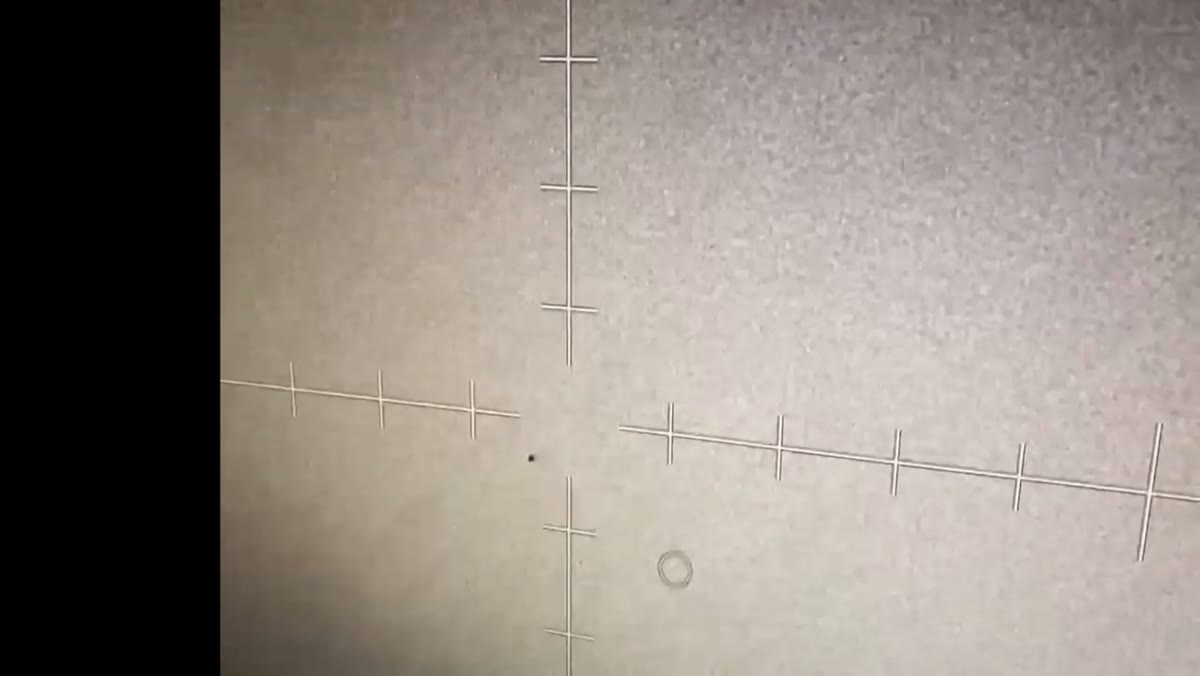
The paperwork trail behind it is layered and, in one respect, revealing. The first PURSUE tranche went out on 8 May 2026 and, according to Deschamps at Sentinel News, already contained this case as a three page file marked SECRET//NOFORN at the top and bottom of every page and titled "USPER Statement about UAP Sighting." Aerotime's Clement Charpentreau, reporting the 8 May release, noted it also carried "infrared still images captured by the FBI showing unidentified objects over the western United States in September and December 2025." Deschamps counts thirty two infrared sensor photographs in two series, with the main series of twenty four carrying embedded timestamps reading 31 December 1999, a factory default that indicates an unset camera clock, and an internal running time covering "a continuous sequence of eleven minutes from 18:10:00 to 18:21:02." Blaze Media's Andrew Chapados, writing on 27 May 2026, independently noted that photographs accompanied the report and that most were dated 1999. Sharp reports the Department of War's position on those images directly: they are "dark, circular objects" beneath a helicopter, "taken through night vision devices by ground-based personnel," and the Department states plainly that "The photos of UAP underneath the helicopter are from this same set of observations." If that attribution holds, the case is not testimony alone. It has government-published imagery attached to it.
The 22 May text also carries its own small authenticity marker. A footnote dated 26 May 2026 records that the version originally posted on 22 May "contained a typographic error in the second paragraph, describing a helicopter flight profile as 'map-of-the-earth.' The correct military aviation term for this profile is 'nap-of-the-earth.' This document has been updated to reflect this correction." A published correction of a term of art, issued four days after posting, is the kind of housekeeping a live records system does and a fabrication does not usually bother with. The second typo, "23,00 feet AGL," was never corrected and still stands in the file.
What the government did not publish is as important as what it did. The UAP Logbook entry on the file, dated 22 May 2026, states the point precisely: "The released file currently provides a first-person operational narrative. It does not publish the radar tracks, FLIR clips, NVG imagery, cockpit video, exact coordinates, aircraft identifiers, range logs, or debrief packet." The narrator, the range, the unit, the aircraft type, the mountain range and the nearby towns are all withheld. Deschamps went further and documented what changed between the classified and public versions. The classified report attributes the observation of a smaller object emerging from a larger one to the co-pilot alone, where the public account credits "the pilots" collectively. More significantly, the classified report places orbs moving toward a neighbouring town at 22:33 and five or six orbs above a village at 22:52, while the published narrative relocates the entire event above the mountains and the firing range and removes any reference to inhabited areas. Deschamps also reports that the classified file notes an office whose name is redacted carried out a test at the site earlier that same day, with the nature of the test likewise redacted, and that this detail does not appear in the public narrative at all. That is a sanitisation with a real evidentiary cost in both directions: it hides a potential prosaic trigger for the thuds, and it hides civilian-proximity witnesses who might have corroborated.
No official body has adjudicated this narrative. The nearest thing to an official verdict is a blanket one. ABC News reported on 22 May 2026, in a piece by Christopher Godburn, Luis Martinez and Ariane Nalty covering the more than fifty videos and documents in the release, that the All-domain Anomaly Resolution Office determined there is "no evidence that any of these incidents are of an extraterrestrial nature" while many remain "unresolved" and unexplained. That is a statement about the tranche, not an identification of these orbs, and it resolves nothing about what rose off the ground and closed to ten feet of a crewed helicopter. Sean Kirkpatrick, the physicist who ran AARO until 2023, gave the sharpest skeptical framing of the programme itself, saying "There's nothing unexpected in the release, and without any analysis or context, will only serve to fuel more speculation, conspiracy and arm-chair pseudoscience, particularly from the playhouse politics theater company." Secretary of War Pete Hegseth said on 6 May 2026 that the documents had "long fueled justified speculation."
Congress has touched the case without resolving it. Jordan Flowers, executive director of the Disclosure Foundation, told CBS News that ODNI "was conducting a UAP-luring operation" and that "That operation was wildly successful," claiming it produced FLIR video and photographs of the orbs, an FBI 302 interview, and a classified briefing for members of Congress including House Majority Leader Steve Scalise. That is an advocate's claim, not a government statement, and it should be read as such. But two members have spoken on the record in ways consistent with it. Representative Eric Burlison said "I was briefed on an event that occurred where they basically tried to set up a perfect-case scenario that would cause UAP to come in. This is when the whole conversation changed, because that event was one that no one could deny." Scalise, asked whether the briefing was eye-opening, replied "Well, you know, whenever you go to a briefing like that, there are some things you see that are eye-opening, and that's about as far as I'll go." Neither statement identifies the object. Both indicate the event was briefed at leadership level.
What did the witnesses think it was?
There are at least eight to ten people inside this event and not one of them has been named. The primary witness is the author of the document, a serving senior officer of the U.S. intelligence community, anonymised in the release as a USPER, a United States person. With him were a colleague who disembarked before the encounters began, and two pilots who stayed with him through all of it. Outside the aircraft were at least one ground team calling FLIR observations over the radio, JOC personnel relaying radar detections in near real time, and the crews of several fighter jets who were operating in the same airspace on a training mission and were asked to help identify the object. Aerotime reported that the infrared imagery published on 8 May 2026 was "taken during the exercise by other federal personnel observing from the ground," and the Department of War, per Liberation Times, ties those photographs to this same set of observations. So the witness pool is not one man in a cockpit. It is a distributed set of observers using different equipment, in different positions, reporting to a common command node.
What the narrator himself believed is stated obliquely but unmistakably. He does not write that he saw a spacecraft. He writes that he did not photograph the closest and most spectacular sighting because "I was focused on assessing what it was and whether it posed a threat." That is a threat-assessment posture, not a wonder posture, and it is the single most credibility-relevant line in the document. He was a serving intelligence officer on an active weapons range treating unknown lights at rotor height as a potential hazard to his aircraft. The pilots reached the same judgment independently and, as he records, "briefly considered landing due to the objects' proximity" before deciding to stay at 700 feet and keep watching. Deciding whether to put an aircraft down because of how close something is sitting to your rotor disk is behaviour that tells you what the crew actually thought they were dealing with.
His conclusion, such as it is, comes in two lines. The first is interpretive: after watching orbs flare in a horizontal formation above the fighters and hold their speed and flight path, "I remarked to the pilots that it seemed the same orbs we had encountered were now 'chasing' the fighters." He hedges it carefully with "it seemed," which is the language of a man reporting an impression rather than an identification. The second is emotional and, coming from an officer writing a formal narrative, notably plain: "We were virtually speechless after these observations." NBC News, in reporting by Laura Strickler, Colleen Long, Justin Goldman and Mosheh Gains published on 22 May 2026, made that line the headline of the story. Then he went in for "a quick debrief before driving home," which is the least dramatic ending imaginable and is the kind of detail invented accounts rarely include.
Corroboration inside the narrative is structural rather than testimonial, and it cuts both ways. The observations were made simultaneously through three independent channels: the officer's unaided eyes, the pilots' image-intensified night vision, and thermal FLIR on the ground. The objects were also, according to the JOC, showing on radar, and the crew were being vectored onto them rather than hunting them. The two large orbs above the rotor disk were seen by the officer with naked eye at the same moment the pilots saw them through NVGs, which is a meaningful cross-check because it rules out an artefact confined to the intensifier tube. Against that, none of these witnesses can be cross-examined. No pilot has been named or interviewed. No ground team member has given an account. The officer is anonymous, which means his rank, his career record, his eyesight, his fatigue state and his prior beliefs about UAP are all unavailable for weighing. Nobody has recanted, but nobody has been available to recant.
The only third-party witness testimony that exists is second hand and comes from the congressional side. Representative Eric Burlison described being briefed on an event where the government "basically tried to set up a perfect-case scenario that would cause UAP to come in," and said "that event was one that no one could deny." Jordan Flowers of the Disclosure Foundation, an advocate rather than a participant, told CBS News the operation "was wildly successful" and produced FLIR video, photographs, an FBI 302 interview and a classified congressional briefing. Neither man was in the helicopter. Their value is limited to establishing that the event was treated seriously enough inside government to be briefed to House leadership, which is corroboration of institutional weight, not of what the lights were. Avi Loeb, assessing the release on 22 May 2026, put the evidentiary status of the testimony about as fairly as it can be put: "The detailed narrative is operationally specific, indicating that we are dealing with a serious matter that should not be dismissed by policy makers or by scientists."
Is the Senior Intelligence Officer Helicopter Encounter real? The two-pass assessment
Pass one. How could all of this be entirely ordinary, and the honest answer has to start with where it happened. This is an active military test range with mountains, a Joint Operations Center, a prepositioned fuel tanker and fighter jets flying training missions in the same airspace on the same night. It is one of the worst possible places on earth to make confident claims about unusual lights, because it is one of the few places where genuinely unusual lights are routine and where a passenger in a helicopter, even a senior intelligence officer, is not necessarily cleared to know what is being flown or fired.
The single strongest prosaic candidate is pyrotechnics: infrared countermeasure flares, illumination rounds, and target or decoy assets associated with weapons testing. This explanation fits an uncomfortable amount of the description and has to be engaged head on rather than waved away. Flares flare up and dim, which is exactly the verb the officer uses four separate times. They are extremely bright point sources that bloom badly in image-intensified night vision. They are dropped in sequences and in geometric patterns, which would account for two orbs side by side, a third and fourth appearing below them in what the officer called a "T" formation, a horizontal line above transiting aircraft, and a triangle around the helicopter. They dim in the order they were dispensed, which is close to what he describes when the formation "dimmed in reverse order." They are orange with a hot white or yellow core, which is a near textbook description of burning magnesium or an IR decoy. They read as "super-hot" on FLIR, which is precisely how the ground team characterised the first object. Crucially, lights appearing directly above fighter jets and "matching the jets' speed and flight path" for ten to fifteen seconds before dimming sequentially is what self-protection flare dispensing looks like from a distance, and it is also what formation aircraft navigation and anti-collision lighting can look like at 23,000 feet from a helicopter hovering at 700 feet. The officer notes he identified the fighters by their blinking navigation lights, which confirms he was resolving small point sources at long range in the dark. If the fighters were part of a training mission, releasing countermeasures over a range is not an anomaly, it is the mission.
The narrator's own report also hands the prosaic case a piece of evidence. He went up to investigate "loud thuds heard in the mountains on the test range" and spent hours finding "remnants from rockets and other projectiles that had crashed during years of weapons testing." He is describing an environment where things are actively being launched, dropped and detonated. Alban Deschamps sharpened this considerably by reporting that the classified version of the file records that an office whose name is redacted conducted a test at the site earlier that same day, and that the nature of the test is also redacted. That single withheld line is the most important unexamined fact in the case. A range test earlier the same day is a plausible source for the thuds that triggered the entire mission, and readers of the public narrative cannot weigh it because it was removed.
Drones are the second serious candidate, and Avi Loeb named them: "Reports on clusters of orbs could be associated with swarms of drones if they are human made and used for military purposes by adversarial nations." Add to that the friendlier and more mundane version, which is that a test range is where new unmanned systems are flown, and a passenger from another agency would not necessarily be briefed on them. Small drones with lights can hover, hold station relative to an aircraft, split visually when a second airframe separates from formation, and outrun a helicopter without difficulty. An object that "had risen from the ground" is more suggestive of something launched from the ground than of something arriving from space.
Then the sensor and human factors. NVGs bloom point light sources into apparent discs, which manufactures the "orb" morphology out of any bright light. FLIR renders a warm object as a bright blob with no scale and no range information, so a hot flare a mile away and a hot object a hundred feet away can look similar. Judging that something passed "within ten feet of the helicopter" at night is a distance estimate no observer can make reliably, and it is worth noting that the ten foot figure did not come from anyone in the aircraft: it was radioed in by a ground team watching on FLIR from a completely different angle, which is the worst possible geometry for judging separation from a helicopter. Everyone involved was hours into a night mission, low on fuel, and primed by several nights of prior orb reports and by a radar-driven intercept. That is a high-expectation, high-workload environment.
And the hardest fact in the file: there are no photographs from the aircraft, by the narrator's own admission. He was assessing a threat, not documenting one. Whatever imagery exists comes from the ground teams, in the form of thirty two infrared frames with an unset camera clock reading 31 December 1999 and, as Deschamps notes, no metadata regarding origin. AARO's blanket finding on the release, that there is "no evidence that any of these incidents are of an extraterrestrial nature" while many stay unresolved, and Sean Kirkpatrick's judgment that the release contains "nothing unexpected" and lacks "any analysis or context," are the reasonable institutional postures given all of the above.
Pass two. If the account is accurate as written, none of that covers it. Flares do not rise from the ground, close to within a few tens of feet of a crewed helicopter, drop below it and accelerate away faster than the helicopter can follow. Flares do not split, with a smaller object emerging from a larger one, observed through NVGs by two pilots. Flares are ballistic and they fall; they do not hold a stationary hover just above a rotor disk, sustain it, then extinguish in reverse sequence and remain in place until they are gone from view. They do not swarm "in all directions" for several minutes and then fade in unison. They do not get painted by radar and vectored onto by a Joint Operations Center on multiple separate occasions in the same hour. And drones, while they solve the hover and the station-keeping, do not readily solve an object that a ground FLIR operator called "super-hot," that outran a helicopter after a close pass, or that appeared as formations holding above fighter jets at around 23,000 feet, which is far outside small drone territory. What is described, if described accurately, is a set of objects capable of ground launch, close approach to a crewed aircraft, apparent division into two, hover, formation flight, and acceleration beyond a helicopter's ability to pursue, operating with apparent impunity over a restricted American weapons range for more than an hour while the range's own radar tracked them and its own fighters were asked to identify them and failed.
The two passes do not resolve into each other, and no institution has resolved them. That is the whole point. There is no official adjudication of this narrative. The United States government did not publish it as a solved case or a cautionary tale. It published it as the testimony of a currently serving senior intelligence officer, sanitised of location, unit and aircraft, and then quietly corrected a term of art in it four days later. The only countervailing official statement is a blanket one about an entire tranche of files, and no named analyst, civilian or governmental, has shown a method that identifies these specific objects as flares, as a specific drone model, as a traced test event, or as anything else. Loeb is right that a narrative this operationally specific should not be dismissed, and the skeptics are right that testimony with no released radar tracks, no cockpit video, no coordinates and no named witnesses cannot be scientifically confirmed either.
The archive tiers this as Unknown. Not Verified Unexplained, because the corroborating material that would authenticate it, the radar tracks, the FLIR clips, the NVG imagery and the debrief packet, has been withheld, and the one set of images tied to the event carries a default 1999 timestamp and no provenance metadata. Not Disputed in either degree, because nothing meeting the standard for a dispute exists: no confession, no recantation, no recovered props, no positive identification of a specific real-world cause, and no independent method-shown analysis of these particular objects. There is a strong and honest prosaic hypothesis in range pyrotechnics, and there is a redacted same-day test that might or might not underwrite it, and until somebody unredacts that line or releases the sensor data, this case stands exactly where the U.S. government left it: a serving officer's first-person account of an hour he could not explain, published by his own government without an answer attached.
Sources
- www.war.gov/medialink/ufo/052226/release_02/documents/ODNI-UAP-D001_USPER_Narrative_Senior_USIC.pdf
- web.archive.org/web/20260723073816if_/https://www.war.gov/medialink/ufo/052226/release_02/documents/ODNI-UAP-D001_USPER_Narrative_Senior_USIC.pdf
- www.nbcboston.com/news/national-international/pilots-astronauts-detail-unexplained-aerial-encounters-declassified-ufo/3954275/
- www.yahoo.com/news/science/articles/unexplained-aerial-encounter-left-u-175524599.html
- abcnews.com/US/pentagon-releases-declassified-ufo-files-including-intelligence-officers/story?id=133209645
- abcnews.com/Politics/pentagon-begins-release-decades-unresolved-ufo-files/story?id=132780534
- www.theblaze.com/return/uap-glowing-orgs-dow-release
- www.liberationtimes.com/home/us-conducted-successful-ufo-luring-operation-advocate-claims-as-government-files-detail-orb-encounters
- www.sentinel-news.org/p/us-military-test-grounds-regularly
- uaplogbook.com/odni-uap-d001-2025-orange-orb-narrative/
- avi-loeb.medium.com/preliminary-assessment-by-avi-loeb-of-the-second-release-of-ufo-files-by-the-u-s-department-of-war-03b6c8d5123d
- www.aerotime.aero/articles/us-releases-ufo-uap-files
- disclosurearchives.com/department-of-war-files
- www.iufodb.com/pentagon-releases-second-batch-of-uap-files-verified-documents-and-videos-from-may-22-2026/
More cases from this region: UFO sightings in United States