The Gulf of Oman AC-130J Gunship UAP Encounters
A U.S. Special Operations gunship crew shooting a live fire exercise over the Gulf of Oman logged roughly twenty five encounters with what their intelligence report called cold orbs, about four feet across, moving between 250 and 1,300 miles per hour. What the Department released is not the aircraft’s own sensor data but a phone recording of the sensor screen.
What did witnesses see at Gulf of Oman?
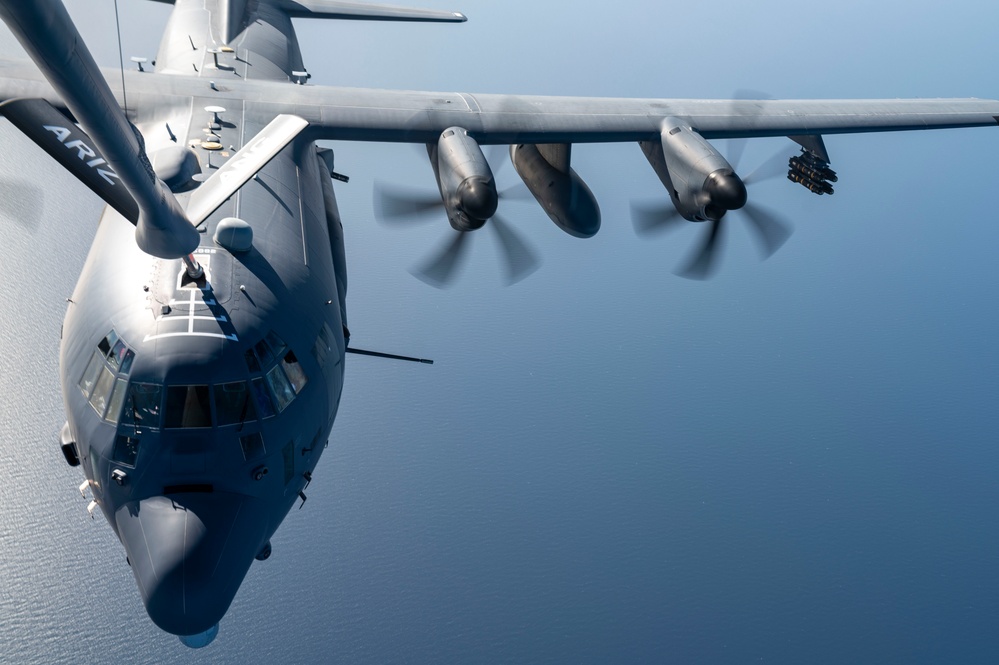
On 8 September 2021 an AC-130J Ghostrider belonging to U.S. Air Force Special Operations Command was working a live fire exercise over the Gulf of Oman, the stretch of water between Iran's southern coast and the northern edge of Oman that funnels into the Strait of Hormuz. The Ghostrider is a heavily sensored aircraft. Air and Space Forces Magazine lists its Precision Strike Package as carrying "two EO/IR sensors" alongside a "Trainable 30 mm GAU-23/A cannon; 105 mm cannon", and puts the crew at nine: two pilots, a combat systems officer, a weapons systems officer, a sensor operator, a loadmaster and three gunners. This is an aircraft whose entire job is to find small things on the ground or on the water in the dark and hit them, and whose crew spend their working lives staring at infrared imagery.
The exercise began in an ordinary way. According to Scientific American's account of the declassified intelligence report, the gunship dropped "a water-activated flare that was meant to act as a mock target for the exercise". A crew member then "tried to observe the flare using the gunship's infrared cameras". That is when the encounter started. Instead of a burning marker on the sea, the sensor showed the flare and, hovering roughly twenty feet above it, two objects the report called "approximately four-foot diameter cold orbs".
The word cold is doing specific technical work there and it is worth being precise about it. On an infrared sensor an object does not appear cold because someone touched it. It appears cold because it is radiating less energy in the sensor's waveband than whatever sits behind it. Over the Gulf of Oman in early September the sea surface is very warm, so an object at or near ambient air temperature, viewed downward against that water, will render as a dark shape on a white-hot display. The crew were not describing a chill. They were describing a contrast polarity, and they were describing it about two objects that had positioned themselves directly over the burning marker they had just deployed.
What followed was not a single sighting. The intelligence report, quoted by CBS News and by Just The News, states that the forces aboard the gunship "observed approximately 25 instances of UAPs while conducting a live fire exercise in the Gulf of Oman". The same report records that "The UAPs were observed as cold orbs flying at lower altitudes between 250 to 1300 MPH in different formations as well as maneuvering aggressively." Scientific American, which read the report directly, adds that it recorded "no detected means of propulsion" and that the report's own title was "Multiple Unidentified Aerial Phenomenon Observed Maneuvering Erratically and In Formation".
Two further details make this encounter unusual even inside the PURSUE corpus. The first is the response to weapons fire. The intelligence report states plainly that "UAPs also appeared to react to the aircraft firing its main cannon." Scientific American describes what that looked like on the sensor: the plane's cannon fired, and "the UAP appeared to rapidly fly away, out of the sensor's feed, without changing altitude." A departure at speed with no altitude change is a specific and testable claim about flight behaviour, not a vague impression. The second detail is the language the report reached for to describe how the objects moved together. Scientific American quotes the report describing the pattern in which the orbs flew off as "similar to how dolphins playfully swim in a pod". Intelligence reporting does not usually reach for that kind of simile, and the fact that a formal document did is itself part of the evidentiary record.
The surviving imagery is a set of six short clips, released as DOW-UAP-PR117 through DOW-UAP-PR122. They run 16, 30, 2, 13, 34 and 26 seconds, a total of two minutes and one second of footage from an encounter series that the report says involved about twenty five separate instances. The Department's own frame descriptions on the DVIDS pages are deliberately flat and non-interpretive. For PR117: "00:00-00:16: An area of contrast remains generally within the center of the sensor field-of-view." For PR118: "00:00-00:30: An area of contrast remains generally within the center of the sensor field-of-view, momentarily exiting the bottom of the frame." PR121 is the most active of the six. Its description reads: "00:13-00:18: A relatively larger area of contrast transits from the bottom of the frame to the top," before the object re-enters from the top left toward the bottom left while a smaller area of contrast exits and re-enters from the upper right quarter. PR120 records a technical event rather than a manoeuvre: "00:08-00:13: The sensor changes modalities twice and the area of contrast loses distinctiveness against the background." That single sentence is the honest core of the whole case, and the assessment below returns to it.
More footage and images of this sighting
What is the official explanation?
This is not a leaked case, a researcher's reconstruction, or a witness account that surfaced years later. It is an officially published, officially unresolved U.S. military encounter, and the paperwork trail is unusually clean.
The chain begins with U.S. Central Command. Every one of the six DVIDS records carries the same verbatim Department of War description, which opens: "The United States Central Command submitted a report of an unidentified anomalous phenomenon to the All-domain Anomaly Resolution Office (AARO)". CENTCOM is the combatant command whose area of responsibility covers the Gulf of Oman, so the reporting went up the correct operational chain to the Pentagon office created by Congress to adjudicate exactly this kind of report. AARO is credited as the releasing unit on all six clips.
The Department's description of the imagery is candid to the point of being self-limiting, and it deserves quoting in full because it frames every analytical question that follows: "This footage is a secondary capture, recorded via a cellular device, of an infrared sensor display aboard a U.S. Special Operations Forces AC-130J Gunship. This footage does not represent native primary sensor data, and the secondary recording method introduces limitations in fidelity, resolution, and overall visual quality. Artifacts inherent to filming a screen, such as blurring or flickering, may be present." Alongside that, the Department states on each page that the accompanying Intelligence Information Report "describes the phenomena as 'cold orbs' approximately four feet in diameter". So the four foot figure and the word cold are not press embellishment. They are the Department's own summary of its own document.
The records were published on 7 August 2026 as part of PURSUE, the Presidential Unsealing and Reporting System for UAP Encounters, in the fifth tranche of declassified UAP material posted at war.gov/UFO. The archived release page states that in response to a presidential directive on transparency, the Department of War, with support from the Office of the Director of National Intelligence, is overseeing government wide efforts to "expeditiously find, review, identify, declassify and publicly release unresolved UAP-related records and historical documents in the federal government's possession", and that the first tranche went out on 8 May 2026 with the fifth released on 7 August 2026. Release 05 contained 41 records. Just The News quoted Pentagon spokesman Sean Parnell announcing it: "Today, the Department of War is publishing the fifth release of declassified and historical Unidentified Anomalous Phenomena files as part of the Presidential Unsealing and Reporting System for UAP Encounters." LBC quoted Secretary of War Pete Hegseth saying the Department "is in lockstep with President Trump to bring unprecedented transparency regarding our government's understanding of Unidentified Anomalous Phenomena" and that "These files, hidden behind classifications, have long fueled justified speculation, and it's time the American people see it for themselves."
The most important official statement is the one that governs the entire archive rather than this specific file. The war.gov PURSUE page states: "The materials archived here are unresolved cases, meaning the government is unable to make a definitive determination on the nature of the observed phenomena. This can occur for a variety of reasons, including a lack of sufficient data, and the Department of War welcomes the application of private-sector analysis, information and expertise. DOW will continue to conduct separate reporting on resolved UAP cases, as mandated by statute." In other words, the Department is not asserting that the Gulf of Oman objects were extraordinary. It is asserting that it looked, and it could not close the file, and it is inviting outsiders to try. CBS News, Scientific American and Just The News all independently report that AARO could not resolve this encounter.
The seventh record in the group is the document that matters most and the one nobody outside government has read in full. The PURSUE manifest lists DOW-UAP-D101, titled "Intelligence Information Report, Unresolved UAP Report, Gulf of Oman, 2021", with official alt text reading "An Intelligence Information Report (IIR) documenting the observations of U.S. military personnel reporting UAP in 2021." That PDF sits on war.gov, which returns HTTP 403 to every non-browser client, and no Wayback capture of it exists as of this writing. This archive has not read it. Every quotation from the IIR reproduced above is taken from named outlets that did read it, principally Scientific American, CBS News and Just The News, and is presented on their authority rather than ours. That distinction is stated here deliberately, because the single most valuable thing a reader could do with this case is obtain and publish the full text of D101.
What did the witnesses think it was?
The witnesses in this case are anonymous, and that anonymity is structural rather than suspicious. The crew were U.S. Special Operations Forces aircrew on an operational deployment in the CENTCOM area of responsibility, and neither AARO nor the Department has released names, ranks, unit designations or the aircraft's tail number. What survives of their reaction is preserved in three indirect but strong forms.
The first is the act of filming itself. Somebody aboard that aircraft took out a personal cellular device and pointed it at a classified sensor display. That is not a neutral act. Aircrew do not casually film mission screens, and the Department's own description confirms the footage "does not represent native primary sensor data". The most natural reading is that the crew judged what they were watching to be important enough to capture by any available means, either because they did not trust the primary recording to preserve it, or because they wanted something they could show other people afterwards. Six separate clips were kept, which suggests repeated deliberate decisions across the encounter rather than one impulsive grab.
The second is the reporting chain. The observations went up as a formal Intelligence Information Report through U.S. Central Command to AARO. An IIR is a raw intelligence product with a real distribution list and real professional consequences for the reporter. Crews who think they have seen a bird, a smoke puff, or a smear on a lens do not generate one. Somebody in that chain believed the sighting had intelligence value, and the report's own title, quoted by Scientific American as "Multiple Unidentified Aerial Phenomenon Observed Maneuvering Erratically and In Formation", records that belief in the drafting officer's own words.
The third is the texture of the language that survived declassification. The report logs about twenty five instances, notes formations, notes aggressive manoeuvring, states there was "no detected means of propulsion", and reaches for the comparison that the objects moved "similar to how dolphins playfully swim in a pod". That is a witness struggling to describe coordinated, purposeful-looking motion in a document that has no vocabulary for it. It reads as someone who was surprised and said so.
One more piece of witness behaviour is worth isolating, because it is the strongest single claim in the file. The crew fired the gunship's main cannon during the encounter, and the intelligence report states that "UAPs also appeared to react to the aircraft firing its main cannon." Scientific American's description of that moment is that the object "appeared to rapidly fly away, out of the sensor's feed, without changing altitude." Note the hedging in the official phrasing: appeared to react. The reporter did not claim causation. They logged a correlation between a discrete, timestamped, unmistakable event on their own aircraft and a change in the behaviour of the thing they were watching, and they let the assessment stand as an appearance. That is disciplined witness reporting, and it is the sort of detail that makes a file harder rather than easier to dismiss.
No civilian witness, no independent ground observer, and no second aircraft has ever been associated with this encounter, and no crew member has come forward publicly in the years since. The case rests entirely on the crew's report, the Department's summary of it, and one hundred and twenty one seconds of phone footage of a screen.
Is the Gulf of Oman AC-130J Gunship UAP Encounters real? The two-pass assessment
PASS ONE. Assume nothing unusual was present, and see how far ordinary explanations carry.
Start with the recording chain, because it is the weakest link and the Department says so itself. This is a phone camera pointed at an infrared display in a vibrating aircraft. The Department warns that "Artifacts inherent to filming a screen, such as blurring or flickering, may be present", and its own frame descriptions never once say object. They say "an area of contrast". That is careful language chosen by people who know the difference. On PR120 the Department records that when "the sensor changes modalities twice", the area of contrast "loses distinctiveness against the background". An object that stops being distinguishable when the sensor's imaging mode changes is behaving exactly as a thermal contrast artifact would behave, and not obviously as a solid four foot body would. That is the single most deflationary line in the entire release and it comes from the Department, not from a critic.
Now the flare, which is where the whole encounter began. The aircraft deployed a water-activated marine flare as a mock target. Devices of that class burn hot and throw a substantial plume of smoke and steam off the sea surface. Rising smoke and water vapour, viewed from above against a sea surface near thirty degrees Celsius, will read as cold, will be roughly spherical while it is buoyant and before it shears, and will sit a short distance above the burning source before drifting. Two cold spheres about four feet across, hovering twenty feet above a marine flare, is not a strange description of a UAP. It is a textbook description of two puffs of condensation and smoke above a burning marker. Any honest assessment of this case has to concede that the opening observation has a strong, boring, physically specific candidate explanation.
The speeds are the second soft point, and the softness is arithmetic. A figure like 250 to 1,300 miles per hour cannot be read off a sensor display. It has to be computed, and computing it requires knowing the range to the object. Nothing in the released material indicates the objects were ever laser ranged, radar tracked, or acquired by anything that returned a distance. Without range, the only thing the sensor measures is angular rate, and angular rate becomes speed only if you assume a distance. Assume a target is far away and a smoke puff drifting past the field of view becomes a hypersonic craft. Add a gimbal slewing on a manoeuvring aircraft, and apparent motion across the frame stops being the object's motion at all. Nothing in the public record shows how the report derived its numbers, and until D101 is published in full those figures should be treated as an estimate of unknown method, not as a measurement.
The conventional traffic candidates deserve a serious look rather than a list. Drones are the strongest of them. The Gulf of Oman in 2021 was one of the most drone-saturated bodies of water on earth. Iranian unmanned systems operated routinely along that coast, and the region had seen repeated attacks on commercial shipping in the preceding months. A U.S. special operations gunship conducting live fire is precisely the sort of activity an adversary would want to observe. Small quadrotors are cool-running, are roughly the right size, can hover, and can absolutely be expected to take an interest in a burning marker on the water. Balloons and windborne debris cover the slow end of the observations. Birds and bats cover the erratic-motion end, and the Gulf of Oman sits under an active autumn migration corridor, though this cuts against the description rather than for it, because birds are warm-blooded and normally render hot, not cold, on a downward-looking thermal sensor. Countermeasure flares, spent casings and burning propellant from the aircraft's own guns are hot signatures rather than cold ones, so they do not fit either.
The crucial point is that no single prosaic candidate covers the whole file, and that is not evidence of anything exotic. Twenty five instances across an exercise is a set of observations, not one observation, and sets of observations routinely have mixed causes. A plausible ordinary reconstruction is that a genuine drone or two were present, that smoke and vapour above the flare produced the hovering cold spheres, that expectation and adrenaline linked the two into a single narrative, and that a phone recording of a jittering screen made the whole sequence unfalsifiable afterwards.
PASS TWO. Now assume the crew reported accurately, and ask what would follow.
Four feet across, cold, hovering stationary above a marine flare, then departing at hundreds of miles per hour with no altitude change and no detected means of propulsion, is a combination with no known engineered answer. The hover matters as much as the speed. A body that can hold station over a point on the sea and then translate at high speed without pitching or climbing has no propulsion signature to hide, because on infrared it has no propulsion signature at all. Anything with rotors, ducted fans, a turbine, or a rocket announces itself thermally, and a gunship sensor operator is among the best qualified people alive to notice when one does not. That thermal absence is the piece that survives every attempt to make this ordinary.
The apparent response to cannon fire is the second surviving element, and it is qualitatively different from the rest. It is a correlation between a discrete event that the witnesses themselves caused, at a moment they controlled and could timestamp, and a change in the objects' behaviour. That is closer to an experiment than an observation. It is also, unfortunately, exactly the kind of claim that the released footage cannot adjudicate, because the two minutes of surviving clips are not synchronised to any weapons event and the Department's frame descriptions do not mention gunfire at all.
The formation behaviour is the third. Multiple objects moving in coordinated patterns, described by a serving intelligence reporter as resembling dolphins swimming in a pod, is not how smoke behaves and not how independent drift behaves. It implies either multiple controlled platforms operating together, which points back to a sophisticated adversary drone operation, or something else entirely.
WEIGHING IT. The strongest arguments against this case are the ones the Department published itself: this is a phone video of a screen, not sensor data; the objects are described only as areas of contrast; and one of them faded into the background the moment the sensor changed modes. The strongest arguments for it are that professional aircrew whose job is thermal imagery filed a formal intelligence report, that the encounter recurred roughly twenty five times rather than once, that the reported thermal signature is absent rather than merely unfamiliar, and that AARO, holding both the full IIR and whatever primary sensor data exists, still could not close it.
No independent analyst has published a method-shown examination of these clips as of this writing. No named expert has offered a positive identification. No skeptical reconstruction has been demonstrated on the actual footage. The prosaic candidates set out above are ours, and they are reconstructions rather than findings, which under this archive's rules is not enough to move a case into a disputed tier. Equally, nothing here is authenticated in the way a native sensor recording would be, so "Verified Unexplained" would overstate what the imagery can carry.
The tier is Unknown. The Department of War published these records specifically as unresolved, stated that it "is unable to make a definitive determination on the nature of the observed phenomena", and explicitly invited outside analysis. That is the honest position and this archive adopts it. The case will not advance further until DOW-UAP-D101 is read in full, which means either war.gov serving the PDF to something other than a browser, a Wayback capture appearing, or a journalist publishing the document itself rather than excerpts from it.
Sources
- www.dvidshub.net/video/1017793/dow-uap-pr117-unresolved-uap-report-gulf-of-oman-2021
- www.dvidshub.net/video/1017795/dow-uap-pr118-unresolved-uap-report-gulf-of-oman-2021
- www.dvidshub.net/video/1017798/dow-uap-pr119-unresolved-uap-report-gulf-of-oman-2021
- www.dvidshub.net/video/1017800/dow-uap-pr120-unresolved-uap-report-gulf-of-oman-2021
- www.dvidshub.net/video/1017802/dow-uap-pr121-unresolved-uap-report-gulf-of-oman-2021
- www.dvidshub.net/video/1017803/dow-uap-pr122-unresolved-uap-report-gulf-of-oman-2021
- web.archive.org/web/20260808030642/https://www.war.gov/UFO/?releaseDate=Release+05
- www.scientificamerican.com/article/latest-pentagon-ufo-files-release-includes-video-of-mysterious-cold-orbs/
- www.cbsnews.com/news/ufo-files-pentagon-5th-release-documents-videos/
- justthenews.com/government/security/pentagon-releases-fifth-batch-ufo-files-comprised-41-records
- insiderpaper.com/pentagon-releases-new-ufo-files-5th/
- www.lbc.co.uk/article/pentagon-releases-fresh-tranche-ufo-files-5HjdfmB_2/
- www.aol.com/articles/pentagon-releases-5th-batch-ufo-130600000.html
- www.airandspaceforces.com/weapons/ac-130j/
- www.dvidshub.net/image/8974341/us-ac-130j-ghostrider-refueled-kc-135-stratotanker
More cases from this region: UFO sightings in International waters